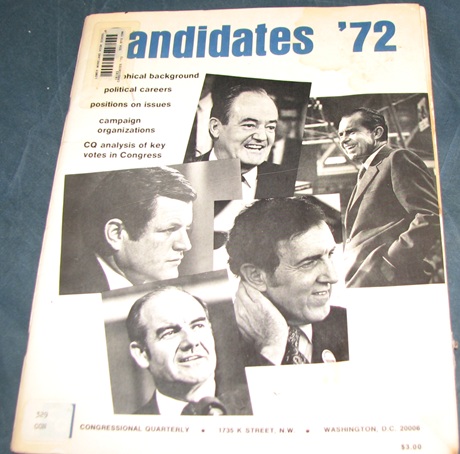
1972! Now, that’s a presidential election that I’m sorry I wasn’t around to witness!
1972, of course, was the year that the Democrats nominated George McGovern and President Richard Nixon went on to win 49 states. McGovern was considered to be one of the most left-wing presidential candidates of all time. He started out as a dark horse but ultimately won the Democratic nomination after the more moderate Edmund Muskie’s campaign turned to be not as strong as people assumed and after Governor George Wallace’s campaign was ended by gunfire in Maryland. (Wallace survived being shot but spent the rest of his life in wheelchair.) McGovern’s campaign knew how to win a primary but had no idea how to win a general election. He ended up getting around 37% of the popular vote. He carried Massachusetts but he lost his home state of South Dakota.
Today, it’s usually assumed that Nixon’s victory was a foregone conclusion but that’s not true. The Republicans had a weak midterm in 1970. The Vietnam War was unpopular. Nixon, himself, had managed to upset both the conservative and the liberal wings of the Republican Party with some of his policies. Much as in 2020, a record number of candidates threw their hat into the ring to take on the incumbent President. 1972 is a great “What if” election. What if the Democrats had nominated Edmund Muskie or Hubert Humphrey? What if the Watergate burglars hadn’t been arrested? What if George McGovern hadn’t picked Thomas Eagleton for Vice President or later asked him to step down as his running mate? Would history be different today?
That’s why I’m glad that I have a copy of Candidates ’72.
Candidates ’72 was published, in 1971, by Congressional Quarterly. It featured profiles of the many men and women who ended up running for President in 1972. It not only detailed their backgrounds and their political stances but it also analyzed their chances of winning their party’s nomination. For a history nerd like me, this book is wonderful because it was written without the benefit of hindsight. It’s a chance to see what people were actually saying about the election of 1972 while it was going on. Often times, it’s quite different from the biased analysis that was written about the election after it had already happened.
The other reason why I like Candidates ’72 is because so many memorable people ran for the Presidency in that year. George McGovern, New York Mayor John Lindsay, U.S. Rep. Shirley Chisholm, Hubert Humphrey, Eugene McCarthy, Los Angles Mayor “Mad Sam” Yorty, George Wallace, Dr. Benjamin Spock, they are just some of the candidates profiled here. Reading the profiles really does reveal that America was at a crossroads in the early 70s. Much like today, a lot of people assumed that radicalism was ascendant while failing to consider just how serious the backlash would eventually become. Some of the other Democrats running actually made George McGovern look like a moderate. Meanwhile, on the Republican side, Nixon was challenged by an anti-war congressman named Pete McCloskey. McCloskey eventually lost his house seat in the 80s but briefly reemerged in 2006 as an environmentalist and anti-war activist. He was also a Holocaust denier so let’s be happy that he never got anywhere near the White House.
(It’s probably a sign of just how chaotic the 1972 election was that a few candidates — John Ashbrook, Terry Sanford — did not get profiled in Candidates ’72, presumably because they jumped into the fray after the book went to the presses.)
Here are the candidates and potential candidates who are profiled in Candidates ’72.
Republicans:
- Vice President Spiro Agnew of Maryland (elected Vice President in the General Election)
- Treasury Secretary John Connally of Texas (declined to run)
- Lobbyist John Gardner (declined to run)
- U.S. Rep. Pete McCloskey of California (suspended campaign during the primaries)
- President Richard M. Nixon of California (won the general election)
Democrats:
- U.S. Rep. William Anderson of Tennessee (dropped out before the primaries)
- Sen. Birch Bayh of Indiana (dropped out before the primaries)
- U.S. Rep. Shirley Chisholm of New York (defeated at the Democratic Convention)
- Former Attorney General Ramsey Clark of New York (declined to run)
- Sen. Fred Harris of Oklahoma (dropped out before the primaries)
- U.S. Sen. Vance Hartke of Indiana (withdrew during the primaries)
- Sen. Howard Hughes of Iowa (dropped out before the primaries)
- Sen. Hubert Humphrey of Minnesota (defeated at the Democratic Convention)
- Sen. Henry Jackson of Washington (defeated at the Democratic Convention)
- U.S. Sen. Edward M. Kennedy of Massachusetts (declined to run)
- New York Mayor John V. Lindsay (withdrew during the primaries)
- Lt. Gov. Lester Maddox of Georgia (withdrew during the primaries)
- Fmr. Sen. Eugene McCarthy of Minnesota (withdrew during the primaries)
- Sen. George McGovern of South Dakota (defeated in the General Election)
- U.S. Rep. Wilbur Mills of Arkansas (withdrew during the primaries)
- U.S. Rep. Patsy T. Mink of Hawaii (withdrew during the primaries)
- U.S. Sen. Walter Mondale of Minnesota (declined to run)
- Sen. Edmund Muskie of Maine (suspended campaign during the primaries)
- Sen. William Proxmire of Wisconsin (dropped out before the primaries)
- R. Sargent Shriver of Maryland (nominated for vice president, lost the general election)
- Gov. George Wallace of Alabama (suspended campaign after being shot in Maryland)
- Los Angeles Mayor Sam Yorty (withdrew during the primaries)
Independents:
- Ralph Nader (declined to run)
- Dr. Benjamin Spock (lost the general election)
Ran, but not profiled:
- U.S. Rep. John Ashbrook (R-OH)
- U.S. Sen. Thomas Eagleton (D-MO, nominated for Vice President but stepped down from the ticket and was replaced by Sargent Shriver)
- State Rep. Sissy Farenthold (D-TX, ran for the Vice Presidency at the Democratic Convention)
- U.S. Rep. Walter Fauntroy (D-DC)
- U.S. Sen. Mike Gravel of Alaska (D-Alaska, run for the Vice Presidency at the Democratic Convention)
- U.S. Rep. Wayne Hays (D-OH)
- Former Governor Endicott Peabody (D-Massachusetts, ran in the nonbinding Vice Presidential primary)
- Former Governor Terry Sanford (D-NC)
- U.S. Rep. John G. Schmitz (R-CA, ran as the candidate of the American Party)
- Cleveland Mayor Carl Stokes (D-OH)
I ordered my copy of Candidates ’72 shortly after I ordered Candidates ’76. Sadly, my copy of Candidates ’72 is not in the best condition and I doubt I’ll ever find another copy. As a proud history nerd, though, I’m still happy to have it.

