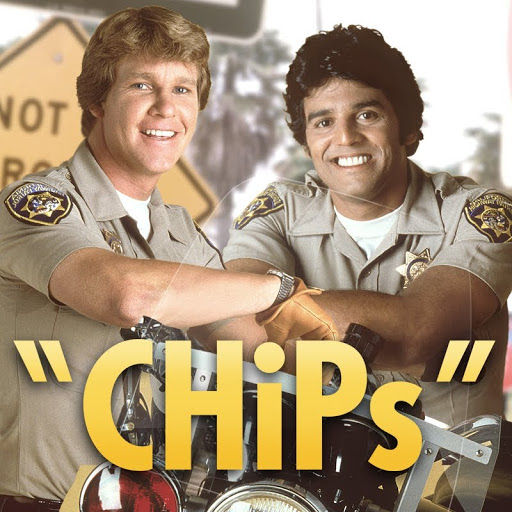
Welcome to Late Night Retro Television Reviews, a feature where we review some of our favorite and least favorite shows of the past! On Mondays, I will be reviewing CHiPs, which ran on NBC from 1977 to 1983. The entire show is currently streaming on Prime!
This week, the computer goes down and Erik Estrada asks, “What’s a computer?”
Episode 5.25 “Overload”
(Dir by Robert Pine, originally aired on May 2nd, 1982)
Reni Santoni and Michael Anderson, Jr. play two thieves who hijack a truck that is delivering computer chips. When the truck is involved in an accident, an old woman named Nettie (Helen Kleeb) spots Anderson hiding in the trailer. She panics and flees from the scene.
Why do the criminals need the computer chips? Reni Santoni’s cousin (Denis Mandel) is a genius who has built a device that allows him to hack into other computers. As a test, he hacks into the Highway Patrol’s computer and rewrites their code. Suddenly, the computers at HPHQ can no longer be used to look up addresses. Bonnie is shorted on her paycheck. Getraer, meanwhile, gets paid a thousand more than usual. Ponch worries because he entered all the numbers in his little black book into the computer and now, he can’t get them out. Listening to him deliver his lines, one gets the feeling that Erik Estrada didn’t have the slightest idea what Ponch was talking about and, to be honest, I get the feeling that whoever wrote this episode was equally as confused. Myself, I’m wondering about the logic of using a work computer for that. I mean, what if he wants to call someone from his swinging bachelor pad?
Eventually, the Highway Patrol does track down Nettie. Nettie turns out to be one of the most annoying old biddies to ever appear on this show. Strangely, everyone at the station is charmed by her, despite the fact that she fled from the scene of a serious accident that was largely caused by her bad driving. Nettie should be going to prison!
This wasn’t much of an episode. Larry Wilcox looked miserable and annoyed from beginning to end and it’s easy to understand why he decided not come back after the fifth season. There are times when it really does appear as if he’s considering pushing Estrada off of his motorcycle. Sorry, Larry, but we all know what show this is!
Only two more episodes to go before we complete this season!
When my mom was dying in 2008 and then when my Dad was in hospice care in 2024, I learned just how important nurses were.
While the doctors that I dealt with were often brusque and overworked, the nurses were the ones who always took the time to answer my questions. While the doctors took an attitude of, “Death happens,” the nurses were the ones who were willing to show compassion. They were the ones who seemed to understand the pain that both myself and my sisters were going through. The nurses were the ones who seemed to care. Even when it comes to something simple like getting my ADHD prescription renewed, I always feel more relaxed when I’m dealing with a nurse than dealing with a doctor.
(Don’t get me wrong. I understand why doctors so often avoid a personal connection with their patients. As Doctor Warshaw (Richard Stahl) puts it in 1970’s The Young Doctors, “mourning is reserved for loved ones.” It may sound cold but it’s the truth.)
When my Dad was in home hospice, we had a nurse the came by the house every day. She was cool and professional but still always seemed to care. She was also a chain-smoker and there were more than a few days that I stepped outside with her. She always had an extra cigarette for me. Usually, I don’t smoke because I have asthma but, at that time, I was so stressed that the calming effect of smoking made the risk worth it. Knowing that the nurse would always arrive early in the morning helped me deal with a very difficult time. At a time when everything felt like it was spinning out of control, the nurse was someone upon whom I could depend. After my father died, I struggled to adjust to a lot of things, including the absence of the nurse. I discovered I missed the nurse’s professional presence. I missed talking about my feelings while burning a cigarette down to its filter.
In short, I have a lot of respect for nurses. They have a difficult job, one that I certainly could not do. But I’m thankful for all that they’ve done for me, my family, and other people’s families.
With all that in mind, I watched 1970’s The Student Nurses earlier today.
The Student Nurses tells the story of four women who are studying to be nurses while working at the local hospital. Phred (Karen Carlson) is introduced when she’s attacked by a crazed patient. Later, she falls for a doctor named Jim (Lawrence P. Casey). Sharon (Elaine Giftos) grows close to a terminally ill patient (Darrell Larson) and discovers the wisdom of Dr. Warshaw’s admonition about mourning. Priscilla (Barbara Leigh), who is regularly admonished for the length of her skirt and for never wearing a bra, meets a charismatic drug dealer named Les (Richard Rust). Les is all about dropping the acid on the beach but he’s not about sticking around when his girlfriend gets pregnant. And finally, Lynn (Brioni Farrell) meets a Latino political activist named Victor Charlie (Reni Santoni) and discovers that some people just aren’t rich enough to go to the hospital. When Victor shoots a cop during a raid on his headquarters, Lynn is forced to make a difficult decision.
The Young Nurses is almost legendary because of its status as a politically-themed exploitation film. It’s a Roger Corman production so there’s a lot of nudity. But director Stephanie Rothman used the genre to explore themes of class conflict and feminism. All four of the nurses are portrayed as being strong and independent women who have sex because they want to and who feel no shame about their decisions. For a 1970 film, that was a big deal. Interestingly, considering the film’s reputation, it’s actually fairly even-handed when it comes to the differing worldviews of the nurses. One of the nurses decides that she wants to serve in the Army Nurse Corps, even if that means going to Vietnam. Another ends up bragging about the gun that she’s carrying in her glove compartment, just in case anyone tries to stand in the way of the revolution. The film treats both of their decisions with respect. The important thing, the film seems to be saying, is that all of them are in control of their own future.
It’s an exploitation film, make no doubt about it. Today, we might talk about the film’s politics and its feminist subtext but I kind of doubt that’s what made the film a box office success in 1970. That said, Stephen Rothman brings some imagination to even the film’s most exploitive scenes. When Priscilla drops acid on the beach, Rothman slowly introduces more and more people to the scene, leaving us to wonder, just as Priscilla does, whether they’re real or their just a part of her trip. All four of the lead actresses are well-cast and fans of great character actors will probably enjoy seeing Reni Santoni playing someone other than a cop or a doctor.
Finally, like so many exploitation films, The Student Nurses is a true time capsule. The music, the clothes, the groovy slang, this is a film that proudly announces that it was made in 1970. We may not have time machines but at least we have the movies.
I have no idea if The Student Nurses is a realistic portrayal of what it was like to be a student nurse in 1970. That said, it’s an entertaining film and, in its grindhouse way, a tribute to the nurses who do so much.
Welcome to Retro Television Reviews, a feature where we review some of our favorite and least favorite shows of the past! On Mondays, I will be reviewing Miami Vice, which ran on NBC from 1984 to 1989. The entire show can be purchased on Prime!
This week, Crockett and Tubbs battle some corrupt cops.
Episode 4.18 “Badge of Dishonor”
(Dir by Richard Compton, originally aired on March 18th, 1988)
Badge of Dishonor opens with Underworld’s Glory, Glory playing on the soundtrack. It’s an early electronic tune, one that isn’t quite EDM but still definitely shows hints of what Underworld and a lot of other synth-pop bands would eventually become. Usually, that would be pretty cool but, unfortunately, the song also has a gospel music feel and I personally gospel music to be excruciatingly dull.
That’s certainly the case here, where the music is played over the opening teaser and the gospel sounds robs it of whatever momentum it might have had. The episode opens with a drug deal gone wrong. Tubbs is working undercover when he and his contacts are suddenly busted by four cops, who kill the real dealers and then steal the drugs and the money. Tubbs barely manages to escape with his life. It should have been an exciting opening but it had a “been there, done that” sort of feel to it. This isn’t the first Miami Vice episode to feature an drug deal gone wrong and it’s not even the first to feature corrupt cops.
The cops in question are all originally from Cuba. Back in Castro’s Hellhole, they were all members of the same street gang. After coming to Miami and building up lengthy juvenile records, the four men were subsequently hired after a race riot (a real-life event that Castillo discusses in his terse manner) led to demands for a more racially-balanced police force. Because the force desperately needed some non-redneck cops, no one bothered to do an extensive background check on the four men when they applied to be cops. Tubbs comments that the corrupt cops are setting “minority hiring back 400 years.”
Crockett and Tubbs’s investigation at first centers on a lieutenant (Reni Santoni) who they think is crooked because he lives on a yacht. The lieutenant explains that he married well and that he suspects the same four cops as Crockett and Tubbs. The lieutenant is subsequently murdered by the cops. It turns out that the corrupt cops are getting their information from an undercover detective named Madison Stone (Michele Shay). Stone has spent the past few years deep undercover, living in a homeless community on the riverfront. Stone is not herself corrupt. She’s just been manipulated and is now in an impossible situation. At least, that’s the way Tubbs views it. Myself, I just felt that Madison Stone appeared to be as bad at working undercover as Sonny Crockett.
Technically, this was a well-made episode. The main problem is that the plot itself just felt so familiar and the four corrupt cops were not particularly interesting. Compared to the usual flamboyant Miami Vice criminals, the cops were pretty bland. In typical Miami Vice fashion, it ended on a dark note. The corrupt cops were defeated but both Madison Stone and their lieutenant were dead. There’s no happy endings in Miami.
After a blow-up at work, air traffic controller John Chester (John Candy) is given five weeks of paid leave. He takes his family to Florida, where they rent a beach house and discover that their summer town is controlled by snobbish sailing champion Al Pellett (Richard Crenna). It’s the snobs vs slobs as Pellett tries to kick John and his family out of their summer rental and John tries to prove himself to his son and daughter (Joey Lawrence and Kerri Green) by winning the local sailing championship. Luckily, John has Sully (Rip Torn), a modern-day pirate captain, on his side.
John Candy was a remarkable talent. It’s just a shame that he didn’t appear in more good films. He will always be remembered for films like Splash, Uncle Buck, Planes, Train, and Automobiles, and Only The Lonely but unfortunately, most of his starring roles were in lightweight, forgettable far like Summer Rental. Candy is likable as John Chester and sympathetic even when he’s losing his temper over every minor inconvenience. But the film itself never really does much to distinguish itself from all of the other 80s comedies about middle class outsiders taking on the richest man in town. Candy is stuck playing a role that really could have been played by any comedic actor in 1985. It’s just as easy to imagine Dan Aykroyd or even Henry Winkler in the role. It feels like a waste of Candy.
The best thing about the film is Rip Torn’s performance as Sully. Torn’s performance here feels like a dry run for his award-winning work as Artie on The Larry Sanders Show. I would have watched an entire movie about Sully. As it is, Summer Rental is inoffensive and forgettable.
Welcome to Retro Television Reviews, a feature where we review some of our favorite and least favorite shows of the past! On Sundays, I will be reviewing the made-for-television movies that used to be a primetime mainstay. Today’s film is 1974’s Indict & Convict! It can be viewed on YouTube.
There’s been a murder!
The wife of Assistant District Attorney Sam Belden (William Shatner) has been found, shot to death. Making things especially awkward is that the body of her lover is found next to her. Though Belden is the obvious suspect, he has an alibi for the time of the murders. He claims that he was in Las Vegas, attending a convention. Two gas station attendants remember seeing him filling up his car with gas at around the same time that his wife and her lover was being shot.
Attorney General Timothy Fitzgerald (Ed Flanders) is not so sure that Belden is innocent. He instructs two of his top prosecutors to check out Belden’s story and to see if there’s enough evidence to not only indict but also to convict. Bob Matthews (George Grizzard) is a veteran prosecutor and he’s the one who narrates the story for us. Assisting him is Mike Belano, who is played by the always likable Reni Santoni. Just three years before this movie aired, Santoni played Harry Callahan’s partner in Dirty Harry. There was just something about Santoni’s friendly but determined demeanor that made him perfect the role of the supportive partner or assistant.
The film is very much a legal procedural, with the emphasis on not only the investigation but also on the strategies and the techniques that are used in the courtroom by Matthews and defense attorney DeWitt Foster (Eli Wallach). In many ways, it feels like a forerunner to Law & Order. Usually, I love court procedurals but Indict & Convict was a bit too slow and high-minded for its own good. Maybe it’s because I’ve been spoiled by all of the legal shows that I’ve seen but I have to admit that I spent a good deal of Indict & Convict wanting the prosecutors to get on with it. Flanders, Grizzard, Santoni, and Wallach were all ideally cast but the film itself sometimes got bogged down with all the debate about the best way to win a conviction. It’s a shame because the story itself is an intriguing one and I actually enjoyed the movie’s use of spinning newspaper headlines to let us know what had happened in between scenes. Also, as a classic film fan, I enjoyed seeing Myrna Loy as the judge. She didn’t get to do much other than say, “Sustained” and “Overruled,” but still …. Myrna Loy!
Most people who watch this film will probably do so out of the hope of seeing some trademark Shatner overacting. William Shatner doesn’t actually get to say much in this film. He spends most of the running time sitting silently at the defense table. Towards the end, he does finally get a chance to deliver a brief speech and it’s everything you could hope for. Shatner takes dramatic pauses. Shatner emphasizes random words. Every line is delivered with the subtext of, “Pay attention, Emmy voters!” Eventually, Shatner would learn the value of laughing at oneself but apparently, that lesson had not yet been learned when he did Indict & Convict.
When a madman pulls out a gun in the middle of a supermarket, he starts out by firing at the produce department. He doesn’t shoot at anyone who works in the produce department. Instead, in slow motion, he blows away cabbages and apples. Then he shoots a shopping cart. He finally gets around to shooting one innocent bystander after telling him to walk down an aisle.
Outside the supermarket, a 1950 Mercury Monterey Coupe pulls up. The personalized license plate reads Awsum 50. The car’s driver (Sylvester Stallone) steps out of the car. His name is Lt. Cobretti but everyone calls him Cobra. Detective Monte (Andy Robinson, who played the killer in Dirty Harry) tells Cobra to stay out of it. Cobra ignores him and goes into the store.
The guman raves that he’s a part of the “new world.”
“You wasted a kid for nothing,” Cobra says. “Now, I think it’s time to waste you.”
And then Cobra does just that.
After getting yelled at by his superiors, Cobra drives back to his apartment, throws away his mail, and uses a pair of scissors as an eating utensil. Just another day in the life of Cobra.
If you hadn’t already guessed, Cobra is the ultimate Sylvester Stallone-in-the-80s Cannon film. In 1985, Stallone could do any film that he wanted to and, even if he wasn’t the director, the job was usually given to someone who wouldn’t stand in the way of letting Sly achieve his vision. (That vision usually involved Stallone getting all of the good shots while everyone else dove for cover.) Stallone is credited as the writer of Cobra and whatever else you can say about the man and his films, Stallone the screenwriter knew exactly what Stallone the actor was good at. There’s not much meaningful dialogue in Cobra and most of it is made up of either Stallone threatening to shoot people or characters like the Night Slasher (Brian Thompson) bragging about how Cobra can’t touch him because of the constitution. There is more intentional humor in Cobra than I think most people realize and there are a few scenes that only make sense if you accept that Stallone was poking fun of his own monosyllabic image. For the most part, though, Cobra is nonstop violence from beginning to end.
Amazingly, Cobra started out as Beverly Hills Cops. Before Eddie Murphy was cast as Axel Foley, Beverly Hills Cop was briefly meant to be a Sylvester Stalllone film. Stallone, however, rewrote the script and took out most of the humor. After the film’s producers reminded Stallone that they were trying to make a comedy, Stallone left the project and most of his ideas ended up in the script for Cobra. The film features a murderous cult, led by the knife-wielding Night Slasher, that is determined to destroy anyone who they think is standing in the way of the “new world.” Only Cobra can both stop them and also protect the life of their latest target, a model named Ingrid Knudsen (Brigitte Nielsen). It’s hard to imagine Eddie Murphy dealing with any of this but it’s perfect for Stallone.
Cobra is a live-action cartoon and Cobra’s battle with the Night Slasher should be taken as seriously as He-Man’s battles with Skeletor. The Night Slasher has no motivation beyond just being evil, Cobra never runs out of bullets or takes even a piece of shrapnel despite having hundreds of cultists shooting at him, and there’s an extended sequence where Ingrid poses with life-size robots. Cobra chews on a toothpick and wears dark glasses and that’s all the personality he needs. After all, crime is the disease and he’s the cure.
First off, I am not about to review the Michael Bay film where Will Smith and Martin Lawrence shoot people and blow things up. Instead, this Bad Boys is a film from 1983 where Sean Penn doesn’t shoot anyone but that’s mostly because he can’t get his hands on a gun. And, at one point, a radio does blow up. So, perhaps this Bad Boys has more in common with the Michael Bay Bad Boys than I originally realized.
Anyway, Bad Boys is about Mick O’Brien (Sean Penn), who is a 16 year-old criminal from Chicago. One night, when one of his crimes goes wrong, Mick’s best friend (Alan Ruck) is killed and Mick accidentally runs over the brother of rival gang leader, Paco (Esai Morales). Mick is sent to juvenile detention where he and his sociopathic cellmate, Horowitz (Eric Gurry), team up to overthrow the two “leaders” of their block, Viking (Clancy Brown, with scary blonde hair) and Tweety (Robert Lee Rush). Meanwhile, Paco is arrested for raping Mick’s girlfriend, JC (Ally Sheedy), and soon finds himself living on the same cell block as Mick.
And it all leads to … violence!
(In the movies, everything leads to violence.)
Bad Boys is one of those films that seems to show up on cable at the most random of times. I’ve never quite understood why because it’s not like Bad Boys is a particularly great film. It’s hard to see anything about this film that would lead a programmer to say, “Let’s schedule 100 airings of Bad Boys!” If anything, it’s the epitome of a good but not that good film. On the one hand, you have to appreciate a film that attempts to take a serious look at both juvenile crime and the true life consequences of tossing every “lawbreaker” into a cell and locking the door. People fetishize the idea of punishing criminals but they rarely consider whether those punishments actually accomplish anything beyond satisfying society’s obsessive need for revenge. (And it’s interesting to note that the problems of 1983 are not that much different from the problems of 2015.) On the other hand, Bad Boys is way too long, heavy-handed, and repetitive. This was one of Sean Penn’s first roles and, much like the film itself, he’s good without being that good. Watching his performance, you get the feeling that James Dean would say, “Nice try.”
However, the film is saved by two actor. First off, there’s Clancy Brown as the stupid but intimidating Viking. With his bad skin, blonde hair, and a permanent snarl on his face, Brown makes Viking into a character who is both ludicrous and scary. And then there’s Eric Gurry as the small and demonic Horowitz. According to his imdb page, Gurry long ago retired from acting but anybody who sees Bad Boys will never forget him.