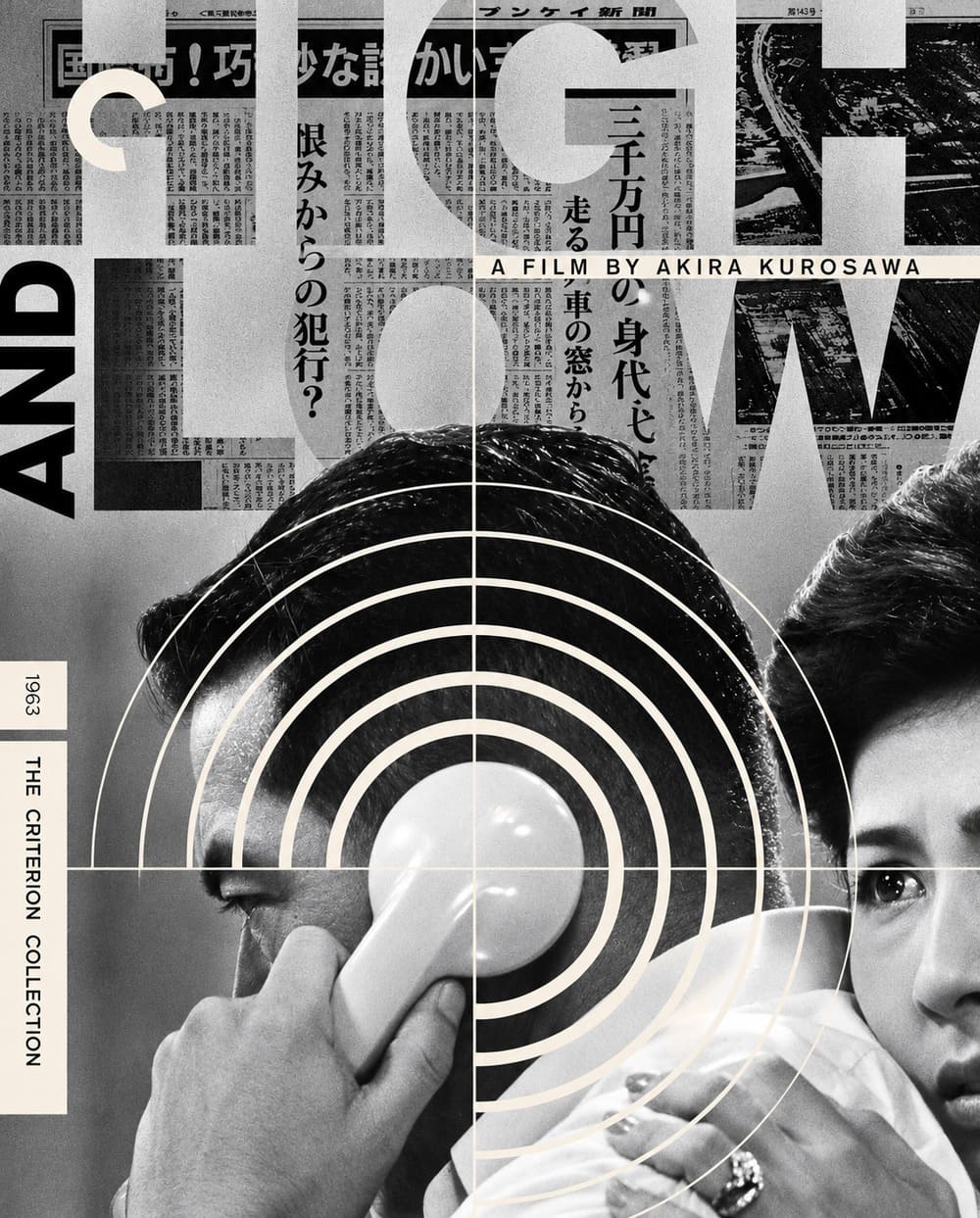
“Success isn’t worth losing your humanity.” — Reiko Gondo
Before anyone gets kidnapped in Akira Kurosawa’s High and Low, a group of men argue about a shoe. It’s an oddly modest way to start a thriller this big. Kingo Gondo, played by Toshiro Mifune, thinks his company ought to make shoes that last. The men visiting his house would rather make something cheaper that’ll sell. You could cut the whole argument and still follow the kidnapping plot, but you’d lose the first good look at the man who’s about to be asked to give up everything he’s worked for. Gondo knows what a badly made shoe feels like in his hands. He knows what it costs to make a better one. Then the phone rings, and somebody asks him to put a price on something he can’t hold or inspect or bargain over in any of the ways he knows.
What makes that opening work is that Gondo isn’t necessarily the nicest person in the room, even when he’s the one making the most sense. Mifune gives him the impatience of somebody who knows his trade and can’t stand having to explain it to people who only know the numbers. He’s also halfway through a maneuver to take control of the company himself. The money that will eventually be demanded as ransom isn’t some idle fortune sitting in a bank. It’s already spoken for, and getting it together has put his family’s future on the line. Gondo’s pride in his work and his appetite for control are hard to separate. The film doesn’t ask us to sort his virtues from his faults before deciding whether we care what happens to him.
The voice on the phone says it has taken Gondo’s son. Then the boy turns up safe, and everyone gets about a second to feel relieved before the awful implication lands: the kidnapper has taken the chauffeur’s son, Shinichi, by mistake. He still wants the money. One of the nastiest things about this twist is how little the caller has to do once the mistake is clear. He doesn’t need to invent a new threat. He can leave the people in that room to work out why a sum that seemed unthinkable but necessary a moment ago now seems open to discussion. Gondo’s relief is completely understandable. So is the chauffeur’s horror at having been there to witness it.
High and Low is a loose adaptation of Ed McBain’s novel King’s Ransom, and Kurosawa’s most revealing change is to make Gondo pay. In the novel, the executive refuses, and the boy survives anyway. Kurosawa doesn’t give Gondo that escape hatch, but he doesn’t let him jump straight to the noble answer either. Mifune makes you sit with a man who can see exactly how paying might save one family from disaster and bring another to the edge of it. The opening argument about shoes matters here. We’ve already seen how much Gondo cares about what the company makes, so the prospect of losing it is more concrete than a man in a nice house saying he’d rather not part with his money.
What I like about the film’s sense of morality is that doing the right thing doesn’t settle the question of what kind of man Gondo is. It would be easy to make the ransom a test he passes and move on, but Kurosawa makes us remember how quickly everyone relaxed when they found out it wasn’t his son. That moment doesn’t cancel out Gondo’s generosity. It makes the choice more interesting: he has to act against an instinct most of us would recognize in ourselves. And the chauffeur doesn’t get a comparable chance to show what he’d sacrifice. He doesn’t have the money, so he has to plead with the man who employs him. The ransom is the same for both men; only one of them gets to weigh it against anything else.
For a movie that spends so much of its first stretch in one room, High and Low never feels like it’s waiting for somebody to open a door and let the cinema in. Kurosawa uses the width of the frame to make a conversation about more than the person talking. Your eye can drift over to the chauffeur while someone else discusses the ransom, and the discussion sounds different because you’re looking at him. At other times, a person at the edge of the room seems to be waiting for permission to enter an argument that will decide their future. By the time Gondo’s living room is crowded with family, employees, and police, you know who usually gets to speak there and can feel how badly the situation has thrown those arrangements off.
The window may be the most important thing in the house. In the opening, it offers the kind of view you can imagine somebody paying a fortune to wake up to. Once the caller makes it clear that the house can be seen from below, all that glass starts to look like a terrible idea. What’s changed isn’t the view; it’s who’s looking. Gondo has been able to see the city without thinking much about who can see him. Now he has to imagine his house as it appears to somebody who doesn’t get to go inside. The title might sound a little blunt if you take it only as a description of where people live. It’s more interesting as a question of what each position lets you see and what it makes easy to overlook.
After so much time waiting for a phone to ring, the ransom drop on the train feels like the movie letting out a breath. Suddenly there’s a moving train, a small window, and a very short amount of time in which to act. Kurosawa doesn’t make the sequence exciting by making it hard to follow. He makes sure we understand the physical problem, then lets the speed of the train do the worrying for us. It’s a wonderful bit of action, but it also marks the point where Gondo can no longer carry the film on his own. He can decide to part with the money. He can’t decide what the kidnapper does next or make the police find him any faster. The movie leaves the house behind because it has run out of questions that can be answered there.
This is where High and Low most clearly feels like a spiritual successor to Stray Dog. In the earlier film, Mifune plays a rookie detective whose stolen gun sends him through a sweltering postwar Tokyo. He follows the case with the shame and urgency of somebody who feels personally responsible for everything that happens next. The longer he searches, the harder it becomes for him to regard the man he’s chasing as someone fundamentally unlike himself. High and Low returns to that uneasy resemblance, but it spreads the work of the investigation across an entire squad. Tatsuya Nakadai’s Inspector Tokura is compelling precisely because he isn’t trying to dominate every scene. He listens, delegates, and lets someone else’s small discovery be the most important thing in the room. There’s a nice contrast between the young Mifune tearing around Tokyo trying to put things right and the older Mifune having to sit back while other people do the work.
Kurosawa develops the cinematic language of the police procedural further by making that work interesting on its own terms. During the squad’s report-back, he cuts between the officers describing their findings and the activity they’re describing. There’s pleasure in hearing a piece of information you might have dismissed on its own and realizing why it matters when another officer adds theirs. The scene doesn’t rely on a brilliant detective withholding the answer so he can impress everybody later. The thinking happens in front of us and belongs to a group. It also has a rhythm quite different from the scenes in Gondo’s house. Up there, people circle the same terrible question without getting any closer to an answer. Here, a room full of people talking can actually move the story forward, provided they pay attention to what the others have seen.
Then, in the middle of all that careful looking, there’s the pink smoke. In a black-and-white film, the color is such a surprise that for a second it hardly matters what it means. Then you remember that it means something very specific: the ransom cases are being burned. I like that the film lets Shinichi call attention to the smoke. Until then, the adults have done most of the talking about him, first as a child in danger and then as a witness. Here he gets to notice something for himself. And for all the sequence’s flash, it’s another variation on that big window in Gondo’s living room. The house on the hill commands a view of Yokohama, but having the best view doesn’t mean you’ll be the first to notice what matters.
The film’s influence makes sense when you consider how many different things a filmmaker could take from it. You could borrow the wrong-child premise and make a thriller that barely resembles Kurosawa’s. You could study the way he stages half a dozen people around a telephone, or how he makes a police briefing as absorbing as a chase. The story has been remade and reinterpreted, most recently by Spike Lee in 2025’s Highest 2 Lowest, with Denzel Washington as a New York music mogul rather than a Yokohama shoe executive. That change brings the story’s travels into focus: an American crime novel became a Japanese film, which in turn gave Lee a way into a story about money and power in his own city. The premise travels well, but the places aren’t interchangeable. So much of what gives Kurosawa’s film its bite is the simple fact that this particular house can be seen from those particular streets.
By the time Gondo sits across from the kidnapper in the final scene, I find myself thinking again about the man arguing over that shoe. At the start, he can pick something up, show you where it’s badly made, and tell you what he would do differently. There’s no equivalent gesture available to him here. The case has been solved, but the man on the other side of the glass isn’t a problem Gondo can fix, or even a person he can be sure he understands. Their reflections overlap, and for a moment the film gives them a closeness that neither man knows what to do with. I wouldn’t trade that awkwardness for a cleaner ending. Gondo did right by Shinichi, and nothing in that last scene takes away from it. But doing right by one person hasn’t made the world any easier to explain. It has brought him close enough to look at someone he used to be able to overlook.
Kurosawa-Mifune Collaborations

