Retro Television Review: Crime Story 1.9 “Justice Hits The Skids”


Welcome to Retro Television Reviews, a feature where we review some of our favorite and least favorite shows of the past!  On Mondays, I will be reviewing Crime Story, which ran on NBC from 1986 to 1988.  The entire show can be found on Tubi!
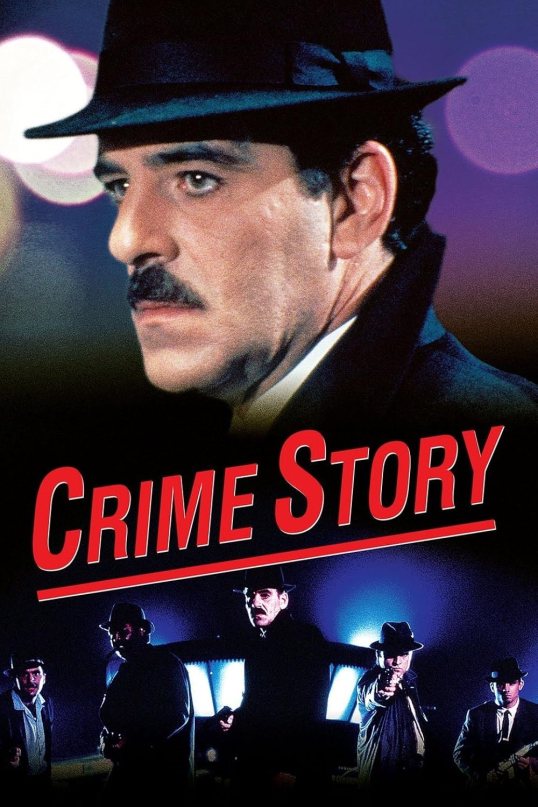
Torello is going to snap….

Episode 1.9 “Justice Hits The Skids”

(Dir by Mario DiLeo, originally aired on November 11th, 1986)

Torello is losing it.

Well, that’s not really a surprise.  Torello has been losing it since the pilot.  However, this episode finds him acting even more intense than usual.  He’s getting divorced.  His best friend Ted Kehoe has been murdered and the federal prosecutor seems to be more interested in trying to prove that Torello is corrupt than in going after Bartoli and Luca.  Torello doesn’t even go to Ted Kehoe’s funeral, leading to everyone thinking that Torello is losing what little grip on sanity he has left.  Even his soon-to-be ex-wife checks in on him.

While Torello stews over Luca, Suzanne Terry attempts to investigate the growing use of drugs in some of Chicago’s poorest neighbors and she gets attacked and put into the hospital as a result.  David Abrams tries to investigate on his own, leading to Suzanne telling him that she needs some time apart from him.  (Before she’s attacked, David takes her out to dinner.  When a racist diner complains and the head waiter asks them to move to a different table, Suzanne wants to leave the restaurant.  David insists that they stay  and finish their meal.  David may see himself as being a righteous crusader but, at the same time, he also comes across as being rather controlling.  It doesn’t seem to occur to him that Suzanne might not want to give any business to a racist restaurant.)  Torello and the Major Crimes Unit then take up the case, even though his superiors tell him not to waste any time on it.

Sweet Haywood (John Canada Tyrell), the drug dealer who attacked Suzanne, is eventually captured.  Sitting in jail, he meets his public defender, who just happens to be David Abrams.  Abrams pulls out a gun and shoots Haywood in the chest.  However, this turns out to just be a fantasy on David’s part.  When the real Haywood demands to know if Abrams is going to keep him out of the jail, Abrams says, “Of course.  That’s my job.  Abrams for the defense.”

The gun-shooting fantasy scene was effective but otherwise, the ending doesn’t make much sense.  Assigning Abrams to serve as the public defender for a guy who was arrested for beating up Abrams’s girlfriend is a massive conflict-of-interest.  If Abrams intentionally offers up a poor defense, Haywood will automatically have grounds for an appeal.  I mean, this is 1963.  This the era of the Warren Court!

Even with that in mind, this wasn’t a bad episode.  David Abrams and Mike Torello are both flawed heroes, which is what makes the show so watchable.  Torello may be fighting on the side of the law but he really does seem like he’s one bad day away from blowing up the entire city of Chicago.  Meanwhile, Abrams clearly sees himself as being the last righteous crusader but he often seems oblivious to how his actions effect other people.  Neither is perfect.  Indeed, each one seems to be just one step away from self-destructing.

We’ll see what happens!

Film Review: The Straight Story (by David Lynch)


Released in 1999, The Straight Story is one of the greatest films ever made about America.

Alvin Straight (Richard Farnsworth) is an elderly veteran of World War II.  He lives in Iowa, a kind but rather taciturn man who doesn’t have time for doctors and would rather live on his own terms.  That said, when his daughter (Sissy Spacek) finally does manage to drag Alvin to a doctor, he’s told to stop smoking and to start using a walker to get around.  Alvin refuses, though he does start using two canes.  Alvin is an old man.  He’s lived a long time and, in his opinion, he knows best about what he needs to do.

For instance, when Alvin hears that his long-estranged brother Lyle (Harry Dean Stanton), has had a stroke, Alvin decides that he need to go Wisconsin to see him.  The only problem is that Alvin can barely see and he can’t walk and there’s no way anyone is going to give him a car or even a driver’s license.  His solution is to ride a lawnmower from Iowa to Wisconsin.

It’s based on a true story and if The Straight Story sounds like a film that will make you cry, it is.  Richard Farnsworth was terminally ill when he was offered the role of Alvin and he accepted because he admired Alvin’s determination to live life his own way.  As portrayed in the film, Alvin is not one to easily betray his emotions.  He grew up as a part of that stoic generation.  He saw his share of violence and death while he was serving during World War II and one gets the feeling that his attitude has always been that, if he could survive that, he can survive anything.  (The closest Alvin gets to becoming openly emotional is when he meets another veteran in a bar and it becomes obvious that the two of them share a bond that, as people who seen and survived war, only they can really understand.)  Farnsworth so completely becomes Alvin Straight that it’s easy to forger that he was a veteran actor who had a long career before starring in The Straight Story.  Alvin may not show much emotion but Farnsworth communicates so much with just the weariness in his eyes and his slow but determined gait that we feel like we know everything about him.

The film follows Alvin on his way to Wisconsin.  Along the way, he meets various people and, for the most part, they’re all good folks.  Even the runaway hitchhiker (Anastasia Webb) turns out to be a kind soul.  When Alvin momentarily loses control of his lawn mower, a group of stranger run out to help him.  They don’t know who he is or why he was riding his lawnmower down the street.  All that matter is that, at that moment, he’s a person who needs help.  The Straight Story celebrates both the beauty and the people of America.  It’s one of the most sincere and life-affirming films ever made, one that contains not a trace of cynicism and which is all the better for it.  And while many people might be shocked to discover that this film was directed by David Lynch, the truth of the matter is that a strong love for America and Americana runs through all of Lynch’s films.  Lynch was an artist who believed that people could surprise you with their kindness and that’s certainly the case with The Straight Story.

The Straight Story was the only one of David Lynch’s films to receive a G-rating.  It was also the only film that Lynch made for Disney.  It’s interesting to look at Lynch’s filmography and see this heartfelt and deeply touching film sitting between Lost Highway and Mulholland Drive.  But The Straight Story really does feature David Lynch at his best.  It also reveals him as a filmmaker who could do something unexpected without compromising his signature vision.  There’s a lot of beautiful, Lynchian images in The Straight Story.  But there’s also a lot of heart.