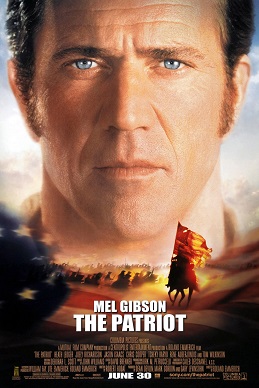
Film Review: The Patriot (dir by Roland Emmerich)


First released in the year 2000, The Patriot stars Mel Gibson (back before the arrests and scandals) as Benjamin Martin.

Benjamin Martin is a planter living in colonial-era South Carolina.  When he was younger, he fought in the French/Indian War and was infamous for his ferocity as a combatant.  However, in the year 1776, he is devoted to working the land and peacefully caring for his children.  When, as a member of the South Carolina General Assembly, he is called upon to cast a vote for or against independence, he abstains.  He’s no fan of the British but he’s also seen the harsh reality of war and doesn’t want his sons to have any part of it.  However, the Assembly still votes for Independence and Martin’s oldest son, Gabriel (Heath Ledger), is among the first to enlist in the army.

Four years later, the British come to the Martin farm and demand that Benjamin had over a wounded Gabriel to them.  When Benjamin resists, the arrogant Col. Tavington (Jason Isaacs) kills one of Benjamin’s other sons.  After Tavington has Gabriel arrested, Benjamin and two of his remaining sons track down the British convoy transporting him.  While his two youngest sons look on in horror, Benjamin savagely shoots and hacks to death all of the British soldiers and rescues Gabriel.

The Patriot may be a film about the American Revolution but it’s also definitely a Mel Gibson film.  That means that Benjamin is man driven as much be revenge as by a desire to win his country’s independence.  The British killed his son and burned down his house.  Benjamin responds by grabbing his musket and packing his axe and soon, it’s more common than not to see Benjamin covered in blood.  Benjamin attacks like a feral beast who is determined to dominate anyone and anything that would invade his territory.  Two of his sons go from being honored to be asked to come along to being terrified at the sight of their father murdering soldier after soldier.  It’s probably the most emotionally honest moment you’ll ever find in a Roland Emmerich film.  Of course, whether Emmerich meant for it to be so is open to debate.

And indeed, it should be noted that The Patriot is very much a Roland Emmerich film.  The running time is an epic 165 minutes.  The battle scenes are long and loud and carefully choreographed.  Gibson was still rugged and handsome when he played Benjamin Martin.  (Both before his downfall and after, Gibson has always been best cast as people who just want to be left alone and who finally snap once it becomes obvious that’s not going to happen.)  Heath Ledger almost appears beatific in his scenes.  The film looks great without ever quite looking authentic.  It’s like a fever dream that is less about how the American Revolution was actually fought and more about how we imagine it was fought.

And you know what?

The film works for me.  This is one of Emmerich’s best films, which admittedly is not a high bar to clear.  Yes, it’s a bit simplistic.  Yes, it’s not historically accurate.  Yes, all of the British are portrayed as being one-dimensional villains.  Who cares?  Whether he realizes it or not, Roland Emmerich has always been a B-movie maker at heart and The Patriot is effective in much the same way that many crude but shameless B-movies are.  The mix of Mel Gibson’s madness, Heath Ledger’s beatific earnestness, and Jason Isaac’s arrogance transforms The Patriot into a triumph of the pulp imagination.  Much like America itself, The Patriot is big and loud and it makes absolutely no apologies.
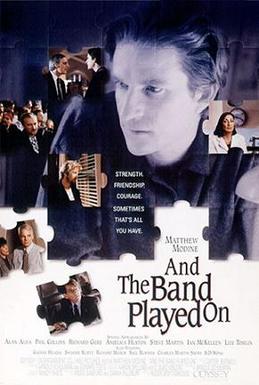
Film Review: And The Band Played On (dir by Roger Spottiswoode)


I live in a very cynical time.

That was one of my main thoughts as I watched 1993’s And The Band Played On.

Directed by Roger Spottiswoode and featuring an all-star cast, And The Band Played On deals with the early days of the AIDS epidemic.  It’s a film that features many different characters and storylines but holding it all together is the character of Dr. Don Francis (Matthew Modine), an epidemiologist who is haunted by what he witnessed during the Ebola epidemic in Africa and who fears that the same thing is going to happen in America unless the government gets serious about the mysterious ailment that is initially called “gay cancer” before then being known as “GRID” before finally being named AIDS.  Dr. Francis is outspoken and passionate about fighting disease.  He’s the type who has no fear of yelling if he feels that people aren’t taking his words seriously enough.  In his office, he keeps a track of the number of HIV infections on a whiteboard.  “Butchers’ Bill” is written across the top of the board.

Throughout the film, quite a few people are dismissive of Dr. Francis and his warnings.  But we, the audience, know that he’s right.  We know this because we know about AIDS and but the film also expects us to trust Dr. Francis because it’s specifically stated that he worked for the World Health Organization before joining the Center For Disease Control in Atlanta, Georgia.  As far as the film is concerned, that’s enough to establish his credentials.  Of course, today, after living through the excesses of the COVID pandemic and the attempts to censor anyone who suggested that it may have begun due to a lab leak as opposed to some random guy eating a bat, many people tend to view both the WHO and the CDC with a lot more distrust than they did when this film was made.  As I said, we live in a cynical time and people are now a lot less inclined to “trust” the experts.  To a large extent, the experts have only themselves to blame for that.  I consider myself to be a fairly pragmatic person but even I now find myself rolling my eyes whenever a new health advisory is issued.

This new sense of automatic distrust is, in many ways, unfortunate.  Because, as And The Band Played On demonstrates, the experts occasionally know what they’re talking about.  Throughout the film, people refuse to listen to the warnings coming from the experts and, as a result, many lives are lost.  The government refuses to take action while the search for a possible cure is hindered by a rivalry between international researchers.  Alan Alda gives one of the best performances in the film, playing a biomedical researcher who throws a fit when he discovers that Dr. Francis has been sharing information with French scientists.

It’s a big, sprawling film.  While Dr. Francis and his fellow researchers (played by Saul Rubinek, Glenne Headly, Richard Masur, Charles Martin Smith, Lily Tomlin, and Christian Clemenson) try to determine how exactly the disease is spread, gay activists like Bobbi Campbell (Donal Logue) and Bill Kraus (Ian McKellen) struggle to get the government and the media to take AIDS seriously.  Famous faces pop up in small rolls, occasionally to the film’s detriment.  Richard Gere, Steve Martin, Anjelica Huston, and even Phil Collins all give good performances but their fame also distracts the viewer from the film’s story.  There’s a sense of noblesse oblige to the celebrity cameos that detracts from their effectiveness.  All of them are out-acted by actor Lawrence Monoson, who may not have been a huge star (his two best-known films are The Last American Virgin and Friday the 13 — The Final Chapter) but who is still heart-breakingly effective as a young man who is dying of AIDS.

Based on a 600-page, non-fiction book by Randy Shilts, And The Band Played On is a flawed film but still undeniably effective and a valuable piece of history.  Director Roger Spottiswoode does a good job of bringing and holding the many different elements of the narrative together and Carter Burwell’s haunting score is appropriately mournful.  The film ends on a somber but touching note.  At its best, it’s a moving portrait of the end of one era and the beginning of another.