Retro Television Review: Crime Story 1.12 “Hide and Go Thief”


Welcome to Retro Television Reviews, a feature where we review some of our favorite and least favorite shows of the past!  On Mondays, I will be reviewing Crime Story, which ran on NBC from 1986 to 1988.  The entire show can be found on Tubi!
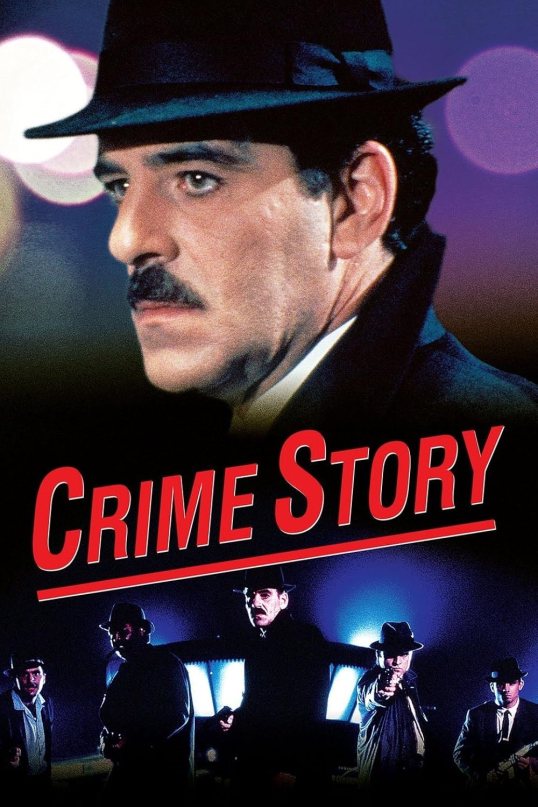
This week, Torello finally tracks down Homan.

Episode 1.12 “Hide and Go Thief”

(Dir by Francis Delia, originally aired on December 12th, 1986)

In Chicago, an unnamed gunman (Paul Guilfoyle) has taken a woman (Lorraine Bracco) hostage and has barricaded himself in a hotel room.  He wants to get on television and he figures that holding a hostage and firing a machine gun out the window is the best way to do it.  The members of the Major Crimes Unit are in the street, ducking behind squad cars whenever the gunman starts firing on them.

It’s definitely a major situation but Torello is more interested in going to Gary, Indiana than exchanging gunfire in Chicago.  Frank Homan (Ted Levine), a former member of Luca’s crew, has been discovered  working as a cook in a Gary diner.  Everyone in Gary knows Frank as “Mike Torello.”  The real Torello is determined to arrest Frank and hopefully use him to take down Luca.  Torello abandons the hostage situation, drives down to Gary, and captures Homan at work.

Finally, some good news for the real Mike Torello, right?  Well, not quite.  After Homan is arrested, U.S. Attorney Harry Brietel (Ray Sharkey) takes custody of him.  Brietel has political ambitions and taking down gangster Manny Weisbord would be a good way for him to make a name for himself.  When Homan is interrogated by Brietel, Homan lies.  He says that he’s never heard of Manny Weisbord.  But, Homan says, he has information that will take down Luca, Phil Bartoli, and a crooked cop.  In exchange for a light sentence and entry into the witness protection program, Homan is willing to testify that Mike Torello is on the take.  Brietel is intrigued.  Fighting police corruption is guaranteed to generate even better press than taking down an actual mobster.

Meanwhile, back in Chicago, Torello rejoins the MCU at the hostage situation.  (Apparently, the gunman has been awake and firing out of his hotel window for two and a half days straight.  One gets the feeling that perhaps it’s wise not to give too much thought to the logistics of this episode’s timeline.)  In a well-shot, slow-motion scene, Torello and his men storm the hotel room and shoot the gunman dead.  The hostage survives.

Significantly, neither the gunman nor the hostage are given names in this episode.  Indeed, Paul Guilfoyle is credited as playing “Deranged Gunman.”  That’s because the gunman and the hostage are really only there to show just how obsessed Torello has become with Luca.  When it comes to destroying Luca and his fledgling criminal empire, all else can wait, even saving an innocent woman from an armed lunatic.

I usually don’t enjoy watching anything that involves a hostage situation because it always seems to lead to the same predictable narrative beats.  Fortunately, this episode avoided most of the usual cliches by making the gunman a total nutcase who never stopped firing his weapon.  The scene where Torello and his men storm the hotel room was stylish enough to verge on being surreal.  As for the Homan plotline, both Ted Levine and Ray Sharkey provided strong performances and I’m looking forward to seeing how Luca and Torello react to being betrayed by the same guy.

All in all, this was a good episode.

Retro Television Review: Crime Story 1.9 “Justice Hits The Skids”


Welcome to Retro Television Reviews, a feature where we review some of our favorite and least favorite shows of the past!  On Mondays, I will be reviewing Crime Story, which ran on NBC from 1986 to 1988.  The entire show can be found on Tubi!

Torello is going to snap….

Episode 1.9 “Justice Hits The Skids”

(Dir by Mario DiLeo, originally aired on November 11th, 1986)

Torello is losing it.

Well, that’s not really a surprise.  Torello has been losing it since the pilot.  However, this episode finds him acting even more intense than usual.  He’s getting divorced.  His best friend Ted Kehoe has been murdered and the federal prosecutor seems to be more interested in trying to prove that Torello is corrupt than in going after Bartoli and Luca.  Torello doesn’t even go to Ted Kehoe’s funeral, leading to everyone thinking that Torello is losing what little grip on sanity he has left.  Even his soon-to-be ex-wife checks in on him.

While Torello stews over Luca, Suzanne Terry attempts to investigate the growing use of drugs in some of Chicago’s poorest neighbors and she gets attacked and put into the hospital as a result.  David Abrams tries to investigate on his own, leading to Suzanne telling him that she needs some time apart from him.  (Before she’s attacked, David takes her out to dinner.  When a racist diner complains and the head waiter asks them to move to a different table, Suzanne wants to leave the restaurant.  David insists that they stay  and finish their meal.  David may see himself as being a righteous crusader but, at the same time, he also comes across as being rather controlling.  It doesn’t seem to occur to him that Suzanne might not want to give any business to a racist restaurant.)  Torello and the Major Crimes Unit then take up the case, even though his superiors tell him not to waste any time on it.

Sweet Haywood (John Canada Tyrell), the drug dealer who attacked Suzanne, is eventually captured.  Sitting in jail, he meets his public defender, who just happens to be David Abrams.  Abrams pulls out a gun and shoots Haywood in the chest.  However, this turns out to just be a fantasy on David’s part.  When the real Haywood demands to know if Abrams is going to keep him out of the jail, Abrams says, “Of course.  That’s my job.  Abrams for the defense.”

The gun-shooting fantasy scene was effective but otherwise, the ending doesn’t make much sense.  Assigning Abrams to serve as the public defender for a guy who was arrested for beating up Abrams’s girlfriend is a massive conflict-of-interest.  If Abrams intentionally offers up a poor defense, Haywood will automatically have grounds for an appeal.  I mean, this is 1963.  This the era of the Warren Court!

Even with that in mind, this wasn’t a bad episode.  David Abrams and Mike Torello are both flawed heroes, which is what makes the show so watchable.  Torello may be fighting on the side of the law but he really does seem like he’s one bad day away from blowing up the entire city of Chicago.  Meanwhile, Abrams clearly sees himself as being the last righteous crusader but he often seems oblivious to how his actions effect other people.  Neither is perfect.  Indeed, each one seems to be just one step away from self-destructing.

We’ll see what happens!

Retro Television Review: Crime Story 1.8 “Old Friends, Dead Ends”


Welcome to Retro Television Reviews, a feature where we review some of our favorite and least favorite shows of the past!  On Mondays, I will be reviewing Crime Story, which ran on NBC from 1986 to 1988.  The entire show can be found on Tubi!

This week, Torello discovers some disturbing facts about an old friend.

Episode 1.8 “Old Friends, Dead Ends”

(Dir by Bobby Roth, originally aired on November 4h, 1986)

Luca has bought a controlling interest in a bottling company so that he can borrow from the pension fund and use that money to purchase casinos in Las Vegas.  He’s brought a reluctant Bartoli in as his partner.  The owner of the company is Ted Kehoe (Mark Hutter), who just happens to be an old friend of Mike Torello’s.  When Kehoe’s business partner, Marilyn Stewart (Dana Wheeler-Nicholson), becomes suspicious of Kehoe’s arrangement with Luca, Bartoli starts to wonder if it’s really worth it to keep Marilyn and Ted around.

This is especially the case after Bartoli’s attorney, Dee (a youngish Eric Bogosian), informs Bartoli that U.S. Attorney Harry Brietel (Ray Sharkey) is planning on indicting both him and Luca for money laundering.  Looking to end Brietel’s case before it can even get started, Luca murders Marilyn Stewart.  Marilyn’s body is later found by two teenagers and–

HEY, IT’S CHRISTIAN SLATER!

This episode does indeed feature an early performance from Christian Slater.  He pays a teenager who is trying to convince his girlfriend to “do it” when they happen to spot Marilyn’s body floating in the river.  Slater’s girlfriend is played by Kim Walker, who was later co-star with Slater in Heathers.

Torello is not happy.  Well, that’s not a surprise.  Torello is never happy.  But this episode gives him even more reasons than usual to be in a foul mood.  Because of his childhood friendship with Ted Kehoe, Brietel suspects that Torello might be corrupt.  After Marilyn is murdered, Brietel seems more interested in trying to pin the murder on Torello than going after Luca.

As for Ted Kehoe, he tells Luca that he’s done working for him.  Kehoe is going to tell the cops everything!  And what is Luca going to do about it?  This episode ends with Kehoe getting thrown out the window of his penthouse and falling several stories down to his death….

Piece of advice: If you’re going to turn on the mob, don’t tell them ahead of time.

This was a good episode!  Torello’s friendship with Kehoe brought some real stakes the story and, once again, we got to see just how ruthless an adversary Ray Luca truly is.  Luca, Bartoli, and the other mobsters can occasionally seem a bit buffoonish.  This episode reminded us that, in Luca’s case, it’s always a mistake to underestimate him.

As for now, Kehoe is dead and Torello is under suspicion.  I look forward to seeing what happens next week!

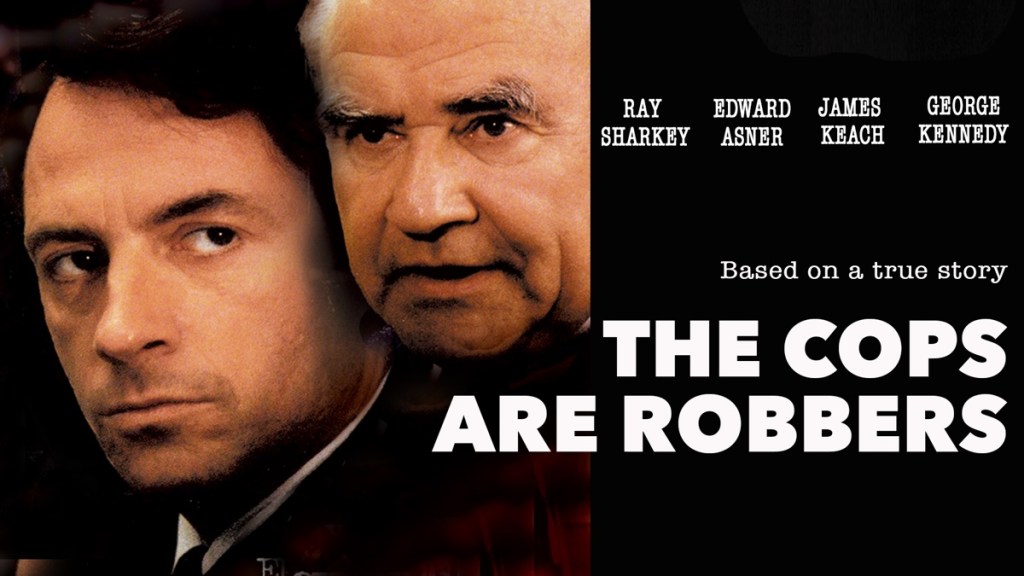
Brad recommends THE COPS ARE ROBBERS (1990)!


If you’re looking for a good “dirty cops” movie to pass the time, I ran across an entertaining one today called THE COPS ARE ROBBERS (AKA – GOOD COPS, BAD COPS). It’s currently playing on Amazon Prime and Tubi. The film is a 1990 TV movie based on the real life robbery of the Boston Depositors Trust bank over Memorial Day weekend in 1980 by a group of corrupt cops. I first became aware of the film when I took part in an interview with Robert F. Lyons about his career on the This Week in Charles Bronson podcast. Lyons specifically mentioned this film as containing a role that he really enjoyed.

THE COPS ARE ROBBERS features an incredible cast, and this is what ultimately sets the movie apart for me. The movie opens as top cop Kirkland, played by George Kennedy, assigns Jake Quinn (Ed Asner), to lead a notoriously corrupt law enforcement agency in Massachusetts. No sooner does Quinn take over, when the Boston Depositors Trust is hit over Memorial Day weekend with over $25 million in cash and jewels taken. The crew of criminals includes current cops Jerry Clemente (Ray Sharkey) and Jimmy Donnelly (Steve Railsback), ex-cop Frank Moran (James Keach), and safe expert Benny Brown (Lyons). Over the next 5 years, with the assistance of officers Brill (James Morrison) and Kellogg (Franc Luz), Jake Quinn does every thing he can to bring Clemente and his crew down! 

Ed Asner, Ray Sharkey and Robert F. Lyons are the real standouts of the film. Asner brings a toughness and honesty to his role honed by decades of playing such roles. In other words, the part fits him like a glove. Sharkey plays his part as a man who’s so arrogant and corrupt that he doesn’t seem to realize that using his position of trust in the community for his own selfish gain is a problem. He seems to think he deserves whatever he can steal, and it’s fun to see the pressure squeeze in on him as the film moves along. After watching the film, I can see why Lyons enjoyed playing this part, as he is excellent in his role as the safe expert. He is one of the most important parts of the robbery, he doesn’t trust cops, and he eventually gets the opportunity to give them a reason not to trust him. It’s a nice showcase for his talents. 

At the end of the day, if you like the cast, enjoy movies based on true stories, or appreciate TV movies from the late 80’s and early 90’s, I definitely think you’ll enjoy THE COPS ARE ROBBERS. Veteran Director Paul Wendkos (CANNON FOR CORDOBA, THE BAD SEED) brings a professional touch to the proceedings, and for me, watching his film was a fun way to spend an evening. 

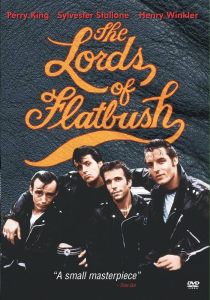
The Lords of Flatbush (1974, directed by Stephen F. Verona and Martin Davidson)


The year is 1958 and four Brooklyn teenagers, all members of a largely non-violent street gang called The Lords of Flatbush, have enough grease in their hair to start a city-wide kitchen fire.  It’s their senior year of high school.  Chico (Perry King) tries to hook up with a new, blonde transfer student (Susan Blakely).  Butchey (Henry Winkler) makes everyone laugh and hides the fact that he’s secretly really smart.  Stanley (Sylvester Stallone) deals with his impending marriage to Frannie (Maria Smith).  Everyone has to grow up eventually but at least the Lords of Flatbush will always have their memories and probably their leather jackets.

Nostalgia films that were extremely popular in the 70s, as the baby boomers were already starting to mythologize their youth.  Lords of Flatbush is very much about that nostalgia, leading to a film that feels sincere but which is also pretty predictable.  With its coming-of-age storylines and its mix of drama and comedy, Lords of Flatbush owes an obvious debt to American Graffiti.  The movie, like its characters, is likable but not exactly memorable.  Today, it’s really only known because it featured early performances from Sylvester Stallone and Henry Winkler.  Winkler got his signature role as the Fonz on Happy Days largely based on his performance as Butchey, though Butchey is nowhere near as cool as the Fonz.  Pre-Rocky, this movie was Stallone’s calling card in Hollywood and he rewrote enough of his own lines that he got an additional dialogue credit.  Stallone actually gives a pretty good performance, even if he is obviously closer to 30 than 18.

Stallone’s best scene is when Stanley is trying to buy an engagement ring and Frannie insists that he buy one that costs $1,600.  For the first time, Stanley realizes that getting married means committing to something other than hanging out with his friends and working on his car.  Stanley buys the ring but threatens the jewelry store owner afterwards, telling him to never show Frannie a $1,600 ring again.

The Lords of Flatbush is a film about the past but it’s mostly interesting due to the future of its stars.

Retro Television Review: Miami Vice 2.8 “Tale of the Goat”


Welcome to Retro Television Reviews, a feature where we review some of our favorite and least favorite shows of the past!  On Mondays, I will be reviewing Miami Vice, which ran on NBC from 1984 to 1989.  The entire show can be purchased on Prime!

This week, things get weird.

Episode 2.8 “Tale of the Goat”

(Dir by Michael O’Herlihy, originally aired on November 15th, 1985)

It’s hard to know where to begin with this one.

Legba (Clarence Williams III) is a drug lord that Sonny has been trying to take down for three years.  While hiding out in Haiti, Legba reportedly dies.  When his body is flown back to Miami, Crockett and Tubbs are waiting in the airport so that Crockett can snap a picture of Legba in his casket.  Legba does indeed appear to be dead.  But, at his voodoo-themed funeral, a man on a motorcycle riddles the casket with bullets.  When Crockett and Tubbs (who were staking out the ceremony) open up the casket, they discover only a dead goat.

“Zombie!” a priest exclaims.

Legba has come back, though not as a member of the undead.  Instead, while in Haiti, he ingested a toxin that put him in a 48-hour coma.  Unlike a lot of people who take the toxin, Legba survives.  However, when he is revived, he has suffered brain damage and is now walking and talking slowly.  That doesn’t stop Legba from getting his old gang back together (including a dwarf who carries a pickaxe) and going after everyone who he feels has betrayed him.  This includes his former lieutenant (Mykelti Williamson) and an obnoxious money launderer (Ray Sharkey) who owns a used car lot.

Tubbs doesn’t believe in voodoo, despite Crockett warning him of the dangers.  Tubbs is more interested in Marie (Denise Thompson), Legba’s ex-girlfriend.  Looking to keep Marie safe from Legba, Tubbs attempts to infiltrate a voodoo ceremony.  You might think this would give Tubbs the perfect excuse to trot out the fake Caribbean accent that he occasionally used during the first season but instead, Tubbs is captured before he can even utter a word.  He’s injected with the toxin and spends 48 hours in a coma, haunted by visions of Legba staring at him!

Eventually, Tubbs does come out of his coma and, amazingly, it takes him about five minutes to fully recover.  The episode ends with another raid on a yacht.  This time, Tubbs manages to kill the villain, shooting him in the back!  In Tubbs’s defense, he was still having visions and he thought Legba was facing him.  Legba dies and Marie is found in a coma but alive.

This was a weird episode, one that had enough plot for a two-parter.  As it is, the story felt rather rushed.  No sooner had Mykleti Williamson and Ray Sharkey made their appearances as criminals then Legba was doing away with them.  No sooner had Marie stepped onto Crockett’s boat then she was being kidnapped by Legba’s men.  No sooner had Tubbs decided to infiltrate Legba’s cult then he was getting injected with the voodoo toxin.  And no sooner had Tubbs woken up from his coma then he was preparing to raid the yacht.  Add to that, Clarence Williams III gave a performance that was without a hint of subtlety, speaking in accent that was impossible to describe.  This wasn’t really a good episode but it was so weird that it was undeniably entertaining.

Next week, Dean Stockwell appears as an old friend of Castillo’s!  Hopefully, he won’t be a voodoo priest.

Horror on TV: The Hitchhiker 5.2 “In Living Color” (dir by John Laing)


On tonight’s episode of The Hitchhiker, the title character (Page Fletcher) continues to come across the worst people on the planet.

This time, that person is Eric Coleman (Ray Sharkey), a once great photographer who now makes a disreputable living taking pictures of celebrities and tragedies.  When Eric has a chance to stop a woman’s suicide, he instead decides to take pictures.  His new assistant goes out of her way to make Eric feel the error of his ways.

This episode features a convincingly sleazy performance from Ray Sharkey.  Eric Coleman is a character who you will definitely want to see receive his comeuppance.

This episode originally aired on April 29th, 1989.

The Cops Are Robbers (1990, directed by Paul Wendkos)


When Kirkland (George Kennedy) appoints veteran cop Jake Quinn (Ed Asner) to command a division of the Massachusetts Metropolitan Police, one of Quinn’s main duties is to root out corruption.  Everyone knows that Captain Jerry Clemente (Ray Sharkey) is crooked but no one’s been able to prove anything.  This has led to Clemente getting so cocky that he tries to pull off the biggest bank robbery of all time.  Working with two other corrupt cops (played by Steve Railsback and James Keach) and some ex-cons who owe him a favor, Clemente masterminds the theft of $25,000,000 worth of jewelry.

Unfortunately, stealing that much brings in not only the FBI but it also makes Quinn even more determined to expose Clemente and all of his crooked associates.  As well, the Mafia wants their part of the action and the members of Celemente’s gang aren’t as smart as their leader.  Soon the walls are closing in.  Will Clemente get away with his crime or will he end up getting arrested and eventually writing a book about the theft that will eventually be turned into a television movie?

Though the title seems more appropriate for a comedy, The Cops Are Robbers is a drama based on a true story.  It actually could have used some comedy because the movie itself is pretty dry and straight forward.  Ed Asner and George Kennedy give their usual competent performances, cast as the type of characters that they could have played in their sleep.  Unfortunately, Ray Sharkey is nowhere near as effective as the man they’re trying to put behind bars.  When he first started out, Sharkey made a name for himself by giving convincing performances as characters who were tough and streetwise but also sometimes neurotic.  He received Emmy and Golden Globe nominations before he became better known for his trips to rehab than his acting ability.  I think that. as an actor, Sharkey’s downfall was that he saw himself compared to Al Pacino so many times that he started to buy it and he eventyally started to attack every role with the same method-style intensity.  Sometimes, like when he played Sonny Steelgrave during the first season of Wiseguy, it worked.  Most of the time, though, it just led to him overacting and bellowing all of his lines.  That’s the case with The Cops Are Robbers.  Sharkey is so loud and perpetually angry that it’s hard to believe that he’s managed to get away with his crimes for as long as he has.

For those of us who don’t live in Massachusetts, the most interesting thing about watching The Cops Are Robbers is trying to keep track of who works for what agency.  When it was mentioned that Clemente works for the Metropolitan Police, I immediately assumed that meant he was a Boston police officer.  Only later did I learn, via a review on the imdb, that the Metropolitan Police were actually a state agency.  That Clemente was a state official and not just a city cop does make his crimes slightly more interesting, though not enough to really liven up The Cops Are Robbers.

In the Line of Duty: Street War (1992, directed by Dick Lowry)


Street War, the fifth In The Line of Duty movie to be produced by NBC, takes place in Brooklyn.  Raymond Williams (Mario Van Peebles) and Robert Dayton (Michael Boatman) are two uniformed officers trying to keep the peace in the projects.  When Raymond is shot and killed in a stairwell, everyone knows that drug dealer Justice Butler (Courtney B. Vance) was responsible but no one can prove it.

The case is assigned to two detectives, Dan Reilly (Peter Boyle) and Victor Tomasino (Ray Sharkey).  Reilly is a veteran cop who is just a few months away from retirement.  Tomasino is the son of a “made man” who can’t understand why the drug lords in Brooklyn aren’t as interested in keeping the peace as the old Mafiosos were.

When Justice leaves Brooklyn so that he can hide out with his family in South Carolina, Reilly and Dayton follow him down there and discover that people in South Carolina distrust the cops just as much as people in Brooklyn.  Meanwhile, back in Brooklyn, Justice’s second-in-command, Prince (Morris Chestnut), tries to keep an all-out war from breaking out.

Prince and Tomasino take turns narrating the movie.  Prince talks about the reality of trying to restart your life after doing time in prison while Tomasino complains that “the animals” have taken over the city.  (Because this was made for television, “Animals” is Tomasino’s go-to label for anyone he dislikes.  Anyone with any experience with the police will know what word he is actually thinking.)  While Chestnut gives a restrained and thoughtful performance, Ray Sharkey shouts his lines and snarls whenever he’s onscreen.  Though it’s not always evident in this movie, Sharkey started out as a talented actor who played small roles in several independent films before starring in The Idolmaker.  Unfortunately, Sharkey was also a heroin addict whose once promising career was derailed by a series of arrests and jail sentences.  He looks thin and tired in Street Wars and, one year after the film aired, he would die of complications from AIDS.

With Sharkey yelling his lines, it falls on Peter Boyle to play the voice of reason in Street War.  Dan Reilly is a cliché, the weary cop who still wants to make the world a better place and who is just a few days away from retirement.  But Boyle does a good job playing him and brings his own natural gravitas to the movie.

Dick Lowry, who directed the first three In The Line of Duty movies, returns for this one and he keeps the action moving.  Street War is significantly more violent than the previous movies, with even two children getting shot onscreen.  The story itself is a predictable and Tomasino’s casual racism can be hard to take (even if he does eventually called out about it) but, thanks to the performances of Boyle, Boatman, Chestnut, and Vance, Street War is an improvement on Mob Justice and an adequate entry in the series.

Street War would be followed by two movies about FBI sieges, The Siege at Marion and Ambush in Waco.  Since I’ve already reviewed both of those, I will be moving onto In the Line of Duty: The Price of Vengeance tomorrow.

Dead On: Relentless II (1992, directed by Michael Schroeder)


Still struggling to recover from having to act opposite Judd Nelson in the previous Relentless film, Los Angeles homicide detective Sam Deitz (Leo Rossi) finds himself investigating another string of seemingly random murders.  This time, the killer is Gregor (Miles O’Keeffe), a master of disguise who hangs his victims, decorates the crime scene with Satanic graffiti, and takes a lot of ice baths.  Deitz is forced to team up with a condescending FBI agent named Kyle Valsone (Ray Sharkey), who has his own reasons for wanting to capture Gregor and who might not have the best interests of the case in mind.  As if having to deal with killer Russians and crooked FBI agents isn’t bad enough, Deitz is also having to deal with the collapse of his married to Meg Foster and the everyday irritations of being an intense New York cop in laid back Los Angeles.

Relentless II is a better than the first Relentless, mostly because Miles O’Keeffe is a better villain than Judd Nelson.  Whereas Nelson was too twitchy to be taken seriously in the first Relentless, O’Keeffe is cold as ice and believably dangerous.  He’s a worthy opponent for Rossi and Sharkey.  How much Keeffe was in this movie?  Just enough to make it work.

Whenever O’Keeffe isn’t doing his thing, the movie focuses on Deitz and Valsone.  To a certain extent, their relationship mirrors the relationship that Deitz had with Malloy in the first Relentless except, this time, the mentor turns out to be just as bad the killer.  Ray Sharkey was a good actor whose career nosedived because of his own addictions.  He was always at his best playing streetwise bad guys, like Sonny Steelgrave in Wiseguy.  He’s good as Valsone, giving a performance that indicates that, even if mainstream Hollywood wasn’t willing to take a chance of him, he could have carved out a direct-to-video career as a poor man’s Michael Madsen.  Unfortunately, Sharkey contracted HIV as a result of his heroin addiction and he died of AIDS just a year after the release of Relentless II.

Leo Rossi gives another good performance as Sam Deitz.  Rossi was usually cast as abusive boyfriends and low-level mobsters and it’s obvious that he enjoyed getting to play a hero for once.  Meg Foster may not get to do much as Deitz’s wife but her otherworldly eyes are always a welcome sight.

Relentless II was the high point of the Relentless films.  It made enough money to lead to a sequel.  Sam Deitz’s days of hunting serial killers were not over.