I miss the WB.
The so-called fifth television network launched in 1995 and ceased operations in 2006. That’s when the WB merged with the sixth television network, UPN, and became known as the CW. (The CW still exists, even though I haven’t watched it since they canceled Dynasty in 2022.) The WB never got much respect from the critics, even though some very important shows aired on the network. Buffy the Vampire Slayer was a WB show. So were Angel, Charmed, Felicity, One Tree Hill, Supernatural, Gilmore Girls, 7th Heaven, Roswell, Smallville, and What I Like About You. Most critics usually considered those shows the exception to the rule. They were the shows that aired in between stuff like Beauty and the Geek and Nick Freno: Licensed Teacher. Well, that’s fine. For those of us of a certain age, it didn’t matter that the WB aired a lot of shows that only lasted a few weeks. What mattered is that the network was home to the shows we planned our nights around.
Critically, UPN got even less respect than the WB. I associated the channel with Star Trek and professional wrestling, neither of which held much appeal for me in the aughts. However, when Buffy switched from the WB to UPN, I followed it to its new network. I watched Veronica Mars and idolized the title character. I watched America’s Next Top Model and cheered for any model who had the guts to talk back to the judges.
The 2006 merger between the two networks hit me harder than it probably should have. I had grown up with the WB and UPN as scrappy rivals, two networks that were continually battling for fifth place. They were the networks that aired shows that seemed to actually speak to what I was going through in my life at the time. It almost felt like a sacrilege to have the two networks come together. Even though some of my favorite shows continued on the CW, things just never felt the same. If the WB and UPN felt like cocky upstarts, the CW seemed like something that had been born out of defeat.
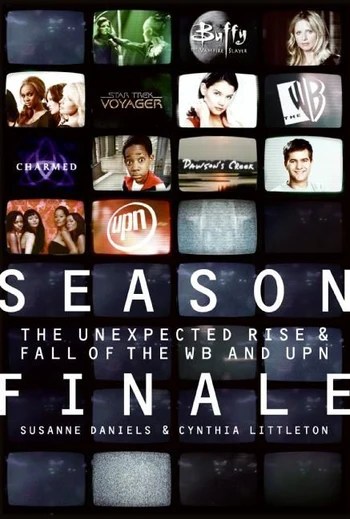
First published in 2007, Season Finale: The Unexpected Rise and Fall of the WB and UPN is a look at the short but colorful history and rivalry of the WB and UPN. Co-author Susanne Daniels was the president of entertainment at the WB, so it’s not surprising that the book tends to go into more detail about the WB’s operations than UPN’s. It makes for an entertaining read. Daniels writes like someone who truly loves television, and the book has plenty of behind-the-scenes information about the shows I grew up with. If nothing else, the WB sounds like it was a fun place to work. UPN, meanwhile, sounds like it was a place where everyone was continually jealous of the WB and also stressed over having to defend programming like Shasta McNasty and The Secret Diary of Desmond Pfeiffer.
The book is only 19 years old, but there are times when it feels like an artifact from a distant age. It was written before #MeToo, before woke, even before the rise of streaming. When I recently reread it, I found myself cringing when I reached the section about the creation and casting of 7th Heaven. The original choice for the role of the saintly Reverend Camden was Beau Bridges, but Bridges turned out to be too expensive. When an executive mentions Stephen Collins, the response is: “I’ve always liked him.”
AGCK!
Of course, today that’s not something anyone would voluntarily say about Stephen Collins. But in 2007 he still had that image of being the type of nice, down-to-earth guy you’d be happy to have as a neighbor. Reading the book reminded me of just how shocked almost everyone was when Collins’s ex-wife first released the tapes of him admitting to inappropriately touching a minor. At the time, I think a lot of people assumed Collins was somehow being set up because that just wasn’t the image he had at all. Of course, Collins himself later admitted it was true.
The book is full of people who have since fallen from grace, and as such it becomes very tempting to try to read between the lines. Joss Whedon is described as being talented but intense, and reading about him reminded me of just how much some of us used to really respect Whedon and his shows. (For the record, I grew disenchanted with Whedon in December of 2016 when he tweeted that it was offensive to say “Happy holidays” because, for him, “they won’t be.” Get over yourself, Joss.) Les Moonves shows up toward the end of the book, and there are frequent references to his reputation for being a hard-driving boss. Even Harvey and Bob Weinstein make a cameo appearance, sending two of their goons down to basically hold Dawson’s Creek creator Kevin Williamson hostage until he finished a rewrite on Scream 2. Reading about Collins, Whedon, and Moonves serves to make you appreciate people like Williamson, Amy Sherman-Palladino, and even Aaron Spelling, all of whom come across as relatively well-adjusted creative people.
Toward the end of the book, Susanne Daniels writes about going to the Emmys with her husband, producer Greg Daniels. The Office wins its only Emmy for Outstanding Comedy Series and Suzanne watches as Greg joins his college friend Conan O’Brien on stage. It’s a sweet moment but also one that, when read today, reminds us of just how much things have changed over the past two decades. Network shows no longer win Emmys. The Office fell apart after NBC boss Jeff Zucker (in a move that feels like it could have been lifted from the early days of UPN) decided not to offer Steve Carell a new contract. The Office was eventually rediscovered when it started streaming on Netflix, and even today people are more likely to remember it as a show they binged online than one they watched every week on NBC. When the book first came out, I shared Susanne Daniels’s frustration over the WB becoming the CW. Today, when I read it, I feel bad for whoever decided to launch a new network right on the edge of the streaming era.
Season Finale is a compulsively readable portrait of the way things once were. Thanks for the memories.