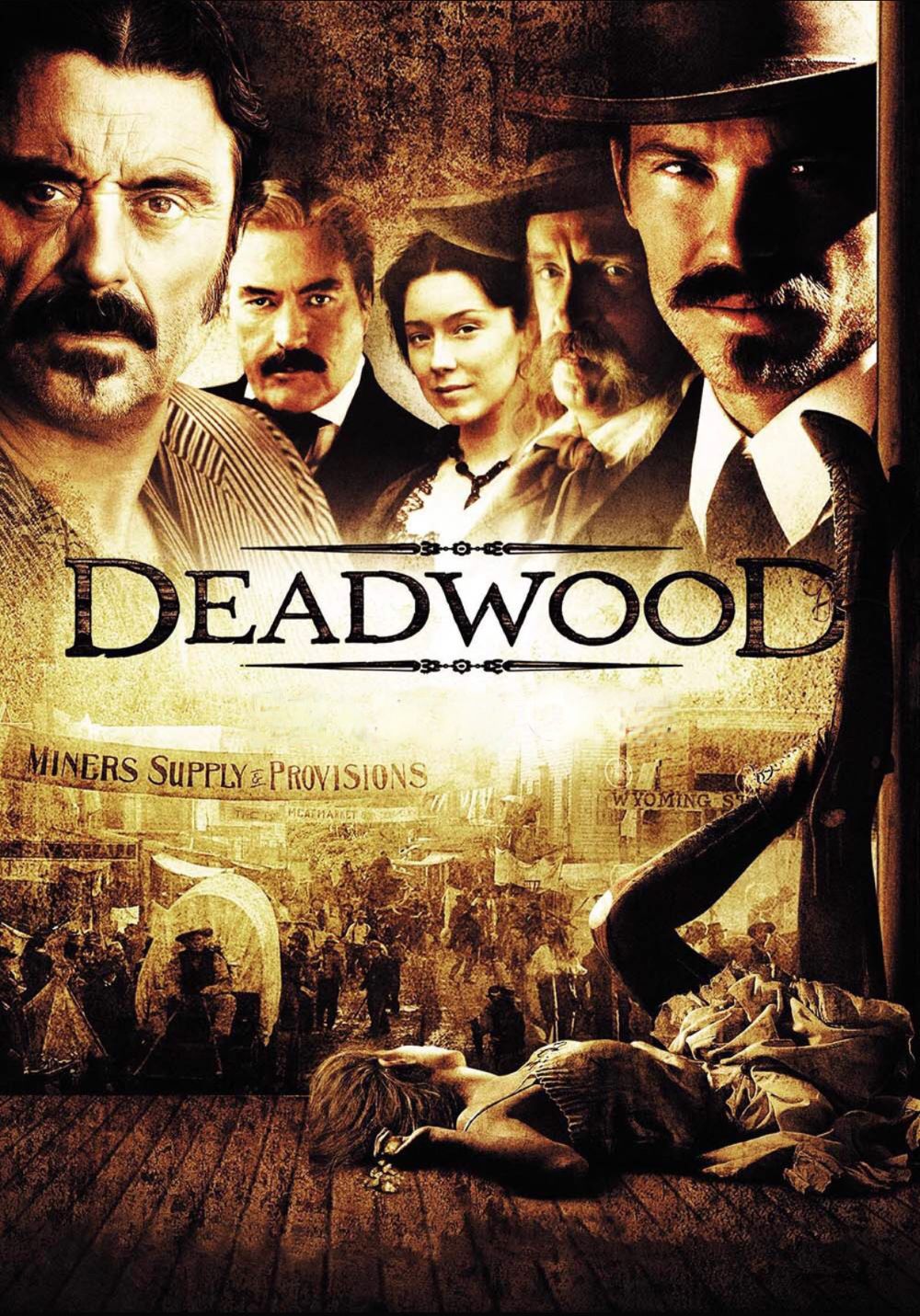
Review: Deadwood (by David Milch)


“Be in my joint in two hours—we’re forming a fuckin’ government.” — Al Swearengen

David Milch’s Deadwood is one of those rare television series that feels less like a conventional prestige drama and more like being dropped into a living, breathing, filthy historical world. Set in the rough gold-rush settlement of Deadwood, South Dakota, during the 1870s, the HBO series takes the familiar pieces of the Western—lawmen, gunfighters, prospectors, saloons, prostitutes, corrupt businessmen, and murder—and turns them into something far richer than a genre exercise. It is a Western, but it is also a story about the difficult, often ugly process of creating a society in the middle of chaos. Civilization in Deadwood is not built by noble speeches or clean acts of heroism. It is assembled through greed, fear, business deals, compromise, bloodshed, exploitation, loyalty, and the occasional act of real compassion.

The show’s biggest strength is its ability to make Deadwood itself feel like one of television’s great settings. At the beginning, the camp exists outside the reach of formal American law, which means everyone who arrives sees an opportunity. Some people come looking for gold. Others come looking to escape old lives, make money, gain power, or take advantage of people too desperate to protect themselves. Every character has a different idea of what Deadwood should become, and the series finds drama in the collision between those competing visions. A claim dispute, a murder, a business arrangement, an illness, a newspaper article, or even a random rumor can become part of the larger struggle over who gets to shape the town’s future.

At the center of that struggle is Seth Bullock, played by Timothy Olyphant with an intensity that makes him seem like he is always one bad conversation away from throwing somebody through a window. Bullock arrives in Deadwood with his friend and business partner Sol Star, hoping to start a hardware business and leave behind his past as a lawman. He wants a calmer, more stable existence, but the town almost immediately drags him back toward violence and public responsibility. Bullock has a powerful sense of justice, but he is not a smooth, patient hero. He is rigid, angry, stubborn, and frequently driven by instinct before reflection. Olyphant gives him a clenched physicality—the hard stare, the tense posture, the barely restrained frustration—that makes it clear Bullock is always fighting to keep the more destructive side of himself under control.

That is what makes Bullock such a compelling protagonist. Deadwood never treats him as a simple white-hat sheriff who comes to tame the frontier. He is more decent than many of the people around him, but he is not uncomplicatedly good. His moral certainty can become self-righteousness, and his willingness to defend the vulnerable can slide into an urge to control a situation through force. At times, Bullock’s anger is justified; at other times, it is frightening. Olyphant’s performance works because he does not try to make Bullock effortlessly likable. Instead, he makes him believable as a man who wants order, justice, and dignity in a place that seems designed to expose every violent impulse he is trying to bury.

If Bullock represents Deadwood’s rough version of moral order, Ian McShane’s Al Swearengen represents its ruthless understanding of power. As the owner of the Gem Saloon, Swearengen initially appears to be the obvious villain: a man who profits from vice, manipulation, intimidation, and murder. McShane gives him such enormous control over the role that every scene becomes more charged when Swearengen walks into it. His speech has a strange, unforgettable rhythm, moving between elaborate insults, sly observations, sudden bursts of rage, and dry comedy. He is part Shakespearean king, part criminal entrepreneur, and part exhausted manager trying to hold together a business and a town full of people who are constantly making life harder for him.

What makes Swearengen one of television’s greatest characters is that the series refuses to flatten him into a conventional bad guy. He is undeniably brutal, often monstrous, and capable of treating human beings as disposable pieces in a larger game. The show never asks the audience to forget that. But as Deadwood faces pressure from outside business interests, political maneuvering, and wealthy figures who see the camp as a resource to be absorbed, Swearengen’s investment in the town becomes clearer. He does not become a hero, but he develops into something more complicated: a man whose selfish ambition is inseparable from a practical, almost territorial loyalty to Deadwood. He understands that the camp can only survive if its people occasionally work together, even if he usually has to manipulate them into doing so.

The relationship between Bullock and Swearengen gives the series much of its electricity. They are rivals, reluctant allies, ideological opposites, and men who recognize certain necessary qualities in each other. Bullock sees Swearengen as a moral disease at the center of the camp. Swearengen sees Bullock as an unpredictable nuisance, but also as someone with the strength and authority to be useful. Their confrontations work because neither man can completely dominate the other. Olyphant and McShane create a tension that goes beyond physical threat. Their conflict reflects the show’s larger question: can Deadwood become a place governed by something closer to law and principle, or will it always belong to the people with the most money, violence, and influence?

Still, Deadwood would not be nearly as great if it were only the Bullock and Swearengen show. Its ensemble is one of HBO’s best, filled with actors who make the camp feel populated by people with histories, grudges, private fears, ambitions, and complicated ties to one another. John Hawkes is excellent as Sol Star, Bullock’s business partner and closest friend. Sol is quieter and more patient than Bullock, but Hawkes never lets that quietness fade into the background. He gives Sol an intelligence and decency that make him a crucial moral and emotional counterweight to Bullock’s volatility. His friendship with Bullock is one of the show’s most believable relationships because Sol understands the good in Bullock without ignoring the damage Bullock’s anger can cause.

Molly Parker is equally strong as Alma Garret, a wealthy widow who gradually becomes much more than an outsider caught in Deadwood’s orbit. Alma could have been written as a standard symbol of refinement in a crude frontier town, but Parker gives her tremendous resolve, intelligence, and emotional restraint. Her story is about survival in a different but no less dangerous form. She is forced to navigate grief, addiction, business interests, motherhood, and the expectations placed on a woman in a violently male world. Her relationship with Bullock is complicated in the best way because it is built from longing, frustration, guilt, repression, and circumstance rather than easy romance.

Anna Gunn brings similar depth to Martha Bullock, who becomes increasingly essential as the series develops. Martha could have been pushed aside as merely the protagonist’s wife, but Gunn makes her one of the clearest-eyed people in the camp. She understands the weight of family, grief, responsibility, and compromise, and she gives the character an emotional firmness that Bullock himself often lacks. Martha does not need grand speeches to establish her strength. Her endurance and intelligence gradually make her one of the show’s most quietly powerful figures.

Robin Weigert’s Calamity Jane is another unforgettable character, and one of the series’ most heartbreaking. Jane is loud, drunk, funny, self-destructive, and seemingly incapable of admitting how deeply she cares about people without covering it in profanity or sarcasm. Weigert finds the sadness beneath every messy outburst. Her love for Wild Bill Hickok, her loyalty to those who treat her with kindness, and her profound discomfort with herself make Jane much more than a colorful Western side character. She can be hilarious one minute and devastating the next, which is exactly the emotional balance Deadwood handles so well.

The supporting cast is so strong that the show continually finds new ways to make minor characters feel essential. Gerald McRaney brings a cold, weathered authority to George Hearst, the wealthy mining magnate whose arrival makes Deadwood’s conflicts larger and more dangerous. Hearst is not simply another local schemer. He represents the corporate and political forces that can crush a place like Deadwood from the outside, turning its chaos into something colder and more organized. McRaney plays him with a calm menace that is often more unsettling than open rage. He does not need to shout to make it clear how much power he has.

Brian Cox is terrific as Jack Langrishe, the theatrical and charismatic impresario whose arrival adds another kind of intelligence to the camp. Langrishe can be charming, funny, and seemingly generous, but Cox always lets the audience see the calculation behind the performance. He understands how to survive around men like Swearengen and Bullock because he knows that people are always playing roles, especially when power is on the line. Garrett Dillahunt also does remarkable work in two very different roles. He first appears as Jack McCall, the disturbed and dangerous killer whose actions leave a permanent mark on the camp. Later, he returns as Francis Wolcott, a polished, educated, deeply unsettling man whose manners barely conceal something vicious underneath. Dillahunt’s ability to make those roles feel so distinct is one of the more impressive acting achievements in the series.

Keith Carradine gives Wild Bill Hickok a tired, melancholy gravitas that makes the legendary lawman feel human rather than mythical. He is aware of his reputation, perhaps exhausted by it, and Carradine captures the loneliness beneath the public image. Jeffrey Jones is wonderfully eccentric as A. W. Merrick, Deadwood’s nervous but idealistic newspaper editor. Merrick’s love of language and belief in the importance of a free press make him both funny and unexpectedly vital. In a town shaped by violence and backroom deals, the act of recording events and trying to tell the truth becomes its own form of resistance.

Kim Dickens is excellent as Joanie Stubbs, a woman carrying deep emotional scars while trying to carve out independence in a world that treats vulnerability as an invitation to exploit someone. Her performance brings tenderness and pain to a character who could have easily been reduced to a plot device. Brad Dourif is another major presence as Doc Cochran, the camp’s exhausted, haunted physician. Dourif makes him funny, strange, compassionate, and spiritually worn down by everything he has seen. Jim Beaver is equally memorable as Whitney Ellsworth, the gruff prospector who gradually reveals himself to be one of the show’s warmest and most honorable people. Powers Boothe’s Cy Tolliver, meanwhile, offers a sharp contrast to Swearengen. He is just as ambitious and cruel, but he lacks Swearengen’s strange capacity for loyalty and for understanding that a town, however dirty and violent, is still an ecosystem that must be maintained.

Milch’s writing is famous for its dense, ornate, profanity-heavy dialogue, and it can take a little time to adjust to the show’s rhythm. These characters do not speak in the clean, direct language of a standard television Western. They circle around their meanings, launch into bizarrely poetic insults, turn routine negotiations into verbal duels, and sometimes say more through implication than through plain statements. But once the language clicks, it becomes one of Deadwood’s greatest pleasures. The dialogue gives the show its own identity. It makes the town sound as alive and unpredictable as it looks.

That stylized language also supports what Deadwood is really about. The series is not interested in selling a clean myth of American rugged individualism. It shows the frontier as a collision between people who need one another and often cannot stand one another. Deadwood grows through compromise, manipulation, sacrifice, corruption, and a slow recognition that nobody can survive entirely alone. Even the most vicious people become tied to a larger network of obligations. The show understands that communities are not built by saints. They are built by flawed, wounded, selfish people who occasionally discover that cooperating is better than destroying each other.

The original series ended after three seasons, which leaves it with an undeniably unfinished quality, but that does not lessen its accomplishments. If anything, the lack of a neat conclusion suits the show’s view of history. Deadwood is always changing, always threatened, and never fully settled. The later film provides a welcome return to the characters and offers some emotional closure, but the series remains the core achievement.

Deadwood is demanding television, but it is never hollow television. Its violence has consequences, its humor is vicious and surprisingly warm, and its characters become richer the more time the audience spends with them. Timothy Olyphant gives Seth Bullock the rage of a man trying to force order onto a world that resists it. Ian McShane turns Al Swearengen into a full, contradictory human being rather than a one-note villain. Around them, Milch assembled an extraordinary ensemble that makes every saloon, storefront, street, and muddy patch of ground feel inhabited. People may start the show for the gunfights, the outlaw mythology, and the famously inventive profanity, but the reason Deadwood endures is its people. It understands that civilization is not born cleanly. It is dragged into existence, often unwillingly, by damaged people trying to make a home in a place that barely resembles one.
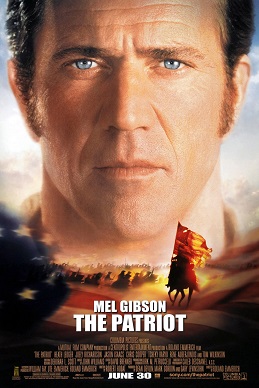
Film Review: The Patriot (dir by Roland Emmerich)


First released in the year 2000, The Patriot stars Mel Gibson (back before the arrests and scandals) as Benjamin Martin.

Benjamin Martin is a planter living in colonial-era South Carolina.  When he was younger, he fought in the French/Indian War and was infamous for his ferocity as a combatant.  However, in the year 1776, he is devoted to working the land and peacefully caring for his children.  When, as a member of the South Carolina General Assembly, he is called upon to cast a vote for or against independence, he abstains.  He’s no fan of the British but he’s also seen the harsh reality of war and doesn’t want his sons to have any part of it.  However, the Assembly still votes for Independence and Martin’s oldest son, Gabriel (Heath Ledger), is among the first to enlist in the army.

Four years later, the British come to the Martin farm and demand that Benjamin had over a wounded Gabriel to them.  When Benjamin resists, the arrogant Col. Tavington (Jason Isaacs) kills one of Benjamin’s other sons.  After Tavington has Gabriel arrested, Benjamin and two of his remaining sons track down the British convoy transporting him.  While his two youngest sons look on in horror, Benjamin savagely shoots and hacks to death all of the British soldiers and rescues Gabriel.

The Patriot may be a film about the American Revolution but it’s also definitely a Mel Gibson film.  That means that Benjamin is man driven as much be revenge as by a desire to win his country’s independence.  The British killed his son and burned down his house.  Benjamin responds by grabbing his musket and packing his axe and soon, it’s more common than not to see Benjamin covered in blood.  Benjamin attacks like a feral beast who is determined to dominate anyone and anything that would invade his territory.  Two of his sons go from being honored to be asked to come along to being terrified at the sight of their father murdering soldier after soldier.  It’s probably the most emotionally honest moment you’ll ever find in a Roland Emmerich film.  Of course, whether Emmerich meant for it to be so is open to debate.

And indeed, it should be noted that The Patriot is very much a Roland Emmerich film.  The running time is an epic 165 minutes.  The battle scenes are long and loud and carefully choreographed.  Gibson was still rugged and handsome when he played Benjamin Martin.  (Both before his downfall and after, Gibson has always been best cast as people who just want to be left alone and who finally snap once it becomes obvious that’s not going to happen.)  Heath Ledger almost appears beatific in his scenes.  The film looks great without ever quite looking authentic.  It’s like a fever dream that is less about how the American Revolution was actually fought and more about how we imagine it was fought.

And you know what?

The film works for me.  This is one of Emmerich’s best films, which admittedly is not a high bar to clear.  Yes, it’s a bit simplistic.  Yes, it’s not historically accurate.  Yes, all of the British are portrayed as being one-dimensional villains.  Who cares?  Whether he realizes it or not, Roland Emmerich has always been a B-movie maker at heart and The Patriot is effective in much the same way that many crude but shameless B-movies are.  The mix of Mel Gibson’s madness, Heath Ledger’s beatific earnestness, and Jason Isaac’s arrogance transforms The Patriot into a triumph of the pulp imagination.  Much like America itself, The Patriot is big and loud and it makes absolutely no apologies.

Film Review: Stargate (dir by Roland Emmerich)


In 1994’s Stargate, James Spader plays Daniel Jackson, a nerdy Egyptologist who is recruited to decipher some hieroglyphics on some ancient stones that are being studied in a secret government facility in Colorado.  Kurt Russell plays Colonel Jack O’Neill, a Special Operations officer who has been suicidal ever since the accidental death of his son.  (He shot himself with Jack’s gun.  Yikes!)

Together …. they solve crimes!

Well, no, not really.  Instead, by deciphering the hieroglyphics, Daniel discovers how to open up a stargate, a wormhole that leads to another planet.  Daniel, Jack, and a group of soldiers go through the stargate to see where it leads.  Daniel is interested in discovering a new world and perhaps coming to understand how the pyramids were built.  Jack just wants to get things over with.  He’s been given a nuclear bomb and told to blow things up if the stargate leads to a hostile world.  Jack doesn’t care if he lives or dies.

That changes once everyone finds themselves on a desert planet where the inhabitants are being exploited by Ra (Jaye Davidson)!  It turns out that Ra actually does exist.  Rather than being the God that the ancient Egyptians believed him to be, Ra is actually an alien who feeds off of the life forces of others.  Every sacrifice that is performed for him allows Ra to extend his life.  When Ra discovers that Daniel and Jack are on the planet and that Jack has a nuclear warhead with him, Ra takes that as a sign of aggression.  He decides to make the warhead even more powerful and send it back through the stargate so that it can blow up the Earth.  Normally, Jack wouldn’t care but fighting for the planet’s oppressed inhabitants has filled him with a renewed purpose.

Stargate is a film that I like almost despite myself.  There’s a lot of reasons why Stargate would seem like the type of film that I would normally dislike.  With the exception of a few films (Starcrash, the Guardians of the Galaxy trilogy), I’m not normally a huge fan of science fiction.  I’m not really a fan of anything that takes place in the desert because I know I would be miserable if I was there.  (Redhead don’t tan, we burn.)  I’m not really a fan of Roland Emmerich as a director.  I’ll never forgive him for Anonymous, which I realize was made decades after Stargate but it was still annoying all the same.

And yet, I do like Stargate.  I like that James Spader gets to play something other than a sinister creep for once.  Nerdy Spader is a very appealing Spader.  I like that Kurt Russell gives a fully committed performance, even if the film itself is somewhat silly.  He doesn’t just go through the motions with his role, that I’m sure the temptation was there to do so.  When Jack is depressed, you believe it.  I like that Jaye Davidson gives an enjoyably bizarre performance as Ra.  (Davidson, who was offered the role after The Crying Game and was shocked when the producers agreed to pay him a million dollars to play Ra, retired from acting after this film.)  I liked the fact that, for once, the aliens truly seemed like aliens as opposed to coming across like stuffy Earthlings in a flying saucer.  And I appreciated that, with this film, Emmerich actually seemed to be having fun with the story as opposed to just stolidly moving the action from one trailer-ready moment to another.

Stargate is silly.  Wow, is it ever silly!  But it’s silly in an enjoyable and entertaining way.  James Spader, Kurt Russell, and Jaye Davidson make the film worth watching.

Late Night Retro Television Reviews: Gun 1.5 “The Hole”


Welcome to Late Night Retro Television Reviews, a feature where we review some of our favorite and least favorite shows of the past!  On Tuesdays, I will be reviewing Gun, an anthology series that ran on ABC for six week in 1997.  The entire show is currently streaming on Tubi!

This week, the gun ends up at the bottom of a swimmin’ hole!

Episode 1.5 “The Hole”

(Dir by Ted Demme, originally aired on May 24th, 1997)

Yep, this episode of Gun centers around an old country swimming hole.  Every day, teenage Sondra (Kirsten Dunst) and her younger brothers, Brendan (Drake Bell) and Tad (Joe Pichler), head down to the Hole.  For Sondra, swimming in the Hole is a chance to escape from her life of living in a trailer park with her trashy mother (Carrie Fisher) and her pervy stepfather (Cliff Bemis).  For Brendan and Tad, going to the Hole is a chance to look for the treasure that they are convinced is at the bottom of the water.  It is true that there is something shiny in the Hole.  Sondra thinks that it might be the diamonds that she could use to finance an escape from the trailer park and a one-way trip down to Florida.  Actually, it’s the pearl-handled gun that’s been at the center of every episode of Gun.

(In this episode, it’s suggested that the gun has been at the bottom of the hole for over a year.  So, how did it end up in that town in the first place?  Is this episode taking place before or after the previous episodes?  I guess the simple solution is that it’s not the same gun as the gun seen in the previous episodes but the part of me that loves continuity is having a hard time accepting that.)

The gun belonged to James Munday (Johnny Whitworth), who has only recently been released from prison.  He was convicted of murdering his girlfriend and only the fact that he was a minor at the time kept him from being given a life sentence.  James claims that his girlfriend died as a part of a failed suicide pact and he’s convinced that the gun in the Hole can prove his innocence.

When James and Sondra meet, it doesn’t take long for them to fall for each other.  Sondra remains James of his dead girlfriend and Sondra, like of all of us, is attracted to brooding rebels.  However, when the rest of the town hears that James has been going to the Hole, a lynch mob is formed.  Dick Sproule (Max Gail), the father of the girl that James was convicted of killing, is soon at the Hole with a rifle in his hands.  Can James prove his innocence and will the town even care?

This episode was extremely overwrought and it featured every flaw that tends to turn me off of anthology shows in general.  All of the characters were broadly drawn.  The dialogue was way overwritten.  Director Ted Demme told the story with a heavy-hand and used slow motion as if he was under the impression that he was the first director to ever consider heightening the drama by slowing things down.  The whole thing just felt like a bad creative writing assignment.  Out of the cast, only Kirsten Dunst was able to really create a character who felt as if she had a life outside of the demands of the story.  Everyone else seemed to be a caricature.  In the end, James may have been a hot, brooding rebel but he was also kind of whiny.  That got old pretty quickly.

*Sigh*  Well, that’s another disappointing episode of Gun for you!  Next week, I’ll be reviewing the series finale.  Hopefully, this show will at least end on a worthwhile note.

Film Review: The Hot Spot (dir by Dennis Hopper)


As befits the title, the 1990 film, The Hot Spot, is all about heat.

There’s the figurative heat that comes from a cast of characters who are obsessed with sex, lies, and murder.  There’s the literal heat that comes from a fire that the film’s “hero” sets in order to distract everyone long enough so that he can get away with robbing a bank.  And, of course, there’s the fact that the film is set in a small Texas town that appears to be the hottest place on Earth.  Every scene in the film appears to be drenched by the sun and, if the characters often seem to take their time from getting from one point to another, that’s because everyone knows better than to rush around when it’s over a hundred degrees in the shade.  As someone who has spent most of her life in Texas, I can tell you that, if nothing else, The Hot Spot captures the feel of what summer is usually like down here.   I’ve often felt that stepping outside during a Texas summer is like stepping into a wall of pure heat.  The Hot Spot takes place on the other side of that wall.

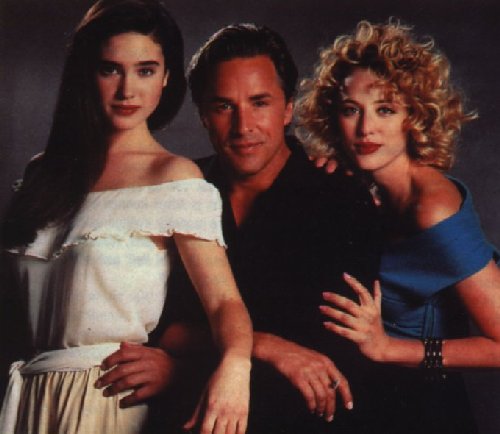
The Hot Spot is a heavily stylized film noir, one in which the the traditional fog and shadows have been replaced by clouds of dust and blinding sunlight.  Harry (Don Johnson) is a drifter who has just rolled into a small Texas town.  Harry’s not too bright but he’s handsome and cocky and who needs to be smart when you’ve got charm?  Harry gets a job selling used cars, though he actually aspires to be a bank robber.  Harry finds himself falling in love with Gloria (Jennifer Connelly), a seemingly innocent accountant who is being blackmailed by the brutish Frank Sutton (William Sadler).  Meanwhile, Harry is also being pursued by his boss’s wife, Dolly (Virginia Madsen), an over-the-top femme fatale who is just as amoral as Harry but who might be a little bit smarter.  Complicating matters is that, while Harry’s trying to rob a bank, he also ends up saving a man’s life.  Only Dolly knows that Harry isn’t the hero that the rest of the town thinks he is.  She tells him that she’ll keep his secret if he does her just one little favor….

The Hot Spot was directed by Dennis Hopper (yes, that Dennis Hopper) and, from the start, it quickly becomes apparent that he’s not really that interested in the film’s story.  Instead, he’s more interested in exploring the increasingly surreal world in which Harry has found himself.  The Hot Spot plays out at a languid pace, which allows Hopper to focus on his cast of small-town eccentrics.  (My particular favorite was Jack Nance as the alcoholic bank president who also doubles as the town’s volunteer fire marshal.)  The film is so hyper stylized that it’s hard not to suspect that every character — with the possible exception of Harry — understands that they’re only characters in a film noir.  For instance, is Dolly really the over-the-top femme fatale that she presents herself as being or is she just a frustrated housewife playing a role?  Is Gloria really an innocent caught up in a blackmail scheme or is she just smart enough to realize that the rules of noir requires her to appear to be Dolly’s opposite?  And is Harry being manipulated or is he allowing himself to be manipulated because, deep down, he understands that’s his destiny as a handsome but dumb drifter in a small town?  Do any of the characters really have any control over their choices and their actions or has everyone’s fate been predetermined by virtue of them being characters in a film noir?  In the end, The Hot Spot is more than just a traditional noir.  It’s also a study of why the genre has endured.

It’s a long and, at times, slow movie, one that plays out at its own peculiar pace.  As a result, some people will be bored out of their mind.  But if you can tap into the film surreal worldview and adjust to the languid style, The Hot Spot is a frequently entertaining and, at times, rather sardonic slice of Texas noir.

Playing Catch-Up: Autumn in New York, Griffin & Phoenix, Harry & Son, The Life of David Gale


So, this year I am making a sincere effort to review every film that I see.  I know I say that every year but this time, I really mean it.

So, in an effort to catch up, here are four quick reviews of some of the movies that I watched over the past few weeks!

  • Autumn in New York
  • Released: 2000
  • Directed by Joan Chen
  • Starring Richard Gere, Winona Ryder, Anthony LaPaglia, Elaine Stritch, Vera Farmiga, Sherry Stringfield, Jill Hennessy, J.K. Simmons, Sam Trammell, Mary Beth Hurt

Richard Gere is Will, a fabulously wealthy New Yorker, who has had many girlfriends but who has never been able to find the one.  He owns a restaurant and appears on the cover of New York Magazine.  He loves food because, according to him, “Food is the only beautiful thing that truly nourishes.”

Winona Ryder is Charlotte, a hat designer who is always happy and cheerful and full of life.  She’s the type who dresses up like Emily Dickinson for Christmas and recites poetry to children, though you get the feeling that, if they ever somehow met in real life, Emily would probably get annoyed with Charlotte fairly quickly.  Actually, Charlotte might soon get to meet  Emily because she has one of those rare diseases that kills you in a year while still allowing you to look healthy and beautiful.

One night, Will and Charlotte meet and, together, they solve crimes!

No, actually, they fall in love.  This is one of those films where a young woman teaches an old man how to live again but then promptly dies so it’s not like he actually has to make a huge commitment or anything.  The film does, at least, acknowledge that Will is a lot older than Charlotte but it still doesn’t make it any less weird that Charlotte would want to spend her last year on Earth dealing with a self-centered, emotionally remote man who is old enough to be her father.  (To be honest, when it was revealed that Charlotte was the daughter of a woman who Will had previously dated, I was briefly worried that Autumn in New York was going to take an even stranger turn….)

On the positive side, the films features some pretty shots of New York and there is actually a pretty nice subplot, in which Will tries to connect with the daughter (Vera Farmiga) that he never knew he had.  Maybe if Farmiga and Ryder had switched roles, Autumn in New York would have worked out better.

  • Griffin & Phoenix
  • Released: 2006
  • Directed by Ed Stone
  • Starring Dermot Mulroney, Amanda Peet, Blair Brown, and Sarah Paulson

His name is Henry Griffin (Dermot Mulroney).

Her name is Sarah Phoenix (Amanda Peet).

Because they both have highly symbolic last names, we know that they’re meant to be together.

They both have cancer.  They’ve both been given a year to live.  Of course, they don’t realize that when they first meet and fall in love.  In fact, when Phoenix comes across several books that Griffin has purchased about dealing with being terminally ill, she assumes that Griffin bought them to try to fool her into falling in love with him.  Once they realize that they only have a year to be together, Griffin and Phoenix set out to make every moment count…

It’s a sweet-natured and unabashedly sentimental movie but, unfortunately, Dermot Mulroney and Amanda Peet have little romantic chemistry and the film is never quite as successful at inspiring tears as it should be.  When Mulroney finally allows himself to get mad and deals with his anger by vandalizing a bunch of cars, it’s not a cathartic moment.  Instead, you just find yourself wondering how Mulroney could so easily get away with destroying a stranger’s windshield in broad daylight.

  • Harry & Son
  • Released: 1986
  • Directed by Paul Newman
  • Starring Paul Newman, Robby Benson, Ellen Barkin, Wilford Brimley, Judith Ivey, Ossie Davis, Morgan Freeman, Katherine Borowitz, Maury Chaykin, Joanne Woodward

Morgan Freeman makes an early film appearance in Harry & Son, though his role is a tiny one.  He plays a factory foreman named Siemanowski who, in quick order, gets angry with and then fires a new employee named Howard Keach (Robby Benson).  Howard is the son in Harry & Son and he’s such an annoying character that you’re happy when Freeman shows up and starts yelling at the little twit.  As I said, Freeman’s role is a small one.  Freeman’s only on screen for a few minutes.  But, in that time, he calls Howard an idiot and it’s hard not to feel that he has a point.

Of course, the problem is that we’re not supposed to view Howard as being an idiot.  Instead, we’re supposed to be on Howard’s side.  Howard has ambitions to be the next Ernest Hemingway.  However, his blue-collar father, Harry (Paul Newman, who also directed), demands that Howard get a job.  Maybe, like us, he realizes how silly Howard looks whenever he gets hunched over his typewriter.  (Robby Benson tries to pull off these “deep thought” facial expressions that simply have to be seen to be believed.)  There’s actually two problems with Howard.  First off, we never believe that he could possibly come up with anything worth reading.  Secondly, it’s impossible to believe that Paul Newman could ever be the father of such an annoying little creep.

Harry, of course, has problems of his own.  He’s just lost his construction job.  He’s having to deal with the fact that he’s getting older.  Fortunately, his son introduces him to a nymphomaniac (Judith Ivey).  Eventually, it all ends with moments of triumph and tragedy, as these things often do.

As always, Newman is believable as a blue-collar guy who believes in hard work and cold beer.  The film actually gets off to a good start, with Newman using a wrecking ball to take down an old building.  But then Robby Benson shows up, hunched over that typewriter, and the film just becomes unbearable.  At least Morgan Freeman’s around to yell at the annoying little jerk.

  • The Life of David Gale
  • Released: 2003
  • Directed by Alan Parker
  • Starring Kevin Spacey, Kate Winslet, Laura Linney, Gabriel Mann, Rhona Mitra, Leon Rippy, Matt Craven, Jim Beaver, Melissa McCarthy

For the record, while I won’t shed any tears whenever Dzhokahr Tsarnaev is finally executed, I’m against the death penalty.  I think that once we accept the idea that the state has the right to execute people, it becomes a lot easier to accept the idea that the state has the right to do a lot of other things.  Plus, there’s always the danger of innocent people being sent to die.  The Life of David Gale also claims to be against the death penalty but it’s so obnoxious and self-righteous that I doubt it changed anyone’s mind.

David Gale (Kevin Spacey) used to the head of the philosophy department at the University of Texas.  He used to be a nationally renowned activist against the death penalty.  But then he was arrested for and convicted of the murder of another activist, Constance Harraway (Laura Linney) and now David Gale is sitting on death row himself.  With his execution approaching, journalist Bitsey Bloom (Kate Winslet) is convinced that Gale was framed and she finds herself racing against time to prevent Texas from executing an innocent man…

There’s a lot of things wrong with The Life of David Gale.  First off, it was made during the Bush administration, so the whole film is basically just a hate letter to the state of Texas.  Never have I heard so many inauthentic accents in one film.  Secondly, only in a truly bad movie, can someone have a name like Bitsey Bloom.  Third, the whole film ends with this big twist that makes absolutely no sense and which nearly inspired me to throw a shoe at the TV.

Of course, the main problem with the film is that we’re asked to sympathize with a character played by Kevin Spacey.  Even before Kevin Spacey was revealed to be a sleazy perv, he was never a particularly sympathetic or really even that versatile of an actor.  (Both American Beauty and House of Cards tried to disguise this fact by surrounding him with cartoonish caricatures.)  Spacey’s so snarky and condescending as Gale that, even if he is innocent of murder, it’s hard not to feel that maybe David Gale should be executed for crimes against likability.

A Movie A Day #94: Eye of the Storm (1991, directed by Yuri Zeltser)


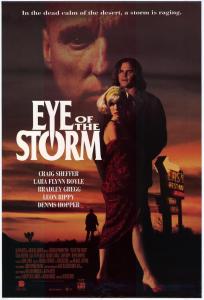
A motel sits off of a highway in the Nevada desert.  One night, two criminals (Ally Walker and German boxer Wilhelm von Homburg) brutally murder the husband and wife who own the motel.  Their youngest son, Steven, flees the criminals by jumping through a window and is left for dead.
Ten years later, the motel is still sitting off the highway, operated by the blind Steven (Bradley Gregg) and his older brother, Ray (Craig Sheffer).  Ray is very protective of his brother and, when a car pulls up to the motel, he does not even want to turn on the vacancy sign.

The motel’s newest guests are a very unlikely couple.  Marvin Gladstone (Dennis Hopper) is an alcoholic gambler who regularly berates at his much younger trophy wife, Sandra (Lara Flynn Boyle).  Marvin and Sandra were heading to Las Vegas to renew their vows but the drunk Marvin accidentally drove their car off the road.  Now, Marvin and Sandra are stranded at the motel while a dust storm approaches and one of the brothers turns out to be psychotic.

Eye of the Storm is another low-budget and predictable thriller from the 1990s but, taken on its own terms, it’s not bad.  Along with some striking shots of the desert, Eye of the Storm features a quartet of strong performances.  For fans of David Lynch, the main interest here will be seeing Blue Velvet‘s Dennis Hopper and Twin Peaks‘s Lara Flynn Boyle as a couple in trouble.  Hopper especially seems to be enjoying himself and when his character leaves the movie, Eye of the Storm becomes much less interesting.  Lara Flynn Boyle is sexy throughout, enough to make you reconsider everything you thought you knew about Donna Hayward.

See this one on a double bill with Red Rock West.

Lisa Cleans Out Her DVR: The Arrival (dir by David Twohy)


I recorded The Arrival off of Cinemax on March 3rd.  Having just watched it, I am 95% sure that it is not the same movie as the Arrival that I saw in theaters last fall.

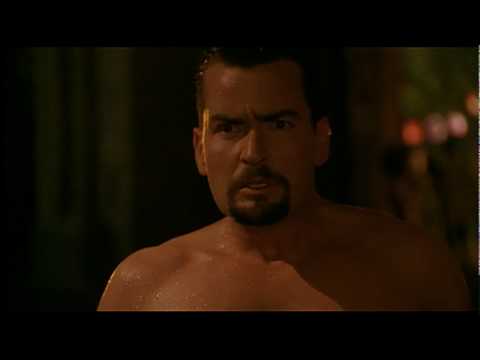
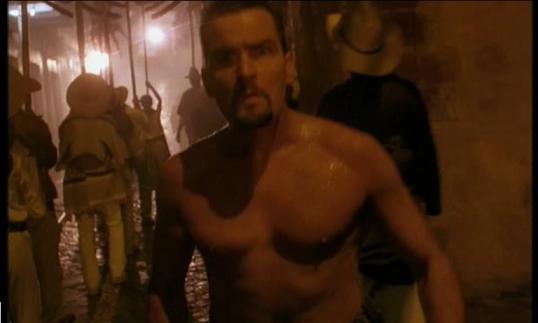
It’s true that both films deal with the arrival of aliens and feature scenes that take place in space ships.  And it’s also true that both films involve scientists trying to figure out what the aliens want.  However, The Arrival that I recorded featured far more of Charlie Sheen than I remembered being in the Arrival that I saw in theaters.  Amy Adams and Jeremy Renner were nowhere to be seen but Charlie Sheen was all over the freaking place.

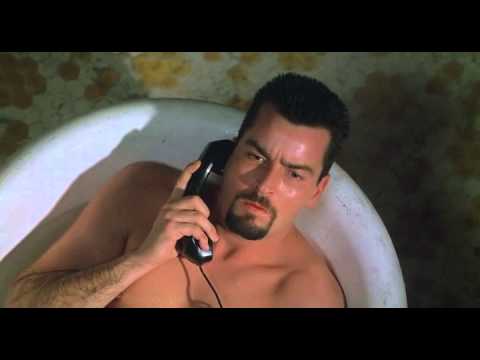
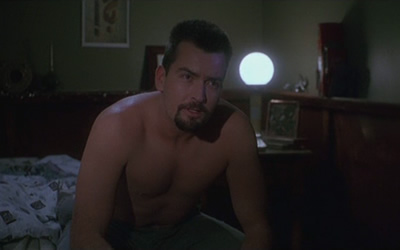
And I mean all of Charlie Sheen.  The Arrival was made back in 1996 and I guess that Charlie Sheen was still working out back then because, seriously, he is either naked or, at the very least, shirtless for the majority of the movie.  What’s funny is that, with a few minor exceptions, there’s rarely a reason for him to be naked.  I guess someone just said, “We might as well record Charlie Sheen looking fit and healthy while we still can…”

The Arrival is a relatively serious movie.  Oh, it has moments of humor but it’s all Hollywood blockbuster humor.  It’s not a comedy by any means.  It’s always strange seeing Charlie Sheen in a serious role because … well, he’s Charlie Sheen.  Plus, he was never a particularly good dramatic actor.  He walks through The Arrival with this grim look frozen on his face and that, combined with his muscular chest, makes him look like a killer robot from the future.  You keep waiting for Charlie to say, “I’ll be back.”

Of course, Charlie Sheen isn’t playing a killer robot.  He’s playing Zane Zaminsky, an astronomer who works for the government.  Or, at least, he did work for the government until he detected an alien signal coming from a nearby star.  He’s fired and blackballed by his boss, Phil (Ron Silver).  Unable to get work, Zane does what anyone would do.  He and Kiki (Tony T. Johnson), the streetwise neighbor kid, set up a DIY astronomy lab in his basement.

At least, that’s what I think he did.  I kind of had a hard time following The Arrival‘s plot.  It all seemed a little bit overcomplicated, especially when savvy viewers will have already guessed that 1) the aliens are real, 2) Phil is an alien, 3) there’s a big government conspiracy involved, 4) and Zane has stumbled across it.

What are the aliens doing on the planet?  To figure that out, Zane’s going to have to go to Mexico and meet with climatologist Illana Green (Lindsay Crouse).  However, we already know what the aliens are  doing.  They’re attempting to destroy the environment so that they can wipe out humanity.  We know this because that’s what aliens are always trying to do!  They’re always either trying to save the environment or destroy it.  My personal theory is that Bill Nye, The Science Guy is actually an alien.  It explains a lot.

Anyway, it may sound like I’m criticizing The Arrival but it was actually kind of a fun movie in its dumb way.  It’s a serious movie but it’s also kind of a silly movie.  Any film that features Charlie Sheen as anyone other than Charlie Sheen is going to be watchable just on a WTF sort of level.  Beyond that, Ron Silver makes for a rather convincing alien and director David Twohy keeps the action moving quickly.  Several of Twohy’s shots are memorably atmospheric, even if they often do feature a bearded and naked Charlie Sheen.

Is The Arrival as good as Arrival?  HELL NO!  Arrival is one of the greatest science fiction films ever made.  The Arrival is a rather minor sci-fi melodrama but it’s fun nonetheless.  Just don’t expect it to make any sense.  To quote the bard, John Lennon, “Turn off your mind, relax, and float downstream.”

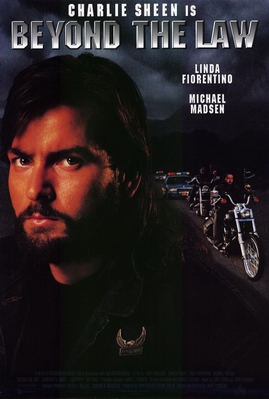
Insomnia File #12: Beyond The Law (dir by Larry Ferguson)


What’s an Insomnia File? You know how some times you just can’t get any sleep and, at about three in the morning, you’ll find yourself watching whatever you can find on cable? This feature is all about those insomnia-inspired discoveries!

Beyond_the_Law_(1992_film)_poster

Last night, if you were awake at one in the morning, you could have turned on FLIX and watched the 1993 film Beyond The Law.

Now, you may look at the title and think to yourself, “That movie sounds way too generic for anyone to watch.”  And, to a certain extent, you’re right.  Based, so the narrated epilogue insists, on a true story, Beyond The Law is about a troubled cop who goes undercover and joins a biker gang.  After gaining the trust and friendship of the gang’s ruthless leader, the cop struggles to maintain a between order and chaos.  Sometimes, he succeeds.  Sometimes, he doesn’t.  Largely, his success is dependent on whatever the narrative requires at the moment.

It’s totally predictable but, at the same time, it’s hard not to watch.  When a film starts with an Indian shaman telling Charlie Sheen that his dark side is going to destroy him, how can you not keep watching?

That’s right … the undercover cop is played by Charlie Sheen.  Fortunately, since Beyond the Law was made in 1993, we’re talking about the sexy and dangerous Charlie Sheen who showed up at the end of Ferris Bueller’s Day Off and not the sad and bloated Charlie Sheen who co-starred on Two And A Half Men.

Charlie’s a deputy in Arizona who, as a result of his traumatic childhood, has a violent temper.  After he gets into a fist fight with another deputy (played by Rip Torn), he is told that he can either quit the force or he can go undercover.  He chooses to go undercover.  Fortunately, he knows an informant (Leon Rippy) who can teach him how to pass for a biker.  The informant’s nickname is Dildo (no, really) but later, we find out that his given name is Virgil.  And he’s Charlie’s guide through the Hell of the Arizona underworld, just as another Virgil led Dante through another Hell…

Yes, it’s totally heavy-handed but somehow, it’s appropriate.  The title may be generic but, within the first 30 minutes of the film, Beyond the Law gives us Indian wisdom, strange flashbacks, references to Dante, a guy named Dildo, and Charlie Sheen.  But that’s not all!  Beyond the Law also has Michael Madsen!

Michael Madsen plays Blood, the leader of the biker gang that Charlie has to infiltrate. And he gives a classic Michael Madsen performance, full of random squints, arched eyebrows, menacing pauses in the middle of dialogue, and that famous Michael Madsen half-smirk.  Predictable as its plot may be, Beyond The Law is your only chance to see Charlie Sheen and Michael Madsen compete to see who can chew the most scenery.  Charlie does his crazy eyes.  Madsen does his half-smirk.  In the end, I would say that Madsen wins.

Charlie also ends up having a relationship with an photojournalist (Linda Fiorentino).  Before going undercover, he gave her a speeding ticket and, when they later meet at a biker gathering, she immediately recognizes him but keeps his secret.  She doesn’t really get to do much in the film but I still liked the character because she was tough and she was the only person in the film who could outsmirk Michael Madsen.

Beyond The Law is nothing special but it’s worth watching just for the chance to see Michael Madsen and Charlie Sheen acting opposite each other.

Previous Insomnia Files:

  1. Story of Mankind
  2. Stag
  3. Love Is A Gun
  4. Nina Takes A Lover
  5. Black Ice
  6. Frogs For Snakes
  7. Fair Game
  8. From The Hip
  9. Born Killers
  10. Eye For An Eye
  11. Summer Catch


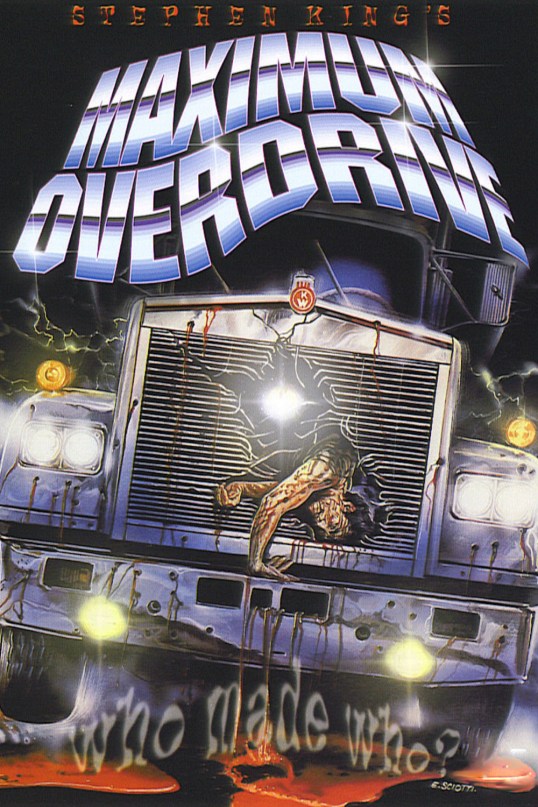
Icarus File No. 2: Maximum Overdrive (dir by Steven King)


mo

There is exactly one effective sequence to be found in Maximum Overdrive, a horror film from 1986 that attempts to show us what would happen if all of Earth’s machines decided to destroy humanity.

It takes place at the end of a little league game.  The coach, happy that his team has won, declares soda for everyone!  He walks over to the soft drink machine and puts in his coins and…nothing happens.  The coach stares at the machine perplexed.  His team gathers around him.

Suddenly, a can flies out of the machine and hits the coach in the groin.  Coach falls to his knees, just to get another can driven straight into his skull, leaving him with a big bloody hole in his head.  As the coach twitches, his teams starts to run away.  Suddenly, the machine is shooting cans out at them.  Some of the kids escape but quite a few don’t.

Suddenly, as the kids flee, a driverless steamroller crashes through a fence and drives across the field, graphically flattening one of the players…

It’s over-the-top, it’s kind of scary, it’s fun in a naughty sort of way, and it’s exciting to watch.  It’s totally absurd and yet it’s effective at the same time.  It’s a really brilliant scene, one that hints at what Maximum Overdrive could have been.  It hints that Maximum Overdrive‘s first-time director did have some potential and watching it, one is tempted to feel a pang of regret over the fact that he never directed another film after this one.

However, then you watch the rest of Maximum Overdrive and you realize that one effective scene was a total fluke.  To your horror, you realize that this film’s director (and screenwriter) has decided to set nearly the entire film in the ugliest and most disgusting truck stop in the world.  You realize that the director has no idea how to maintain suspense and that his idea of horror appears to be having a lot of trucks constantly circling the truck stop.  And then, worst of all, you realize that the unlikable caricatures inside the truck stop are meant to be our heroes!

And you find yourself wondering if things could possibly get any worse.  Well, believe me — they can.

First off, a guy named Camp Loman (Christopher Murney) shows up and reveals himself to be a total lech and then starts trying to sell bibles and really, what do you expect from someone named Camp Loman?  And, what’s annoying, is that the film’s director seems to think that he’s blowing our mind by presenting us with an hypocritical bible salesman.  I mean, seriously — the amount of time devoted to Camp Loman will make you nostalgic for scenes of a steamroller crushing a child.

And then Emilio Estevez shows up as our hero but he scowls through the entire movie and delivers all of his lines through gritted teeth, as if he’s pissed off about appearing in Maximum Overdrive and really, who can blame him?  That said, it doesn’t really make for an enjoyable performance.

But hey — Emilio’s not the only person in the truck stop.  There’s also Pat Hingle, playing the owner of the truck stop.  He’s overweight, wears a tie, smokes a cigar, and speaks with a vaguely Southern accent.  Hmmmmm, do you think he’s going to be a bad guy?

Oh!  And let’s not forget the waitress played by Ellen McElduff.  “WE MADE YOU!” she shouts at the machines and then she shouts it again and again and again and again and it’s almost as if the film is being directed by a guy so in love with his own dialogue that he doesn’t realize how annoying the same line gets when it’s screeched over and over again.

And I haven’t even gotten to the helium-voiced newlyweds yet…

When I recently watched Maximum Overdrive on Encore, there were a lot of things that annoyed me, such as the bad pacing, the bad acting, the bad dialogue, the bad special effects, the bad cinematography, and the bad everything else.  But what really got to me was just how inconsistent this movie was.  Some machines turned into killers but oddly, others did not.  At one point, a machine gun starts shooting at the people in the truck stop but the weapons that Pat Hingle keeps in the truck stop never turn on their human masters.  Seriously, if you’re going to make a terrible movie, at least be consistent.

So, you may be asking, why is this an Icarus File?  Well, it was directed by Stephen King, the writer who is routinely called the “master of horror.”  King may be a great writer but, judging from this movie, he was a really crappy director.  I imagine, when the film was in pre-production, the logic was that if King could write a scary book then he could definitely direct a scary movie.

Nope.

It turns out that, just as Icarus should never have gotten so close to the sun, Stephen King should never have directed a movie.

Previous Icarus Files:

  1. Cloud Atlas