“If it weren’t for poverty, half of these people wouldn’t be sick.” — Dr. Kyojo Niide
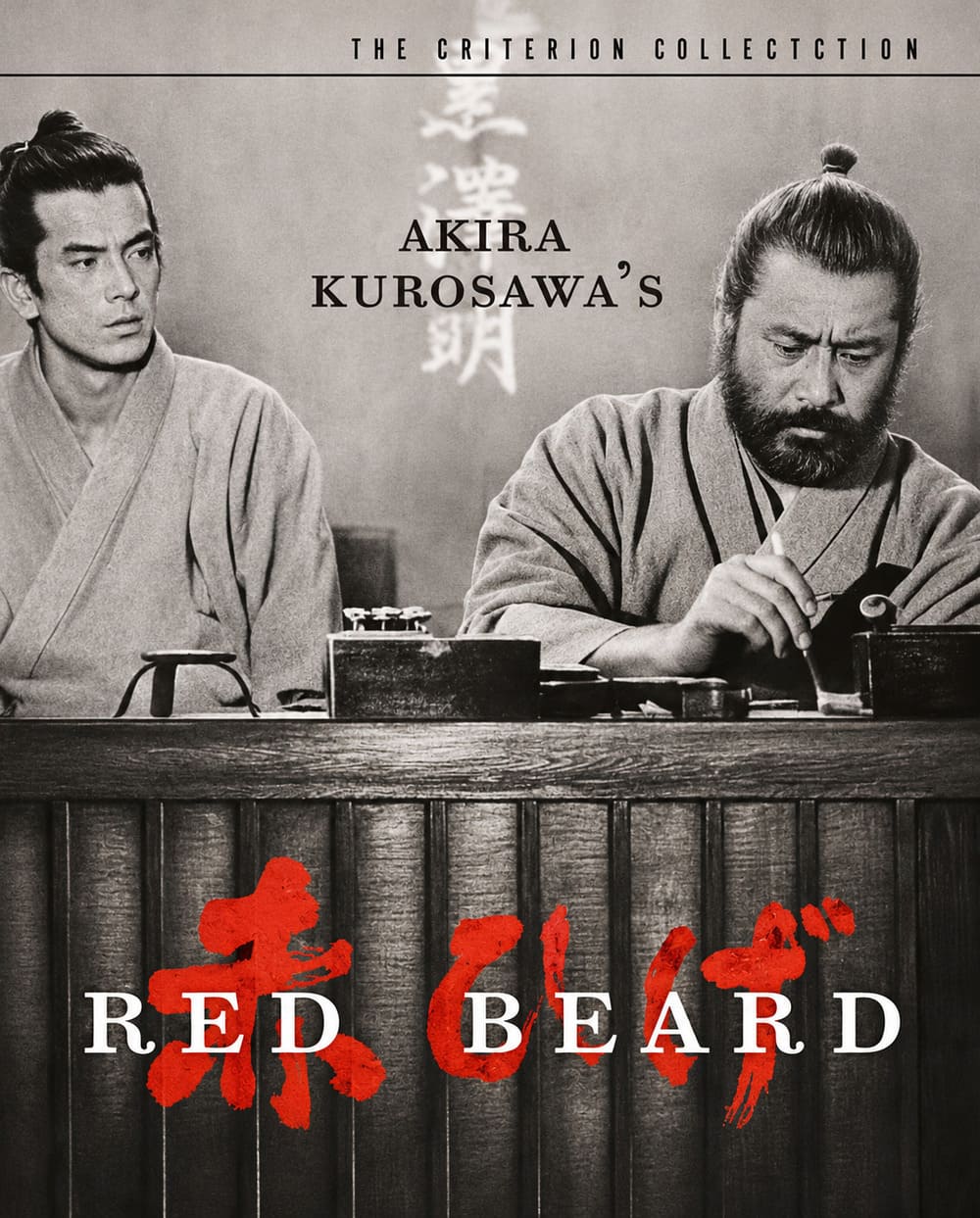
There are plenty of movies about learning to become a better person, but few make the process feel as demanding, messy, and worthwhile as Akira Kurosawa’s Red Beard (1965). Set largely inside a clinic for the poor in nineteenth-century Japan, it turns medical training into an education in how to look at other people. That might sound like a prescription for three hours of worthy speeches. Thankfully, Kurosawa has something livelier in mind: a sprawling drama full of bruised pride, frightening encounters, unexpected humor, and compassion that actually requires work. It is deeply sentimental, certainly, but rarely soft about what suffering does to people.
The film also carries the weight of a farewell. Red Beard was the sixteenth and final collaboration between Kurosawa and Toshiro Mifune, and Kurosawa’s last black-and-white feature. After the restless energy of their earlier work together, there is something moving about seeing Mifune become the still center of such an expansive film. Their partnership ends not with a swordsman riding away, but with a doctor continuing his rounds. Whatever happened outside the frame, the artistic relationship reaches an unusually fitting conclusion here: Mifune’s immense authority becomes a force that helps everyone else find their footing.
Despite the title, our entry point is not Mifune’s Dr. Kyojo Niide, nicknamed Red Beard, but Noboru Yasumoto, played by Yuzo Kayama. Fresh from studying Dutch medicine in Nagasaki, Yasumoto expects a prestigious career serving the powerful. Instead, he finds himself assigned to a clinic whose patients offer little money and absolutely no social advantage. He treats the posting like an administrative insult. His refusal to wear the clinic’s uniform is a particularly revealing bit of rebellion: before he has properly met these people, he has already decided that caring for them is beneath him.
Kayama makes that arrogance believable without turning Yasumoto into an unbearable little monster. His stiffness and wounded vanity suggest someone whose entire understanding of success has suddenly become useless. More importantly, his eventual change is gradual. Kurosawa does not arrange one inspirational conversation and declare the young man cured of selfishness. Yasumoto has to sit beside dying patients, listen to stories he would previously have dismissed, and discover how little his qualifications prepare him for another person’s fear. The movie’s length becomes part of its argument. An education like this cannot happen on a convenient schedule.
Mifune, meanwhile, gives a performance built around restraint rather than display. Red Beard is intimidating, sometimes brusque, and not especially interested in making himself likable. But Mifune lets concern register beneath the severity without constantly advertising it. A pause or a shift in attention can tell us more than a reassuring speech would. The character risks becoming an impossibly wise father figure, yet his practical manner gives the idealism some weight. This is not a man floating above ordinary problems. He has a clinic to run, vulnerable people to protect, and limited patience for anyone confusing professional status with actual usefulness.
One of the film’s smartest decisions is allowing the clinic to become more interesting than the relationship that initially organizes it. Patients, cooks, attendants, and doctors gradually fill out a community rather than remaining background figures in Yasumoto’s personal development. The work of keeping people alive involves food, cleaning, conversation, and watchfulness as much as medical knowledge. That gives the film’s humanism a welcome material basis. Compassion is not simply something the good characters feel. It is something people do together, often repetitively, without much recognition. The clinic functions because care circulates through it instead of belonging exclusively to its commanding doctor.
Kurosawa’s visual organization makes that communal life tangible. The widescreen compositions give rooms a remarkable sense of social geography: someone listening at the edge of a scene can matter as much as the person speaking. Doorways, partitions, and stretches of floor separate characters while keeping their relationships visible. Even when the camera stays relatively still, the image feels active because bodies and glances keep rearranging its emphasis. This is handsome filmmaking, but the beauty is not merely decorative. Kurosawa makes us notice who occupies a space, who remains outside it, and how the distance between people can gradually close.
The episodic structure can initially feel like a detour from the main story. Sahachi’s account of his marriage, in particular, expands into a substantial tragedy of its own. Yet that apparent interruption is central to what the film asks of Yasumoto and the audience. A patient is not just the illness currently occupying a bed. He has an entire life that the young doctor knows nothing about. Tsutomu Yamazaki gives Sahachi’s generosity an underlying ache, and the extended flashback allows that generosity to become something more complicated than saintliness. Listening becomes a form of recognition, not simply a useful bedside skill.
The emotional center, though, is Otoyo, a traumatized girl rescued from a brothel and brought to the clinic. Terumi Niki’s performance is remarkable because it does not make her character’s pain conveniently appealing. Otoyo is suspicious, defensive, and unable to accept kindness on command. Her resistance gives the film some of its hardest moments. Yasumoto cannot simply apply his newly developing goodness and expect gratitude. He has to keep showing up without controlling the response. When the direction of care eventually reverses and she tends to him, their relationship becomes reciprocal rather than a flattering portrait of a rescuer and his grateful patient.
There is also a wonderfully strange interruption in which Red Beard deals with the men trying to prevent Otoyo’s rescue by demonstrating an alarming command of anatomy. Suddenly, the medical drama has made room for a Mifune action sequence. It is satisfying, funny, and arguably too easy: a complicated world briefly becomes a problem that the strongest good man can solve with his hands. The doctor’s subsequent regret does not entirely erase that contradiction. Still, the tonal jolt has personality. Kurosawa lets us enjoy the spectacle, then reminds us that breaking bodies is an awkward accomplishment for someone devoted to healing them.
Not every element lands quite as gracefully. The dangerous patient known as the Mantis brings a charged, almost horror-like atmosphere, but her presentation can feel more sensational than searching. Elsewhere, the accumulation of suffering sometimes makes Kurosawa’s emotional intentions very visible. This is not a film that worries much about appearing restrained or fashionable. It wants to move you, and occasionally you can feel it pushing. Yet the strongest passages earn that pressure through patient attention. By the time the clinic’s women call a desperately ill boy’s name into a well, the gesture feels less like manufactured uplift than a community refusing to surrender one of its own.
What ultimately makes Red Beard so affecting is that its optimism survives an honest acknowledgment of limits. The clinic cannot abolish poverty, undo exploitation, or prevent every death. Being decent does not grant anyone control over the outcome. What it can change is whether another person faces suffering alone. That is a modest proposition expressed on a grand cinematic scale, and the tension gives the film its staying power. As a final Kurosawa–Mifune collaboration, it is magnificent; as a drama about learning to care, it remains challenging rather than merely comforting. You leave impressed by the filmmaking, but also slightly embarrassed by your own impatience.
Kurosawa-Mifune Collaborations

