by Walter DeMaris
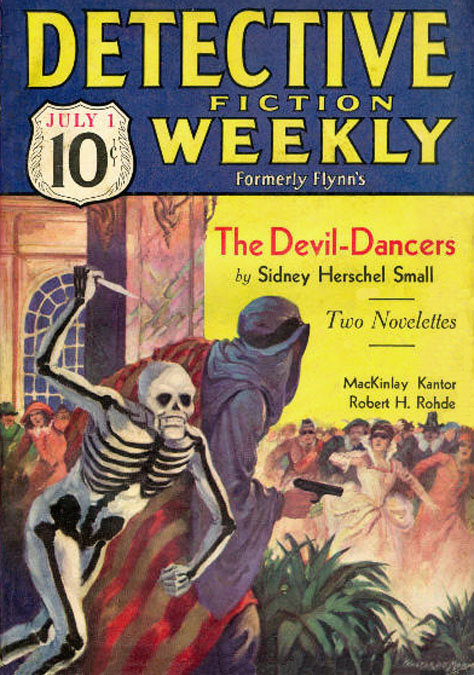
This cover is from 1933.
by Walter DeMaris
This cover is from 1933.
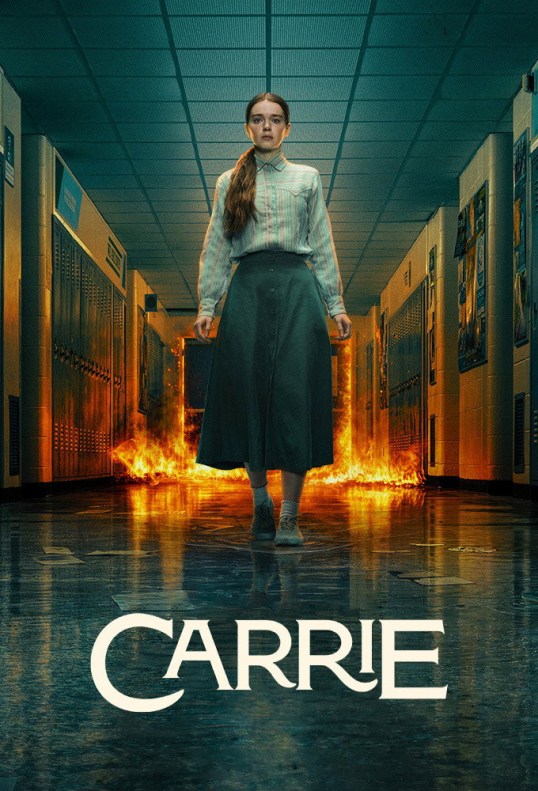
If I had to choose two words to describe Mike Flanagan’s “reimagining” of Carrie, they would probably be “fan fiction.”
In fact, it’s sometimes humorous just how obviously this miniseries is a work of fan fiction. Carrie White (blandly played by Summer Howell) may be a bullied and sheltered girl with telekinetic powers, but now she has a best friend, Emaline (an equally bland Thalia Dudek, who looks less like a 2026 teenager and more like the bassist in a 1990s riot grrrl band), who also has a power and always has the best advice and the snarkiest comebacks! What would Carrie do without her best friend Emaline? And while Margaret White (Samantha Sloyan) is still present as an overprotective and paranoid force in Carrie’s life, there’s now another maternal figure named Adelaide (Kate Siegel) who exists to talk about how those with secret powers are always being held down by a society that’s just not capable of accepting how important they are. Adelaide opens each episode with a monologue that feels like it was written by a 2017 college freshman who has just watched Linda Sarsour on YouTube. Watching the miniseries, one gets the feeling that Flanagan and his writers really wanted to make a show called Emaline and Adelaide and decided to graft them onto Carrie.
Ever since this miniseries was announced, there’s been a lot of talk about how Flanagan has updated the story. In this case, that means there’s an emphasis on phones and social media, as if teenagers couldn’t find a way to hurt each other even before technology caught up with them. In fact, social media is pretty much to blame for everything that happened. The audience is meant to violently roll their eyes at Margaret White for believing in conspiracy theories and religion while, at the same time, accepting a portrayal of the dangers of social media that makes Aaron Sorkin look even-handed and calm. One gets the feeling that if this show had been made just a few years earlier, it would have found a way to blame Margaret White and Chris Hargensen for the January 6th riots. There is a riot in the sixth episode, but it just involves all of the students doing a massive walkout to protest Chris Hargensen’s secret Instagram account. “Death to Hargensen!” the students chant, and it briefly seems like maybe Flanagan is going to make a bigger point about how the bullies can become the bullied, but ultimately, this is too much of a work of fan fiction to delve too deeply into anything that complex. It’s also too much of a work of the streaming era to introduce an idea that can’t be neatly summed up in 15 seconds.
Yes, this is a new version of Carrie. If King’s novel and De Palma’s film gave us a Carrie White who was never happy until that one prom night and who lashed out after that happiness was stolen from her, the Mike Flanagan miniseries gives us a Carrie who becomes the most popular girl in school even before prom night. No longer does Tommy (Joel Oulette) ask Carrie to prom as a favor to his guilt-ridden girlfriend, Sue Snell (Siena Agudong). Instead, he asks Carrie as a friend. Carrie’s no longer sheltered and shy. Instead, she’s somewhat smug and annoying. She sneaks out of the house many times before prom night. She goes to a party. She goes to the junkyard and curses like a sailor while showing off her powers. Her best friend Emaline is impressed. What would Carrie do without her best friend, Emaline? Of course, by changing all of this, Flanagan robs the story of all of its emotional power. This is probably the first version of Carrie where I’ve actually found myself getting annoyed with Carrie as a character. Towards the end of the miniseries, she just becomes so smug and self-righteous, like the girl at school who used to sweetly pull you aside to tell you that your skirt was too short. This is a version of the story that lets Carrie off the hook. Emaline is the one who suggests that she use her powers to get revenge. Adelaide and her dumbass cult are the ones who accidentally set fire to the school. Carrie dances in the street with Emaline and, for a few seconds, you actually find yourself wishing for the calming hand of Ryan Murphy.
Yes, I know that Stephen King has endorsed Mike Flanagan’s changes. That doesn’t mean that I have to. The fact of the matter is that Stephen King has consistently shown that he will endorse just about anything, and it’s also been a while since King has written anything that can match the power of his earlier work. There’s a world of difference between the youngish and struggling writer who originally wrote Carrie and the wealthy boomer who is now probably better known for his angry tweets than his more recent literary output. As well, it’s obvious that King likes Flanagan. Flanagan is the ultimate fan. And yet, considering that Flanagan’s best film, Hush, was also his simplest, one can’t help but feel that Flanagan would do well to stop adapting his heroes and maybe just try to focus on creating unapologetic suspense.
It’s the curse of elevated horror. Right now, the critics who hate entertaining horror love slow-moving elevated horror. They go on and on about the subtext, as if there wasn’t subtext to be found in the horror movies that were made in the past. The truth of the matter is that the subtext is usually the least interesting thing about these films and series. Making a film or a show that is critical of capitalism and religion is hardly the radical act that the critics seem to think it is. There’s nothing particularly interesting or special to be found between the lines when it comes to this version of Carrie. Indeed, for all the time and effort that the series puts into villainizing Margaret White and Chris Hargensen, they’re ultimately the most interesting characters because Samantha Sloyan and Alison Thornton are the only two performers who are allowed to break free from the show’s rigid ideological structure. (Samantha Sloyan especially deserves a lot of credit for finding a hint of reality in her portrayal of Margaret.) Chris and Margaret are compelling because they’re the only characters who don’t just parrot the accepted lines and the accepted thinking. They’re the only characters who seem to have a life and an outlook that was formed by something other than the demands of the show. We’re meant to shake our heads when Margaret becomes an online celebrity with a podcast, but instead, we’re interested and almost happy for her because Margaret is actually doing something unexpected and making an effort to take actual control of her life. It’s hard not to feel that this version of Margaret White deserved a better ending than what the show gave her. In the end, Margaret feels less like a villain and more like a victim of the show’s writers and their own feelings about religion and politics. (One wonders if the writers realize that their show ultimately makes the case that all of the tragedy could have been avoided if the government had simply stayed out of it and just allowed Margaret to continue to homeschool her daughter.) If previous versions of Carrie seemed to be designed to appeal to shy outsiders, this version of Carrie is designed to compliment self-styled victims who don’t have the self-awareness necessary to realize that they are now the bullies.
In the end, Carrie feels like a forgotten Showtime series from 2018 and, if it had been made by anyone other than Mike Flanagan, no one would care.
Previous Icarus Files:
 Returning home from his latest adventure, Hercules (Reg Park) and his sidekick, Theseus (George Ardisson), are shocked to find their home city has fallen victim to a plague that puts its victims in a trance-like state. The woman that Hercules loves, Deianira (Leonara Ruffo), is one of the victims and, since she was also the city’s queen, the sinister Lico (Christopher Lee) is ruling in her place.
Hercules consults with the oracle, Medea (Gaia Germani). Medea says that the plague can only be lifted by the Stone of Forgetfulness, which can only be found in the land of the dead, Hades. Hercules and Theseus set out for Hades but before they can enter the realm of the dead, they have to perform a quest to defeat a rock monster and retrieve a magic apple from a giant tree. Nothing is simple in ancient Greece.
The best of all the Hercules films, Hercules in the Haunted World may not have had Steve Reeves in the lead role but it did have Mario Bava behind the camera. Bava shows what a clever director can achieve just through creative lighting, colorful mists, and detailed set design. The film has all of the mythological monsters and toga-clad action that you expect from a Hercules film but it also has atmosphere, bleeding plants made from the souls of the dead, zombies, and Christopher Lee. Lee may not be playing a vampire here but he still finds an excuse to drink blood in an attempt to achieve immortality.
Reg Park was a Brit who was inspired to become a bodybuilder after watching Steve Reeves in a competition. When Reeves left the role of Hercules, Park was cast in his place. Park only made a total of five peplum films and he was even worse at expressing emotion than Steve Reeves. Park did have the physique necessary to play Hercules and that was really all that was needed. Though Park tired of acting, he would still go on to mentor another bodybuilder who was inspired by Steve Reeves and would play Hercules in a film, Arnold Schwarzenegger.
On tonight’s episode of One Step Beyond, Cloris Leachman plays Rita Wallace, an American photographer in France. She’s looking for a model whose face will serve as the ultimate symbol of the country. One day, a haunted-looking man (Marel Dalio) shows up at her apartment. She thinks he’s a model. The truth, needless to say, is something quite different….
This episode features good performances from both Leachman and Dalio. In real life, Dalio was an icon of French cinema and a favorite of Jean Renoir’s. When the Nazis invaded France, the Jewish Dalio fled Paris and, after a harrowing journey, eventually made it to America. In America, he played the croupier in Casablanca and appeared in several other films. Tragically, the rest of his family did not escape and were murdered by the Nazis. Dalio returned to France after the end of the war and remained an in-demand character actor for several more decades, making his final film appearance in 1980.
The Darkroom originally aired on February 10th, 1959.

Artist Unknown
Coming to use from 1939, this cover is here to help us all get ready for the annual TSL horrorthon, starting tomorrow!

It’s nearly Halloween! Have you picked out your costume yet?
No?
Don’t worry! The Shattered Lens is here to help! For inspiration, check out the fashionable outfits featured on these pulp paperback covers, all done by artist Boris Vallejo! Find your costume below!


Happy Halloween!
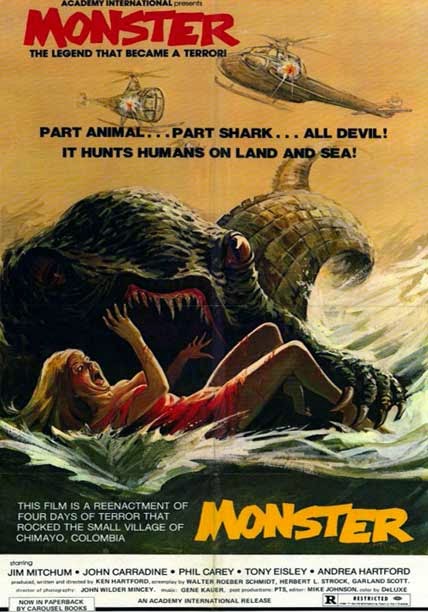
Today, we have a little indie film from 1980. This film was released under several names, including Monster. However, I prefer the title under which it has been included in several Mill Creek box sets: Monstroid: It Came From The Lake!
Monstroid tells the story of what happens when a monster emerges from a lake and starts killing people in Columbia. Superstitious villagers blame a local woman whom they believe to be a witch. Even though the town priest (and no horror fan should be surprised to discover that the priest is played by John Carradine) claims that he can exorcise the evil spirits that have possessed her, the villagers would rather burn her at the stake. Meanwhile, the local Big Evil Corporation has sent in Travis (James Mitchum) to take care of the monster!
And what a monster! Listen, there’s a lot of negative things that I could say about this low-budget film but the monster is simply adorable and must be seen by anyone who appreciates the rubber monsters that populated horror films in the days before CGI.
Plus, how can you resist a film that features not only Robert Mitchum’s son but John Carradine as well?
Enjoy Monstroid: It Came From The Lake!

Yay! I was just thinking that it would be nice to get a trailer for a new Bruce Campbell film and — surprise! — here it is!
Not only does Black Friday feature Bruce but it also features Devon Sawa, who seems like he deserves to make a bit of comeback.
Here’s the trailer for Black Friday:
 David Banner (Bill Bixby), still hoping to find a cure for the condition that causes him to turn into the Hulk (Lou Ferrigno) whenever he gets injured or stressed out, heads up to Portland. Pretending to be a simple-minded janitor named David Bellamy, Banner gets a job working in the lab of Dr. Ronald Pratt (Philip Sterling). Banner hopes that Dr. Pratt’s research holds the secret that can release him from being the Hulk. When Dr. Pratt learns Banner’s secret, he and his wife (Barbara Tarbock) work with Banner to try to cure him and to understand the Hulk.
David Banner is not the only person who has infiltrated the lab. KGB agent Jasmin (Elizabeth Gracen) has also been sent to the lab with orders to steal Pratt’s research. Jasmin hates working for the KGB but she’s been told that her sister will be killed unless she complete one final mission. When Jasmin meets and falls in love with David, she starts to reconsider her loyalties. When the KGB finally makes their movies, Jasmin is going to have to decide who to help and the Hulk is going to have to come through and save the day one final time.
David Banner’s saga finally comes to a close in The Death of the Incredible Hulk, the third and last of the Incredible Hulk television movies. It’s also the best of the three, though that might not by saying much when you consider the quality of the first two. While the other two movies both served as backdoor pilots for other heroes and the Hulk was barely even present in the 2nd movie, The Death of the Incredible Hulk keeps the focus squarely on David Banner and the Hulk. (Though Jasmin does seem like she could be a version of the Black Widow, I think the similarities between the two characters are a coincidence. Beautiful and conflicted KGB agents were a popular trope in the 80s and early 90s.) Both Bixby and Ferrigno get to show off what they can do in their signature roles. Bixby is especially good at capturing Banner’s tortured and lonely existence and his performance helps to make The Death of the Incredible Hulk something more than just another cheap sci-fi TV movie.
Though the film stays true to its title and ends with a mortally wounded Banner saying that he’s finally free, it was not intended to be the final Hulk film. There were plans to bring David Banner back to life and presumably, the Hulk would have come back with him. Unfortunately, Bill Bixby himself died in 1993, before shooting could begin on The Return of the Incredible Hulk.
What the sweet Hell is this crap!?
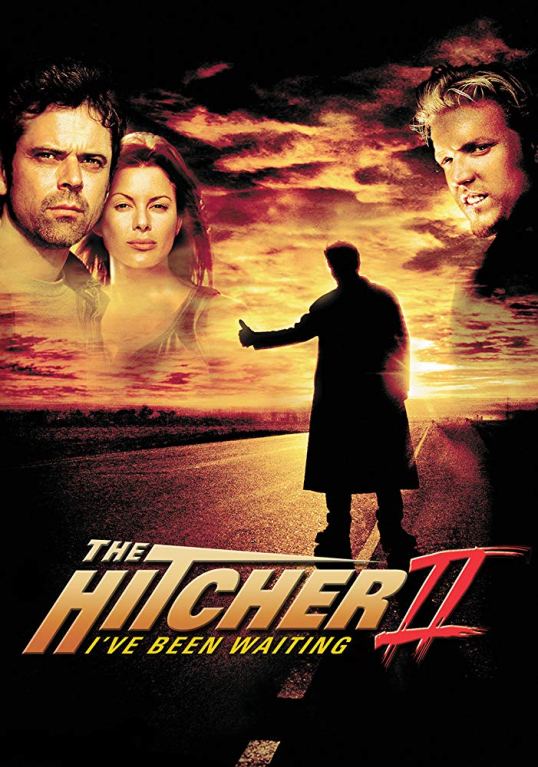
So, the 2003 film, The Hitcher II: I’ve Been Waiting, is a sequel to the original Hitcher. That’s the film where C. Thomas Howell plays a dumbass who picks up a hitchhiker played by Rutger Hauer and then kicks him out after a few miles because Hauer’s like totally insane. So, Hauer responds by murdering random people and framing Howell. The Hitcher‘s a pretty good film, largely because of the terrifying performance of Rutger Hauer as the title character.
The Hitcher came out in 1986. It got terrible reviews and didn’t do well at the box office but it found an audience when it was released on video. In fact, The Hitcher became a bit of a cult favorite, which is what it deserved to be. Then, 23 years later, a direct-to-video sequel was released and….
Seriously, this movie is so bad.
C. Thomas Howell returns, playing Jim, the same character that he played in the first movie. Jim is still haunted by what happened in the first movie. He’s a cop now but he fears that his encounter with the original Hitcher may have contributed to him using excessive force on a kidnapping suspect. Seeking some time away from the stress of it all, Jim decides to visit a friend in Texas. He and his girlfriend, Maggie (Kari Wuhrer) hit the road and, as they drive through the desert, they see a hitchhiker standing by the side of the road….
Now, I know what you’re saying. “Oh, come on!” you’re yelling. “There’s no way Jim would be make the same stupid decision twice!”
Well, you’re right. Jim doesn’t stop to pick the guy up. Instead, Maggie is the one who decides to pull over. Apparently, Jim has never bothered to tell Maggie about any of the terrible stuff that happened during the first film. Considering that Jim is apparently waking up constantly with nightmares and he’s on the verge of having a mental breakdown, you would think that all of this would be something that he would share with Maggie but no. Maggie is totally shocked when Jim later tells her that he had a bad experience picking up a hitchhiker.
Anyway, in this case, the hitchhiker is named Jack (Jake Busey) and …. wow, shock of shocks! He’s totally fucking crazy! That’s right — it’s happening again! So, Jack is chasing Jim and Maggie across the desert, murdering people and framing Jim and Maggie for the crimes. Does this sound familiar? Jim is eventually killed, giving C. Thomas Howell an excuse to never have to appear in another direct-to-video sequel. Can Maggie beat the new Hitcher at his own game?
Oh, who cares? This version of The Hitcher basically has none of the weird subtext of the first film. Unlike Rutger Hauer’s Hitcher, who seemed to be almost erotically obsessed with Jim, Jake Busey’s Hitcher doesn’t have much on his mind beyond killing people. If Rutger Hauer was all about quiet menace and charismatic intensity, Jake Busey is loud and in your face and so obviously crazy that it’s hard to have much sympathy for anyone stupid enough to pick him up.
The main problem with The Hitcher II is that it gets so damn repetitive. I lost count of the number of times that a cop showed up, refused to listen as Maggie shouted, “STOP! HE’S A KILLER,” and then got gunned down. Seriously, this film featured the stupidest cops that I’ve ever seen. The same thing keeps happening for 90 minutes or so, at which point we get a pithy one liner and then big explosion. And then the movie’s over!
Yay!