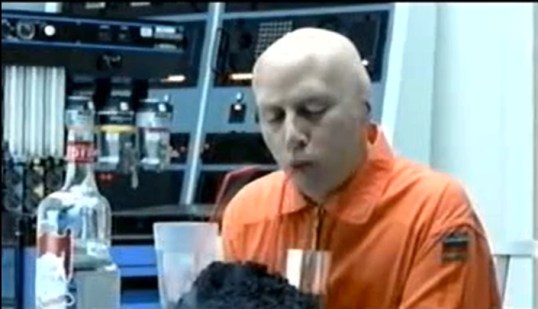
Welcome to Retro Television Reviews, a feature where we review some of our favorite and least favorite shows of the past! This Thursday, I will be reviewing Area 57, which was produced for NBC in 2007. The show can be found on YouTube!
Episode 1.1 “Pilot”
(Dir by Dean Parisot, filmed in 2007, never aired)
Col. Steven Isaac (Matthew Lillard) has been assigned to Area 57, a military base in the Nevada desert. Isaac is excited to read his orders and discover that Area 57 is home to an extraterrestrial. He arrives at the base. He meets by-the-book Lt. Irene Maloof (Jane Lynch). He meets the plain-spoken General Keller (Bruce McGill). He meets head scientist Dr. Annabelle Fermi (Kelly Hu). Finally, Isaac announces that he really wants to meet the alien.
Suddenly, Dr. Fermi emerges from her laboratory and says that the alien has died. General Keller announces that Area 57 is being shut down. All of the soldiers cheer. The general explains that the alien wasn’t always popular. Isaac still insists on seeing the body. With Dr. Fermi at his side, he gets his first look at the alien and accidentally spills his coffee on him. The alien (played by Paul Reubens) comes back to life. It turns out that he was just going through a sleep cycle. General Keller announces that Area 57 is not closing and no one is going home.
With the entire base still angry with him, Isaac still insists on meeting the alien. The alien asks him about his education. Isaac says that he attended college through an endowment. The alien says that many of the soldiers like Dr. Fermi. Isaac agrees that she’s attractive. The alien then announces to Irene that Isaac was making crude comments about Fermi and bragging about how endowed he was.
Isaac realizes the truth. The alien is a jerk. He also learns that the alien has been at Area 57 for 40 years and that, so far, the government has learned nothing from him.
That’s the plot of Area 57. NBC thought enough of the idea to commission a pilot, but the network never aired it. It’s available on YouTube. Watching it, you can see what the problem was. The alien is established as such a jerk that it’s hard to imagine anything else that could have been done with the character. Paul Reubens plays the role under a good deal of makeup, and he’s more off-putting than intriguing. That said, Matthew Lillard was genuinely funny as the earnest and idealistic Col. Isaac. He was so excited about meeting an alien that it was impossible not to feel sorry for him when the alien turned out to be a jerk.
If we ever do meet aliens, I have a feeling that something like Area 57 might be seen as prophetic. There’s a tendency to assume that alien visitors will be interesting, erudite, and worth knowing. I think that if there are aliens out there, they’re just as likely to be as annoying as the average human.
“That is my family, but that’s not my home. My home is back in 1978!” — David Freeman
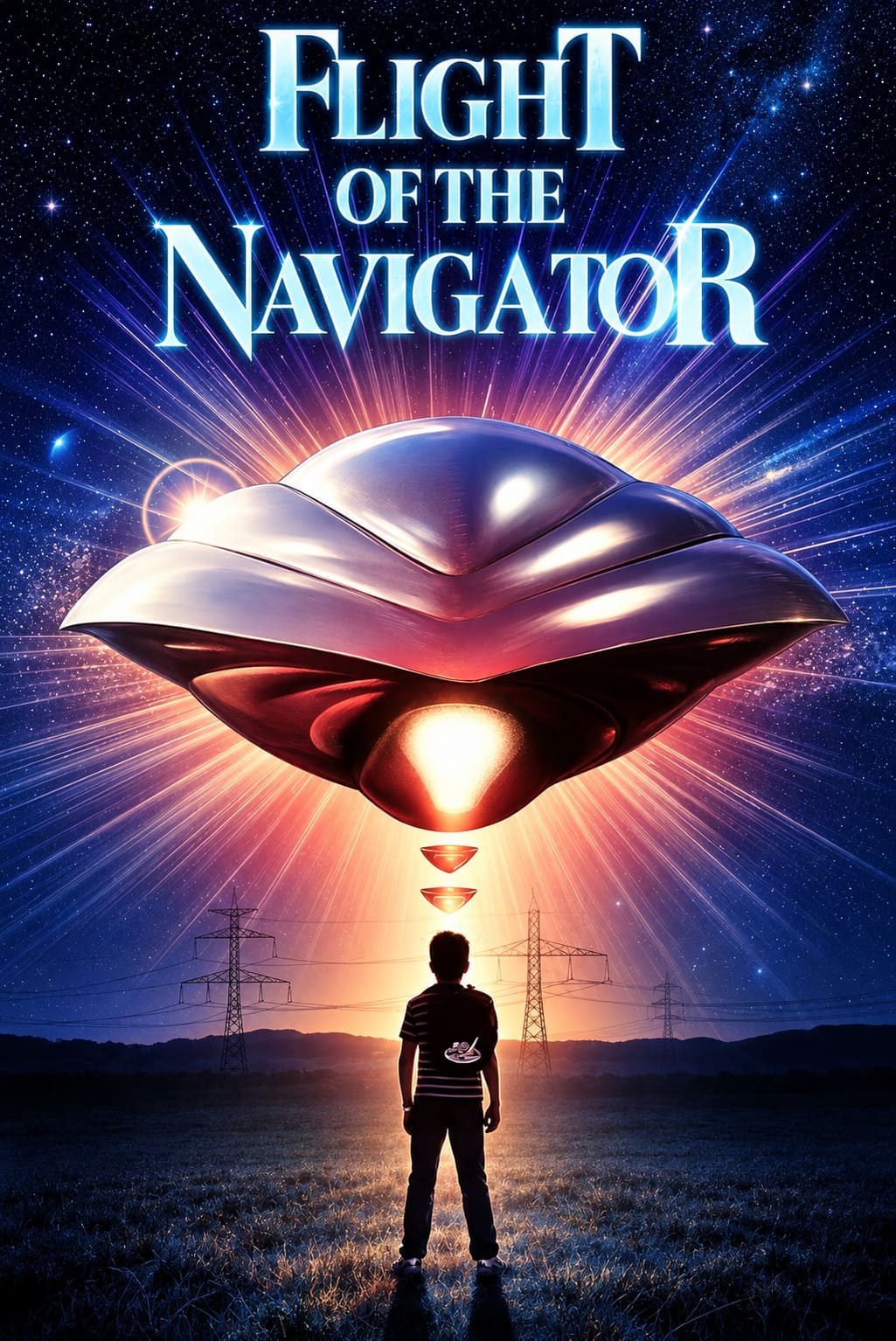
Flight of the Navigator turns a child’s worst possible homecoming into an unexpectedly funny, wistful, and imaginative science-fiction adventure. Released in 1986, it begins as a modest suburban mystery before expanding into a story about time displacement, missing years, alien technology, and the strange loneliness of returning home to a life that has moved on without you. It has the glossy, accessible surface of a Disney adventure, but there is a surprisingly melancholy idea at its center: what would it feel like to lose eight years of your life while everyone you love has had to live through them without you?
The movie follows David Freeman, a 12-year-old boy who disappears in 1978 after going into the woods to retrieve his younger brother Jeff. David wakes up in 1986, apparently having been gone only a few hours from his own point of view. The shock is immediate. His parents are older, Jeff is now his taller teenage brother, the family has moved, and David has become a long-unsolved missing-person case. This opening stretch is probably the film’s strongest material because it plays the scenario straight enough to make it genuinely unsettling. David is not simply a kid dropped into a flashy futuristic world; he is a child abruptly disconnected from the only reality he knows.
That emotional hook gives Flight of the Navigator more weight than many similar children’s adventures. David’s confusion is easy to understand, and the film wisely lets the situation breathe before revealing all of its science-fiction machinery. The sight of his family recognizing him after years of grief is touching, but it also comes with discomfort. David wants everything to return to normal, while his parents are overwhelmed by the impossible fact that their vanished son has returned unchanged. The movie does not dig into the full psychological consequences of that situation, because it is still fundamentally a family adventure, but it gives the idea enough attention to make the stakes feel personal.
Once NASA becomes involved, the story shifts into a more conventional but still entertaining sci-fi mode. Doctors discover that David has advanced knowledge in his brain that he cannot consciously explain, and the mystery leads him to a crashed alien spacecraft. The ship, known as the Trimaxion Drone Ship, is the movie’s most iconic element. Its smooth silver form, with no visible seams or conventional cockpit, still looks appealing because it has a simple, alien elegance. It is not overly busy or mechanical in the way many science-fiction vehicles are. Instead, it resembles a floating metallic organism, something sleek and strange that could plausibly have appeared in a child’s dream.
The ship’s computer, MAX, is what really gives the movie its personality. Voiced by Paul Reubens, MAX begins as a calm, efficient artificial intelligence but gradually becomes sillier and more mischievous after downloading human information from David’s era. Reubens’ performance is a major reason the character works. He does not simply do a recognizable Pee-wee Herman routine, although the playful vocal energy is certainly there. MAX’s changing voice and increasingly erratic sense of humor make him feel like an alien intelligence trying to imitate human behavior and getting it only partly right.
There is a fine line between amusing and annoying when a movie lets its comic sidekick become too hyperactive, and Flight of the Navigator occasionally crosses it. MAX can become a little much, especially during the later scenes where he starts cracking jokes, changing his vocal effects, and behaving like an overexcited child with access to interstellar technology. Still, that energy is part of what makes the film feel uniquely of its era. MAX is not as polished or emotionally sophisticated as later animated or CGI companions, but he remains memorable because he is odd. His humor feels less like a studio-tested collection of one-liners and more like a machine that has accidentally discovered cartoons, pop culture, and sarcasm all at once.
Joey Cramer carries much of the movie as David, and he gives the role more sincerity than the material sometimes requires. He is believable as a regular kid who becomes frightened, angry, curious, and eventually exhilarated by what is happening around him. David is not written as a perfect young hero. He can be stubborn and impulsive, especially when he decides he has to take control of his own situation, but that makes sense. Adults have spent much of the story examining him, restraining him, and treating him as a scientific puzzle. His decision to escape with MAX is reckless, yet it also feels like the response of a child who is desperate to reclaim some agency.
The film’s visual effects deserve credit for helping sell its larger ideas. By modern standards, the effects are obviously dated in places, particularly when the ship changes shape or moves at impossible speeds. Yet the movie uses its effects well enough that they remain charming rather than distracting. The morphing sequence in which the ship transforms into its sleeker form was especially impressive for the time, and even now it has an appealing practical-digital hybrid quality. It does not look completely real, but it looks imaginative. The ship has presence, and the movie understands the pleasure of simply watching it fly through clouds, skim across water, or streak through the night sky.
The electronic score by Alan Silvestri is another major part of the film’s identity. Silvestri is often associated with larger, more overtly heroic scores, especially in films such as Back to the Future, but his work here is more synthetic and futuristic. The music helps create a sense of wonder while also grounding the film in the mid-1980s. It can sound very much of its time, with prominent synthesizers and a clean electronic texture, but that is not a weakness. The score fits a movie about an ordinary kid encountering a cold, shiny, unknowable piece of advanced technology.
One of the better things about Flight of the Navigator is that it does not make its protagonist’s adventure entirely consequence-free. David gets to fly an alien ship, travel at incredible speeds, and encounter a universe beyond his suburban life. That is the wish-fulfillment element, and the film delivers it well. At the same time, the adventure exists because something has gone wrong in David’s life. His journey begins with loss. The movie never becomes as emotionally dark as its premise could allow, but it never completely forgets that David has been separated from his family and displaced in time.
The ending is satisfying because it returns the story to that emotional core. David’s ultimate choice is not just about whether he wants to keep flying around with MAX. It is about whether he can go home, even if home is no longer exactly what it was. The resolution is neat and arguably a little too convenient, but it earns its feel-good payoff. This is a family film, after all, and the movie knows that its audience wants the wonder of space travel without being left in despair over the time-travel implications.
In the end, Flight of the Navigator remains a warm, inventive, and slightly strange piece of 1980s science-fiction. It is not a perfect movie. Some of the comedy is broad, the adults at NASA are more functional than memorable, and the story occasionally rushes past ideas that could have been explored more deeply. But its central concept is strong, its spaceship is iconic, its score is distinctive, and its combination of melancholy and fun gives it more staying power than many nostalgia-driven family movies. It captures the feeling of being a kid who wants to escape into the unknown, while also recognizing that the people waiting at home are what make that escape matter.
The Blues Brothers! They’re on a mission from God.
Jake (John Belushi) and Elwood Blues (Dan Aykroyd) are two Chicago orphans who love the blues and committing crime. After Jake is paroled from Joliet Prison, he’s picked up by Elwood in an old police car. Elwood traded the original Bluesmobile for a microphone. Jake understands, even if he still doesn’t like being seen in a police car. When they visit the orphanage where they were raised, Sister Mary Stigmata (Kathleen Freeman) beats them with a ruler and tells them that the orphanage is going to close if she can’t pay a $5,000 tax bill. Jake and Elwood set out to reform their band, raise $5,000, and save the orphanage. Jake and Elwood may be two career criminals who never take off their dark glasses but they’re on a mission from God.
Along the way to putting the band together and raising $5,000, Jake and Elwood meet characters played by everyone from James Brown to Ray Charles to Aretha Franklin. You never know when a big production number might break out. Jake and Elwood also step on a few toes. Soon, the Blues Brothers being chased by the police, the national guard, Jake’s parole officer (John Candy), Charles Napier’s country-western band, and a group of Illinois Nazis (led by Henry Gibson). There’s also a mysterious woman (Carrie Fisher) who wants to kill them. She has an impressive array of weapons but terrible aim.
The Blues Brothers was the first comedy to be based on a Saturday Night Live bit. Unlike most other SNL movies, The Blue Brothers develops its plot far beyond what was originally seen on television. Jake and Elwood get a full backstory and they also get personalities that go beyond the black suits and the dark eyewear. The Blues Brothers features Belushi at his most energetic but it’s also one of the few films to actually know what to do with Dan Aykroyd’s eccentric screen presence. If Belushi’s Jake is all about earthly pleasures, Aykroyd’s Elwood almost seems like a visitor for another world. Aykroyd’s performance of the Rawhide theme song is one of the film’s highlight.
The Blues Brothers has its share of funny lines and its famous for the amount of pointless destruction that it manages to fit into its storyline (with the “unnecessary violence” being authorized by the Chicago police to stop the Blues Brothers) but it’s also as surprisingly sincere tribute to the blues. It’s a movie that can balance Ray Charles shooting at a shoplifter and a massively destructive car chase in a suburban mall with Cab Calloway playfully performing Minnie the Moocher and Aretha Franklin bringing down the house (or diner, as the case may be). The movie can feature both a jump over an open drawbridge and Steven Spielberg as the clerk at the tax office. It’s one of the strangest comedies ever made and it features all the excesses that would bring an end to 70s Hollywood but when Jake and Elwood say they’re on a mission from God, you believe them.
As some of our regular readers undoubtedly know, I am involved in a few weekly live tweets on Twitter and Mastodon. I host #FridayNightFlix every Friday, I co-host #ScarySocial on Saturday, and I am one of the five hosts of #MondayActionMovie! Every week, we get together. We watch a movie. We tweet our way through it.
Tonight, at 10 pm et, #FridayNightFlix has got 1988’s Big Top Pee Wee, starring Paul Reubens!
If you want to join us this Friday, just hop onto twitter, start the movie at 10 pm et, and use the #FridayNightFlix hashtag! It’s a friendly group and welcoming of newcomers so don’t be shy.
Big Top Pee Wee is available on Prime! See you there!
Watching this movie was such a strange experience.
Now, of course, I say that as someone who grew up watching and loving the television version of Buffy the Vampire Slayer. Back when Buffy was on TV, I was always aware that the character had first been introduced in a movie but every thing I read about Buffy said that the movie wasn’t worth watching. It was a part of the official Buffy mythology that Joss Whedon was so unhappy with what was done to his original script that he pretty much ignored the film when he created the show.
So, yes, the 1992 movie version of Buffy the Vampire Slayer showed how Buffy first learned that she was a slayer, how she fought a bunch of vampires in Los Angeles, and how her first watcher met his end. But still, Joss Whedon was always quick to say that the film should not be considered canonical. Whenever anyone on the TV show mentioned anything from Buffy’s past, they were referencing Joss Whedon’s original script as opposed to the film that was eventually adapted from that script. (For instance, on the tv series, everyone knew that Buffy’s previous school burned down. That was from Whedon’s script. However, 20th Century Fox balked at making a film about a cheerleader who burns down her school so, at the end of the film version, the school is still standing and romance is in the air.) In short, the film existed but it really didn’t matter. In fact, to be honest, it almost felt like watching the movie would somehow be a betrayal of everything that made the televisions series special.
Myself, I didn’t bother to watch the film version of Buffy the Vampire Slayer until several years after the television series was canceled and, as I said at the start of the review, it was a strange experience. The movie is full of hints of what would make the television series so memorable but none of them are really explored. Yes, Buffy (played here by Kristy Swanson) has to balance being a teenager with being a vampire slayer but, in the film, it turns out to be surprisingly easy to do. Buffy is just as happy to be a vampire slayer as she is to be a cheerleader. In fact, one of the strange things about the film is just how quickly and easily Buffy accepts the idea that there are vampires feeding on her classmates and that it’s her duty to destroy them. Buffy’s watcher is played by Donald Sutherland and the main vampire is played by Rutger Hauer, two veteran actors who could have played these roles in their sleep and who appear to do so for much of the film. As for Buffy’s love interest, he’s a sensitive rebel named Oliver Pike (Luke Perry). On the one hand, it’s fun to see the reversal of traditional gender roles, with Oliver frequently helpless and needing to be saved by Buffy. On the other hand, Perry and Swanson have next to no chemistry so it’s a bit difficult to really get wrapped up in their relationship.
I know I keep coming back to this but watching the movie version of Buffy is a strange experience. It’s not bad but it’s just not Buffy. It’s like some sort of weird, mirror universe version of Buffy, where Buffy starts her slaying career as a senior in high school and she never really has to deal with being an outcast or anything like that. (One gets the feeling that the movie’s Buffy wouldn’t have much to do with the Scooby Gang. Nor would she have ever have fallen for Angel.) Kristy Swanson gives a good performance as the film version of Buffy, though the character is not allowed to display any of the nuance or the quick wit that made the television version a role model for us all. Again it’s not that Buffy the movie is terrible or anything like that. It’s just not our Buffy!