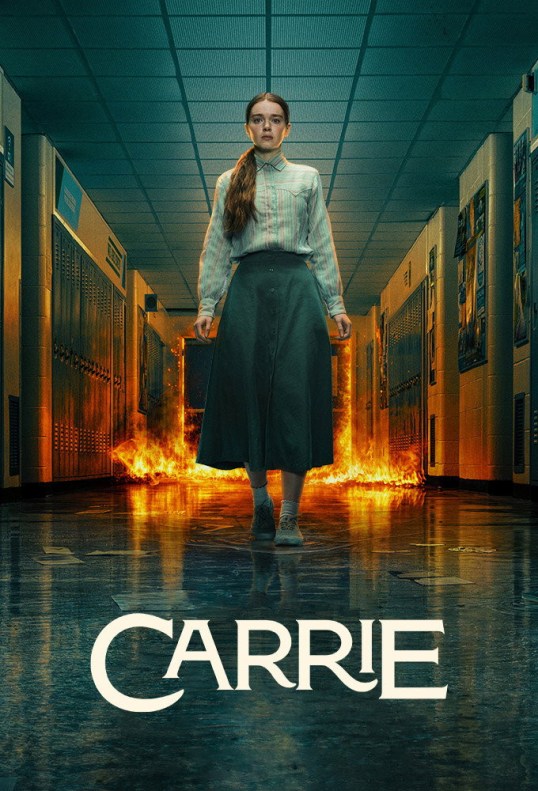
If I had to choose two words to describe Mike Flanagan’s “reimagining” of Carrie, they would probably be “fan fiction.”
In fact, it’s sometimes humorous just how obviously this miniseries is a work of fan fiction. Carrie White (blandly played by Summer Howell) may be a bullied and sheltered girl with telekinetic powers, but now she has a best friend, Emaline (an equally bland Thalia Dudek, who looks less like a 2026 teenager and more like the bassist in a 1990s riot grrrl band), who also has a power and always has the best advice and the snarkiest comebacks! What would Carrie do without her best friend Emaline? And while Margaret White (Samantha Sloyan) is still present as an overprotective and paranoid force in Carrie’s life, there’s now another maternal figure named Adelaide (Kate Siegel) who exists to talk about how those with secret powers are always being held down by a society that’s just not capable of accepting how important they are. Adelaide opens each episode with a monologue that feels like it was written by a 2017 college freshman who has just watched Linda Sarsour on YouTube. Watching the miniseries, one gets the feeling that Flanagan and his writers really wanted to make a show called Emaline and Adelaide and decided to graft them onto Carrie.
Ever since this miniseries was announced, there’s been a lot of talk about how Flanagan has updated the story. In this case, that means there’s an emphasis on phones and social media, as if teenagers couldn’t find a way to hurt each other even before technology caught up with them. In fact, social media is pretty much to blame for everything that happened. The audience is meant to violently roll their eyes at Margaret White for believing in conspiracy theories and religion while, at the same time, accepting a portrayal of the dangers of social media that makes Aaron Sorkin look even-handed and calm. One gets the feeling that if this show had been made just a few years earlier, it would have found a way to blame Margaret White and Chris Hargensen for the January 6th riots. There is a riot in the sixth episode, but it just involves all of the students doing a massive walkout to protest Chris Hargensen’s secret Instagram account. “Death to Hargensen!” the students chant, and it briefly seems like maybe Flanagan is going to make a bigger point about how the bullies can become the bullied, but ultimately, this is too much of a work of fan fiction to delve too deeply into anything that complex. It’s also too much of a work of the streaming era to introduce an idea that can’t be neatly summed up in 15 seconds.
Yes, this is a new version of Carrie. If King’s novel and De Palma’s film gave us a Carrie White who was never happy until that one prom night and who lashed out after that happiness was stolen from her, the Mike Flanagan miniseries gives us a Carrie who becomes the most popular girl in school even before prom night. No longer does Tommy (Joel Oulette) ask Carrie to prom as a favor to his guilt-ridden girlfriend, Sue Snell (Siena Agudong). Instead, he asks Carrie as a friend. Carrie’s no longer sheltered and shy. Instead, she’s somewhat smug and annoying. She sneaks out of the house many times before prom night. She goes to a party. She goes to the junkyard and curses like a sailor while showing off her powers. Her best friend Emaline is impressed. What would Carrie do without her best friend, Emaline? Of course, by changing all of this, Flanagan robs the story of all of its emotional power. This is probably the first version of Carrie where I’ve actually found myself getting annoyed with Carrie as a character. Towards the end of the miniseries, she just becomes so smug and self-righteous, like the girl at school who used to sweetly pull you aside to tell you that your skirt was too short. This is a version of the story that lets Carrie off the hook. Emaline is the one who suggests that she use her powers to get revenge. Adelaide and her dumbass cult are the ones who accidentally set fire to the school. Carrie dances in the street with Emaline and, for a few seconds, you actually find yourself wishing for the calming hand of Ryan Murphy.
Yes, I know that Stephen King has endorsed Mike Flanagan’s changes. That doesn’t mean that I have to. The fact of the matter is that Stephen King has consistently shown that he will endorse just about anything, and it’s also been a while since King has written anything that can match the power of his earlier work. There’s a world of difference between the youngish and struggling writer who originally wrote Carrie and the wealthy boomer who is now probably better known for his angry tweets than his more recent literary output. As well, it’s obvious that King likes Flanagan. Flanagan is the ultimate fan. And yet, considering that Flanagan’s best film, Hush, was also his simplest, one can’t help but feel that Flanagan would do well to stop adapting his heroes and maybe just try to focus on creating unapologetic suspense.
It’s the curse of elevated horror. Right now, the critics who hate entertaining horror love slow-moving elevated horror. They go on and on about the subtext, as if there wasn’t subtext to be found in the horror movies that were made in the past. The truth of the matter is that the subtext is usually the least interesting thing about these films and series. Making a film or a show that is critical of capitalism and religion is hardly the radical act that the critics seem to think it is. There’s nothing particularly interesting or special to be found between the lines when it comes to this version of Carrie. Indeed, for all the time and effort that the series puts into villainizing Margaret White and Chris Hargensen, they’re ultimately the most interesting characters because Samantha Sloyan and Alison Thornton are the only two performers who are allowed to break free from the show’s rigid ideological structure. (Samantha Sloyan especially deserves a lot of credit for finding a hint of reality in her portrayal of Margaret.) Chris and Margaret are compelling because they’re the only characters who don’t just parrot the accepted lines and the accepted thinking. They’re the only characters who seem to have a life and an outlook that was formed by something other than the demands of the show. We’re meant to shake our heads when Margaret becomes an online celebrity with a podcast, but instead, we’re interested and almost happy for her because Margaret is actually doing something unexpected and making an effort to take actual control of her life. It’s hard not to feel that this version of Margaret White deserved a better ending than what the show gave her. In the end, Margaret feels less like a villain and more like a victim of the show’s writers and their own feelings about religion and politics. (One wonders if the writers realize that their show ultimately makes the case that all of the tragedy could have been avoided if the government had simply stayed out of it and just allowed Margaret to continue to homeschool her daughter.) If previous versions of Carrie seemed to be designed to appeal to shy outsiders, this version of Carrie is designed to compliment self-styled victims who don’t have the self-awareness necessary to realize that they are now the bullies.
In the end, Carrie feels like a forgotten Showtime series from 2018 and, if it had been made by anyone other than Mike Flanagan, no one would care.
Previous Icarus Files:
- Cloud Atlas
- Maximum Overdrive
- Glass
- Captive State
- Mother!
- The Man Who Killed Don Quixote
- Last Days
- Plan 9 From Outer Space
- The Last Movie
- 88
- The Bonfire of the Vanities
- Birdemic
- Birdemic 2: The Resurrection
- Last Exit To Brooklyn
- Glen or Glenda
- The Assassination of Trotsky
- Che!
- Brewster McCloud
- American Traitor: The Trial of Axis Sally
- Tough Guys Don’t Dance
- Reach Me
- Revolution
- The Last Tycoon
- Express to Terror
- 1941
- The Teheran Incident
- Con Man
- Looker
- 1776
- Here
- The Adventures of Brisco County, Jr.
- The Cable Guy
- A Chorus Line

