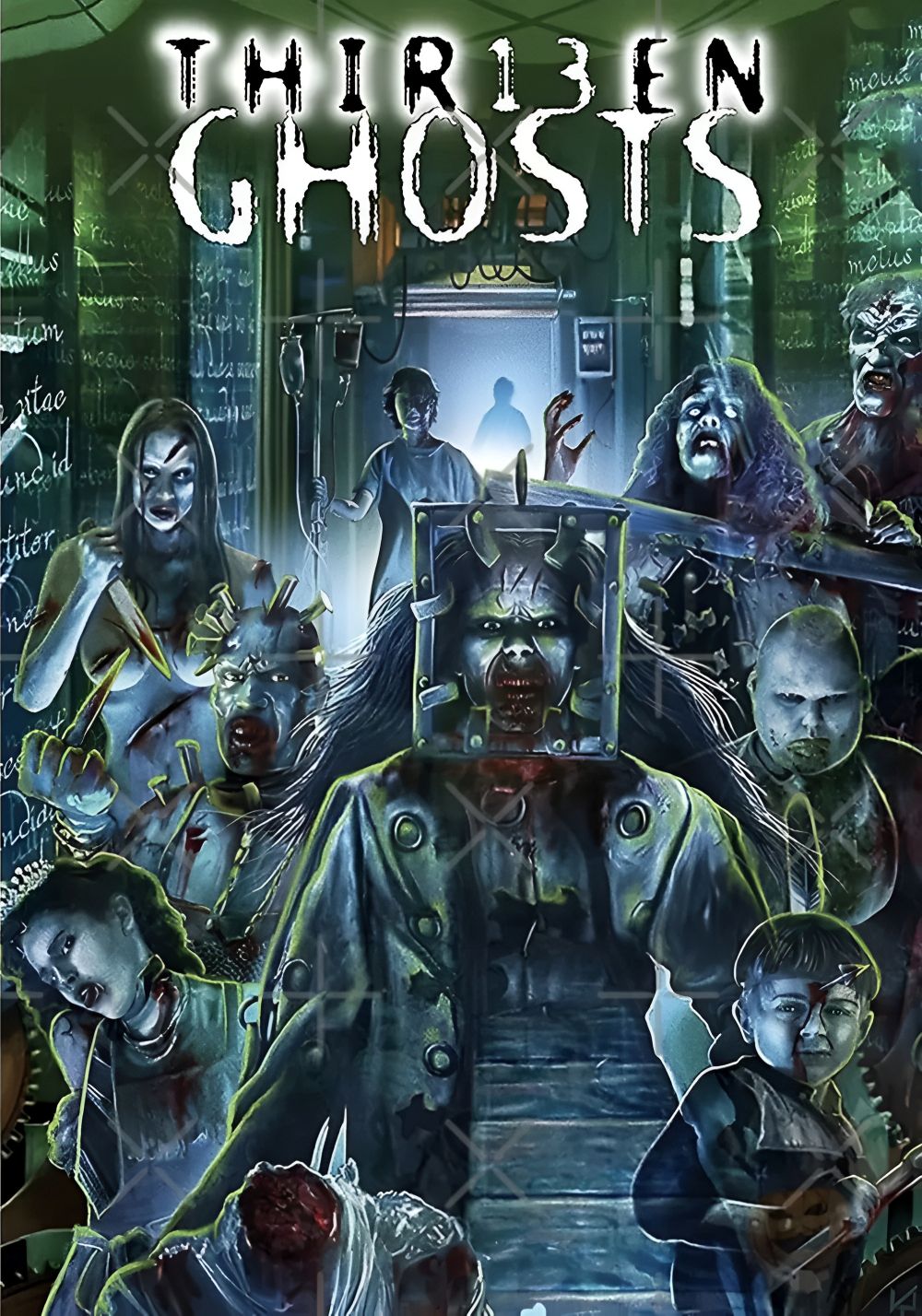
Horror Film Review: Thirteen Ghosts (dir. by Steve Beck)


“Did I say there’s a petting zoo downstairs? No! There are ghosts downstairs, Arthur!” — Dennis Rafkin

In Thirteen Ghosts, getting a spectacular house for free turns out to be considerably worse than struggling to afford one. That cruel little reversal gives Steve Beck’s 2001 horror film a promising starting point: a family’s apparent good fortune becomes another nightmare they have to survive. As a remake of William Castle’s 1960 film 13 Ghosts, though, it isn’t interested in preserving much of its predecessor’s low-budget charm. Beck trades playful spook-show entertainment for grotesque creatures and brutal violence. The result has an unmistakable identity, but its impressive visual imagination often outpaces its ability to tell a compelling story.

Tony Shalhoub plays Arthur Kriticos, a widowed father trying to provide some stability for his children. When his wealthy uncle Cyrus, played by F. Murray Abraham, leaves him an extraordinary house, it looks like the kind of opportunity he can’t afford to question. Arthur arrives with his family and their nanny, only to discover that their new home contains trapped spirits and some deeply suspicious machinery. Naturally, the house isn’t simply haunted. Its design has a purpose, and the people walking through it have become part of something they don’t understand.

There’s a nasty streak running through that setup, and the remake embraces it. Castle’s original has the scrappy appeal of an old carnival attraction, where the modest effects and ghost-viewing gimmick contribute to the fun. Beck’s version wants to hit harder. The ghosts look tortured, their attacks feel vicious, and the atmosphere offers little of the earlier film’s playful reassurance. That approach separates the remake from the original rather than leaving it feeling like a glossy imitation. Still, the difference is enormous. It keeps the basic inheritance premise while taking the experience about as far from Castle’s charmingly cheap thrills as possible.

The strongest part of that transformation is the house itself. Its glass walls, strange inscriptions, and mechanical components make it feel more like an elaborate trap than somewhere anyone could live. The transparency is especially effective. Haunted-house movies usually make darkness and concealment threatening, but here the characters can look through walls without knowing what they’re seeing or how to reach safety. Everything appears exposed, yet very little feels understandable. Even during stretches when the plot becomes clumsy, the setting holds your attention. There’s almost always an unsettling detail somewhere in the frame.

The special glasses that reveal the ghosts make good use of that environment. Without them, a seemingly empty room can contain something capable of killing you. With them, the house becomes even less inviting. It’s a clever connection to the original’s viewing gimmick, repurposed to suit the remake’s harsher personality. The bathroom encounter with the Angry Princess is particularly effective because it builds danger around a character’s limited awareness. For a moment, the film doesn’t need complicated explanations or frantic action. The simple possibility of sharing a confined space with an unseen threat does the work.

The creatures are equally important to the movie’s appeal. Their makeup, clothing, and physical behavior suggest distinct personalities and horrible histories. They aren’t interchangeable figures waiting to jump into the camera. Several look interesting enough to support much longer sequences, which makes their treatment frustrating. The movie introduces these elaborate designs and then rushes toward the next confrontation. You want to understand what separates one spirit from another, but the screenplay too often treats them as obstacles in a supernatural obstacle course. The imagination behind their appearances is stronger than the storytelling that puts them to use.

That hurry extends to the scares. Beck frequently pushes the action with rapid editing, loud sound effects, and sudden bursts of violence. There’s some fun in that aggressive approach, especially if you enjoy horror that refuses to be restrained. But the constant pressure eventually flattens the suspense. When nearly every encounter arrives at full volume, there’s little room for dread to build. An ugly figure lingering behind glass can be more disturbing than another noisy attack. The movie creates plenty of striking images, then seems nervous about letting the audience sit with them.

The actors help keep the chaos watchable. Shalhoub gives Arthur a weary sincerity that makes his concern for his children believable. Matthew Lillard brings an anxious, twitchy energy that fits the increasingly frantic situation, while Shannon Elizabeth and Rah Digga add life to the ensemble. Unfortunately, the family’s emotional circumstances get less attention than the machinery surrounding them. Arthur’s desire to turn an inheritance into security should make the house’s betrayal sting. Instead, the film keeps interrupting that thread to explain another supernatural complication or send everyone running. The characters remain likable enough, but they rarely become as interesting as their surroundings.

By the time the house has revealed its true colors, Thirteen Ghosts has made a better case for its production design than its storytelling. There’s real pleasure in its elaborate nastiness, and Beck deserves credit for giving the remake a personality separate from Castle’s original. This isn’t the same haunted-house ride with a fresh coat of paint; it’s a colder, bloodier attraction built on the old foundation. Whether that trade works depends on how much creature design and frantic violence you need to stay entertained. For me, there’s enough to enjoy, but not enough to stop wishing the movie would slow down and let its best ideas haunt us.
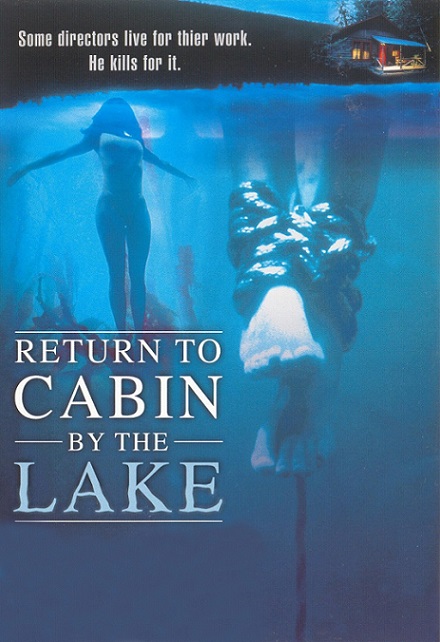
Retro Television Reviews: Return To Cabin By The Lake (dir by Po-Chih Leong)


Welcome to Retro Television Reviews, a feature where we review some of our favorite and least favorite shows of the past!  On Sundays, I will be reviewing the made-for-television movies that used to be a primetime mainstay.  Today’s film is 2001’s Return To Cabin By The Lake!  It  can be viewed on YouTube.

Stanley Caldwell (Judd Nelson) is back!

At the end of Cabin By The Lake, screenwriter Stanley had managed to escape from the police by faking his own drowning.  Return to Cabin By The Lake finds Stanley using a variety of disguises and fake identities in his effort to once again become a part of the film industry.  He is particularly interested in the fact that his previous murder spree is being turned into a movie.  He’s considerably less happy about the fact that everyone involved in the movie continually disparages his work as a screenwriter.  He’s even less happy when he hears them speculating that there was a sexual-motive behind Stanley’s murders or that Stanley was acting out against his mother.  For someone who spent the previous movie drowning innocent women and then visiting their bodies in the lake, Stanley sure does seem to be shocked to discover that most people don’t have a high opinion of him.  You’re a murderer, Stanley.  People don’t like murderers.

Anyway, as a master of disguise, Stanley is able to work his way into the production of the film.  Even though everyone on the set is spending 24 hours a day obsessing on and recreating the crimes of Stanley, no one is suspicious of the guy who looks just like Stanley and who keeps saying stuff like, “Stanley would never do that!”  Stanley becomes obsessed with script writer Andrea (Dahlia Salem).  He also comes to resent the film’s shallow director, Mike Helton (Brian Krause, giving the film’s best performance).  Stanley decides that he would be a better director of the film so he buries Mike alive and then takes over direction.

Return To Cabin By The Lake is a bit more deliberately humorous than the first film.  If Cabin By The Lake was full of pleasant townspeople and earnest police officers, Return To Cabin By The Lake is populated with caricatures of various Hollywood phonies.  Everyone involved in Return To Cabin By The Lake‘s film-within-a-film is blithely unconcerned with the feelings of the the victim’s loved ones nor do they really care about telling the story accurately.  Helton’s only concern is that the script have enough sex.  That Stanley not only takes over as director but turns out to be a pretty good at it would appear to be Return To Cabin By The Lake’s ultimate statement on the film industry.

Judd Nelson is a bit more energetic in the sequel than he was in the first film.  That said, Return To Cabin The By The Lake makes the mistake of asking us to buy the idea of Stanley being a master of disguise.  Judd Nelson is always going to look and sound like Judd Nelson, regardless of whether he’s wearing a wig or not.

Though it’s a bit constrained by being a made-for-TV movie, Return To Cabin By The Lake is a marked improvement on the first film, one that has more humor and a better performance from its lead.  The film ends with an opening for another sequel but it was apparently never to be.

What Lisa Watched Last Night #145: The Preacher’s Sin (dir by Michelle Mower)


Last night, I watched the latest Lifetime film, The Preacher’s Sin!

preachers-sin

Why Was I Watching It?

What else was I going to watch?  The Democratic debate?  Not likely…

Seriously, though, everyone knows how much I love Lifetime!  Plus, the title of the film promised a sinning preacher and Lifetime has a pretty good track record when it comes to sinning preachers.

What Was It About?

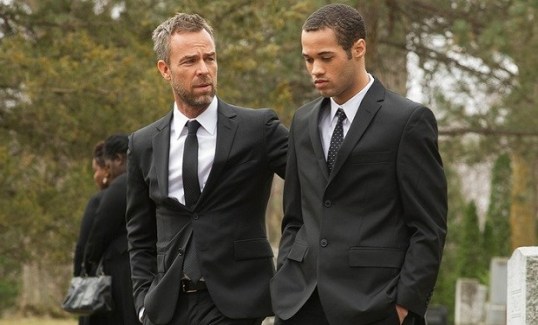
Evan Tanning (JR Bourne) is a successful and popular preacher.  He has his own radio show, where he gives advice on how to raise a family.  Much like Will Ferrell in A Deadly Adoption, he is popular on the book tour circuit.  As the movie opens, he has just signed a contract with Bill Traggert (Bill Lake) and his show is about be nationally syndicated.  Sure, Bill might be a little bit sleazy but it looks like everything’s perfect in Evan’s life…

Except, of course, it isn’t.  Evan has just discovered that he has an illegitimate son (Demi Oliver) and, once Bill finds out, Evan finds himself being blackmailed.  Add to that, Evan is the legal guardian of his niece Jamie (Allie Gonino), a rebellious teenager who has recently been arrested for driving drunk.  When Jamie gets arrested a second time, Evan struggles to try to figure out how to deal with her.

What Evan doesn’t realize is that Jamie was set up by Bill’s evil daughter, Tinsley (Stephanie La Rochelle).  When Tinsley escalates her bullying of Jamie, Evan is forced to take a stand and confront his past.

What Worked

The film was well-acted and it definitely had an intriguing first hour.  JR Bourne did a good job as the preacher and so did Allie Gonino as Jamie.  (Add to that, I really liked Jamie’s hair.)  There’s been a lot of bitchy mean girls on Lifetime but few of them have been played with the amount of sociopathic panache that Stephanie La Rochelle brought to the role of Tinsley.

What Did Not Work

So, here’s the thing: with a title like The Preacher’s Sin, I was expecting the film to feature the preaching sinning.  I mean, okay — he did have an extramarital affair but that was before he even became a preacher.  He never knew that he had a son and, once he found out, Evan went out of his way to accept and help him out..

To be honest, a better title for the film would have been Tinsley’s Sin because Tinsley was the one who kept doing the wrong thing.  As a lot of people on twitter pointed out, the final 30 minutes of the film — which were pretty much dominated by Tinsley’s sins — felt like they were happening in a totally different movie.

“Oh my God!  Just like me!” Moments

Oh my God, I so related to Jamie!  It’s not just that we were both rebellious teenagers who had to deal with jealous haters.  It was also the fact that she was judged for having better hair than everyone else.  I have red hair and Jamie had green hair.  Judging from this movie, the only thing more difficult than being a redhead is being a greenhead.

Lessons Learned

It’s not easy being green.