The 2020 Chicago Film Critics Association Snubs Capone


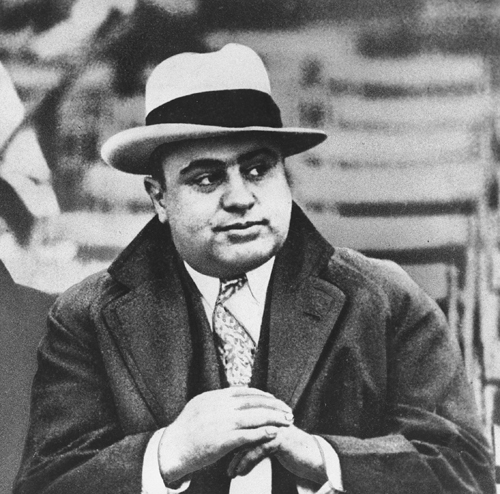
Here are the 2020 nominees of the Chicago Film Critics Association!  While they nominated many worthy films and performers, one cannot help but notice that they totally snubbed Capone and Tom Hardy.  That seems a bit ungrateful, considering all that Al Capone did for the city of Chicago.

The winners will be announced on December 21st!

BEST PICTURE
Da 5 Bloods
First Cow
Lovers Rock
Nomadland
Promising Young Woman

BEST DIRECTOR
Emerald Fennell – Promising Young Woman
Spike Lee – Da 5 Bloods
Steve McQueen – Lovers Rock
Kelly Reichardt – First Cow
Chloé Zhao – Nomadland

BEST ACTOR
Riz Ahmed – Sound of Metal
Chadwick Boseman – Ma Rainey’s Black Bottom
Anthony Hopkins – The Father
Delroy Lindo – Da 5 Bloods
Steven Yeun – Minari

BEST ACTRESS
Jessie Buckley – I’m Thinking of Ending Things
Carrie Coon – The Nest
Viola Davis – Ma Rainey’s Black Bottom
Frances McDormand – Nomadland
Carey Mulligan – Promising Young Woman

BEST SUPPORTING ACTOR
Chadwick Boseman – Da 5 Bloods
Bill Murray – On the Rocks
Leslie Odom, Jr. – One Night in Miami
Paul Raci – Sound of Metal
David Strathairn – Nomadland

BEST SUPPORTING ACTRESS
Maria Bakalova – Borat Subsequent Moviefilm
Toni Collette – I’m Thinking of Ending Things
Amanda Seyfried – Mank
Letitia Wright – Mangrove
Yuh-Jung Youn – Minari

BEST ORIGINAL SCREENPLAY
Da 5 Bloods – Danny Bilson, Paul De Meo, Kevin Willmott & Spike Lee
Never Rarely Sometimes Always – Eliza Hittman
Promising Young Woman – Emerald Fennell
Soul – Pete Docter, Mike Jones & Kemp Powers
The Trial of the Chicago 7 – Aaron Sorkin

BEST ADAPTED SCREENPLAY
The Father – Christopher Hampton & Florian Zeller
First Cow – Jonathan Raymond & Kelly Reichardt
I’m Thinking of Ending Things – Charlie Kaufman
Nomadland – Chloé Zhao
One Night in Miami – Kemp Powers

BEST ANIMATED FILM
Onward
A Shaun the Sheep Movie: Farmageddon
Soul
The Wolf House
Wolfwalkers

BEST DOCUMENTARY
Collective
David Byrne’s American Utopia
Dick Johnson is Dead
The Social Dilemma
Time

BEST FOREIGN LANGUAGE FILM
(A tie in the nominations process resulted in six nominees in this category)
Another Round
Bacurau
Beanpole
Collective
La Llorona
Vitalina Varela

BEST CINEMATOGRAPHY
First Cow – Christopher Blauvelt
Lovers Rock – Shabier Kirchner
Mank – Erik Messerschmidt
Nomadland – Joshua James Richards
The Vast of Night – Miguel Ioann Littin Menz

BEST ORIGINAL SCORE
Da 5 Bloods – Terence Blanchard
Ma Rainey’s Black Bottom – Branford Marsalis
Mank – Trent Reznor & Atticus Ross
Soul – Trent Reznor & Atticus Ross and Jon Batiste
Tenet – Ludwig Goransson

BEST ART DIRECTION
Birds of Prey
Emma.
First Cow
I’m Thinking of Ending Things
Mank

BEST COSTUME DESIGN
Birds of Prey
Emma.
First Cow
Ma Rainey’s Black Bottom
Mank

BEST USE OF VISUAL EFFECTS
I’m Thinking of Ending Things
The Invisible Man
The Midnight Sky
Possessor
Tenet

BEST EDITING
I’m Thinking of Ending Things – Robert Frazen
Lovers Rock – Chris Dickens & Steve McQueen
Nomadland – Chloé Zhao
Tenet – Jennifer Lame
The Trial of the Chicago 7 – Alan Baumgarten

MILOS STEHLIK AWARD FOR PROMISING FILMMAKER
Radha Blank – The Forty-Year-Old Version
Lee Isaac Chung – Minari
Emerald Fennell – Promising Young Woman
Darius Marder – Sound of Metal
Andrew Patterson – The Vast of Night

MOST PROMISING PERFORMER
Maria Bakalova – Borat Subsequent Moviefilm
Kingsley Ben-Adir – One Night in Miami
Sidney Flanigan – Never Rarely Sometimes Always
Kelly O’Sullivan – Saint Frances
Helena Zengel – News of the World

Here Are The Nominees of the 2020 Indiana Film Journalists Assosciation!


Bad Education

The Indiana Film Journalists Association (IJA) has announced their nominees for the best of 2020!  They’ll be announcing the winners on December 21st!

What I like about these nominations is that there’s a lot of them.  2020 may have been a difficult year for many but there were a lot of good films released and it does seem kind of silly (as it does every year) to limit things to some sort of arbitrary number.  Why only nominate 10 films when you could nominate 20 or 30?  Many of the nominees below will appear on my own personal best lists in January.

The other thing that I like about these nominees is that the include films like Bad Education and Mangrove.  There’s some debate as to whether or not these films should be considered Oscar eligible.  I feel that they should be so it’s nice to see that the folks in Indiana agree with me!

Here are the nominees:

BEST FILM
Da 5 Bloods
Another Round
The Assistant
Athlete A
Bad Education
Crip Camp: A Disability Revolution
Dick Johnson is Dead
Emma.
The Father
First Cow
I’m Thinking of Ending Things
Ma Rainey’s Black Bottom
Minari
The Nest
Never Rarely Sometimes Always
Nomadland
One Night in Miami
Palm Springs
The Personal History of David Copperfield
Possessor
Promising Young Woman
Small Axe: Mangrove
Song Without a Name
Soul
Sound of Metal
The Trial of the Chicago 7
The Twentieth Century
The Vast of Night

BEST ANIMATED FEATURE
Onward
Soul
Wolfwalkers

BEST FOREIGN LANGUAGE FILM
76 Days
Another Round
Bacurau
Beanpole
La Dosis
Song Without a Name

BEST DOCUMENTARY
76 Days
All In: The Fight for Democracy
Athlete A
Boys State
Crip Camp: A Disability Revolution
Desert One
Dick Johnson is Dead
Disclosure
John Lewis: Good Trouble
The Last Out
Miss Americana
MLK/FBI
Time
Totally Under Control
Welcome to Chechnya

BEST ORIGINAL SCREENPLAY
Lee Isaac Chung – Minari
Brandon Cronenberg – Possessor
Pete Docter, Mike Jones and Kemp Powers – Soul
Sean Durkin – The Nest
Emerald Fennell – Promising Young Woman
Kitty Green – The Assistant
Eliza Hittman – Never Rarely Sometimes Always
Tobias Lindholm and Thomas Vinterberg – Another Round
James Montague and Craig W. Sanger – The Vast of Night
Matthew Rankin – The Twentieth Century
Andy Siara – Palm Springs
Aaron Sorkin – The Trial of the Chicago 7
Alice Wu – The Half of It

BEST ADAPTED SCREENPLAY
Christopher Hampton and Florian Zeller – The Father
Armando Iannucci and Simon Blackwell – The Personal History of David Copperfield
Charlie Kaufman – I’m Thinking of Ending Things
Mike Makowsky – Bad Education
Kemp Powers – One Night in Miami
Jonathan Raymond and Kelly Reichardt – First Cow
Ruben Santiago-Hudson – Ma Rainey’s Black Bottom
Chloé Zhao – Nomadland

BEST DIRECTOR
Lee Isaac Chung – Minari
Brandon Cronenberg – Possessor
Pete Docter – Soul
Sean Durkin – The Nest
Emerald Fennell – Promising Young Woman
Kitty Green – The Assistant
Eliza Hittman – Never Rarely Sometimes Always
Kirsten Johnson – Dick Johnson is Dead
Charlie Kaufman – I’m Thinking of Ending Things
Regina King – One Night in Miami
Spike Lee – Da 5 Bloods
Melina Léon – Song Without a Name
Steve McQueen – Small Axe: Mangrove
Matthew Rankin – The Twentieth Century
Kelly Reichardt – First Cow
Aaron Sorkin – The Trial of the Chicago 7
George C. Wolfe – Ma Rainey’s Black Bottom
Alice Wu – The Half of It
Chloé Zhao – Nomadland

BEST ACTRESS
Haley Bennett – Swallow
Jessie Buckley – I’m Thinking of Ending Things
Carrie Coon – The Nest
Viola Davis – Ma Rainey’s Black Bottom
Sidney Flanigin – Never Rarely Sometimes Always
Julia Garner – The Assistant
Han Ye-ri – Minari
Leah Lewis – The Half of It
Rachel McAdams – Eurovision Song Contest: The Story of Fire Saga
Frances McDormand – Nomadland
Pamela Mendoza – Song Without a Name
Cristin Milioti – Palm Springs
Elisabeth Moss – The Invisible Man
Carey Mulligan – Promising Young Woman
Aubrey Plaza – Black Bear
Margot Robbie – BIrds of Prey (and the Fantabulous Emancipation of One Harley Quinn)
Anya Taylor-Joy – Emma.

BEST SUPPORTING ACTRESS
Jane Adams – She Dies Tomorrow
Maria Bakalova – Borat Subsequent Moviefilm
Toni Collette – I’m Thinking of Ending Things
Olivia Colman – The Father
Olivia Cooke – Sound of Metal
Allison Janney – Bad Education
Margo Martindale – Blow the Man Down
Talia Ryder – Never Rarely Sometimes Always
Youn Yuh-jung – Minari

BEST ACTOR
Christopher Abbott – Possessor
Ben Affleck – The Way Back
Riz Ahmed – Sound of Metal
Kingsley Ben-Adir – One Night in Miami
Paul Bettany – Uncle Frank
Chadwick Boseman – Ma Rainey’s Black Bottom
Eli Goree – One Night in Miami
Anthony Hopkins – The Father
Hugh Jackman – Bad Education
Jude Law – The Nest
Delroy Lindo – Da 5 Bloods
Mads Mikkelsen – Another Round
Jesse Plemons – I’m Thinking of Ending Things
Eddie Redmayne – The Trial of the Chicago 7
Steven Yeun – Minari

BEST SUPPORTING ACTOR
Chadwick Boseman, Da 5 Bloods
Bo Burnham – Promising Young Woman
Bill Burr – The King of Staten Island
Peter Capaldi – The Personal History of David Copperfield
Colman Domingo – Ma Rainey’s Black Bottom
Aldis Hodge – One Night in Miami
Caleb Landry Jones – The Outpost
Alan Kim – Minari
Frank Langella – The Trial of the Chicago 7
Orion Lee – First Cow
Ewan McGregor – BIrds of Prey (and the Fantabulous Emancipation of One Harley Quinn)
Bill Murray – On the Rocks
Leslie Odom, Jr. – One Night in Miami
Paul Raci – Sound of Metal
J.K. Simmons – Palm Springs
Dan Stevens – Eurovision Song Contest: The Story of Fire Saga
David Strathairn – Nomadland
David Thewlis – I’m Thinking of Ending Things

BEST VOCAL / MOTION CAPTURE PERFORMANCE
Sean Bean – Wolfwalkers
Tina Fey – Soul
Jamie Foxx – Soul
Oliver Platt – I’m Thinking of Ending Things
Donald Ray Pollock – The Devil All the Time
Ben Schwartz – Sonic the Hedgehog

BEST ENSEMBLE ACTING
Da 5 Bloods
Another Round
The Devil All the Time
I’m Thinking of Ending Things
The King of Staten Island
Ma Rainey’s Black Bottom
Minari
One Night in Miami
The Personal History of David Copperfield
She Dies Tomorrow
The Trial of the Chicago 7
Uncle Frank

BEST MUSICAL SCORE
Erick Alexander and Jared Bulmer – The Vast of Night
Terence Blanchard – One Night in Miami
Ludovico Einaudi – Nomadland
Ludwig Göransson – Tenet
Emile Mosseri – Minari
Richard Reed Parry – The Nest
Trent Reznor and Atticus Ross – Soul
William Tyler – First Cow
Jay Wadley – I’m Thinking of Ending Things
Isobel Waller-Bridge and David Schweitzer – Emma.
Benjamin Wallfisch – The Invisible Man
Jim Williams – Possessor

BREAKOUT OF THE YEAR
Maria Bakalova (actress) – Borat Subsequent Moviefilm
Max Barbakow (director) – Palm Springs
Emerald Fennell (writer / director) – Promising Young Woman
Sidney Flanigin (actress) – Never Rarely Sometimes Always
Alan Kim (actor) – Minari
Orion Lee (actor) – First Cow
Leah Lewis (actress) – The Half of It
Darius Marder (writer / director) – Sound of Metal
Andrew Patterson (director) – The Vast of Night
Tayarisha Poe (writer / director) – Selah and the Spades
Kemp Powers – co-writer / co-director for Soul and writer for One Night in Miami
Matthew Rankin (writer / director) – The Twentieth Century
Andy Siara (writer) – Palm Springs
Autumn de Wilde (director) – Emma.

HOOSIER AWARD
Athlete A
Eliza Hittman, writer / director of Never Rarely Sometimes Always and graduate of Indiana University

ORIGINAL VISION AWARD
After Midnight
Assassin 33 A.D.
Dick Johnson is Dead
I’m Thinking of Ending Things
Possessor
Promising Young Woman
She Dies Tomorrow
The Twentieth Century
The Vast of Night
Vivarium

Mangrove

Holiday Film Review: A Very British Christmas (dir by Steven Nesbit)


2019’s A Very British Christmas tells the story of Jessica (Rachel Shenton), a world-famous singer who misses her flight to Vienna and somehow ends up stuck in a small country village in England.  Now, to be honest, I’m not really sure how Jessica missed her flight or why she ended up in that village.  I probably missed some important dialogue in the beginning to explain the problem with the flight and arriving in the village had something to do with getting too relaxed on a train.  But, to be honest, in the grand scheme of the film’s overall story, it really doesn’t matter why she’s in the village or why she missed her plane.

Instead, what’s important is that it’s nearly Christmas and Jessica needs a place to stay.  Fortunately, the local B&B is owned by a handsome widower named Andrew (Mark Killeen).  Andrew lives with his adorable daughter and his caring mother.  He’s not only a perfect host but he’s also an aspiring artist and he’s also the one man in the village who can hopefully convince the rest of the landowners not to sell out to a mining company….

Does all this sound familiar?  This may be a very British Christmas but it’s also a very Hallmark-y Christmas, even though this is not technically a Hallmark film.  That said, it has everything that you would typically expect from a Hallmark Christmas film.  Rachel and Andrew fall in love.  They do Christmas stuff.  They tour the countryside.  Rachel has to decide whether to stay in the village or to leave so that she can continue with her career.  You already know what’s going to happen.

I have to admit that I do wish that the film had been a bit more British.  Nowadays, when I hear the term “Very British,” I assume that means that there will at least be a fierce debate over Brexit, a good deal of casual profanity, and a lot of football talk.  Instead, this movie takes place in the type of British village that we Americans like to fantasize about, the place where all of the streets are cobblestone, all the citizens are friendly and earnest and everyone has mince pies for breakfast.

That said, it’s a sweet movie and, if you like this sort of thing, you should enjoy A Very British Christmas.  The scenery is nice, the actors are all likable, and the Christmas cheer cannot be denied.  One thing that I particularly appreciated about this film is that Rachel wasn’t presented as being someone who hated Christmas or who needed a man to show her how to embrace the holiday spirit.  Instead, Rachel pretty much falls in love with both the village and the B&B as soon as she sees it.  She’s not a snob or a cynic who needs be taught the importance of family and love.  Instead, she’s a nice person who meets a bunch of other nice people in a nice village and they all have a nice holiday.  You may have noticed that the key word here is “nice.”  There’s no darkness to be found in A Very British Christmas.  Andrew is a surprisingly cheerful widower and everything pretty much works out wonderfully for everyone.  Yay!

Documentary Review: Alabama Snake (dir by Theo Love)


Snake handling has never been for me.

Oh, don’t get me wrong.  I know that there are a lot of people who incorporate handling poisonous serpents into their religious rituals.  And I can even kind of see the appeal of it.  If the idea is that your faith is so strong that you don’t have to worry about what’s going to happen to you if you die, why not prove it by holding something that could potentially kill you?  If you believe that God is going to protect you, why would you fear handling a creature that can inject toxin straight into your bloodstream?

In fact, I’ll even go further and I’ll even acknowledge that there’s probably quite a rush that comes from successfully grabbing a snake and dancing around without getting bit.  I mean, it only makes sense.  Before you pick up the snake, you would undoubtedly be terrified.  But once you grabbed it and started to move around with it, the relief of not being bitten would have to be overwhelming.  In fact, it would probably be so overwhelming that it could potentially put you in a bit of a trance.  When I was eighteen, I was in a pretty serious car accident.  The car flipped over with me in it.  It was terrifying when it happened but after I realized that I had somehow survived the experience without only a few cuts and bruises, I was so exhilarated that I felt like I could fly.  I felt as if I had proof that I was special.  If I wasn’t special, how else could you explain me totaling my car without breaking my neck?

So, don’t get me wrong.  I get it.  That said, snake handling is not something that I could ever see myself doing.  Seriously, snake are scary!  I’ve seen my share of them and they always freak me out.  I once nearly stepped on a rattlesnake in New Mexico.  In Arkansas, I saw a water moccasin slithering down a creek.  I swear that I once saw a boa constrictor in Oklahoma, though my sisters swear that I was just dreaming and that there aren’t any boa constrictors in Oklahoma.  Maybe they’re right but still, the point stands.  I could flip my car and survive a hundred times, I’m still never going to go anywhere near a snake.

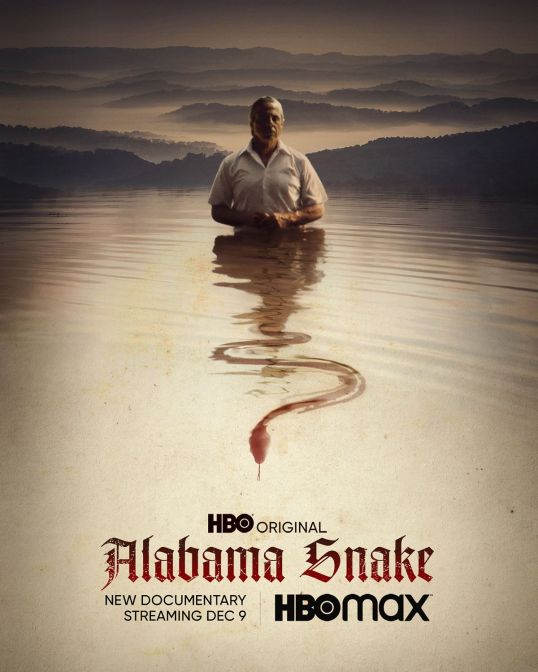
Alabama Snake is a creepy true crime documentary about Glenn Summerfield, a Pentecostal minister who did handle snakes.  In fact, he had an entire farm of them.  In 1991, he was arrested for trying to murder his wife, Darlene, with those snakes.  Darlene claimed that Glenn was an angry and mentally unbalanced drunk who forced her to stick her hand into a box of rattlesnakes, not once but twice.  The defense claimed that Darlene was trying to kill Glenn with the snakes but that she accidentally got bitten instead.

Featuring commentary from local historian and folklorist Thomas Burton, Alabama Snake takes a look at the crime, the trial, and the culture of fundamentalist serpent handling.  It’s a Southern Gothic horror story and it makes for creepy and atmospheric viewing.  Though the documentary doesn’t always go as far beneath the surface as one might hope that it would, it tells an interesting story and Thomas Burton provides lively commentary.  Fans of strange true crime will enjoy it and those of us who need another excuse to be wary of snakes will find one.

Holiday Film Review: The Christmas Chronicles 2 (dir by Chris Columbus)


If I ever actually meet Santa Claus, I’ll be really disappointed if he doesn’t look like a bearded Kurt Russell.

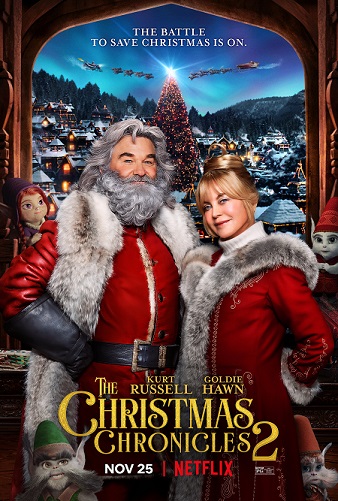
Russell plays the role of St. Nicholas in The Christmas Chronicles 2 and he’s absolutely perfect in the role.  It’s not just that Russell is an intensely likable actor, though that’s certainly some of it.  Santa, after all, should be a likable character and it’s pretty much impossible not to like Kurt Russell.  Even when he was killing people in Death Proof, he was still the most likable serial killer that you could ever hope to meet.  Beyond just being likable, though, Russell brings a lot of joi de vivre to the role of Santa.  As played by Russell, Santa loves what he does.  Spreading Christmas cheer and keeping the holiday spirit alive is what he lives for.  Over the years, movies have given us stern Santas and humorous Santas and occasionally even incompetent Santas.  Kurt Russell is the fun Santa.

In The Christmas Chronicles 2, Russell is joined by his real-life partner, Goldie Hawn.  Goldie plays Mrs. Claus, who turns out to be a witch but a good one.  She’s the type of witch who makes gingerbread cookies the explode, which is certainly the best type of witch to be.  As I watched Goldie Hawn in this film, it occurred to me that if Hollywood is ever foolish enough to try to remake The Wizard of Oz, Goldie would be the perfect choice for Glinda.  Not surprisingly, Hawn and Russell have a lot of chemistry in The Christmas Chronicles 2.  They’re the perfect couple.  They’re exactly who you would hope Santa and Mrs. Claus would turn out to be.

(I have to say that, of all the Hollywood couples out there, Kurt Russell and Goldie Hawn are the couple that I would want to actually live next door to.  Kurt seems like he would be good about repairing stuff around the neighborhood while Goldie seems like she would be the type to keep an eye on my Amazon deliveries until I got home from work or wherever.  I’d much rather live next to them than George and Amal Clooney, if just because the Clooneys seem like they would be the type to complain because you accidentally clipped their yard with a lawn mower or something.)

The Christmas Chronicles 2 actually does have a plot and it tells a pretty sweet little story.  A bitter elf named Belsnickel (Julian Dennison) is trying to ruin Christmas and it’s all up to Katie (Darby Camp) and Jack (Jahzir Bruno) to help Santa and Mrs. Claus save the world’s Christmas spirit.  Along the way, Katie gets to travel through time and meet her father and both Katie and Jack learn about the importance of family.  It’s all very sincere and very sweet and if it doesn’t bring at least one tear to your eyes this holiday season, you’re hopeless.  That said, The Christmas Chronicles 2 is ultimately all about star power and charisma.  The film works because Russell and Hawn are a total joy to watch.  Consider this: it’s a 114-minute film but the main story is resolved in 90 minutes.  The remaining 24 minutes are spent watching Russell and Hawn light a Christmas tree and hang out with Santa’s elves and it’s absolutely delightful to watch!  By the end of the film, you basically just want to move to the North Pole and live with the Clauses.

The Christmas Chronicles 2 is currently on Netlfix and it’s a fun little holiday romp.  It’s perfect for kids and the adults who sometimes have to watch movies with them.  There’s a great musical number and a few surprisingly clever jokes.  (I loved that when Santa and Mrs. Claus watched It’s A Wonderful Life, it was a version that had been dubbed into the Elvish language.)  Check it out.  It’ll lift your holiday spirits.


Holiday Film Review: Christmas Lodge (dir by Terry Ingram)


So, here you are.  You’re hiking in the wilderness with your boyfriend and you can’t help but notice that he doesn’t seem to be much of an outdoorsman.  He’s a city boy and you’re a mountain girl and who knows if those two cultures can come together.

Well, it turns out that they can’t but don’t worry!  No sooner has your boyfriend dumped you than you’ve found a new purpose in life!  You’re helping to restore and rebuild the old Christmas lodge where you and your family used to spend the holidays.  The important thing is to get it done quickly enough so that grandpa can see the lodge for one last time before he dies.  Fortunately, the lodge is owned by a handsome man who needs someone to be a mother for his daughter.  Perfect, right?

There’s really not a lot of conflict to be found in this film.  Erin Karpluk plays Mary, who decides to save the lodge and, at no point, does she really suffer from the type of self-doubts that you would expect someone to suffer in a film like this.  Instead, she decides to do it and then she does it.  There’s a few people who think that Mary is wasting her time but they quickly change their minds.  Even her break-up with her boyfriend has to be one of the nicest, most polite break-ups that I’ve ever seen.

Make no doubt about it, 2011’s Christmas Lodge is a holiday movie.  It’s continually positive and upbeat and unabashedly sentimental and, if you’re into that sort of thing, you’ll enjoy it.  And, to be honest, the holidays is a good time to give up cynicism and be optimistic for at least a few days.  Me, I get cheerfully sentimental when it comes to the holidays.  I smile at every Christmas tree.  I love every gift that I get.  And I usually shed a few tears while sharing memories with the family.  That’s what the holidays are for.  Christmas Lodge does a good job of tapping into that spirit.

That said, Christmas Lodge is perhaps a bit more religious that some people are going to like.  The film may seem like a typical romantic Hallmark holiday film but ultimately, there’s a lot of talk about God wanting the lodge to be built and the family to come together.  At one point, Mary’s grandfather even asks a hesitant carpenter what Jesus would do if he was told that the lodge needed to be repaired.  Personally, I suspect that he would open up the lodge to the poor and the homeless but, in Christmas Lodge, apparently he would just give up whatever other projects he had going on and lend a helping hand so the family could gather there while snow gently fell outside.

That said, I’m a sucker for any film that has people celebrating the holidays while snow gently falls from the sky.  Christmas Lodge is a sweet-natured movie.  It’s not the type of film that you’re going to watch in the harsh heat of the summer but, for the sentimental holidays, it gets the job done.

Holiday Film Review: Beyond Tomorrow (dir by A. Edward Sutherland)


I’m standing at the edge of tomorrow
And its all up to me how far I go
I’m standing at the edge of tomorrow

I’ve never seen such a view before
A new world before my eyes
So much for me to explore
It’s where my future lies

Today I’m standing at the edge of tomorrow
From here the future looks bright for me
And it’s all up to me how far I go
It’s my time to break away
I’m standing at the edge of tomorrow
Today

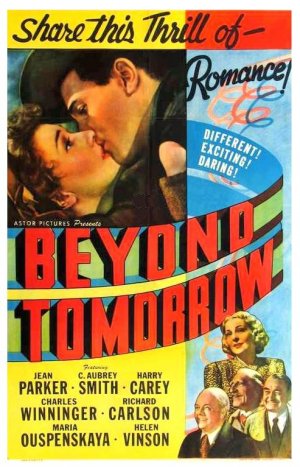
Beyond Tomorrow is a strange film from 1940.  Technically, it is a holiday film.  It takes place during the Christmas season and there’s a lot of very peppy scenes featuring people celebrating the holidays.  I watched the movie with my friends in the Late Night Movie Gang.  We’re a pretty sentimental group but even we felt that some of the characters went a bit overboard with the holiday cheer.  The film is also comedy and a romance and a musical and a ghost story and a melodrama and finally an oddly sincere meditation on life and death.  That’s a lot of weight for one film to carry and there were more than a few times that Beyond Tomorrow seemed like it might collapse in a heap of Christmas ambition.  Fortunately, the film always righted itself and, in the end, it actually managed to be …. well, definitely more interesting than what any of us were expecting!

The film opens with three businessmen (Harry Carey, C. Aubrey Smith, and Charles Winninger) living in a mansion with their Russian housekeeper (played by Maria Ouspenskaya, who was also the old gypsy lady in The Wolf Man).  As almost something of a lark, the three men arrange for James (Richard Carlson) to meet Jean (Jean Parker).  Jean is a teacher.  James is a singing cowboy from Texas.  Together, with the encouragement of the three businessmen, Jean and James get together.  Awwwww!

Unfortunately, the three businessmen are then all killed in a plane crash.  However, their ghosts remain on Earth and watch over the growing love between James and Jean.  Unfortunately, James become a singing sensation on the radio and soon, he’s being tempted to cheat.  Meanwhile, Jean’s ex-husband is running around with murder in his heart and a gun in his hand!  This romantic comedy has suddenly taken a very dark turn!

While the three ghosts look after James and Jean, they consider why they’re still on Earth and not in the afterlife.  One ghost is eventually greeted by his son, who died during the Great War.  Another one of the businessmen is haunted by vaguely defined sins and, even in death, he refuses to repent because he feels that he doesn’t deserve to go to Heaven.  Instead, he continually walks off into the darkness.  The last businessman continually tries to push James and Jean on the right path but it turns out that it’s not easy for the dead to talk sense to the living.

You can probably give yourself whiplash trying to keep up with the film’s tonal changes.  It starts out with romance and comedy and then suddenly, it’s turns into an existential rumination of love, forgiveness, and guilt.  Once the three businessmen die, it becomes a totally different story.  Suddenly, soldiers are returning from the dead and the gates of Hell are beckoning.  And, on top of that, James keeps breaking out into song every few minutes!

It’s a very strange film.  Unfortunately, from the start, the pacing feels off.  By today’s standards, Beyond Tomorrow gets bogged down in all of the songs and the scenes of holiday mirth-making.  That may not have been as much of a problem for audiences in 1940 but I have to say that, speaking as someone trying to watch this film in 2020, Beyond Tomorrow made my ADD go crazy.  If not for my friends and their patient willingness to inform me what was going on in the film, I probably wouldn’t have been able to follow the film’s storyline.

That said, the film was fairly well-acted and the final scenes, with the heavenly gates in the sky, are undeniably effective.  Speaking as a history nerd, I found it interesting to see how the shadow of World War I still hung over a film that was made 21 years after that war ended.  As the scenes in which one of the ghosts is a reunited with son showed, America was still dealing with trauma and horror of the first modern war.  (One year after the release of Beyond Tomorrow, Japan would bomb Pearl Harbor and America entered World War II, a conflict that many hoped to avoid precisely because they remembered the all of the men who didn’t make it home during the previous war in Europe.)  Messy though the film may be, Beyond Tomorrow functions well as both a historical document and a bit of sentimental wish fulfillment.

Compared to holiday classics like the original Miracle on 34th Street and It’s A Wonderful Life, Beyond Tomorrow is relatively unknown.  Certainly, it’s no classic.  But, for fans of both Christmas and old movies, it’s still an interesting trip into the past.

Film Review: Small Axe: Red White and Blue (dir by Steve McQueen)


Red, White, and Blue opens with a very young Leroy Logan (Nathan Vidal) standing on a London street corner.  Behind him is the school that he attends.  He’s wearing a school uniform.  As the other students walk past him, they say hi and acknowledge the very obvious fact that Leroy is a student who is waiting to be picked up by his parents.

That, however, doesn’t matter to the two white police officers who walk up to Leroy and start to interrogate him as to why he’s standing on the street corner.  They inform Leroy that there have bee several burglaries in the area and that the burglar is a young, black male.  They start to search Leroy.  The only thing that stops them is the arrival of Leroy’s father, Ken (Steve Toussaint).  Ken reprimands the police for harassing his son.  While driving Leroy home, Ken tells Leroy that he expects his son to do two things for him.  Leroy is never to become “a roughneck” and he’s never to bring the police to his front door.

Jump forward several years and Leroy Logan (now played by John Boyega) is now grown up and working as a forensic scientist.  When his father is beaten by two police officers who claim that Ken was blocking traffic and that he was resisting arrest (neither is true), Leroy decides to channel his anger into something productive.  He applies to join the police force, hoping to bring about change from within.

Needless to say, that turns out to be more difficult than even Leroy was expecting.  At first, Leroy finds himself being used as a prop.  Knowing that they’ve got to fix their public image, the police uses Leroy as a part of their latest public relations campaign, featuring him in advertisements and news stories.  But on the streets, Leroy finds himself an outsider.  His fellow cops, the majority of whom are white, refuse to have his back and welcome him to the force by writing racist graffiti on his locker.  Meanwhile, the members of his community now distrust Leroy, accusing him of selling out and calling him a traitor.  Leroy became a police officer believing that he could be an agent of change but he soon discovers that no one is interested in changing.

At the heart of the film is Leroy’s relationship with his father.  Though Leroy joined the force to try to make life better for men like his father, he didn’t tell Ken about his decision.  In fact, Ken doesn’t find out until two police officers show up at this doorstep, checking to make sure that Leroy put the correct address on his application.  Ken believes that the system cannot be changed.  Leroy disagrees.  The film leaves it to us to decide which man is correct.

Red, White, and Blue is based on a true story.  Leroy Logan was one of the first blacks to join the London Metropolitan Police and he joined for the same reasons that are shown in the film.  Eventually, Leroy would work his way up to being a superintendent and he would help to found and later chair the Black Police Association.  Interestingly enough, the details of Leroy’s eventual success are left out of Red, White, and Blue.  Instead, the film ends with Leroy and his father at the kitchen table, still wondering if things can change.  It’s an ambiguous ending, one that’s hopeful because, even though he’s disillusioned, Leroy hasn’t given up but, at the same time, it’s also one that accepts that it’s going to take more than just one man to change the culture of the police.  It’s an ending that suggests that racism is so ingrained in society that the only way to vanquish it might be to just start all over again from the beginning.  It’s an ending that manages to be both low-key and revolutionary at the same time.

Red, White, and Blue is the third film in Steve McQueen’s Small Axe anthology.  It’s a deceptively simple film, one that kind of sneaks up on you and takes you by surprise.  The minute that you start to think the film is going to be just another well-intentioned liberal plea for tolerance, McQueen will throw in an unexpectedly honest scene that will shake your expectations.  For instance, when Leroy tries to help a prisoner who has been brutalized by a bunch of racist cops, his help is rejected and Leroy discovers that the prisoner hates him even more than he hates the cops who were beating on him.  The prisoner takes it for granted that the white cops are going to be brutal but he saves his most vicious scorn for someone whom he consider to be a traitor to his race.  McQueen directs in a matter-of-fact but enthralling style, emphasizing the bleak coldness of the London landscape.

John Boyega and Steve Toussaint both anchor the film with ferocious performances.  Leroy spends the majority of the film having to hold back his anger and, sometimes, his despair and Boyega does a wonderful job suggesting what’s going on behind Leroy’s outward calmness.  Boyega does get to do some yelling, of course.  When he confronts his follow police officers for refusing to respond to his calls for backup, Boyega doesn’t hold back.  But his best moments are the quiet ones, where Boyega subtly but powerfully suggests that anger and the pain that Leroy has to deal with every day.

Red, White, and Blue is a short but powerful film.  Check it out on Prime.

Holiday Film Review: Yes, Virginia, There Is A Santa Claus (dir by Charles Jarrott)


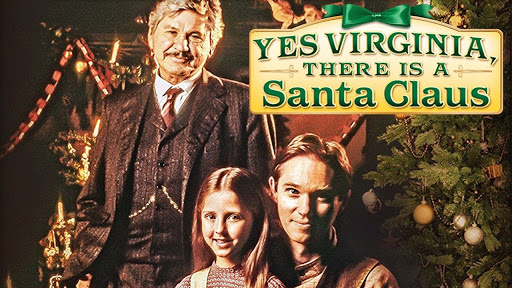
The year is 1897 and eight year-old Virginia O’Hanlan (Katharine Isabelle — yes, that Katharine Isabelle) has a problem.  All of her “little friends” say that there is no Santa Claus!  When she asks her father (Richard Thomas) about whether or not there’s a Santa Claus, he suggests that she write a letter to the New York Sun.  “If you see it in the Sun,” he says, “it must be true!”  The letter ends up on the desk of a gruff editor (Edward Asner) who assigns Virginia’s question to Frank Church (Charles Bronson), an alcoholic who is still mourning the deaths of his wife and child. Conquering his own cynicism and depression, Church writes an editorial reply that goes on to become not just a holiday classic but also the most frequently reprinted editorial in history.  Yes, Virginia, Church begins, there is a Santa Claus….

This 1991 film is a sweet-natured retelling of the famous story of Frank Church’s editorial.  Of course, it takes considerable liberties with the actual story.  Here’s just a few examples.

In real life, the editorial was published in September.  In the movie, it’s published on Christmas Eve.

In real life, Virginia’s father was a doctor and she came from a middle class family.  In the movie, Virginia’s father is an Irish immigrant and laborer who is so poor that the O’Hanlan’s might not be able to afford a Christmas!  They live in a tenement and Virginia’s father is frequently harassed by not only the cops but also corrupt labor officials.

In real life, Frank Church was a notoriously cynical atheist who reportedly had little use for Christmas and specifically didn’t sign his name to his famous editorial because he didn’t think much of it.  At the time that he wrote the editorial, he was also a bachelor.  He did marry shortly after the editorial was published but he never had any children.  In the film, Frank is a widower who rediscovers his zest for life and who smiles broadly while listening to Virginia’s father read it aloud.

And, of course, in real life, it’s very probable that the letter was written by Virginia’s parents because how many eight year olds would actually write something like, “Some of my little friends say there is no Santa Claus.”  In the movie, however, Virginia writes the letter herself.

In other words, this is a nice movie that just happens to be terrible history.  The film does end with a disclaimer that clarifies that “certain events have been fictionalized.”  Actually, the entire story has been fictionalized, with the exception of the content of Church’s editorial.  That said, this is a sweet-natured and generally likable movie.  If nothing else, it’s a film that means well and, as tempting as it may be to roll your eyes at the film’s unabashed sentimentality, it’s sincerity feels right for the holiday season.  It’s a made-for-TV movie from the early 90s so don’t expect any surprises but it’s nicely acted and even Charles Bronson seems to be in a good mood by the end of it.

As far as movies about journalists lying to children are concerned, this is a good one.  Just don’t watch it for a history lesson.

Star in the Dust (1956, directed by Charles F. Haas)


The time is the late 1800s and the place is the town of Gunlock.  Gunlock is split between the ranchers and the farmers, with the ranchers eager to buy all of the land around the town and the farmers refusing to sell.  Trying to keep the peace is Sheriff Bill Jorden (John Agar), who not only wants to keep war from breaking out in Gunlock but who also wants to live up to the example of his legendary father.

There’s a prisoner in the Gunlock city jail.  Sam Hall (Richard Boone) is a notorious gunman who has been convicted of killing three farmers.  He’s due to hang at sunset but everyone in town believes that Sam will somehow escape the executioner.  (They’re even taking bets down at the local saloon and casino.)  Everyone knows that Sam was hired by the ranchers but Sam has yet to name which rancher specifically invited him to come to town.  The farmers want to lynch Sam.  The ranchers want to break him out of jail and arrange for him to be killed in the resulting firefight.  Meanwhile, Sheriff Jorden insists that he’s going to carry out Sam’s sentence by the letter of the law.  Complicating matters for Jorden is that he’s engaged to Ellen Ballard (Mamie Van Doren), the sister of the main rancher, George Ballard (Leif Erickson).

I was really surprised by Star in the Dust, which turned out to be far better than I would normally expect a John Agar/Mamie Van Doren western to be.  Though Agar, Boone, and Van Doren get top-billing, Star in the Dust is really an ensemble piece, with several different people responding to the possible hanging of Sam Hall in their own way.  Sam’s girlfriend, Nellie Mason (Colleen Gray), tries to figure out a way to keep Sam alive.  One of the ranchers, Lew Hogan (Harry Morgan), is morally conflicted about whether or not to honor his word to help Sam escape, especially after he finds out that Sam tried to rape his wife (Randy Stuart).  Even the old deputies (played by James Gleason and Paul Fix) get a few minutes in the spotlight before the shooting begins.  The town of Gunlock comes to life and everyone, from the villains to the heroes, has a realistic motivation for reacting in the way that they do to Sam’s pending execution.

Mamie van Doren’s role is actually pretty small.  She doesn’t have enough screen time to either hurt or help the film overall.  John Agar is as stiff as always but, for once, it works for his character.  Sheriff Jorden isn’t written to be a bigger-than-life John Wayne type.  Instead, he’s just a small town lawman trying to do his job and keep the peace.  Not surprisingly, the film is stolen by Richard Boone, who brings a lot of unexpected shading and nuance to the role of Sam Hall.  Hall may be a killer but he has his own brand of integrity and, if he’s going to die, he’s determined to do it his way.

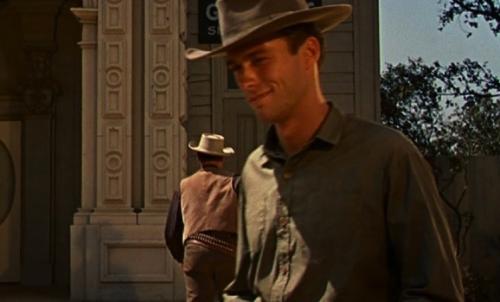
Produced by the legendary Albert Zugsmith, Star in the Dust is a surprisingly intelligent and well-acted B-western.  If you watch carefully, you might even spot Clint Eastwood playing a ranch hand named Tom who wants to know if he should put money down on Sam Hall being hanged.  Though he was uncredited in this tiny role, Star in the Dust was Eastwood’s first western.