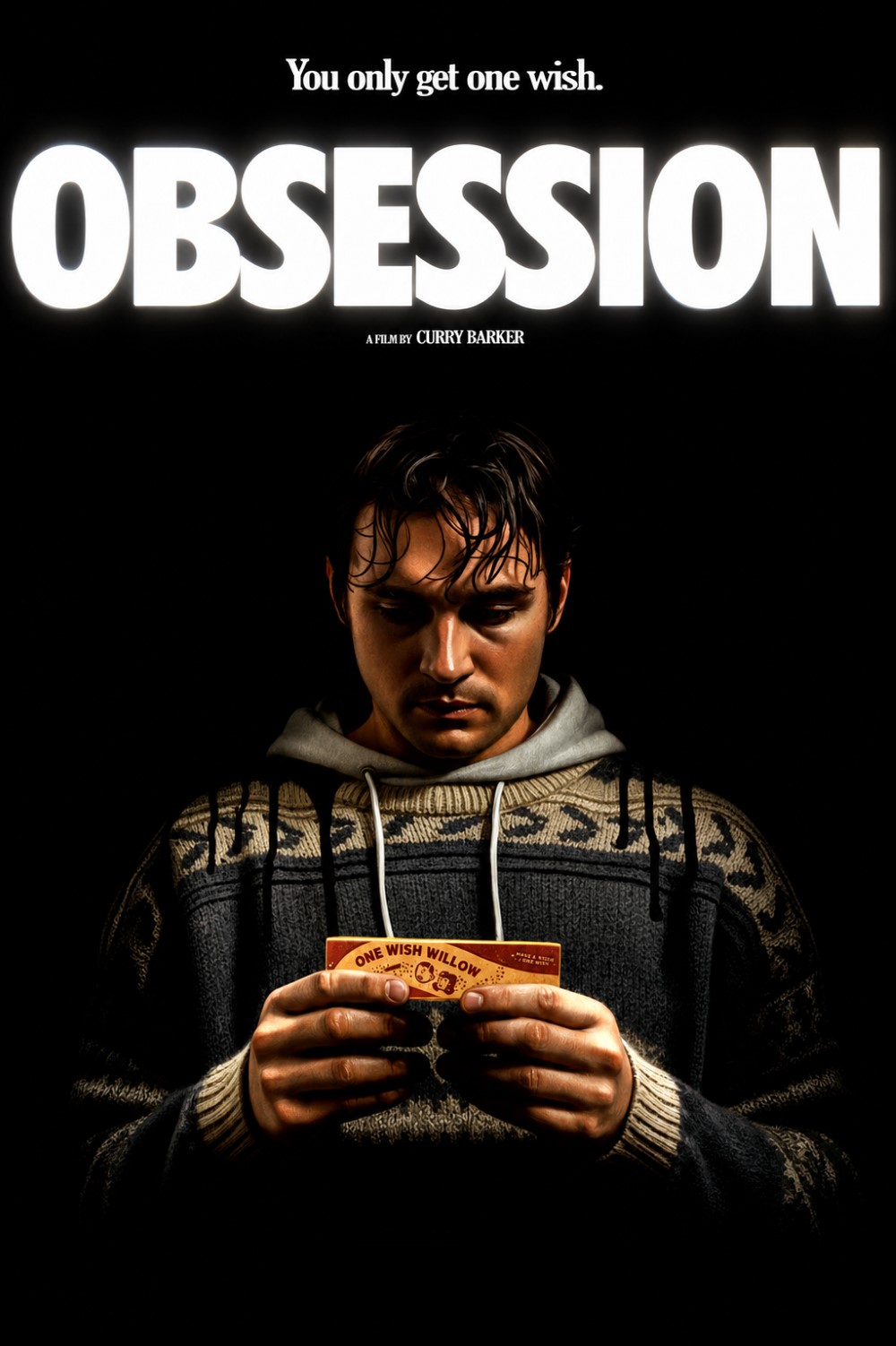
“Just because you chose this for her doesn’t make it less real.” — Phone Operator
There is something especially unsettling about horror films that begin with a simple emotional truth. Obsession, written and directed by Curry Barker, starts with a feeling most people understand: wanting someone to love you back. Barker takes that universal desire and twists it into something ugly, tragic, and terrifying. The result is a horror film that works both as a supernatural nightmare and as an uncomfortable examination of loneliness, entitlement, and emotional dependency.
The premise sounds deceptively simple. Bear, played by Michael Johnston, is a socially awkward young man hopelessly in love with his longtime friend Nikki, played by Inde Navarrette. Bear convinces himself that if circumstances were just slightly different, Nikki would finally realize he is the right person for her. When he discovers a supernatural object known as the “One Wish Willow,” he makes the disastrous decision to wish that Nikki would love him completely. Naturally, the wish mutates into something horrific, transforming Nikki’s affection into a violent and all-consuming obsession.
At its core, Obsession feels like an old-fashioned monkey’s paw story updated for the modern age. Barker takes the familiar “be careful what you wish for” premise and dials the nastiness up to 11. The film fully commits to the emotional ugliness of its concept, giving the well-worn trope a vicious bite that makes the movie far better than it has any reason to be. Instead of treating the supernatural element like a gimmick, Barker roots the horror in emotional selfishness and the terrifying consequences of trying to control another person’s feelings.
What makes the film work so well is that Barker avoids turning the story into a heavy-handed moral lecture. The script trusts the audience to understand the disturbing reality underneath Bear’s actions. Bear is not portrayed as a cartoon villain. He is insecure, lonely, emotionally immature, and quietly resentful. That complexity makes him far more unsettling because he feels recognizable. The film taps into a very modern type of “nice guy” entitlement, where affection is viewed less as mutual connection and more as something owed or deserved.
Michael Johnston gives an impressively layered performance as Bear. He never plays the character as openly monstrous right away. Instead, Johnston leans into Bear’s passivity and self-pity, making him seem like someone convinced life has unfairly denied him happiness. Even as events spiral out of control, Bear continues rationalizing his decisions instead of fully confronting the damage he has caused. Johnston manages to make the character pathetic, frustrating, and disturbing all at once.
Inde Navarrette delivers the film’s strongest performance as Nikki. Once the wish begins taking hold, Navarrette shifts between affection, emotional collapse, desperation, and outright menace with remarkable control. What makes her performance especially effective is that Nikki never stops feeling human beneath the horror. There is a lingering sadness to the character because the film makes it clear she is losing her autonomy piece by piece. That loss of agency becomes one of the movie’s most disturbing ideas.
More than anything, Obsession is about the horror of emotional suffocation. Barker exaggerates toxic relationship dynamics into supernatural horror, but the emotions underneath everything feel believable enough to sting. The film understands how frightening dependency can become when love starts turning into possession. In many ways, the supernatural curse almost feels secondary to the emotional damage unfolding between the characters.
One of the film’s biggest surprises is how confidently Barker handles tone. Considering his background in online comedy and internet content, it would have been easy for the movie to lean too heavily into irony or self-awareness. Instead, Obsession balances dark humor and psychological dread remarkably well. There are genuinely funny moments throughout the film, often rooted in painfully awkward social interactions, but the comedy never weakens the horror. If anything, it makes scenes more uncomfortable because the characters and situations feel recognizable.
Visually, the film punches far above its apparent budget. Barker and cinematographer Taylor Clemons create an atmosphere that feels claustrophobic and emotionally oppressive. The framing often leaves characters isolated within empty spaces, subtly reinforcing the loneliness and discomfort driving the story. The lighting also deserves praise, frequently bathing scenes in dim yellows, reds, and shadows that gradually make ordinary environments feel increasingly hostile.
The sound design is equally effective. Barker wisely avoids relying only on loud jump scares. Instead, the film builds tension through silence, distant noises, and subtle audio distortions that make scenes feel emotionally wrong before anything overtly frightening even happens. Combined with Rock Burwell’s unsettling score, the movie maintains a lingering sense of dread that hangs over nearly every scene.
When the horror finally erupts into violence, Barker shows admirable restraint. The graphic moments land hard because the emotional groundwork has already been carefully established. Some scenes are genuinely difficult to watch not simply because they are bloody, but because the violence feels directly tied to desperation, obsession, and loss of control. The film understands that emotional discomfort can often be more disturbing than gore itself.
If the movie has weaknesses, they mostly stem from Barker occasionally pushing the central metaphor a little too hard. Some later scenes become slightly obvious in their symbolism, and a few supporting characters feel underdeveloped compared to the leads. Still, those flaws never seriously damage the film because the central performances and atmosphere remain compelling throughout.
What ultimately makes Obsession stand out from many modern horror films is how emotionally specific it feels. Rather than chasing broad social commentary, Barker narrows his focus onto a very particular kind of emotional dysfunction. The film is less interested in making sweeping statements about relationships and more interested in examining the terrifying consequences of confusing love with ownership.
In that sense, the “One Wish Willow” works less as a magical object and more as a representation of selfish fantasy. Bear wants love without vulnerability, rejection, or reciprocity. He wants an easy shortcut to emotional fulfillment. The horror comes from realizing that genuine love cannot exist without freedom.
There are traces of earlier psychological horror films throughout Obsession. The movie occasionally recalls the obsessive fixation of Misery and the emotional body horror of Possession, though Barker filters those influences through a distinctly modern lens shaped by internet-age loneliness and social isolation. Yet despite those influences, the film never feels derivative. Barker’s voice as a filmmaker comes through clearly in both the emotional discomfort and escalating supernatural chaos.
Perhaps the most impressive thing about Obsession is how assured it feels for a filmmaker still early in his career. Barker directs with confidence, gradually tightening the emotional pressure until the movie becomes almost suffocating by its final act. By the end, the film reaches a level of tragic inevitability that feels earned rather than forced.
Obsession succeeds because it recognizes how frightening loneliness and emotional dependency can become when mixed with entitlement and fantasy. Beneath the supernatural premise is a painfully human story about people confusing obsession with love. Curry Barker turns that idea into a disturbing, darkly funny, emotionally bruising horror film that lingers long after the credits roll.
For a filmmaker making such an ambitious leap into feature-length horror, Barker delivers something remarkably confident and emotionally sharp. Obsession is creepy, uncomfortable, tragic, and surprisingly insightful. More importantly, it feels like the arrival of a filmmaker who understands how modern horror can reflect real emotional anxieties while still delivering an entertaining and deeply unsettling experience. In many ways, Barker joins the recent wave of younger horror filmmakers like Oz Perkins and Zach Cregger who have proven that horror, dread, and dark comedy do not have to work against each other. Like those directors, Barker understands how to blend discomfort, absurdity, and genuine emotional tension into a cohesive whole, creating a film that is as unsettling as it is unexpectedly funny.


Pingback: Lisa Marie’s Week In Review: 5/18/26 — 5/24/26 | Through the Shattered Lens
Pingback: The Odyssey (dir. by Christopher Nolan) | Through the Shattered Lens