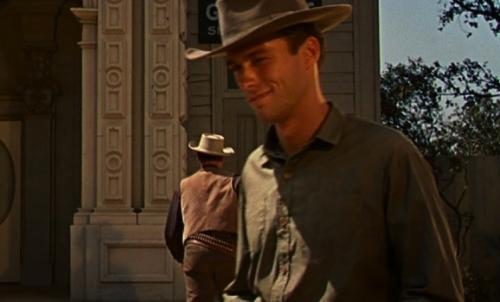
Some films should never be remade and that’s certainly the case with 1957’s The Incredible Shrinking Man.
Why does Scott Carey (played by Grant Williams) start to shrink? While the film does offer up a vague explanation involving chemicals that altered his molecular structure, the film doesn’t waste too much time on the reasons. Instead, what’s important is that he is shrinking. Every day, Scott Carey finds himself getting smaller and smaller and nobody can do anything to stop it. Even the scientific cure proves itself to be only temporary. It’s not just that Scott is getting smaller physically. His confidence is also shrinking. Everything that used to define him as a human being is disappearing. When the press learns that he’s shrinking, he loses his dignity. When he lashes out at the world around him, he loses his self-respect. When he gets angry at his wife, he loses his security. Finally, he’s small enough that, even though he can still speak, he’s essentially lost his voice. He loses the world that he knows and discovers an entirely different world existing within the reality that he once took for granted.
The film is famous for the scene in which Scott, who has been reduced to living in a dollhouse, is attacked by a cat. (Officially, the cat that attacks Scott later played Audrey Hepburn’s cat in Breakfast at Tiffany’s. Rumor has it, though, that Orangey the Cat was actually several different cats who all used the same name.) The cat attack is certainly a bravura bit of filmmaking on the part of director Jack Arnold. Whenever our cats get upset over getting fed a minute or two late, I’m reminded of Scott opening the door of the dollhouse and seeing that giant cat staring in at him. That said, for me, the scariest moment in the film comes at the start when Scott is enveloped in the strange mist that will eventually cause him to start shrinking. It’s such an atmospheric and creepy scene but Arnold is smart enough not to overplay anything. Scott and his wife originally dismiss it as nothing. That’s what most of us do when something strange happens. It’s a scene that also captures the random cruelty of Scott’s fate. If he had simply gone below deck on his boat, he never would have started to shrink. If his wife had remained on deck with him, she would have shrunk with him and Scott wouldn’t have had to face his fate alone.
Jack Arnold is truly the often-unsung hero of The Incredible Shrinking Man. He took the material seriously. Even more importantly, he stuck with screenwriter Richard Matheson’s ending. When the studio insisted that the film should end with Scott returning to his full height, Arnold refused to shoot it and, amazingly, the studio didn’t make him. Even when test audiences said that they would have liked the film better if Scott had returned to his original height, the studio released Jack Arnold’s version of the film. Not many studios would have the guts to do that today. (Then again, after 20 years of comic book movies, audiences would probably just assume that Scott was going to turn into a superhero and not get upset.) The film ends with the triumph of Scott defeating a spider, but it also ends with Scott still shrinking and we’re left to wonder what could be smaller than microscopic.
I’m normally not a huge fan of science fiction but The Incredible Shrinking Man is a great film. Occasionally, there will be a report of someone wanting to remake it. Hopefully, it’ll never happen. The Jack Arnold/Richard Matheson version is the only one we need.