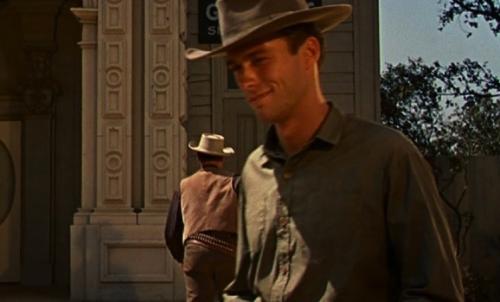
Retro Television Review: Warden Duffy Of San Quentin 1.1 “The Hostages”


Welcome to Retro Television Reviews, a feature where we review some of our favorite and least favorite shows of the past!  This Thursday, I will be reviewing Warden Duffy of San Quinten, which aired its only episode on NBC in 1952.  The show can be found on YouTube!
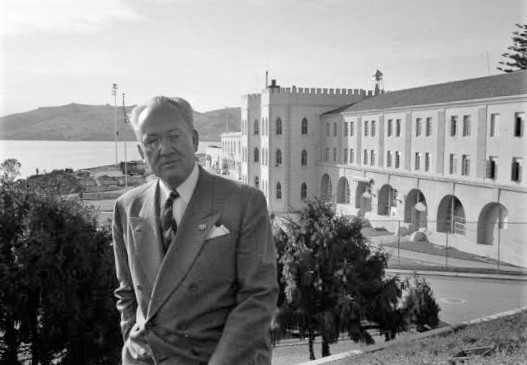
The real-life Warden Clinton Duffy

Episode 1.1 “The Hostages”

(Dir by Walter Doniger, originally aired in 1952)

“Welcome to my hometown,” Warden Clinton Duffy (Paul Kelly) narrates over a montage of still shots of California’s San Quentin Prison. Duffy explains that San Quentin has its own fire department, its own athletic field, its own hospital, and even its own jail, reserved for the prisoners who are too dangerous to be allowed in the general population.

Shot in a noir style, this episode follows one prisoner (John Ireland) who masterminds an attempted jailbreak. He gets his brother (Charles Nolte) to smuggle in a gun. He and his accomplice (Lawrence Tierney) take two members of the prison board hostage and kill a guard. The dapper Clinton Duffy, well known as an advocate for prison reform, tries to negotiate. Negotiations don’t go well, and the episode ends with Tierney, Ireland, and their accomplices dead on the floor of their cell.

Warden Clinton Duffy was a real person. He served as San Quentin’s warden from 1940 to 1952 and had a reputation as a liberal-minded reformer who tried to treat the prisoners with as much humanity as possible. Duffy wrote several books about his time as warden and was also known as an opponent of capital punishment. This show presents him as someone who wants the best for his prisoners but is still willing to give the order to shoot if that’s what is needed to protect innocent lives. Indeed, one gets the feeling that the prisoners’ biggest mistake was taking hostages. If the hostages’ lives hadn’t been in danger, Duffy probably would have been more willing to talk.

Interestingly, Paul Kelly, the actor who plays Duffy, was himself a former San Quentin inmate. Kelly was convicted of manslaughter in 1927 after he beat another actor, Ray Raymond, to death. (Kelly was having an affair with Raymond’s wife and claimed that he had no idea how hard he had hit Raymond when the other actor confronted him.) Kelly served 25 months in San Quentin and, when he was released, was told that while on parole he could take acting jobs, but only if they paid no more than $30 a week. Amazingly, his manslaughter conviction didn’t seem to slow his career at all. Nowadays, an unconfirmed rumor of cannibalism is enough to force a once-prominent actor to start working with Uwe Boll.

As for the pilot, it wasn’t picked up for a series, and it’s easy to see why. The pilot has a noir look that I liked, but the action moved slowly. Stories about hostage negotiations often seem dramatically inert, if only because they always seem to go through the exact same beats. Dog Day Afternoon is the exception to the rule. That said, director Walter Doniger obviously liked the idea of putting Duffy’s story on screen, because he later directed the 1954 film Duffy of San Quentin. In the film, Warden Duffy was again played by Paul Kelly.

Paul Kelly died of a heart attack in 1956, at the age of 57. Clinton Duffy retired as warden of San Quentin in 1952, the same year this pilot aired. He died in 1982.
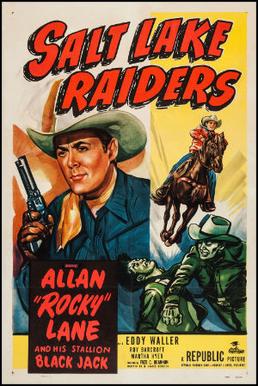
 

Salt Lake Raiders (1950, directed by Fred C. Brannon)


When convicted murderer Fred Mason (Myron Healey) escapes during a prison transfer, frontier Marshal Rocky Lane (Allan Lane) is brought in to re-capture him.  It’s believed that Fred has returned to the ghost town of Silver City so that he can retrieve a buried treasure of $100,000.  But when Rocky tracks Fred down, Fred insists that he was set up and that he didn’t kill anyone.  Rocky, Fred, and Nugget Clark (Eddy Waller) are soon captured by outlaw Brit Carson (Roy Barcroft), who is also searching for the money.

I wasn’t planning on watching Salt Lake Raiders today.  I’ve long wanted to review a Whip Wilson western and I was hoping I would be able to find one of his films, Silver Raiders, on YouTube.  However, every search that I did for Silver Raiders just returned Salt Lake Raiders.  Instead of watching a Whip Wilson western, I ened up just watching another Allan Lane western.

Salt Lake Raiders is a competently-made but not very memorable western.  The person who set up Fred is no big surprise.  The ghost town is a good location and, as always, Allan Lane is a believable hero.  Eddy Waller, as usual, plays sidekick Nugget Clark and lovely Martha Hyer plays the daughter of the man who Fred was accused of killing,  The movie holds your interest but it’s also so predictable that it is easy to understand why the studios abandoned B-western movies once television started giving them to people for free.

Unless I missed it, there is no mention of Salt Lake City or any other salt lakes in this movie.

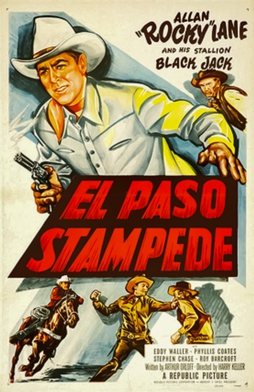
El Paso Stampede (1953, directed by Harry Keller)


With the country distracted by the Spanish-American war, someone is stealing cattle on the border between Mexico and the United States.  Federal marshal Rocky Lane (Allan Lane) is sent to investigate.  He gets a job with Nugget Clark (Eddy Waller), a local feed merchant, and gets to know Nugget’s daughter, Alice (Phyllis Coates).  As was usually the case with these B-westerns, it turns out that the band of onery outlaws is secretly being led by a villain who is an otherwise respectable member of society.  When it comes to the Old West in these films, the biggest threat was not from the outlaws but instead from the greedy and corrupt settlers who wanted to get their own piece of the action and who were willing to sell out their own neighbors and sometimes their own country to get it.  It falls to Rocky and Nugget to save the day, rescue Alice from the bad guys, and recover the cattle.

This was the last of the B-westerns to star Allan Lane as Rocky Lane and Eddy Waller as his sidekick.  Unfortunately, the arrival of television made short programmers like this one obsolete.  Kids could now just watch westerns on television instead of spending the day down at the theater.  This was not a bad western for the Rocky Lane character to go out on, though.  The plot is predictable but that’s to be expected for a 53-minute programmer like this one.  However, Rocky is an appropriately square-jawed hero.  He rides his horse, Black Jack, with authority and he looks convincing handling a gun and throwing a punch.  There are actually some good shots involving the outlaws’s hideout, which just happens to be hidden behind a waterfall.  For western fans, El Paso Stampede is a watchable and undemanding genre entry.

As I mentioned earlier, this was the last film to star Allan Lane.  He appeared in a few more westerns after El Paso Stampede but it was always in supporting roles.  Allan Lane appeared in 88 films, the majority of which were B-westerns like this one.  Today, though, Lane is best-remembered for a role for which he wasn’t even given onscreen credit, providing the voice of the talking horse, Mr. Ed.

Streets of Ghost Town (1950, directed by Ray Nazarro)


Years ago, Bill Donner (George Cheseboro) double-crossed the other members of the Selby Gang and ran off with all of their stolen gold.  Now, Donner is blind and half-crazy.  When he says that he hid the gold in the ghost town of Shadeville, the Durango Kid (Charles Starrett), Smiley Burnette, and Sheriff Dodge (Stanley Andrews) ride off to find it.

Shadeville is long abandoned and, as the three men spend the night in a deserted saloon, Smiley is worried about ghosts.  The Durango Kid tells the story of the first time he met the Selby Gang.  The next morning, they discover that they are not the only ones who have come to Shadeville to look for the gold.

Like many of the later Durango Kid movies, Streets of Ghost Town is mostly made up of stock footage to Starrett’s earlier films.  This was a cost-cutting technique on the part of Columbia Pictures but it actually works because the flashbacks were always to the horse chases and the gunfights that the audience came to see in the first place.  In the days before home video and cable, those scenes were probably still new to many of the people sitting in the theater.

Starrett always made for a good hero and Smiley Burnett’s comic relief never took away from the films’s storylines.  This outing features a great scene where Durango shoots a skull in the dark just to let anyone watching him know that he’s a good shot.  I also enjoyed George Cheseboro’s manic performance as a man who really loves his gold.  Despite all of the stock footage, Streets of Ghost Town is still an above average Durango Kid film, predictable but entertaining if you’re a fan of the genre.

Star in the Dust (1956, directed by Charles F. Haas)


The time is the late 1800s and the place is the town of Gunlock.  Gunlock is split between the ranchers and the farmers, with the ranchers eager to buy all of the land around the town and the farmers refusing to sell.  Trying to keep the peace is Sheriff Bill Jorden (John Agar), who not only wants to keep war from breaking out in Gunlock but who also wants to live up to the example of his legendary father.

There’s a prisoner in the Gunlock city jail.  Sam Hall (Richard Boone) is a notorious gunman who has been convicted of killing three farmers.  He’s due to hang at sunset but everyone in town believes that Sam will somehow escape the executioner.  (They’re even taking bets down at the local saloon and casino.)  Everyone knows that Sam was hired by the ranchers but Sam has yet to name which rancher specifically invited him to come to town.  The farmers want to lynch Sam.  The ranchers want to break him out of jail and arrange for him to be killed in the resulting firefight.  Meanwhile, Sheriff Jorden insists that he’s going to carry out Sam’s sentence by the letter of the law.  Complicating matters for Jorden is that he’s engaged to Ellen Ballard (Mamie Van Doren), the sister of the main rancher, George Ballard (Leif Erickson).

I was really surprised by Star in the Dust, which turned out to be far better than I would normally expect a John Agar/Mamie Van Doren western to be.  Though Agar, Boone, and Van Doren get top-billing, Star in the Dust is really an ensemble piece, with several different people responding to the possible hanging of Sam Hall in their own way.  Sam’s girlfriend, Nellie Mason (Colleen Gray), tries to figure out a way to keep Sam alive.  One of the ranchers, Lew Hogan (Harry Morgan), is morally conflicted about whether or not to honor his word to help Sam escape, especially after he finds out that Sam tried to rape his wife (Randy Stuart).  Even the old deputies (played by James Gleason and Paul Fix) get a few minutes in the spotlight before the shooting begins.  The town of Gunlock comes to life and everyone, from the villains to the heroes, has a realistic motivation for reacting in the way that they do to Sam’s pending execution.

Mamie van Doren’s role is actually pretty small.  She doesn’t have enough screen time to either hurt or help the film overall.  John Agar is as stiff as always but, for once, it works for his character.  Sheriff Jorden isn’t written to be a bigger-than-life John Wayne type.  Instead, he’s just a small town lawman trying to do his job and keep the peace.  Not surprisingly, the film is stolen by Richard Boone, who brings a lot of unexpected shading and nuance to the role of Sam Hall.  Hall may be a killer but he has his own brand of integrity and, if he’s going to die, he’s determined to do it his way.

Produced by the legendary Albert Zugsmith, Star in the Dust is a surprisingly intelligent and well-acted B-western.  If you watch carefully, you might even spot Clint Eastwood playing a ranch hand named Tom who wants to know if he should put money down on Sam Hall being hanged.  Though he was uncredited in this tiny role, Star in the Dust was Eastwood’s first western.