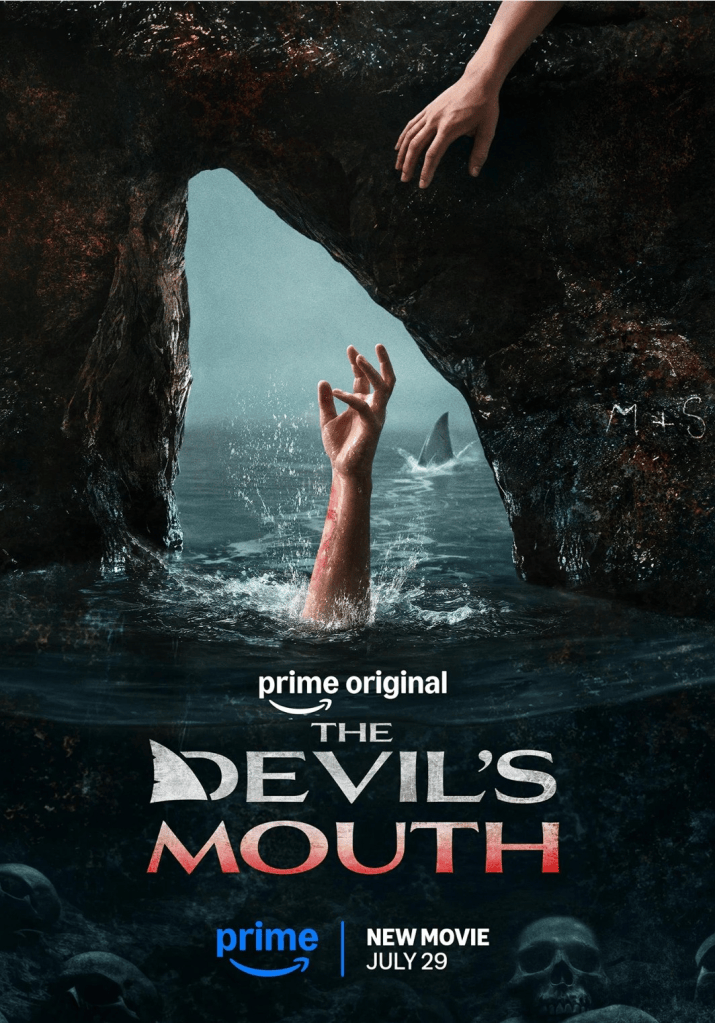
This is movie should be called- Thank Goodness, my friends are all dead!
I don’t always hope for the death of comrades, but when I do I drink… well, it’s Pellegrino…
“The Devil’s Mouth” is a movie that looks more expensive that it is and that is actually a signature of the producer/director Jeff Wadlow. He budgets his films to have nothing left at the end; so, it looks like a studio film, but it was only 3.5MM.
If you’re trying become a filmmaker on a budget, watch an interview with Jeff Wadlow below.
This was a great way to begin my Horrorthon because I got to start it with Lisa. My regular readers know that Horrorthon films are a mixed bag, AT BEST. There are movies that don’t take themselves seriously and just have fun, there are short films that are masterworks, and there are Alex Magana films that strain my belief in humanity’s ability for redemption.
“The Devil’s Mouth” takes place in Thailand and Sara McKenna (Kathryn Newton) is on an caving trip with her MANY toxic friends. Five minutes into the film and the friends are all snorkeling; unfortunately, Sara decides to snorkel too, but her terrible friends mix themselves up and boat off and leave her behind “47 Meters Down” style. Then, she gets attacked by jellyfish and gets actual wounds. Her most toxic friend Max (Lana Condor) doesn’t even apologize. Max’s main personality trait is that she bosses people around the whole movie (badly) and gets most of the group killed.
Sara needs a tough love friend or dad to say, “Look, you’re comin home or I’ll meet you there. Leave that trash behind!”
Also, why are these 20 somethings going caving in the first place and not wanting to just drink and sleep around…ON LAND?! You’re in Thailand! You all should be trying create some souped up version of HPV.
Sara and her terrible friends go to this cave system that was flooded with salt water and it looks super creepy and Max demands the group ignore the guide and go in the evil cave system. It is really amazing that Max and her friends have lived as long as they have. They can barely swim, they have claustrophobia, relationship issues, and Max, the toxic garbage person, leading them.
Because the cave was flooded with salt water, bull sharks have come into the cave system and start eating them all. Unfortunately, Max stubbornly continues to live until the final 15 minutes. Sara valiantly fights of sharks and risks her life to try to keep the body count down, but the sharks just want it more!
Dario Argento spent years trying to bring his version of The Phantom of the Opera to life.
Argento has said that he’s always been fascinated by the story of the mysterious and deformed man living underneath the Paris Opera. He has described watching Arthur Lubin’s 1943 version of the tale as one of the formative events of his childhood. In the ’70s, when he was at the height of his popularity, Argento sought to film his own version of the story in Moscow. When that didn’t work out, Argento put his plans for the Phantom aside. It wasn’t until he was filming Trauma and caught a television airing of the 1925 Phantom of the Opera that Argento returned to the project. Argento’s version of The Phantom of the Opera was released in 1998 and was dismissed by most critics. Even today, it has a reputation for being Argento’s worst film. It’s also not an easy one to see. Whereas most of Argento’s films are always streaming somewhere, The Phantom of the Opera usually is not.
Argento’s Phantom of the Opera opens in Paris in the 19th century. A baby is placed in a basket and, much like Moses, is set adrift in a river. A group of empathetic rats save the baby. The baby grows up to be the Phantom of the Opera (Julian Sands), a classically handsome man who lives in the sewers and protects the rats from anyone who might try to harm them. (Just as rats are killed if they leave the sewers, humans are killed if they enter them.) After the Phantom hears Christine Daaé (Asia Argento) singing alone on the stage of the Paris Opera, he approaches her in the empty theater and tells her that her singing has brought light to his heart. The Phantom and Christine develop a telepathic bond, and she becomes the only person whom he allows to enter the sewers and live. Sometimes Christine loves the Phantom and sometimes she doesn’t. Sometimes the Phantom is a tragically romantic figure and sometimes he’s just a black-clad figure who bites people’s tongues out of their mouths. The Phantom becomes obsessed with Christine, and Christine becomes just as obsessed with the Phantom. Meanwhile, Christine’s other suitor—the aristocratic Raoul (Andrea Di Stefano)—smokes opium, hallucinates that Christine has turned into a prostitute, and languidly watches as two men jump into a pool and fight over the merits of Rimbaud. Painter Edgar Degas makes a cameo appearance but manages to avoid the Phantom’s wrath.
As I mentioned earlier, The Phantom of the Opera is not one of Argento’s more highly regarded films. It’s a slow-paced film, one in which the action often seems to go off on strange tangents that don’t really pay off in the long run. (The opium den brings to mind the deliberately ugly orgy scenes that Tinto Brass directed for Caligula, just without the subversive snap.) Argento attempts to portray the Phantom as both an achingly romantic figure and the type of sociopath who brutally kills anyone who enters the sewer. If he were only killing the rat catchers, the Phantom’s actions could be understood. But as soon as he kills two lovers who just happened to be looking for some privacy, it becomes impossible to sympathize with him. Argento’s attempt to portray The Phantom of the Opera as a story of romance sits uncomfortably with scenes in which the Phantom forces himself on Christine.
That said, I actually like Julian Sands’s performance as the Phantom. Argento’s Phantom is not disfigured in any way and, while that may go against the spirit of the story, at least it means Julian Sands didn’t have to wear a mask while filming his role. Sands exudes a cool, sexy danger, and that makes him just right for Argento’s version of the character. Asia Argento plays Christine as someone who only looks innocent, and it does bring an interesting subtext to the story. Indeed, if not for the prologue featuring the rats saving the Phantom as a baby, one could interpret the Phantom as a manifestation of Christine’s own psychosis. As for the rats, they are yet another example of Argento suggesting that animals have special telepathic powers. For all the criticism Argento has taken for the mystical animals he has included in his later films, it appears to be an idea Argento really likes. Personally, I think there’s a quirky charm to it, but I seem to be in the minority.
I can defend elements of The Phantom of the Opera, but I can’t really defend the film as a whole. It’s a bit too cluttered in its storytelling, and the mix of grand romance and brutal violence doesn’t really work. If this film had been made earlier in Argento’s career, perhaps he could have recreated the grandeur of Paris, but at a time when his films were no longer automatic box-office hits and when the Italian film industry itself was struggling, The Phantom of the Opera often looks cheap and unconvincing. Every director has the occasional misfire. Dario Argento has The Phantom of the Opera.
#TubiThursday is a weekly watch party that meets over Thursday at 10 pm et and watches a movie, preferably one that is on Tubi. If you join us, use the #TubiThursday hashtag.
“You may think you’re getting off free, but there’s other justice in this world besides the law!” — Mrs. Ritter
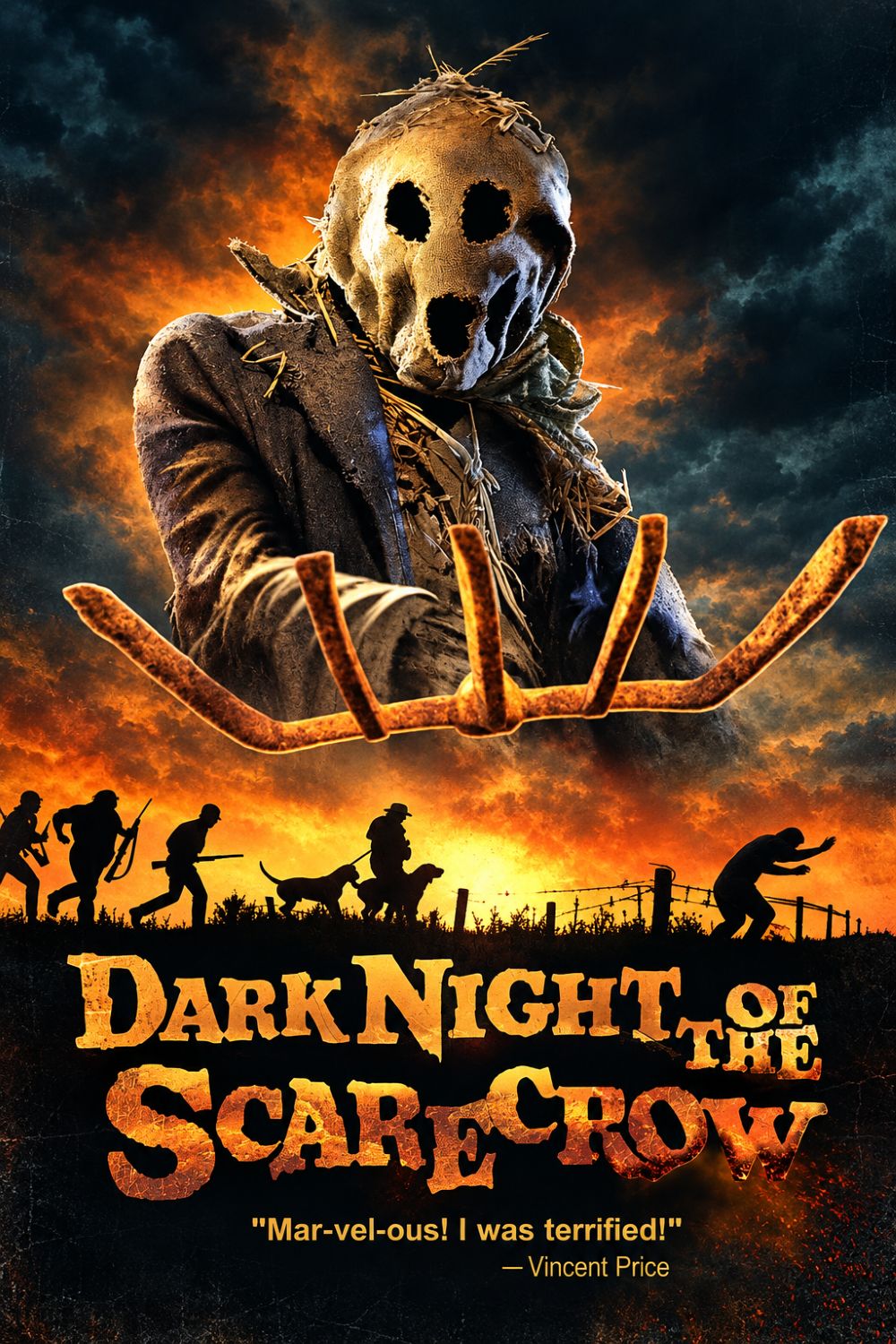
Frank De Felitta’s Dark Night of the Scarecrow is one of those deceptively modest horror movies that earns its power through atmosphere, patience, and an unusually bitter sense of injustice. Originally made for television in 1981, it has none of the glossy excess or elaborate effects work associated with many theatrical horror releases of its era. What it does have is a sharply constructed premise, a remarkable villain performance from Charles Durning, and a quiet rural setting that becomes steadily more unnerving as the story moves from tragedy into supernatural revenge. It is the kind of film that understands a scarecrow is already an inherently creepy image; it does not need to overexplain or overuse that image to make it work.
The story takes place in a small Southern town where Bubba Ritter, played by Larry Drake, is a gentle, developmentally disabled man whose closest friend is a young girl named Marylee Williams. Their friendship is innocent and affectionate, but it is viewed with suspicion by Otis P. Hazelrigg, a cruel local mail carrier with a personal grudge against Bubba. When Marylee is attacked by a dog and briefly goes missing, Hazelrigg turns the situation into an accusation, convincing three other men that Bubba has harmed the girl. Before anyone bothers to learn the truth, the men hunt Bubba down, shoot him, and stage the scene to make it appear as though he was armed. It is a brutal opening act precisely because the movie refuses to treat its central tragedy as an excuse for cheap melodrama. Bubba is not a monster, and the men who kill him are not panicked heroes making an understandable mistake. They are cowardly, angry men who allow prejudice and resentment to become a death sentence.
That foundation is what separates Dark Night of the Scarecrow from a standard slasher or revenge movie. The supernatural material only becomes effective because the human evil comes first. Bubba’s death is not merely a plot device to unleash a vengeful ghost; it is the film’s moral wound. De Felitta, a veteran novelist as well as the director, approaches the story with an eye for the emotional damage left behind by that act. The film slows down after the killing, allowing the town to sit with the consequences while Hazelrigg becomes increasingly paranoid that Bubba has returned from the grave.
Charles Durning is the movie’s secret weapon. Hazelrigg is one of those villains who is frightening not because he is physically unstoppable, but because he is such a believable bully. Durning gives him a sweaty, blustering confidence that gradually rots into panic. He is the sort of man who believes his position in the community gives him the right to make judgments about everyone else, and he has no trouble manipulating weaker men into sharing responsibility for his own cruelty. Durning never plays Hazelrigg as a cartoonish sadist. Even when he is snarling threats or trying to cover up the murder, there is something painfully recognizable about him: a man who has built his identity around authority and cannot bear the possibility that he has been exposed as morally bankrupt.
Hazelrigg’s hatred of Bubba also has a nasty layer of projection to it. The movie never outright says he is a pedophile, but it heavily implies it through his creepy interest in Marylee, the way he watches her, and Mrs. Ritter’s pointed remarks. That makes his obsessive claim that Bubba is a threat even more grotesque: Hazelrigg seems to be accusing Bubba of the impulses he cannot admit in himself. The implication makes his hostility toward their friendship feel less like misplaced civic concern and more like jealousy, possessiveness, and a desperate effort to hide his own corruption behind moral outrage. It is one of the film’s darkest touches, especially because it remains mostly beneath the surface rather than being presented as a blunt plot revelation.
Larry Drake has a more difficult task because Bubba spends much of the movie absent, concealed, or transformed into a possible supernatural presence. Yet his early scenes are essential. Drake makes Bubba sweet and childlike without turning him into an object of pity or a collection of mannerisms. His relationship with Marylee, played warmly by Tonya Crowe, gives the film its emotional center. There is genuine tenderness in the way Bubba helps her, plays with her, and treats her with uncomplicated kindness. That sweetness makes the later violence feel all the more ugly. Marylee’s grief also carries real weight, because she is one of the only people who completely understands that Bubba was innocent.
The scarecrow itself is used with admirable restraint. There are no elaborate explanations about ancient curses, possession, or elaborate rules governing the entity. The film instead lets the audience wonder whether Bubba’s spirit has actually returned, whether the scarecrow is a physical vessel for vengeance, or whether Hazelrigg is simply losing his mind under the pressure of guilt. That ambiguity gives the movie much of its lasting chill. A scarecrow standing in a distant field, visible at the edge of a frame or appearing where it should not be, is often more frightening than a clearly defined monster charging at the camera. De Felitta recognizes that the image is powerful because it is still, silent, and vaguely human without actually being human.
The television origins are noticeable in some ways. The pacing is deliberate, the violence is largely implied rather than graphic, and the production is understandably small-scale. But those limitations wind up serving the movie. The lack of gore forces the film to emphasize suggestion, shadows, sound, and the ominous openness of its rural setting. Cornfields, dirt roads, farm equipment, abandoned buildings, and dark porches all become part of the film’s horror vocabulary. It feels less like a slick studio shocker and more like a regional ghost story someone might tell you after dark, the kind where the details are simple but the moral is savage.
De Felitta also has a good sense of escalation. The revenge scenes are not huge set pieces, but they are memorable because each one turns something ordinary into a source of menace. The scarecrow’s presence becomes a warning that the men involved in Bubba’s death cannot escape what they did. Instead of relying on body counts alone, the movie builds suspense around Hazelrigg’s growing desperation. Every time he sees the scarecrow—or thinks he sees it—his confidence cracks a little further. The real terror is not just that the dead may be coming for him. It is that there may be no way to outrun the truth.
The ending delivers the kind of grimly satisfying horror-movie justice that the story has earned. It is not triumphant in a cheerful sense, because nothing can undo the tragedy that put the plot in motion. Still, there is a bleak pleasure in watching Hazelrigg finally face the consequences of his actions. The film’s revenge is measured rather than sadistic, and that makes it more effective. It feels like a judgment rather than a spectacle.
Despite its TV roots, Dark Night of the Scarecrow has become a very underrated horror film, with many genre aficionados lauding it as one of the best horror films made, period. That reputation is understandable. It is not the loudest or bloodiest horror film of the early 1980s, and viewers expecting a fast-paced scarecrow slasher may initially be surprised by how much time it spends on character, grief, and small-town malice. But that is exactly why it endures. The film has a soul beneath its scares, and its simple supernatural premise gains force from the cruelty of the world around it.
Ultimately, Dark Night of the Scarecrow works because it never forgets that its monster is born from human wrongdoing. The scarecrow is frightening, but Hazelrigg and the mob that follows him are worse because they are entirely plausible. Frank De Felitta turns a compact television movie into a haunting morality tale about prejudice, guilt, repression, and the terrible cost of refusing to see another person’s humanity. Its effects may be modest, but its mood is potent, its villain is unforgettable, and its final image lingers like something standing motionless at the far end of a field.
Hi there and welcome to October! This is our favorite time of the year here at the Shattered Lens because October is our annual horrorthon! For the past several years (seriously, we’ve been doing this for a while), we have celebrated every October by reviewing and showing some of our favorite horror movies, shows, books, and music. That’s a tradition that I’m looking forward to helping to continue this year!
First released in 1925, The Phantom of the Opera is today best known for both Lon Chaney’s theatrical but empathetic performance as the Phantom and the iconic scene where Mary Philbin unmasks him. However, the film is also a perfect example of early screen spectacle. The Phantom of the Opera was released during that period of time, between Birth of the Nation and the introduction of sound, when audiences expected films to provide a visual feast and Phantom of the Opera certainly accomplishes that. Indeed, after watching this film and reading Gaston Leroux’s original novel, it’s obvious that the musical was inspired more by the opulence of this film than by the book.
This film is also historically significant in that it was one of the first films to be massively reworked as the result of a poor test screening. The film’s ending was originally faithful to the end of the novel. However, audiences demanded something a little more dramatic and that’s what they got.
Hi, everyone! Tonight, on Mastodon, I will be hosting the #TubiThursday watch party! Join us for the 2008 Stallone masterpiece, Rambo!
You can find the movie on Tubi and you can join us on Mastodon at 9 pm central time! (That’s 10 pm for you folks on the East Coast.) We will be using #TubiThursday hashtag! See you then!
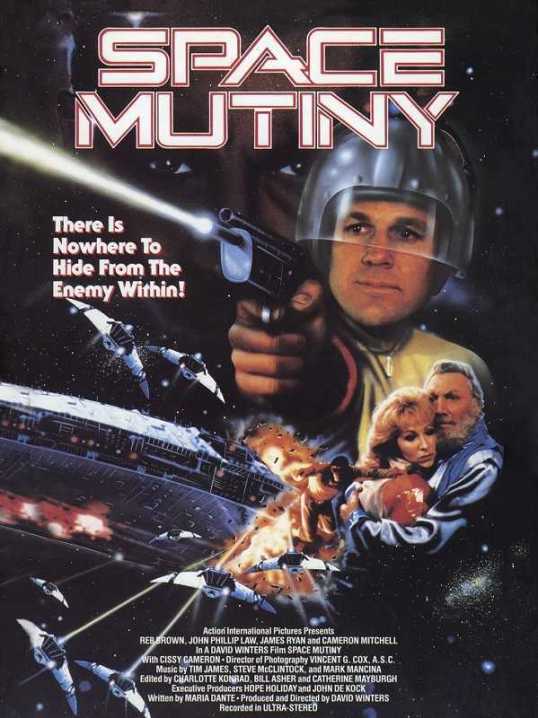
UPDATE: Well, it appears that Tubi has removed Rambo from its service. So, instead, we will be watching SPACE MUTINY(1988), starring Reb Brown! Sorry for any inconvenience!
The opening of Dario Argento’s 1977 masterpiece, Suspiria, is about as perfect an opening as one could hope for. American ballet student Suzy Banyon (Jessica Harper) arrives in Freiburg, Germany. Both Argento and Harper perfectly capture Suzy’s confusion as she makes her way through the airport and, as torrential rain drenches her, attempts to hail a taxi and get a ride to the dance academy. (What Suzy doesn’t know, of course, is that the dance academy is home to the ancient witch known as The Mother of Sighs.)
With this opening scene, Argento both immediately establishes the off-center, nightmarish atmosphere of Suspiria and establishes Suzy as a character who we, as the audience, relate to and care about. Suspiria is a great film and it all begins with this brilliant opening.
(And just as Suzy is starting her journey to the school, we are just starting Horrothon! Get ready for the best 31 days of the year!)
4 Or More Shots From 4 Or More Films is just what it says it is, 4 shots from 4 of our favorite films. As opposed to the reviews and recaps that we usually post, 4 Shots From 4 Films lets the visuals do the talking!
4 Shots From 4 Horror Films
Suspiria (1977, dir by Dario Argento, DP: Luciano Tovoli)
The Shining (1980, dir by Stanley Kubrick, DP: John Alcott)
The Thing (1982, dir by John Carpenter, DP: Dean Cundey)
Day of the Dead (1985, dir by George Romero, DP: Michael Gornick)
Welcome to October! October is a big month here at the Shattered Lens. It’s the month when we devote the majority of our time to the horror genre. It’s time for our annual Horrorthon! Last year, we had a record number of Horrorthon posts. I’d love to break that record this year! A thousand posts? Hey, why not? Mostly, though, I just want this year’s Horrothon to be fun for both our writers and our readers!
Here’s what I’m looking forward to this October!
Halloween — This one should really go without saying but I’m going to say it anyway. Halloween is my favorite time of year! The movies, the costumes, the decorations, I love all of it! I remember when I was a kid, I cried when I realized that I was too old to keep trick or treating. But now that I’m adult, I love watching horror movies on the 31st (Night of the Living Dead, baby!) I love the parties. I love how much my sister enjoys giving out candy. The past two years have been tough for us. This year, we’re just looking forward to enjoying the holiday season.
Digger — I’m not really expecting Digger to be that good. Alejandro Inarritu is one of those directors who tends to be way too pleased with himself. But I have to admit that I am kind of hoping that I’ll be proven wrong. Tom Cruise is one of the last true movie stars and I’m interested to see how he’ll do in this film. We’ll find out soon!
Carrie — Do we really need a new version of Carrie? Probably not. But, hey, I look forward debating it with everyone!
The Horror Movies On TCM — TCM never lets me down in October. I can’t wait to binge all of the classic horror that will be aired this month. The truth of the matter is that movies used to be a lot better. Horror movies used to be fun and unapologetic. Elevated horror? Who needs it?
Wicker — Actually, I’m not so much looking forward to Wicker as much as I’m looking forward to other people watching Wicker and reacting to it. As I mentioned in my review of The Roses, I’ve recently realized that Olivia Colman is kind of annoying. But still, how often do you see a film about wicker coming to life? Actually, did anyone ask for this? Eh. We’ll see.
Sense and Sensibility — Jane Austen in October? Call it counterprogramming! I’m actually a big fan of counterprogramming. Releasing this in the middle of horror month is a brilliant move.
October’s going to be a great month and those of us at TSL can’t wait to celebrate it with you! What are you looking forward to in October?
“All these traditions, jack-o’-lanterns, putting on costumes, handing out treats, they were started to protect us, but nowadays… no one really cares.” — Principal Steven Wilkins
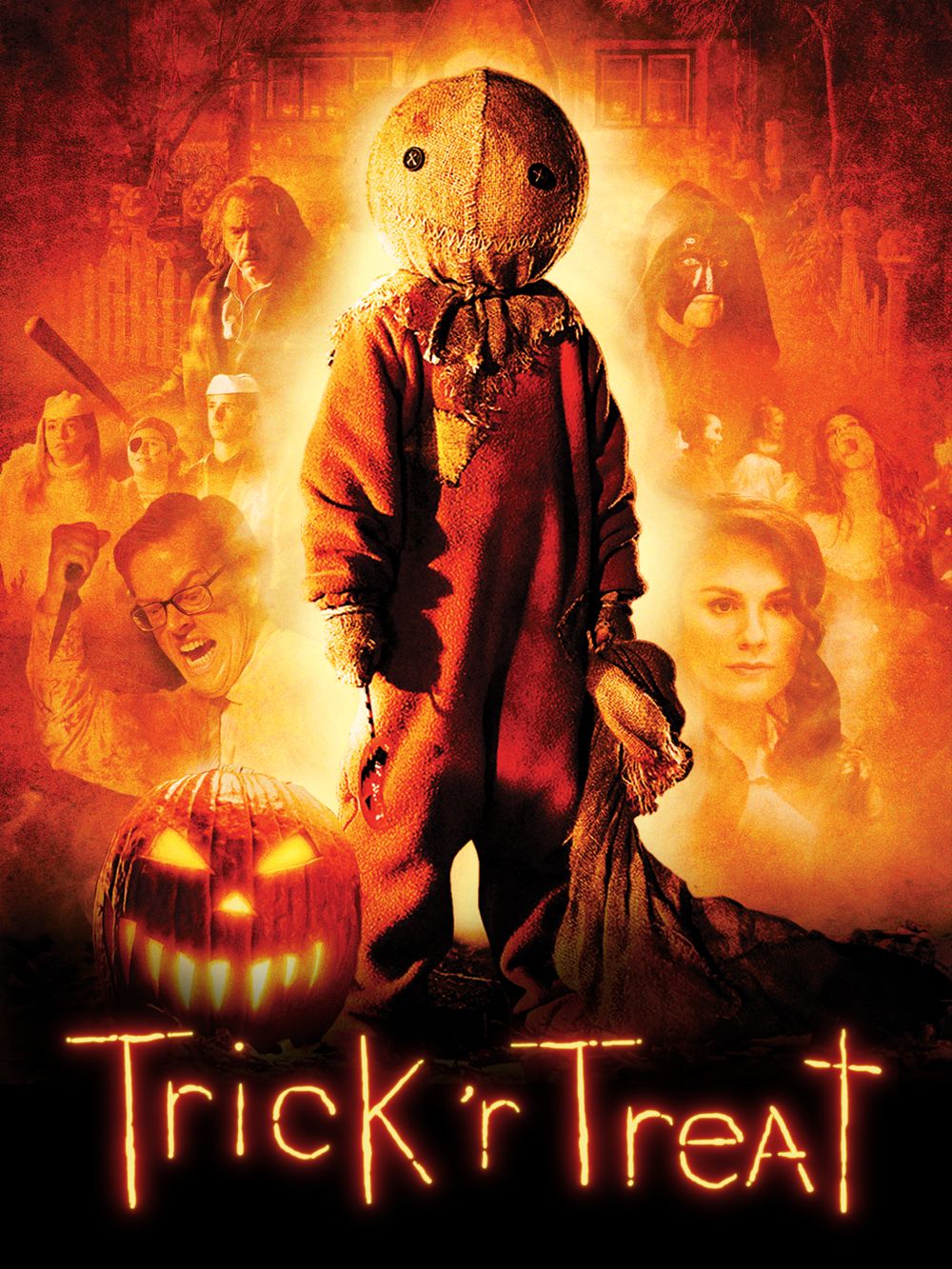
What better and more fun way is there to celebrate the full month of scares and horror that October has become than with Michael Dougherty’s 2007 film Trick ’r Treat? It is the kind of Halloween movie that feels less like it was merely set on the holiday and more like it was built out of everything people love about it. Trick ’r Treat has jack-o’-lanterns glowing on porches, costumes ranging from charming to grotesque, chilly nighttime streets, old local legends, candy bowls, haunted-school-bus stories, werewolves, serial killers, and that ever-present feeling that something is watching from behind a tree. It is funny, nasty, creepy, and strangely cozy at the same time. More than almost any modern horror film, it understands Halloween as a whole atmosphere rather than a collection of familiar props.
At first glance, the movie looks like an anthology film. It is divided into several distinct stories with their own central characters, premises, and horror styles. One segment involves a principal with a murderous secret, another follows a group of kids investigating a grim local legend, another centers on young women looking for dates at a costume party, and another focuses on a bitter old man dealing with a small but persistent visitor. Each story could almost function as its own short horror movie. Dougherty clearly enjoys shifting tones, moving from slasher material to ghost-story melancholy, then into monster-movie lunacy and dark comedy. But the key difference is that Trick ’r Treat is not simply an anthology stitched together by a host or a framing device. Every story told in the film ties into an overarching story unfolding across one night of Halloween.
That structure is one of the movie’s smartest features. Characters drift in and out of one another’s narratives, sometimes briefly and sometimes in ways that completely change the audience’s understanding of what they have already seen. A person who seems like a background extra in one sequence becomes the focus of another. A strange sound, a distant scream, a passing school bus, or a visual detail in one story can gain much more meaning when it reappears elsewhere. The movie plays with chronology too, allowing events to overlap and occasionally revealing that scenes which seemed straightforward were occurring at a different point in the night than viewers assumed. It rewards attention without becoming confusing for the sake of being clever.
Dougherty handles those connections smoothly because the film never stops feeling like one continuous Halloween night. The transitions are playful rather than showy. The camera may follow a character down a street, past a decorated yard, into another group’s story, and suddenly the audience has entered a different kind of nightmare. That makes the town itself feel like a character. It is not a generic horror-movie setting where bad things happen because the script requires them to. It feels like a community with traditions, buried crimes, local myths, annual rituals, and plenty of people who are either hiding something or about to discover something unpleasant.
The town’s Halloween obsession is also what gives the film its personality. Trick ’r Treat treats Halloween rules almost like ancient laws: wear a costume, hand out candy, never blow out a jack-o’-lantern before midnight, and always respect the dead. Breaking those rules does not guarantee immediate punishment in a simple moralistic way, but it certainly puts people at risk. The film’s central icon, Sam, embodies that idea. Wearing orange pajamas, a burlap sack mask, and carrying a lollipop that can become a weapon, Sam is one of the great modern horror mascots because he is both adorable and deeply unsettling. He is not presented as a typical slasher villain with a detailed backstory or a conventional motivation. He feels more like the living spirit of Halloween itself: mischievous, ceremonial, cruel when necessary, and completely devoted to the holiday’s traditions.
Sam’s presence gives the movie a connective thread beyond plot mechanics. He appears in the background, watches over events, and eventually takes center stage in a way that is both amusing and genuinely tense. There is something almost storybook-like about him. He resembles a child going door to door for candy, but his behavior suggests an old supernatural force enforcing rules everyone else has forgotten. The movie wisely never overexplains him. Horror icons often become less interesting once every mystery is reduced to lore, family trees, and exposition. Sam works because Dougherty lets him remain partly unknowable.
The cast is another reason the film holds together so well. Dylan Baker is excellent as Steven Wilkins, the seemingly mild suburban principal whose cheerful politeness becomes much more disturbing once the movie reveals what he is doing after dark. Baker has a talent for making every smile look just slightly too controlled. His storyline is especially effective because it mixes grotesque humor with an unsettling domestic quality. He is not stalking victims through a foggy forest or living in an abandoned asylum. He is cleaning up a mess in his backyard while trying to maintain a normal family routine. That contrast makes his scenes nastier and funnier.
Brian Cox brings real weight to Mr. Kreeg, the grumpy old man at the center of the film’s most memorable Sam-focused material. Cox could have played him as a broad caricature, but he gives the character enough fear, frustration, and hidden sadness to make the confrontation feel more substantial than a simple old-man-versus-monster sequence. The movie’s final act uses his house almost like a haunted maze, with the warm, cluttered interior gradually becoming a battlefield. The tone remains playful, yet there is a real sense of danger whenever Sam drops the cute disguise and shows what he can do.
Anna Paquin also stands out in the segment involving Laurie and her friends. At first, it seems like the film is setting up a familiar vulnerability narrative: young women in costumes, a dark forest, strange men, and the possibility of a predatory attacker. Then Trick ’r Treat gleefully twists expectations. The reveal is not subtle, but it is staged with enough energy and confidence that it lands as a crowd-pleasing monster-movie moment. Dougherty knows that horror does not always need to be grim to be effective. Sometimes the best reaction is an audience laughing in surprise right before a scene turns bloodier than expected.
The school-bus story is probably the film’s creepiest material. The idea of children killed by adults and returning as drowned, decayed figures could have been handled in a cheap or overly cruel way, but the movie gives it a sad, mythic edge. The ghosts are frightening, but the story is also about guilt, buried history, and a town that has allowed its ugliest secret to become a campfire legend. The children may be supernatural monsters by the time they reappear, but the adults who wronged them are even more horrifying. That is a recurring theme throughout Trick ’r Treat: Halloween monsters are dangerous, but human selfishness, cowardice, and cruelty tend to create the worst consequences.
Visually, the film has aged remarkably well because it does not chase a slick, overly polished look. It has a rich autumnal color palette full of oranges, blacks, deep reds, and warm porch-light yellows. The night scenes are dark enough to feel threatening but clear enough that viewers can appreciate the costumes, decorations, and production design. Every street seems covered in leaves, every house has candles or carved pumpkins, and every shadow seems capable of hiding a creature. It feels like a heightened version of childhood Halloween memories, except those memories have been invaded by murderers, werewolves, demons, and ghosts.
The practical effects and creature work add a lot to that charm. The movie uses CGI when needed, but it does not depend on weightless digital spectacle. Sam’s physicality, the werewolf transformations, the decayed school-bus children, and the various masks and props all have a tactile quality. They look like things that belong in a haunted attraction, a particularly elaborate costume shop, or an old EC Comics-style horror story. That handmade texture fits the film perfectly. Trick ’r Treat is polished, but it never feels sterile.
What makes the movie so rewatchable is how comfortably it moves between tones. It can be goofy without becoming stupid, gruesome without becoming exhausting, and sentimental about Halloween without turning saccharine. It embraces the holiday’s childish excitement while acknowledging the darker folklore underneath it. There is candy, costumes, and neighborhood fun, but there are also old grudges, punished sinners, restless dead, and things that hunt after midnight. Dougherty understands that those two sides belong together. Halloween is fun partly because it lets people play with fear in a safe, communal way, and Trick ’r Treat captures that balance better than most horror movies.
The film’s anthology-like design gives it variety, while its overlapping characters, recurring events, and shared setting make it feel like one cohesive story rather than a disconnected collection of shorts. Its lasting popularity has also made the lack of a sequel feel increasingly strange. Fans have been clamoring for another trip through Sam’s Halloween night for years, and Dougherty has repeatedly hinted that he has ideas for where a follow-up could go. He has discussed multiple script drafts, storyboards, concept art, and the possibility of giving Sam a new adversary, but the project still has not received an official greenlight.
That uncertainty is frustrating, especially because Trick ’r Treat feels like a world with plenty more stories left to tell. At the same time, it is probably better that Dougherty has not rushed out a sequel just to cash in on the film’s cult status. The original works because it feels carefully constructed, visually specific, and completely committed to its Halloween setting; any follow-up would need to preserve that same mix of horror, comedy, folklore, and interconnected storytelling. For now, Trick ’r Treat remains an annual October rewatch because it honors Halloween’s old traditions while creating its own: a funny, spooky, blood-soaked celebration of costumes, candy, campfire legends, and the things that come out once the porch lights go dark.