The TSL Horror Grindhouse: Demonwarp (dir by Emmett Alston)


George Kennedy vs. Bigfoot!

I think for most people, that will be the main appeal of 1988’s Demonwarp. Bill (George Kennedy) lives in a cabin in the woods with his daughter. After a Bigfoot-like creature kills his daughter, Bill grabs a shotgun and starts wandering around the woods, looking for revenge. And while I’m calling the character Bill, I should make clear that George Kennedy comes across as if he’s playing George Kennedy. If you’ve watched enough TCM, you know George Kennedy as the big, burly guy who might be in his 50s but still looks like he could beat up an army of young punks if he had to. He’s gruff and plainspoken and he doesn’t have much patience for people who aren’t willing to man up and work hard. And so, when Bill declares that he’s going to kill Bigfoot, it’s the equivalent of George Kennedy declaring it. It’s nice to see that, even after winning an Oscar for Cool Hand Luke, George Kennedy still had what it took to keep the woods safe.

Unfortunately, George Kennedy is only a supporting player here. The main characters are a group of teenagers who end up hanging out at a cabin of their own and who soon fall victim to Bigfoot themselves. It takes them a while to accept the help of George Kennedy and, for that, they have only themselves to blame. Obviously, they hadn’t watched Cool Hand Luke or they would have known that George Kennedy is exactly the guy you want to listen to in an extreme situation. If only they had binged the Airport films, as I do every time before I go on any type of vacation, things would have worked out much better for them. Let Joe Patroni in the cockpit and he’ll land that plane right on top of that monster. Problem solved.

Demonwarp is an extremely silly film that I happen to like. Some of that is because I don’t really like camping but I do enjoy going to my family’s lakehouse and every stupid mistake that the teenagers make in Demonwarp is one that I’ve made in real life. Reacting to a scary sound by running outside half-naked or just in a towel? I have lost track of the number of times I’ve done that. Usually, it was because I thought I heard a catfight going on outside. When you hear two cats yelling at each other, you don’t have time to worry about getting fully dressed. Modesty can be the difference between scaring off the other cat or having to take your cat to the vet. I imagine the same is true when it comes to Bigfoot intrusions. Yes, the characters in Demonwarp did some foolish things but they’re all pretty much the same things that I would do.

The other good thing about Demonwarp is that the final 20 minutes features a twist that is so out there and downright weird that it simply has to be seen to be believed. Demonwarp is a thoroughly ludicrous horror film and that’s the main reason to watch it.
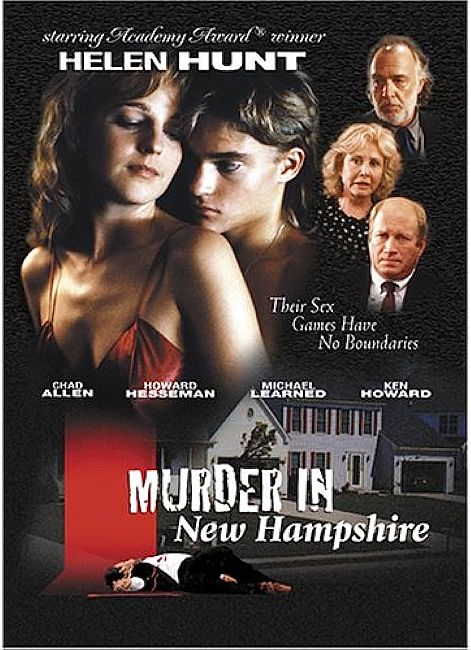
Retro Television Reviews: Murder In New Hampshire: The Pamela Smart Story (dir by Joyce Chopra)


Welcome to Retro Television Reviews, a feature where we review some of our favorite and least favorite shows of the past!  On Sundays, I will be reviewing the made-for-television movies that used to be a primetime mainstay.  Today’s film is 1991’s Murder In New Hampshire: The Pamela Smart Story!  It  can be viewed on YouTube!

When Pamela Wojas (Helen Hunt) first became engaged to Gregg Smart (Hank Stratton), she thought that they would never get older or settle down to a conventional life.  She thought that Gregg would always have long hair and that they would spend the rest of their lives following Van Halen around the country.  But then Gregg got a job with a New Hampshire insurance company and he cut his hair.  And then Pam failed in her attempts to get hired by the local news station and instead, she ended up accepting a job as the part-time media director at a local high school.

Pam spearheaded the school’s anti-drug campaign and ended up working closely with two students in particular, Billy Flynn (Chad Allen) and Cecelia Pierce (Riff Reagan).  Billy and Pam bonded over their shared love of Van Halen and soon, they were having an affair.  Was Pam just trying to relive her youth or was she already setting up Billy to murder her husband?

Based on the true story that also inspired Gus Van Sant’s To Die For, Murder In New Hampshire jumps back and forth through time.  The film opens with Gregg being shot and killed by Billy and one of his friends.  It then cuts to a courtroom, where a prosecutor (Howard Hesseman) tells the jury that Gregg was murdered on the orders of his own wife.  A very conservatively and modestly-dressed Pam sits in the courtroom and provides quite a contrast to the far more wild and hedonistic Pam who we see in the film’s frequent flashbacks.  While Gregg settles comfortably into life as a suburban insurance agent, Pam continually tries to hold onto her past.  While Gregg wins awards for selling the most insurance, Pam tells Billy that Gregg beats her and that he’s dangerous.

It’s difficult to watch Murder In New Hampshire without comparing it To Die For.  They both tell the same story and they even use the same flashback structure.  But if To Die For presented Nicole Kidman as being a soulless killer who was driven by her obsession with being a star, Murder In New Hampshire suggests that Pam’s main motivation was that she just couldn’t handle the idea of settling down and living a conventional, suburban life.  As well, To Die For presented Joaquin Phoenix’s gunman as being someone who was essentially incapable of thinking for himself.  In Murder In New Hampshire, Billy is far more active character.  Though he is undoubtedly manipulated by Pam, Billy is still portrayed as someone who made his own decision to get involved in Pam’s schemes.  If To Die For is a stylized satire of the true crime genre, Murder In New Hampshire is the epitome of what was being satirized.

That said, Murder In New Hampshire is a good example of the true crime genre, largely due to Helen Hunt’s wonderful performance as Pam Smart.  Hunt plays Pam as someone who has never grown up and who is so scared of being required to that she’ll even resort to murder to pull it off.  While Murder In New Hampshire never quite escapes the shadow of To Die For, it’s still an effective film when taken on its own terms.