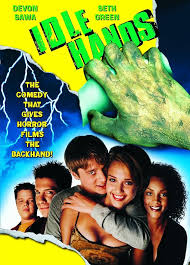
Idle Hands (1999, directed by Rodman Flender)


Anton (Devon Sawa) is a teenager who is so busy getting high and sitting on the couch that it takes him a few days to realize that his right hand has been possessed and has murdered his parents. The hand also kills his two best friends (Seth Green and Elden Henson), but fortunately, they’re able to stick around and talk to him as members of the living dead. Meanwhile, all Anton wants to do is go out on a date with the hot girl next door, Molly (Jessica Alba). Meanwhile, a demon hunter (Vivica A. Fox) is searching for the evil force that has possessed Anton’s hand.
No wonder we all loved this movie in 1999!

Watching the film today, I’m still impressed by the energy of Idle Hands, even if the movie seems to be trying too hard to imitate the zaniness of Sam Raimi. It’s interesting to compare Devon Sawa’s performance here to his more serious turn in Final Destination. I remember that the film was controversial when it first came out because the Columbine shootings were still fresh on everyone’s mind and people weren’t in the mood to laugh at a homicidal teenager, even one who was ultimately not responsible for the actions of his possessed hand. Seen today, the action in Idle Hands is too broad to really be taken seriously as a potentially bad influence.

There wasn’t a teenage boy alive in 1999 who didn’t have a crush on Jessica Alba, but also there wasn’t a boy who didn’t know the awkwardness of not feeling like he could control himself. Sure, we may not have had a possessed hand, but we still always seemed to do the wrong thing at the exact moment that everyone else was watching. If Anton thinks having a possessed hand is bad, just imagine waking up with a big zit on your forehead or forgetting how to put sentences together just because a girl looked in your direction. That’s one reason why Idle Hands is more fondly remembered than some of the other teen horror films from that era. It captures a certain teenage awkwardness. We’ve all been there.

Horror Film Review: Black Friday (dir by Casey Tebo)


Black Friday! It’s an unofficial holiday, or at least it was until the COVID lockdowns screwed up everyone’s spending priorities. After spending Thanksgiving with family, eating turkey, and maybe watching a football game or two, people gather outside of their favorite stores and wait for the doors to open. When those doors open, the crowd rushes into the store with the energy of a riot. Getting in the store first presumably means that you’ll be the first to clear all of the marked-down merchandise off of the shelves. It’s your chance to get a good start on shopping for Christmas. If anyone gets in your way, knock them down. If anyone tries to grab what you’re trying to grab, beat them over the head with Junior’s future Christmas gift. Black Friday is a time when you have to be ruthless. Sure, you could just do all of your shopping online, but then you have to hope that your gifts actually arrive on time and without anyone else opening them. My sisters and I used to love Black Friday, though it’s been a while since we’ve participated. To be honest, I imagine it’s one of those traditions that will soon end. New generations will never know the joy of fighting over a silverware set.

That said, as much as customers love Black Friday and as much as business executives enjoy the extra money, I imagine it really has to suck for the poor people who actually work at the stores. I mean, you’re basically giving up your holiday weekend so that you can deal with a bunch of entitled jerks who think that the world is going to end unless they get the perfect gift, and they’re willing to get into a fight and potentially damage merchandise to do it. It has to suck, cleaning and straightening up after a human tornado has torn through your store. That’s why my sisters and I always went out of our way to not make too much of a mess and to pick up after ourselves on Black Friday.

That said, I don’t think that there’s much that we could have done to help out the crew in 2021’s Black Friday. The employees of We Love Toys already know that, as a toy store, they’re going to get hit hard. What they don’t expect is that a virus is going to break out and it’s going to turn the shoppers and anyone bitten by a shopper into the equivalent of a bloodthirsty zombie. The employees soon find themselves trapped in their store, forced to use toys as weaponry. Fortunately, their manager is played by Bruce Campbell, but Bruce isn’t playing Ash Williams here. Instead, he’s just playing a store manager who made the mistake of opening the doors on Black Friday.

Black Friday is occasionally amusing. I liked the fact that it was occasionally difficult to tell the difference between the infected lunatics and the crazed shoppers. I imagine the film itself would be a bit of wish-fulfillment for anyone who has ever worked in a store on Black Friday. It’s not a classic by any means. Some of the characters are a bit underwritten. But it does have Bruce Campbell, and you can’t go wrong there!

Anyway, this Black Friday, remember to be polite to the people who are just trying to collect a paycheck. They deserve to enjoy their holiday too.

Film Review: Gasoline Alley (dir by Edward Drake)


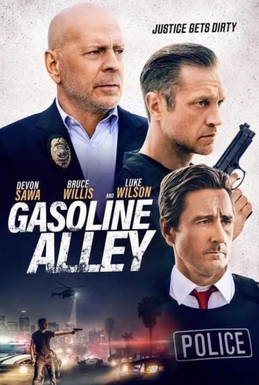
Believe it or not, Gasoline Alley is not that bad.

Don’t get me wrong.  Gasoline Alley is definitely a pulpy film.  The plot is full of twists and turns and it doesn’t always hang together.  There’s more than a few holes to be found in the story.  There’s also a few threads that are left hanging.  Much as in real life, characters appear and then disappear almost at random.  In many ways, the film plays out like a dream, a jumbled mix of concerns and ideas and images.  The viewer is often left to figure out how to fit everything together on their own.  Obviously, that type of  approach won’t appeal to everyone but, for me, it was the perfect way to tell the film’s story.  The world of Gasoline Alley often doesn’t make sense but neither does the world outside of your window.  Gasoline Alley‘s mystery often feels like a jigsaw puzzle where someone has jammed pieces randomly into each square and then pounded on them until they managed to fit in the slots.  It’s chaos but it’s an appropriate approach for a film that takes place in a chaotic world.

Gasoline Alley also one of the final films that Bruce Willis made before his retirement and, with all the rumors about whether or not Willis was pushed into spending the last few years of his career appearing in low-budget and B-movies, it’s often undeniably awkward to watch him in his final films.  As is the case with almost all of Willis’s recent films, he doesn’t get much screen time in Gasoline Alley.  He’s only in a handful of scenes and his dialogue is limited and delivered in a flat monotone.  He plays a key character but much of what the character does and says occurs off-screen and is described to us second-hand.  And yet, at the same time, Willis still has enough natural presence that his performance works as far as the basic needs of the film are concerned.  He’s playing a character who is meant to be intimidating and Willis still has enough of that tough guy energy that his performance is effective.    

Willis plays a homicide detective named Freeman.  Freeman and his partner, Vargas (Luke Wilson), are investigating the murder of four prostitutes and their number one suspect is a tattoo artist named Jimmy Jayne (Devon Sawa).  Jimmy’s father was a decorated police detective.  His mother was a prostitute.  Jimmy spent several years in prison for assault, though Jimmy claims that he was simply acting in self-defense.  (“He came at me with a screwdriver,” Jimmy says, without further elaboration.)  While he was in prison, Jimmy befriended an actor who was doing time for DUI.  Having been released, Jimmy is now the tattoo artist to the stars.  He has his own tattoo parlor, called Gasoline Alley.  Because one of the murdered women was found with one of Jimmy’s personalized lighters on her body, Jimmy is a suspect.  Jimmy, however, claims that he merely met her in a bar.

Jimmy starts to investigate the murders on his own and it quickly becomes clear that he’s a better investigator than either of the detectives who are on the case.  Though Jimmy is trying to clear his name, he’s also determined to get justice for the murdered women, all four of whom appear to him as either ghosts or drug-induced hallucinations at a key moment in the film.  Jimmy’s investigation leads him into the world of human trafficking, police corruption, and the darkest corners of the film industry.  Indeed, one of Gasoline Alley‘s major points seems to be that everyone in Hollywood is corrupt.  The actor who Jimmy saved in prison is a pretentious loser who, at one point, goes off on a rant that was obviously based on Christian Bale’s infamous Terminator meltdown.  Meanwhile, the adult film industry is represented by a sleazy director who snorts cocaine, tells bad jokes, and throws parties that are almost exclusively populated by crooked cops.  As one cop puts it, “He knows whose lives matter.”

Gasoline Alley has gotten terrible reviews but I think those reviews have more to do with the fact that this is a low-budget Bruce Willis flick than the film itself.  Gasoline Alley is actually not bad at all.  It’s an entertaining work of pulp fiction, a quickly-paced film that takes a look at how life is lived and lost in the shadows of “decent” society.  Because he’s an ex-con, Jimmy is destined to be an outcast, regardless of how many stars come to him for their tattoos.  But, at the same time, it’s Jimmy’s outcast status that allows him to infiltrate and understand the dark side of Los Angeles.  It’s because Jimmy’s an outcast that he’s determined to get justice for the victims that respectable society would rather just ignore.  Director Edward Drake fills the movie with images of neon-suffused decadence.  The atmosphere may be sleazy but it’s also undeniably plausible.  Luke Wilson does a good job playing Willis’s talkative partner but the film is stolen by Devon Sawa, who brings a mix of weary dignity and righteous fury to the role of Jimmy.  Sawa has been through his own well-publicized troubles and perhaps that’s why he seems to instinctively understand why it’s so important that Jimmy not only clear his name but also get justice for those who have been victimized in the shadows.  As played by Sawa, Jimmy is cynical and often tired but he still hasn’t given up his desire to make the world a better place.

No, Gasoline Alley is not a bad film at all.  Instead, it’s a portrait of a harsh world and a look at the people who are simply trying to make it from one day to the next.  Much like Robert Aldrich’s Kiss Me Deadly, Gasoline Alley is a journey through a brutal world where people get what they want at the cost of their own souls.  It’s a film that, like many of the classic B-movies and film noirs of the 40s and 50s, will be rediscovered and better appreciated in the future.

Bruce Campbell and Devon Sawa Provide The Best Customer Service In The Trailer for Black Friday


Yay!  I was just thinking that it would be nice to get a trailer for a new Bruce Campbell film and — surprise! — here it is!

Not only does Black Friday feature Bruce but it also features Devon Sawa, who seems like he deserves to make a bit of comeback.

Here’s the trailer for Black Friday:

Horror Film Review: Final Destination (dir by James Wong)


I was recently rewatching the 2000 film, Final Destination, and a few things occurred to me.

Number one, no one ever really thanks Devon Sawa for getting them off that plane before it explodes.  Final Destination opens with a group of high school students boarding a plane so that they can go on their senior class trip to Paris.  (I wish I had gone to their high school.  Our senior class trip was to …. well, we didn’t get one.)  When Alex Browning (Devon Sawa) has a vision of the plane exploding, he freaks out and he, his teacher, and a few other students are kicked off the plane.  Needless to say, everyone’s pretty upset with Alex but then, just a few minutes after taking off, the plane does explode.  Alex was right.  He saved everyone’s lives.

And yet, no one ever says, “Thank you, Alex!”  Instead, everyone is still like, “Hey, that’s the weirdo that ruined our trip to Paris!”  No, the plane exploding is what ruined your trip to Paris.  Alex saved your life!  Poor Alex.  And yet, it kind of makes sense.  In the face of inexplicable tragedy, people need someone to blame and Alex is a convenient scapegoat.

That scapegoating continues once the survivors of the flight start to mysteriously die.  No one wants Alex near them, even though Alex has managed to figure out that Death is stalking them because they messed up its plans by getting off of that plane.  Then again, Alex doesn’t always come across as if he’s the most stable person in the world.  Gaunt and hallow-eyed, Sawa portrays Alex as someone who haunted by survivor’s guilt even before it became obvious that he and his former friends were being targeted.  Sawa, it should be said, gives a remarkably good performance in Final Destination.

Another thing that occurred to me as I rewatched Final Destination is that, in this film, Death doesn’t have much of a sense of humor.  The Final Destination sequels are notorious for their elaborate and often ironic death scenes, the majority of which seem to indicate that Death might be a little bit too clever and precocious for its own good.  However, in the first Final Destination, Death is a lot more direct and, in some ways, a lot more sadistic.  Terry Chaney (Amanda Detmer) steps out in the street and gets run over by a bus.  Goofy Billy Hitchcock (Seann William Scott — why two n’s Seann!?) makes the mistake of standing too close to the railroad tracks and he loses the top half of his head.  Death really only get creative when it comes to taking out Todd Waggner (Chad E. Donella) and Ms. Lewton (Kristen Cloke) and, even then, it’s methods are nowhere near as elaborate as they would eventually become.

The final thing that I noticed is that Final Destination holds up really well.  It’s hard to remember now but, when Final Destination first came out, a lot of critics dismissed it as just being a slasher film with a slightly clever twist.  But actually, that twist is far more than just “slightly” clever and the film really does a lot more with the idea than it’s often given credit for.  Final Destination is a film full of thrills and chills — I still freak out at some of those death scenes — but it’s also a film that always makes me think about mortality.  Has our destiny already been written?  Can we defeat death?  Or are we just pawns with our fates predetermined?  In the end, that’s what makes Final Destination so effective.  We all know that we can’t escape death, both in real life and in the movies.  The one thing that everyone has in common is that death is eventually going to come for all of us.  It’s the one enemy that we can’t defeat or laugh away.  Instead, all we can do is try to hold it off for a while.  Final Destination taps into the fears that we all have.

The plot is clever.  The script is frequently witty.  I liked the fact the characters were all named after horror movie icons.  Plus, you got Tony Todd dominating the entire film with just a brief role.  Final Destination is a classic.

6 More Films That You May Have Missed: Ai Weiwei: Never Sorry, Goon, Headhunters, Jeff Who Lives At Home, The Philly Kid, and Safety Not Guaranteed


Hi there!  Continuing my effort to get caught up, here are six more films that I saw earlier this year but, for whatever reason, had not reviewed yet.

1) Ai Weiwei: Never Sorry (dir by Alison Klayman)

One of my favorite films of 2012 was this revealing documentary about the Chinese artist and activist Ai Weiwei.  Filmed over the course of two years, this film follows Ai as he uses the tools of social media to try to stand up to the oppressive Chinese government.  In the film’s strongest scenes, Ai reveals how the government attempted to cover up the massive destruction of the 2008 Sichuan Earthquake.  For his efforts to give identities to the victims of this natural disaster, Ai is beaten by the police and eventually imprisoned.

Ai WeiWei: Never Sorry is a film that should be seen by anyone who thinks that any greater good can be accomplished by sacrificing personal freedom.

2) Goon (dir by Michael Dowse)

Based on a true story, Goon tells the story of Doug Glatt (played, in a winning performance, by Seann William Scott), a Boston bouncer who joins a minor league hockey team.  Eventually, he gets called up to play in Canada and faces his idol (and new rival) Ross Rhea (played by Liev Schreiber) on the ice.  Along the way, he also romances a hockey groupie (Alison Pill) and befriends a burned out teammate (Marc-Andre Gondrin).

I have to thank Arleigh for suggesting that I see Goon because, otherwise, I probably wouldn’t have given this film a chance.  I don’t know much about sports in general and I know even less about hockey.  (Leonard is our resident hockey expert here at the Shattered Lens.)  However, Goon turned out to be a truly pleasant surprise, a sports film that even someone like me can enjoy.

While the film’s plot may be predictable, director Dowse and his cast tell the story well and they all manage to strike the perfect balance between humor, melodrama, and sentimentality.  Seann William Scott is usually not thought of as being a versatile actor but, on the basis of his performance here, he deserves to be reevaluated.  Williams makes Doug Glatt into a truly likable thug and he and Alison Pill make for a very cute and likable couple.  When you start watching Goon, you know where the journey is going to lead you but that doesn’t make the trip any less enjoyable.

3) Headhunters (dir by Morten Tyldum)

In 2012, one of the best thrillers to be released in America was this import from Norway.  Roger Brown (played by Askel Hennie) is Norway’s most successful corporate headhunter.  Along with having a beautiful wife, Roger also has a mistress and all the other material trappings of wealth.  Despite this, Roger is insecure over only being 5’6 and he deals with his insecurity by pursuing a second, secret career as an art thief.  When Roger discovers that Clas, his latest client, is having an affair with his wife, Roger breaks into Clas’s apartment and steals a valuable painting.  However, it turns out that Clas is not only a trained mercenary but he’s also a psychotic killer and soon, he’s pursuing Roger.

Headhunters is a truly exciting film, one that actually keeps the audience guessing with each twist and turn.  Best of all, the film features a truly memorable lead performance from Askel Hennie.  Playing the type of character who, in the past, would have been played by Klaus Kinski, Henie makes his sleazy character into an odd likable and compelling hero.

4) Jeff, Who Lives At Home (dir by Jay and Mark Duplass)

Jeff (Jason Segal) is a 30 year-old unemployed stoner who lives in his mother’s basement and who spends his day obsessing on the movie Signs and talking about his belief in Destiny.  One day, he gets a phone call from some one asking for “Kevin.”  Jeff reacts by finally leaving his mom’s basement and searching for this mysterious Kevin.  Meanwhile, Jeff’s brother (Ed Helms) is convinced that his wife (Judy Greer) is cheating on him and Jeff’s lonely mom (Susan Sarandon) spends her workday at work getting messages from a secret admirer.

Not much happens in Jeff, Who Lives At Home and the film dares you to get as annoyed with Jeff as everyone else in his family.  However, when taken on its own mellow terms, this is an enjoyable and occasionally even moving film.  It helps if you really like Jason Segal and seriously, who doesn’t?  Susan Sarandon gives a touching performance as well and the filmmakers make excellent use of Helms’ needy persona.

5) The Philly Kid (dir by Jason Connery)

Dillon (Wes Chatham) is a college wrestler who is wrongly convicted for the murder of a police officer.  After spending ten years in prison, Dillon is paroled and returns to his home in Baton Rouge.  Managed by his friend Jake (a manic Devon Sawa), Dillon becomes a cage fighter and ultimately finds himself fighting for his life against corrupt promoters and a crooked cop.

The Philly Kid is a pretty uneven film.  The plot will never surprise you and, halfway through the film, The Philly Kid descends into over-the-top melodrama.  However, both Chatham and Sawa give good performances and, as directed by Jason Connery, the film’s many fight scenes are vivid and exciting to watch.  The film was filmed in Baton Rouge and it makes good use of the Louisiana atmosphere.

The Philly Kid may ultimately just be a genre film but it’s a well-done genre film.

6) Safety Not Guaranteed (dir. by Colin Trevorrow)

Kenneth (Mark Duplass) is the type of person that we’ve all met at some point in our life.  He works as a clerk in a grocery store and spends his time talking about his dead girlfriend and how secret agents are watching his every move.  He also claims to have built a time machine and posts a classified ad where he asks for someone to volunteer to go back in time with him.  The ad is spotted by Jeff (Jake M. Johnson), a smarmy magazine writer in Seattle who travels to Kenneth’s hometown in order to investigate (and, it’s later revealed, track down an ex-girlfriend).  Accompanying the reporter is Darius (played by Aubrey Plaza), a disillusioned intern who has her own reasons for wishing that she could go back into past.  Following Jeff’s orders, Darius approaches and befriends Kenneth by claiming to be interested in his ad.  While the well-meaning but paranoid Kenneth trains her for their trip into past, Darius finds herself falling in love with him…

Safety Not Guaranteed is one of those low-key, sweet natured films that I simply can’t help but love.  The film views it’s damaged characters with a wry compassion and it wraps up its story with one of the best endings of 2012.  Aubrey Plaza is best known for being sarcastic on Parks and Recreation but, with this film, she shows that she’s capable of doing a lot more.