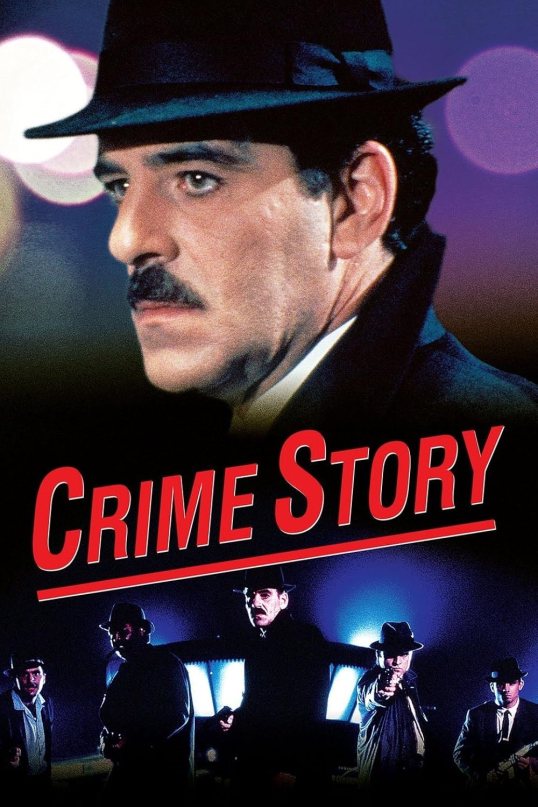
Welcome to Retro Television Reviews, a feature where we review some of our favorite and least favorite shows of the past! On Mondays, I will be reviewing Crime Story, which ran on NBC from 1986 to 1988. The entire show can be found on Tubi!
This week, guess who screws up?
Episode 1.14 “Fatal Crossroads”
(Dir by Gary Sinise, originally aired on January 9th, 1987)
As much as I want to like David Abrams — and I did like him for the first few episodes — he’s just dumb. Offended by the fact that Luca is using his legal advice to try to beat his indictment, David starts this episode out by approaching Luca in public and announcing that he’s not only quit the public defenders office but that he’s also decided to join the D.A.’s office, specifically so he can take guys like Luca down. Then, later on in the episode, David approaches Luca again and, this time, he brings along his father (Nathan Davis). David’s father, a former low-level gangster, brags about how smart David is and how he’s going to take Luca down.
So, of course, Luca has someone put a bomb underneath David’s car.
And, of course, it’s David’s father who decides to borrow the car to go to the store and who ends up getting blown up.
And yes, it’s a terrible thing that David’s father got blown up. BUT WHAT DID DAVID THINK WAS GOING TO HAPPEN!? He knows who Luca is! He knows that Luca will kill people without a second thought. So why the Hell is David walking up to Luca and basically daring him to try to kill him? I mean, David’s father was in the rackets! David should have known better and, for that matter, David’s father should have known better.
I’m sorry but David Abrams is a moron.
For some reason, Luca also tries to take a hit out on Torello, despite the fact that Luca’s entire legal strategy depends on Torello denying Homan’s claims that Torello is crooked. Fortunately, Torello is somehow brilliant enough to realize that Luca is going to take a hit out on him and the members of the Crime Squad are smart enough to take a look at a building and somehow figure out exactly which room a sniper would be hiding in. If only David Abrams was as smart!
This episode featured a few too many coincidences and a bit too much of David Abrams suddenly acting like an idiot. It was directed by Gary Sinise, who is one of my favorite people. Sinise does a good job of capturing the drizzly gangster movie atmosphere but the script could have used a bit more work.
Welcome to Retro Television Reviews, a feature where we review some of our favorite and least favorite shows of the past! On Mondays, I will be reviewing Crime Story, which ran on NBC from 1986 to 1988. The entire show can be found on Tubi!
This week, Homan sings.
Episode 1.13 “Strange Bedfellows”
(Dir by Francis Delia, originally aired on December 26th, 1986)
Homan is in federal custody and he’s telling Breitel all that he knows about Luca and Bartoli. He’s also making up a story about Torello taking a bribe. Even though Homan’s Torello story is pretty shaky, Breitel is looking forward to taking down a crooked cop and launching his political career off of of the publicity.
Bartoli is not amused when he learns that he’s being indicted. However, Luca is able to convince Manny Weisbord to provide him with a top-level defense attorney. Manny also makes it clear that Luca no longer works for Phil. Instead, Luca works with Phil. Lucas has another reason to be happy. When he runs into David Abrams at a bar, he gets some free legal advice. Luca explains that Homan is lying about Torello. Abrams tells Luca that, if they can prove that Homan is lying about Torello, it will be easier to convince a jury that Homan is lying about Luca and Bartoli as well.
Torello, meanwhile, responds to his upcoming indictment by going to Las Vegas and playing some golf. He’s in a great mood until he sees that his indictment is one the front page of the newspaper.
Not much really happened in this episode of Crime Story. That’s not really a complaint. If anything, it was a bit of a nice change-of-pace. We got to watch the characters just be themselves. Luca, who rarely shows emotion, actually smiles when he hears that Torello is about to be indicted along with “his favorite people.” Luca actually has a sense of humor and an appreciation for irony. Who would have guessed? Meanwhile, Torello continues to be just a bit too intense for his own good. Even on vacation, he seems like he’s just one frustration away from snapping.
Welcome to Retro Television Reviews, a feature where we review some of our favorite and least favorite shows of the past! On Mondays, I will be reviewing Crime Story, which ran on NBC from 1986 to 1988. The entire show can be found on Tubi!
This week, Torello finally tracks down Homan.
Episode 1.12 “Hide and Go Thief”
(Dir by Francis Delia, originally aired on December 12th, 1986)
In Chicago, an unnamed gunman (Paul Guilfoyle) has taken a woman (Lorraine Bracco) hostage and has barricaded himself in a hotel room. He wants to get on television and he figures that holding a hostage and firing a machine gun out the window is the best way to do it. The members of the Major Crimes Unit are in the street, ducking behind squad cars whenever the gunman starts firing on them.
It’s definitely a major situation but Torello is more interested in going to Gary, Indiana than exchanging gunfire in Chicago. Frank Homan (Ted Levine), a former member of Luca’s crew, has been discovered working as a cook in a Gary diner. Everyone in Gary knows Frank as “Mike Torello.” The real Torello is determined to arrest Frank and hopefully use him to take down Luca. Torello abandons the hostage situation, drives down to Gary, and captures Homan at work.
Finally, some good news for the real Mike Torello, right? Well, not quite. After Homan is arrested, U.S. Attorney Harry Brietel (Ray Sharkey) takes custody of him. Brietel has political ambitions and taking down gangster Manny Weisbord would be a good way for him to make a name for himself. When Homan is interrogated by Brietel, Homan lies. He says that he’s never heard of Manny Weisbord. But, Homan says, he has information that will take down Luca, Phil Bartoli, and a crooked cop. In exchange for a light sentence and entry into the witness protection program, Homan is willing to testify that Mike Torello is on the take. Brietel is intrigued. Fighting police corruption is guaranteed to generate even better press than taking down an actual mobster.
Meanwhile, back in Chicago, Torello rejoins the MCU at the hostage situation. (Apparently, the gunman has been awake and firing out of his hotel window for two and a half days straight. One gets the feeling that perhaps it’s wise not to give too much thought to the logistics of this episode’s timeline.) In a well-shot, slow-motion scene, Torello and his men storm the hotel room and shoot the gunman dead. The hostage survives.
Significantly, neither the gunman nor the hostage are given names in this episode. Indeed, Paul Guilfoyle is credited as playing “Deranged Gunman.” That’s because the gunman and the hostage are really only there to show just how obsessed Torello has become with Luca. When it comes to destroying Luca and his fledgling criminal empire, all else can wait, even saving an innocent woman from an armed lunatic.
I usually don’t enjoy watching anything that involves a hostage situation because it always seems to lead to the same predictable narrative beats. Fortunately, this episode avoided most of the usual cliches by making the gunman a total nutcase who never stopped firing his weapon. The scene where Torello and his men storm the hotel room was stylish enough to verge on being surreal. As for the Homan plotline, both Ted Levine and Ray Sharkey provided strong performances and I’m looking forward to seeing how Luca and Torello react to being betrayed by the same guy.
Welcome to Retro Television Reviews, a feature where we review some of our favorite and least favorite shows of the past! On Mondays, I will be reviewing Crime Story, which ran on NBC from 1986 to 1988. The entire show can be found on Tubi!
This week, the Major Crimes Unit follows a ring of things from Chicago to Iowa!
Episode 1.10 “For Love Or Money”
(Dir by Bobby Roth, originally aired on December 5th, 1986)
An investigation into a new Chicago robbery crew leads the Major Crimes Unit to the small town in Iowa that the crew calls home. After the MCU busts the crew, the Mayor is so thrilled that he gives them all the key to the city and invites them to party at the local bar, which turns out to be a surprisingly happening place. Torello, who has just signed his divorce papers, gets drunk, steals a car, and sleeps with the mayor’s wife. That’ll teach him to hand out keys to the city!
Meanwhile, Danny feels sorry for one of the thieves. Howie Dressler (a very young Gary Sinise) is not a ruthless criminal. Instead, he’s someone who has lost his job and who is desperately trying to pay the bills His wife (Moira Sinise) is a victim of polio and lives in an iron lung. Danny wants to cut a deal with Howie.
Unfortunately, though the thieves don’t fully realize it, the thieves work for Ray Luca’s organization. Luca and Paulie take Howie for a ride to a warehouse, where they tie him to a chair. Howie swears to them that he’s not going to rat them out. He says that he’ll take the fall and that the only reason he talked to the MCU was to protect his wife. Howie says that he did what any real man would do in the situation. Luca seems to be sympathetic and motions at Paulie to let Howie go.
Or does he?
Later, Torello, Danny, and the boys are called to another warehouse where the bodies of the thieves have been found. The majority of them were beaten to death. Howie was hanged.
Yikes!
Back at the bar, Danny gets drunk. When Torello shows up to take him home, Danny says that he should have let Torello execute Ray Luca when he had the chance. Torello nods and then says, “I will kill Ray Luca.”
This episode really gave us a look into the mentality of Torello and the other members of the Major Crimes Unit. We’ve always known that Torello is obsessed with Luca but, in this episode, we saw just how obsessed. Torello seems to feel that he’s now on a holy mission to personally kill Luca. The members of MCU obsess over the criminals they chase and, when they don’t have a criminal to chase, they end up losing control, getting drunk, and impulsively stealing cars. Say what you will about Ray Luca, he’s at least a little bit more disciplined.
I get the feeling none of this is going to lead to a happy ending.
Welcome to Retro Television Reviews, a feature where we review some of our favorite and least favorite shows of the past! On Mondays, I will be reviewing Crime Story, which ran on NBC from 1986 to 1988. The entire show can be found on Tubi!
Torello is going to snap….
Episode 1.9 “Justice Hits The Skids”
(Dir by Mario DiLeo, originally aired on November 11th, 1986)
Torello is losing it.
Well, that’s not really a surprise. Torello has been losing it since the pilot. However, this episode finds him acting even more intense than usual. He’s getting divorced. His best friend Ted Kehoe has been murdered and the federal prosecutor seems to be more interested in trying to prove that Torello is corrupt than in going after Bartoli and Luca. Torello doesn’t even go to Ted Kehoe’s funeral, leading to everyone thinking that Torello is losing what little grip on sanity he has left. Even his soon-to-be ex-wife checks in on him.
While Torello stews over Luca, Suzanne Terry attempts to investigate the growing use of drugs in some of Chicago’s poorest neighbors and she gets attacked and put into the hospital as a result. David Abrams tries to investigate on his own, leading to Suzanne telling him that she needs some time apart from him. (Before she’s attacked, David takes her out to dinner. When a racist diner complains and the head waiter asks them to move to a different table, Suzanne wants to leave the restaurant. David insists that they stay and finish their meal. David may see himself as being a righteous crusader but, at the same time, he also comes across as being rather controlling. It doesn’t seem to occur to him that Suzanne might not want to give any business to a racist restaurant.) Torello and the Major Crimes Unit then take up the case, even though his superiors tell him not to waste any time on it.
Sweet Haywood (John Canada Tyrell), the drug dealer who attacked Suzanne, is eventually captured. Sitting in jail, he meets his public defender, who just happens to be David Abrams. Abrams pulls out a gun and shoots Haywood in the chest. However, this turns out to just be a fantasy on David’s part. When the real Haywood demands to know if Abrams is going to keep him out of the jail, Abrams says, “Of course. That’s my job. Abrams for the defense.”
The gun-shooting fantasy scene was effective but otherwise, the ending doesn’t make much sense. Assigning Abrams to serve as the public defender for a guy who was arrested for beating up Abrams’s girlfriend is a massive conflict-of-interest. If Abrams intentionally offers up a poor defense, Haywood will automatically have grounds for an appeal. I mean, this is 1963. This the era of the Warren Court!
Even with that in mind, this wasn’t a bad episode. David Abrams and Mike Torello are both flawed heroes, which is what makes the show so watchable. Torello may be fighting on the side of the law but he really does seem like he’s one bad day away from blowing up the entire city of Chicago. Meanwhile, Abrams clearly sees himself as being the last righteous crusader but he often seems oblivious to how his actions effect other people. Neither is perfect. Indeed, each one seems to be just one step away from self-destructing.
“We will not go quietly into the night! We will not vanish without a fight! We’re going to live on! We’re going to survive! Today, we celebrate our Independence Day!” — President Whitmore
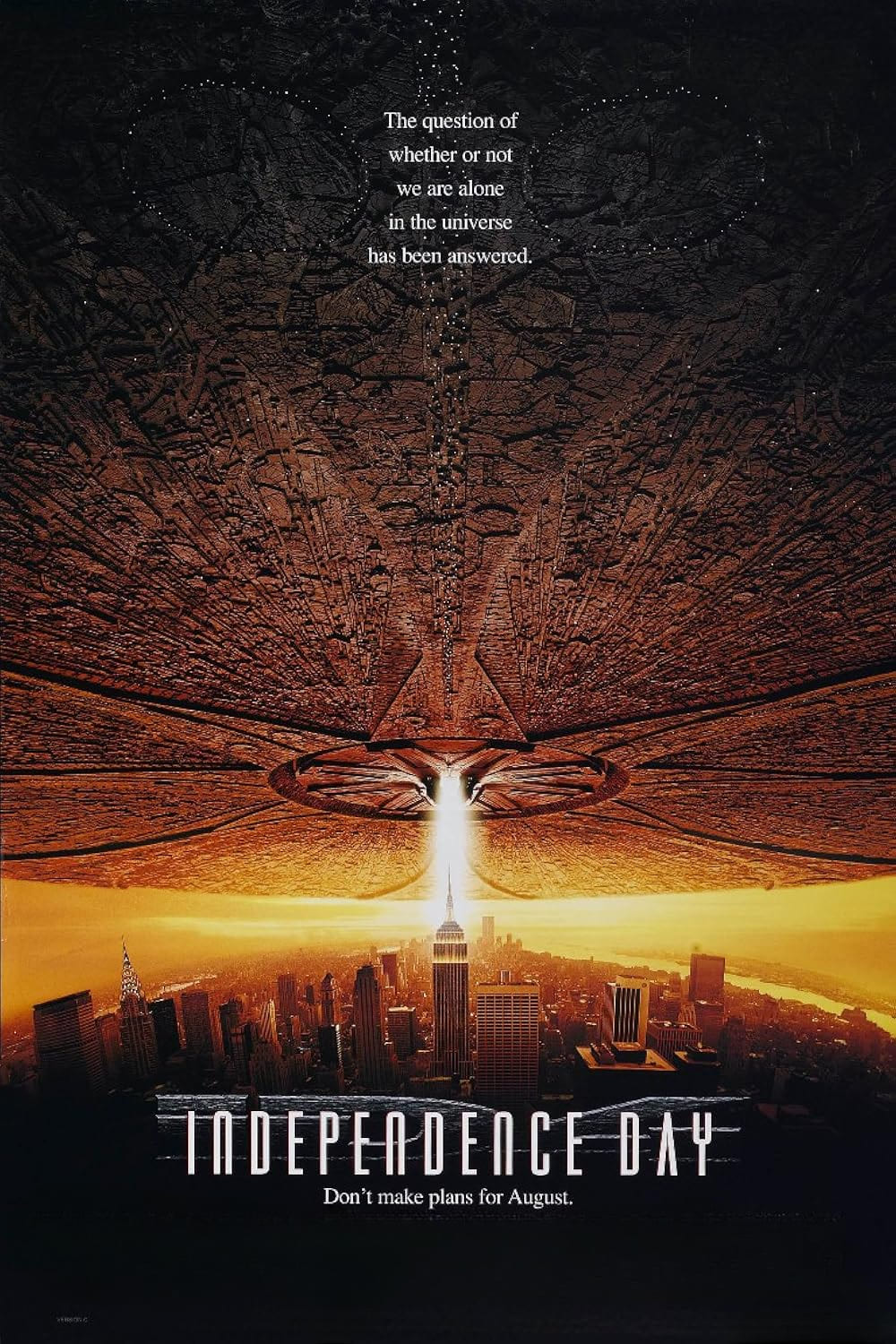
If you were around in the summer of 1996, you already know exactly where you were when you first saw the trailer for Independence Day. There was this massive shadow creeping over the moon, followed by that terrifying, booming sound effect, and then the White House just absolutely getting vaporized by a giant laser beam. It was a cultural moment. Director Roland Emmerich hadn’t really made his mark on Hollywood yet, but with this one movie, he essentially invented the modern summer blockbuster template of destroying famous global landmarks. Looking back at Independence Day almost three decades later, it is honestly wild how well this movie holds up, not as a piece of high art, but as a perfectly calibrated, ridiculously entertaining popcorn machine.
The premise is beautifully simple: massive alien spaceships suddenly appear over Earth’s major cities, they don’t come in peace, and humanity has to figure out how to fight back before we go the way of the dinosaurs. What makes the first act of the movie so effective is the slow build. Emmerich doesn’t just start with explosions; he lets the dread simmer. We see the massive ship hover over New York City, casting a shadow that blocks out the sun, and the sheer scale of the thing is awe-inspiring. Then, when the ships finally initiate their attack sequence, the payoff is spectacular. The practical effects combined with early CGI create these massive, rolling walls of fire that tear through iconic buildings. It is destructive poetry, and as a kid watching it, it was the most incredible thing I had ever seen. Even now, the destruction feels heavy and tactile in a way that modern, entirely computer-generated action sequences often don’t.
But a movie is only as good as its characters, and Independence Day has arguably one of the greatest ensemble casts of the 1990s. You have Will Smith playing Captain Steven Hiller, a fighter pilot who is desperately trying to get promoted while also dealing with his girlfriend, her son, and their dog. Smith is at the absolute peak of his early movie star charm here, delivering some of the most quotable one-liners in action movie history. Punching an alien in the face and yelling “Welcome to Earth!” is the kind of ridiculous machismo that only Smith could pull off without making you cringe. Then you have Jeff Goldblum as David Levinson, an MIT-educated cable repairman and environmentalist who figures out the alien signal is a countdown. Goldblum is basically doing his classic Goldblum thing—stuttering, eccentric, highly caffeinated—but it works perfectly because he serves as the perfect foil to Smith’s brute physicality.
The supporting cast is so deep that it feels like an Ocean’s Eleven of sci-fi tropes. Bill Pullman plays President Thomas J. Whitmore, and he gives the role an earnestness that elevates the material. He’s not an action hero; he’s a former fighter pilot who is clearly in over his head but steps up when his people need him most. You also have Judd Hirsch as Goldblum’s cranky, kvetching father, providing fantastic comic relief. Randy Quaid plays Russell Casse, a traumatized former pilot who was abducted by aliens years ago and is written off as a drunk by his small town, giving the movie an underdog storyline. And you can’t forget Brent Spiner as Dr. Okun, the wildly eccentric Area 51 scientist who gets way too excited about the alien biology. Every single one of these actors is fully committed to the bit, no matter how absurd the situation gets.
Now, if we are being completely honest, we have to talk about the plot, which is essentially held together with scotch tape and sheer willpower. The entire third act revolves around Goldblum and Smith flying a captured alien spacecraft up to the mothership to upload a computer virus using a 1996 Apple PowerBook. Yes, an Earth laptop somehow interfaces perfectly with an advanced extraterrestrial operating system, and yes, the aliens apparently don’t have McAfee, Norton or any kind of firewall to prevent a rudimentary human virus from crippling their entire defense grid. It is monumentally stupid if you think about it for even five seconds. But the secret to Independence Day is that it moves so fast and has so much momentum that you simply do not have time to care. The movie dares you to roll your eyes, but then it immediately distracts you with another massive explosion or a great quip from Will Smith, and you just go along for the ride.
The climax of the movie is a masterclass in cheesy, triumphant blockbuster filmmaking. Before the final aerial assault on the alien ships, President Whitmore gives a speech to the troops that has become completely ingrained in pop culture. “Today we celebrate our Independence Day!” he yells, and it is so incredibly corny, but I challenge you not to get at least a little bit pumped up when the music swells. The dogfight that follows is chaotic and thrilling, culminating in Randy Quaid’s character making the ultimate sacrifice by flying his jet directly into the alien weapon. It is exactly the kind of melodramatic, heroic moment that Emmerich excels at, and it hits the emotional beats it needs to hit, even if you saw it coming from a mile away.
You also have to appreciate how unapologetically intense the movie feels despite skating by with a PG-13 rating. People get vaporized, cities are leveled, and there is a genuine sense of apocalyptic dread that permeates the middle of the film. When the aliens first attack, Emmerich actually takes the time to show the aftermath, including cars blowing up in tunnels and people desperately trying to outrun the fireballs. Harvey Fierstein’s character dramatically dying while just sitting in his car, rolling up the window as if that’s going to stop a giant wall of alien fire, is a weirdly specific, dark comedy beat that you rarely see nowadays. The movie has real stakes, and you genuinely feel like humanity is on the brink of extinction.
It is crazy to think about the legacy of Independence Day and how it changed Hollywood. Before this, disaster movies were mostly relegated to B-movie status or Irwin Allen productions from the 1970s. Emmerich proved that you could blend disaster spectacle with sci-fi action and make an absolute fortune. This movie paved the way for Armageddon, Godzilla, The Day After Tomorrow, and essentially the entire concept of the modern cinematic destruction porn genre. They did eventually make a sequel, Independence Day: Resurgence, in 2016, but it completely missed the point of the original. It was too slick, too reliant on weightless CGI, and it lacked the ragtag, underdog charm that made the first one so special.
At the end of the day, Independence Day is just pure, unadulterated cinema comfort food. It does not demand anything from you as a viewer other than to sit back, suspend your disbelief, and enjoy the fireworks. It captures a very specific mid-90s vibe where movies could be big, dumb, loud, and incredibly fun without taking themselves too seriously. Roland Emmerich has directed a lot of movies since then where he has destroyed the world in various different ways, but he has never quite managed to capture the lightning in a bottle that he did here. Whenever the Fourth of July rolls around, or whenever you just need a reliable, edge-of-your-seat action movie to kill a couple of hours, Independence Day is always there, waiting to welcome you to Earth one more time.
Welcome to Retro Television Reviews, a feature where we review some of our favorite and least favorite shows of the past! On Mondays, I will be reviewing Crime Story, which ran on NBC from 1986 to 1988. The entire show can be found on Tubi!
This week, Torello discovers some disturbing facts about an old friend.
Episode 1.8 “Old Friends, Dead Ends”
(Dir by Bobby Roth, originally aired on November 4h, 1986)
Luca has bought a controlling interest in a bottling company so that he can borrow from the pension fund and use that money to purchase casinos in Las Vegas. He’s brought a reluctant Bartoli in as his partner. The owner of the company is Ted Kehoe (Mark Hutter), who just happens to be an old friend of Mike Torello’s. When Kehoe’s business partner, Marilyn Stewart (Dana Wheeler-Nicholson), becomes suspicious of Kehoe’s arrangement with Luca, Bartoli starts to wonder if it’s really worth it to keep Marilyn and Ted around.
This is especially the case after Bartoli’s attorney, Dee (a youngish Eric Bogosian), informs Bartoli that U.S. Attorney Harry Brietel (Ray Sharkey) is planning on indicting both him and Luca for money laundering. Looking to end Brietel’s case before it can even get started, Luca murders Marilyn Stewart. Marilyn’s body is later found by two teenagers and–
HEY, IT’S CHRISTIAN SLATER!
This episode does indeed feature an early performance from Christian Slater. He pays a teenager who is trying to convince his girlfriend to “do it” when they happen to spot Marilyn’s body floating in the river. Slater’s girlfriend is played by Kim Walker, who was later co-star with Slater in Heathers.
Torello is not happy. Well, that’s not a surprise. Torello is never happy. But this episode gives him even more reasons than usual to be in a foul mood. Because of his childhood friendship with Ted Kehoe, Brietel suspects that Torello might be corrupt. After Marilyn is murdered, Brietel seems more interested in trying to pin the murder on Torello than going after Luca.
As for Ted Kehoe, he tells Luca that he’s done working for him. Kehoe is going to tell the cops everything! And what is Luca going to do about it? This episode ends with Kehoe getting thrown out the window of his penthouse and falling several stories down to his death….
Piece of advice: If you’re going to turn on the mob, don’t tell them ahead of time.
This was a good episode! Torello’s friendship with Kehoe brought some real stakes the story and, once again, we got to see just how ruthless an adversary Ray Luca truly is. Luca, Bartoli, and the other mobsters can occasionally seem a bit buffoonish. This episode reminded us that, in Luca’s case, it’s always a mistake to underestimate him.
As for now, Kehoe is dead and Torello is under suspicion. I look forward to seeing what happens next week!
Welcome to Retro Television Reviews, a feature where we review some of our favorite and least favorite shows of the past! On Mondays, I will be reviewing Crime Story, which ran on NBC from 1986 to 1988. The entire show can be found on Tubi!
This week, the Torello marriage falls apart.
Episode 1.7 “Pursuit of a Wanted Felon”
(Dir by Aaron Lipstadt, originally aired on October 28th, 1986)
Last week, a recently acquitted man named Hector (Ving Rhames) was arrested after murdering his landlord. Torello, Danny, and David Abrams were all upset.
This week, they’ve all moved on. Sorry, Ving Rhames, you were only a one-episode guest star.
David is pursuing his relationship with Suzanne Terry (Pam Grier). At a cocktail party, Detective Walter Clemmons (Paul Butler), the black member of the Crime Squad, approaches Suzanne and warns her that she shouldn’t be pursuing a relationship with “that white boy.” Seriously, this is the first time that Walter’s gotten any real dialogue since the show began and it’s basically to tell Suzanne not to pursue an interracial relationship. “We’re only seven years out from integration,” Clemmons says, an awkward piece of dialogue that is meant to remind viewers that this show takes place in 1963. The show actually deserves some credit for being realistic about how many people would have viewed David and Suzanne’s budding romance in 1963. I just find it interesting that the show’s only regular black character is the one who is shown objecting while all of the white Chicago cops don’t have a problem with it. Who knew the Chicago police force was so progressive in the early 60s?
(I really want to like Stephen Lang’s performance as David but something feels off about it. It’s not a bad performance. I stand by my earlier praise. It’s just that David is such a caricature of an early 60s liberal that it is sometimes hard for me to tell if his character is supposed to be satirical or not. In episodes like this, where David is portrayed as being a cool hipster, Lang can seem a bit stiff and miscast. He’s much better when he’s giving an emotional speech in court.)
Luca continues to prove himself indispensable to Manny Weisbrod. In this episode, he blows up a union leader who doesn’t want to take orders from the mob.
Finally, Mike and Julia Torello split up in this episode. It’s not really a shock. Mike Torello is extremely intense and obsessed with his job. He’s tightly wound, to the point where he seems like he might just randomly shoot someone at any given moment. An attempt to take a relaxing vacation with Julie is a disaster. (The motel is tacky. The service is mediocre. Mike spends the entire time threatening the staff and complaining.) As soon as Torello returns to Chicago, he hops on a plane for Cleveland in an unsuccessful attempt to capture Frank Holman. When Torello returns home, he finds that Julie is preparing to go out with another man.
“You are not going to watch my TV,” Torello says, before grabbing the TV and leaving the apartment with it.
Does that scene sounds familiar? That’s probably because Michael Mann later reused the scene, almost word-for-word, in Heat. It’s a good scene. It’s certainly the most memorable moment in this episode.
Otherwise, this episode felt a bit bland. Torello’s doomed marriage isn’t really that interesting and I actually kind of got annoyed with David and Suzanne going to a cocktail party when they really should have been trying to get Hector out of prison. I laughed at Torello’s irritation at the hotel and his line about the TV. Those were the highlights. The rest of this installment was forgettable.
Welcome to Retro Television Reviews, a feature where we review some of our favorite and least favorite shows of the past! On Mondays, I will be reviewing Crime Story, which ran on NBC from 1986 to 1988. The entire show can be found on Tubi!
This week, David Abrams gets his time in the spotlight.
Episode 1.6 “Abrams For The Defense”
(Dir by Aaron Lipstadt, originally aired on October 14th, 1986)
In the slums of Chicago, Hector Lincoln (Ving Rhames) strikes his landlord, Sturkowski (Frederick Nuemann), after one of Hector’s children is bitten by one of the rats that roams freely through the apartment building. Hector is arrested and facing time in prison. Public defender David Abrams (Stephen Lang) defends Hector in court, claiming that conditions in the slums were so bad that Hector only struck Sturkowski in self-defense. Helping David to make his case about the conditions in Sturkowski’s building is a crusader reporter named Suzanne Terry (Pam Grier).
This episode was all about showing us who David Abrams is. David’s father was a mob lawyer but David has no interest in working with people like Ray Luca and Phil Bartoli. Instead, he wants to defend the poor and the downtrodden. Torello and Krychek happen to stop by the trail and they’re impressed with David’s passion. Krychek is disgusted when Sturkowski says that Hector and his family don’t deserve to live a better life. Who knew that two Chicago cops would be so liberal?
To celebrate Hector’s acquittal, a block party is held. David is the guest of honor and, for reasons that aren’t really clear, he decides to invite Torello and Krychek to come celebrate with him. Everyone at the block party is super excited that two cops are hanging out with them. But then Sturkowski tries to evict the Lincolns and Hector strikes him again. This time, he kills Sturkowski. Torello and Krychek promptly arrest Hector as the episode comes to an end.
(And that is why you don’t invite cops to the block party.)
This episode was well-acted, if a bit heavy-handed. (To a certain extent, it reminded me of those episodes of Miami Vice where Crockett would certainly start talking like an undergrad who had just read about Marx for the first time.) It certainly allowed us to get to know more about David Abrams and Stephen Lang and Pam Grier had a good deal of chemistry as two people who appear to be poised on pursuing a relationship that was not all that common in 1963 Chicago. The block party was where the episode kind of lost me, just because I found it hard to believe that Torello and Krychek would not only show up but be treated as the guests of honor despite the fact that most of the people at the party wouldn’t have the slightest idea who they were. I can understand Abrams being welcomed because Abrams kept Hector out of prison. But Torello and Krychek are just two random, middle-aged, white cops.
This episode established David Abrams as being a man caught between two different worlds, the law and lawless. I can’t wait to see what the show does with him.
Welcome to Retro Television Reviews, a feature where we review some of our favorite and least favorite shows of the past! On Mondays, I will be reviewing Crime Story, which ran on NBC from 1986 to 1988. The entire show can be found on Tubi!
This week, Luca has to prove himself.
Episode 1.5 “The War”
(Dir by Leon Ichaso, originally aired on October 7th, 1986)
Luca is in trouble.
Last week’s episode ended with Max Goldman on the receiving end of a beating from Noah Ganz’s goons. Goldman survives and returns with a message. Ganz is not happy that Luca tried to steal his book. Bartoli, Weisbord, and Fosse all inform Luca will have to resolve the Ganz situation on his own.
Luca tries to get public defender David Abrams (Stephen Lang) to act as a negotiator for him but David doesn’t want to get involved in the mobster lifestyle that made his father rich. David just wants to defend the poor and play sax in a jazz club. When Luca is attacked while driving in Chicago, he realizes that negotiating with Ganz is a dead end.
Instead, he just kills Ganz. In a bravura sequence, Luca shows up at a hotel and, with the help of sniper, takes down Ganz’s bodyguards. Then he uses a bomb to take out Ganz while the latter is holding court in an elevator. A plume of white smoke puffs out of the hotel’s exhaust vent.
Having taken care of the issue, Luca is welcomed back into the family. Weisbord says, “Call me Mac.” Fosse (played by Michael Madsen) nods and slowly smokes a cigarette.
Meanwhile, Torello’s wife miscarries. This is the episode that features the clip of Torello walking down a lonely Chicago street on a rainy night. (The clip is prominently featured during the show’s opening credits.) In fact, both Torello and Luca end up spending a good deal of time walking around at night while David Abrams plays his saxophone. It’s a scene that is so overstylized that it shouldn’t work but somehow, it does. If nothing else, it reminds us that Crime Story of two dangerously obsessed men on a collision course.
This was a good episode, if just because it showed that Luca can be a clever criminal when he needs to be. Before this episode, Luca seemed to be clearly outmatched by Torello. With this episode, Luca proved himself to be Torello’s equal.