“It is not the strongest of the species that survives, nor the most intelligent, it is the one that is most adaptable to change.” — Sophia
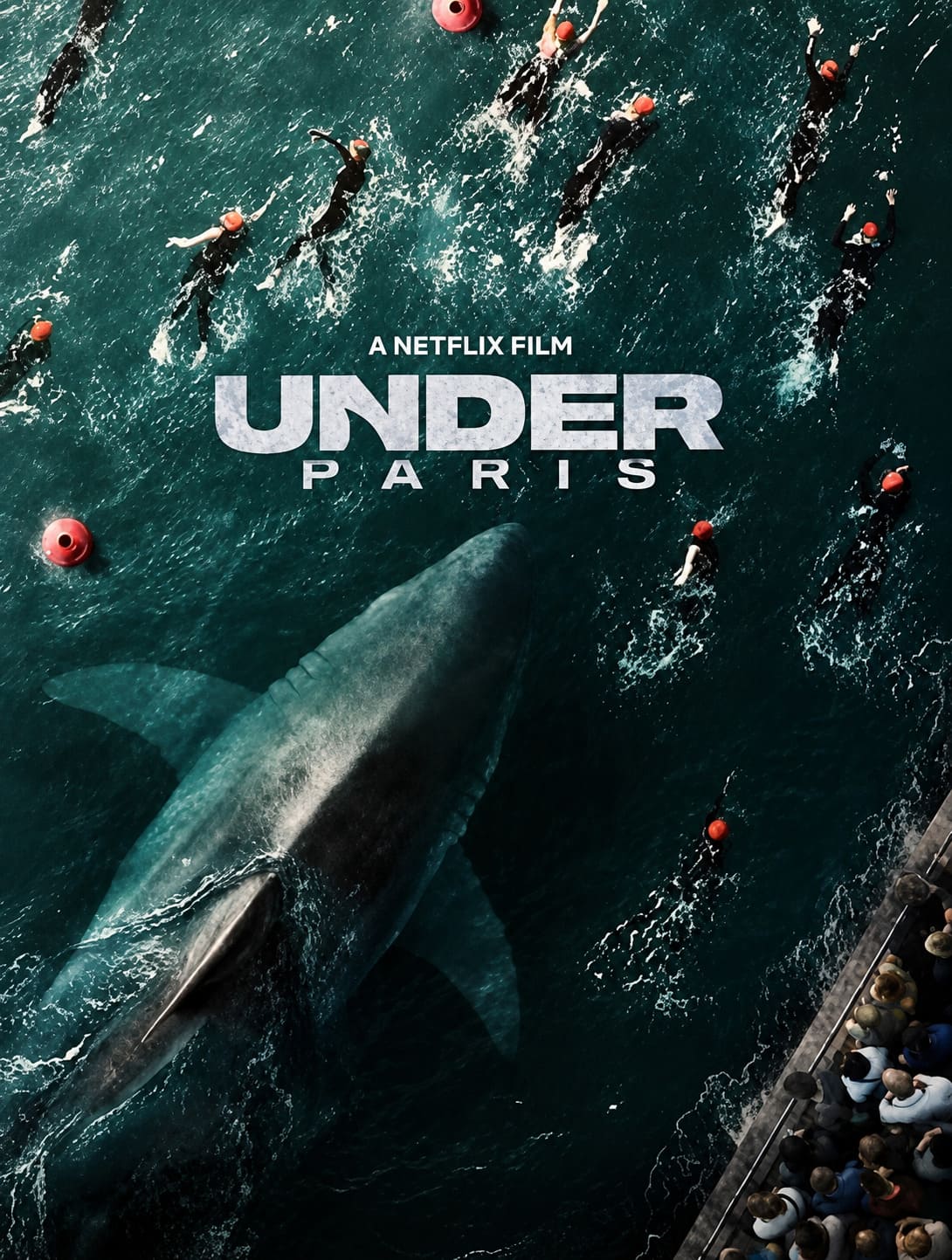
Under Paris is one of those movies that grabs you by the throat and doesn’t let go—literally, in this case. Directed by Xavier Gens, the mind behind gritty, high-octane thrillers like Frontier(s) and The Divide, this creature feature dives headfirst into the claustrophobic nightmares lurking beneath the City of Light. And let me tell you, if you’ve ever romanticized the Parisian catacombs, this film will cure you of that real quick.
The story kicks off with a team of scientists exploring the unexplored tunnels under Paris, only to stumble upon something that definitely shouldn’t exist. What starts as a routine expedition turns into a fight for survival when they realize they’re not alone down there. The creatures in question are blind, feral, and terrifyingly fast, with a taste for human flesh. It’s The Descent meets Tremors, but with a distinctly French flair. The film wastes no time setting up its premise, throwing the audience into the dark, cramped corridors where every shadow could be a predator. The tension is palpable from the jump, and Gens doesn’t bother with slow-burn scares—this is a full-throttle horror ride.
What makes Under Paris stand out is its commitment to practicality. The creatures are brought to life with a mix of practical effects and CGI, and for the most part, it works. The designs are grotesque yet believable, with elongated limbs, jagged teeth, and a primal way of moving that makes them feel like something out of a nightmare. The practical effects, in particular, give the creatures a tangible weight that CGI alone often struggles to achieve. When they’re on screen, you believe they’re real, and that’s half the battle in a monster movie. The sound design deserves a shoutout too—the way the creatures communicate through clicks and hisses is unsettling in the best way, adding to the immersive dread.
The characters are, admittedly, a mixed bag. The cast is led by a group of scientists and urban explorers, each with their own quirks and backstories, but the film doesn’t spend much time fleshing them out. This is a survival horror flick, not a character study, so don’t expect deep emotional arcs. That said, the actors do a solid job with what they’re given. The standout is probably the team’s leader, whose growing desperation as the situation spirals out of control feels authentic. There’s also a refreshing lack of the usual horror-movie stupidity—most of the characters make decisions that, while not always smart, at least feel human. They panic, they argue, they try to rationalize the irrational, and it makes their plight all the more relatable.
The setting is a character in its own right. The labyrinthine tunnels under Paris are a horror fan’s dream—narrow, dimly lit, and filled with the kind of eerie silence that makes every distant noise sound like a death sentence. Gens and his cinematographer make the most of the claustrophobic environment, using tight camera angles and rapid cuts to keep the audience on edge. There’s a sequence early on where the team’s headlamps flicker, plunging them (and us) into total darkness, and it’s a masterclass in building tension without relying on jump scares. The film also does a great job of playing with sound, or the lack thereof. In the quiet moments, all you hear is the characters’ ragged breathing and the distant, unsettling skittering of something inhuman.
If Under Paris has a weakness, it’s that it doesn’t always know when to slow down. The pacing is breakneck, which works for the most part, but there are moments where a little breathing room would’ve helped. Some of the CGI, particularly in the wider shots, can look a bit rough, though it’s never bad enough to pull you out of the movie. And while the creatures are terrifying, their backstory is a bit thin. The film hints at a larger mythology—something about evolution and isolation—but it’s never fully explored. That’s not necessarily a dealbreaker, but it does leave you with a few unanswered questions.
All that said, Under Paris delivers exactly what it promises: a tense, visceral, and often downright terrifying descent into madness. It’s a film that understands the assignment—give the audience scares, gore, and a sense of dread that lingers long after the credits roll. Gens has a knack for blending horror with social commentary, and while Under Paris doesn’t dive as deep into the latter as some of his other work, it’s still there in the margins. The idea of something monstrous lurking beneath the surface of one of the world’s most romanticized cities is a potent one, and the film doesn’t shy away from the metaphorical implications.
In the end, Under Paris is a must-watch for horror fans, especially those who appreciate their scares with a side of action. It’s not a perfect movie, but it’s a damn effective one. It’s the kind of film you’ll want to watch with the lights off, the volume up, and maybe a friend or two to clutch onto when things get really intense. And trust me, they do. Xavier Gens has crafted a creature feature that’s as brutal as it is brilliant, and it’s a testament to his skill as a director that, even in the darkest, most chaotic moments, you’re never quite sure what’s going to happen next. Just don’t blame me if you start side-eying manhole covers after this one.
Warner Bros. just released the full trailer for Alejandro G. Iñárritu’s Digger, which is kind of giving off a mix of Kubrick’s Dr. Strangelove and some classic Coen Brothers fare. It also features more of the cast, which includes Riz Ahmed (Sound of Metal), Sandra Hüller (Project Hail Mary), John Goodman (Kong: Skull Island), Emma D’Arcy (HBO’s House of the Dragon), Sophie Wilde (Talk to Me), Robert John Burke (HBO’s The Last of Us), Jesse Plemons (Bugonia), a trio of Guillermo Del Toro actors in Burn Gorman (Pacific Rim), Corey Johnson (Hellboy) and Michael Stuhlberg (The Shape of Water).
Tom Cruise’s character looks like he sets off a chain of events that he’ll have to set right, though how, we’ll have to find out when the film premieres later this year.
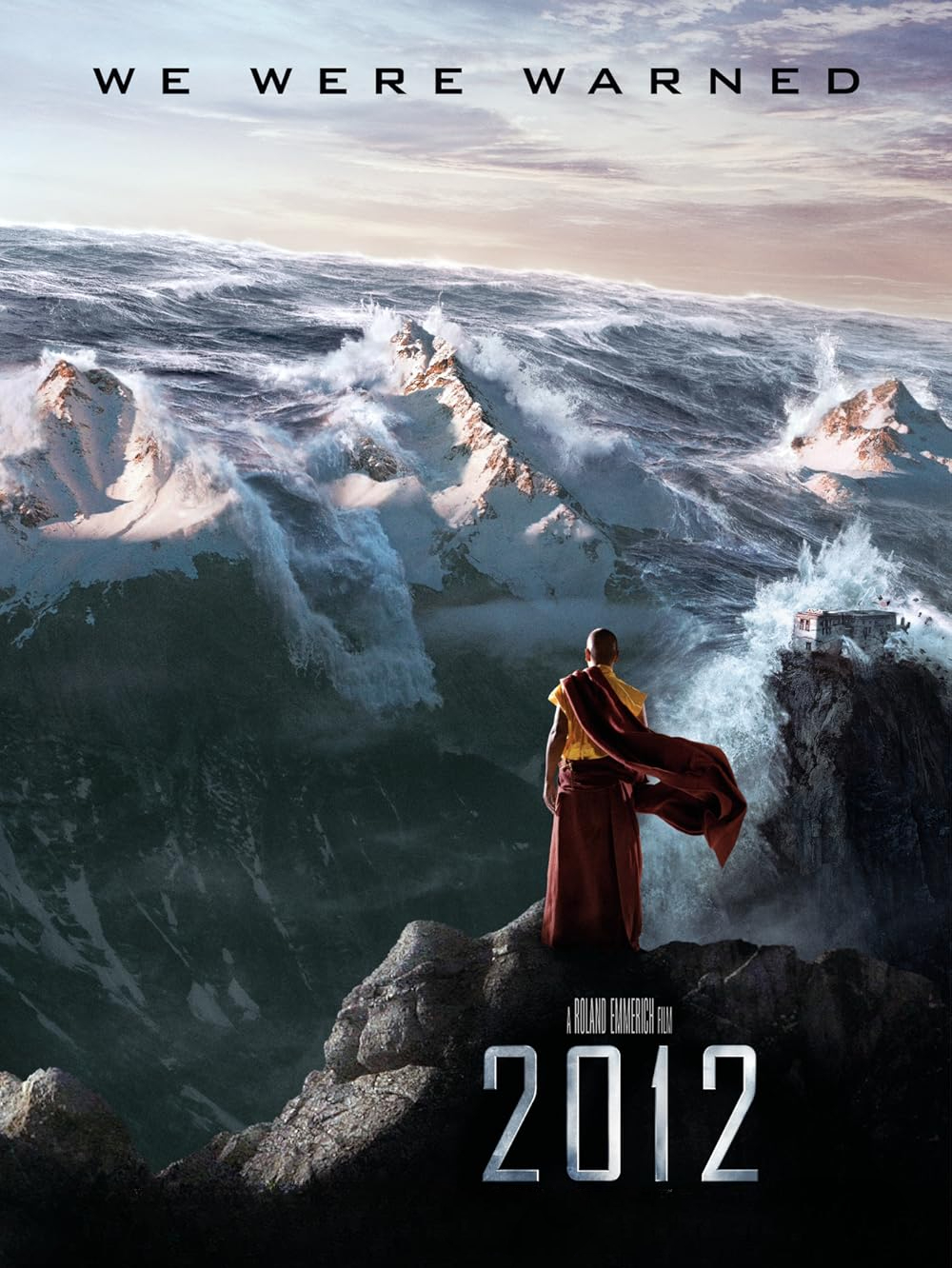
Roland Emmerich has a reputation that precedes him, and it’s not exactly a glowing one. When his name pops up as the director of a new blockbuster, it’s easy to let out an audible groan. He’s not quite in the same league as Uwe Boll for sheer cinematic atrocities, but he gives Michael Bay a serious run for his money in the “most frustratingly inconsistent big-budget filmmaker” category. This is a guy who once showed real promise with cult sci-fi action flicks like Universal Soldier and Stargate, then hit his commercial and creative peak with the wildly entertaining Independence Day. But ever since that 1996 high point, Emmerich’s films have followed a disappointing trajectory, each one seemingly more bloated and less satisfying than the last. Godzilla was a mess. The Day After Tomorrow had its moments but collapsed under its own ridiculousness. So when 2012 rolled around in late 2009, expectations were, to put it mildly, low. Yet somehow, against all odds, Emmerich delivered his most purely enjoyable disaster flick since Independence Day—a film so gleefully, unapologetically over-the-top that it transcends its many, many flaws.
2012 takes the idea of apocalyptic cinema and cranks it up to eleven, then snaps the dial off and sets it on fire. The premise is simple: the Mayan calendar wasn’t just a quirky ancient artifact—it was a warning. The world, as we know it, is set to end in the year 2012, thanks to a series of cataclysmic events triggered by solar neutrinos heating up the Earth’s core. The film spends its first act methodically setting up this global doomsday through two very different perspectives. On one side, you’ve got Dr. Adrian Helmsley, played with quiet intensity by Chiwetel Ejiofor, a scientist who discovers the impending disaster and tries to warn world leaders. On the other, there’s Charlie Frost, a conspiracy theorist radio host played by Woody Harrelson with the kind of manic energy that suggests he might actually believe the world is ending—or at least that his next cup of coffee is. These early scenes are a mix of pseudo-science and doomsday preaching, but they serve their purpose: by the time the first real disaster strikes, you’re primed and ready for the chaos.
And oh, what chaos it is. 2012 isn’t just a disaster movie—it’s a full-blown disaster epic, a nearly three-hour spectacle of global annihilation that feels like Emmerich finally decided to stop holding back. This is a film where entire continents are reshaped, where cities crumble into the sea, and where billions of people meet their end in the most visually inventive ways possible. The destruction of Los Angeles is a particular standout, a sequence so relentless and well-executed that it’s hard not to watch with your jaw hanging open. John Cusack plays Jackson Curtis, a limousine driver and failed novelist who finds himself in the middle of the carnage while trying to pick up his kids from their mother’s new boyfriend’s mansion. As the ground literally splits open beneath him, Curtis has to outdrive an earthquake that’s turning the San Andreas Fault into a real-life game of Frogger. Buildings collapse, freeways pancake, and the entire city slides into the Pacific Ocean in a scene that’s as thrilling as it is absurd. It’s the kind of moment that defines 2012: completely ridiculous, yet undeniably impressive in its sheer audacity.
But Los Angeles is just the appetizer. From there, the film takes us on a world tour of destruction. Yellowstone National Park erupts in a supervolcano explosion that turns the American Midwest into a smoldering wasteland. Mega-tsunamis, some as tall as the Himalayas, crash over entire landmasses, swallowing cities whole. Air Force One gets caught in a pyroclastic flow. And through it all, Cusack’s everyman hero is trying to get his family to safety, which in this case means boarding one of the massive arks built by the world’s governments to preserve humanity—or at least the rich and well-connected. The arks, a last-ditch effort to save a sliver of civilization, become the film’s most fascinating and frustrating element. On one hand, they’re a clever narrative device, forcing the characters into a high-stakes race against time. On the other, they highlight the film’s most glaring ethical and logical inconsistencies. Why are only certain people allowed on board? How did they build these things in secret? And why does Danny Glover’s President Wilson, a man who seems perpetually one step behind the crisis, get to be the moral compass of the story? The answers, of course, are “because the plot demands it” and “who cares, look at that explosion!”
The cast of 2012 is what you’d charitably call an ensemble, though “B-list all-stars” might be more accurate. Cusack is fine as the reluctant hero, though he’s never fully convincing as a man who can outsmart the apocalypse. Amanda Peet plays his ex-wife, Kate, a woman so perpetually exasperated by her former husband that you wonder why she ever married him in the first place. Their kids, played by Liam James and Morgan Lily, are mostly there to scream and look terrified, which they do adequately. Chiwetel Ejiofor brings a much-needed dose of gravitas as the scientist trying to sound the alarm, though even he can’t sell some of the film’s more outlandish scientific explanations. Danny Glover’s President Wilson is… well, he’s Danny Glover as the President, which is about as convincing as it sounds. And then there’s Woody Harrelson, who steals every scene he’s in as Charlie Frost, the conspiracy theorist who may or may not be onto something. Harrelson’s performance is so delightfully unhinged that it almost makes you wish the film had focused more on his character and less on Cusack’s family drama.
And that’s the thing about 2012: the human elements are almost uniformly the weakest part of the film. The dialogue is often clunky, the character arcs are predictable, and the emotional beats frequently fall flat. But none of that matters because Emmerich and his team have crafted a film that’s so visually stunning, so relentlessly paced, and so committed to its own absurdity that you can’t help but get swept up in it. This is a movie that understands exactly what it is: a guilty pleasure, a spectacle, a chance to watch the world end in the most extravagant ways possible. It doesn’t ask you to think too hard or invest too deeply in its characters. It just asks you to sit back, grab some popcorn, and enjoy the ride. And on that front, 2012 delivers in spades.
What’s most impressive about 2012 is the sheer scale of its ambition. This isn’t a film content with destroying a single city or even a single country. Emmerich wants to tear down the entire planet, and he does so with a level of detail and creativity that’s hard not to admire. The visual effects are top-notch, and the film’s destruction sequences are some of the most memorable in the disaster genre. The mega-tsunami that crashes over the Himalayas is a particular highlight, a moment so awe-inspiring in its scope that it’s easy to forget you’re watching a movie that’s otherwise filled with groan-worthy dialogue and one-dimensional characters. And then there’s the final act, where the arks become the stage for a last-ditch effort to save humanity. The sequences aboard the ark are a mix of tension and spectacle, as the characters navigate the chaos of a world literally coming apart at the seams.
Of course, 2012 isn’t without its share of head-scratching moments. The science is, to put it kindly, questionable. The idea that solar neutrinos could heat up the Earth’s core to the point of global destruction is pure fantasy, and the film’s explanation for how the arks were built and funded is so flimsy it might as well not exist. The pacing, too, can be uneven. The first act drags a bit as it sets up the various plot threads, and the final act feels rushed, as if Emmerich realized he had to wrap things up before the runtime hit the three-hour mark. And then there’s the film’s tone, which can be wildly inconsistent. One moment, you’re watching billions of people die in horrific ways; the next, you’re supposed to laugh at a joke from one of the side characters. It’s a balancing act that doesn’t always work, but somehow, it doesn’t derail the film either.
At its core, 2012 is a throwback to the disaster movies of the 1970s, films like The Poseidon Adventure and The Towering Inferno that were more concerned with spectacle than substance. Those films were often criticized for their thin plots and wooden acting, but they endured because they delivered on the one thing that mattered: thrilling, large-scale destruction. 2012 is cut from the same cloth. It’s a film that knows its audience and knows exactly what they want. And what they want, it turns out, is to watch the world end in the most spectacular ways possible. In that sense, 2012 is a resounding success. It’s a bad movie, sure, but it’s a bad movie that’s an absolute blast to watch. It’s the kind of film you put on when you want to turn off your brain, crank up the volume, and lose yourself in the sheer, unadulterated joy of watching everything burn.
So, is 2012 a good film? By most traditional measures, no. The plot is silly, the characters are thin, and the dialogue is often laughable. But as a piece of pure, unfiltered disaster porn, it’s one of the best. Emmerich has always been a director who prioritizes spectacle over subtlety, and 2012 is the purest expression of that philosophy. It’s a film that doesn’t just meet expectations—it exceeds them, if only by virtue of its sheer, unrelenting ambition. And in a world where so many blockbusters feel like they’re playing it safe, there’s something refreshing about a movie that’s willing to go this big, this bold, and this unapologetically over-the-top. 2012 may not be high art, but it’s a hell of a lot of fun. And sometimes, that’s more than enough.
“We will not go quietly into the night! We will not vanish without a fight! We’re going to live on! We’re going to survive! Today, we celebrate our Independence Day!” — President Whitmore
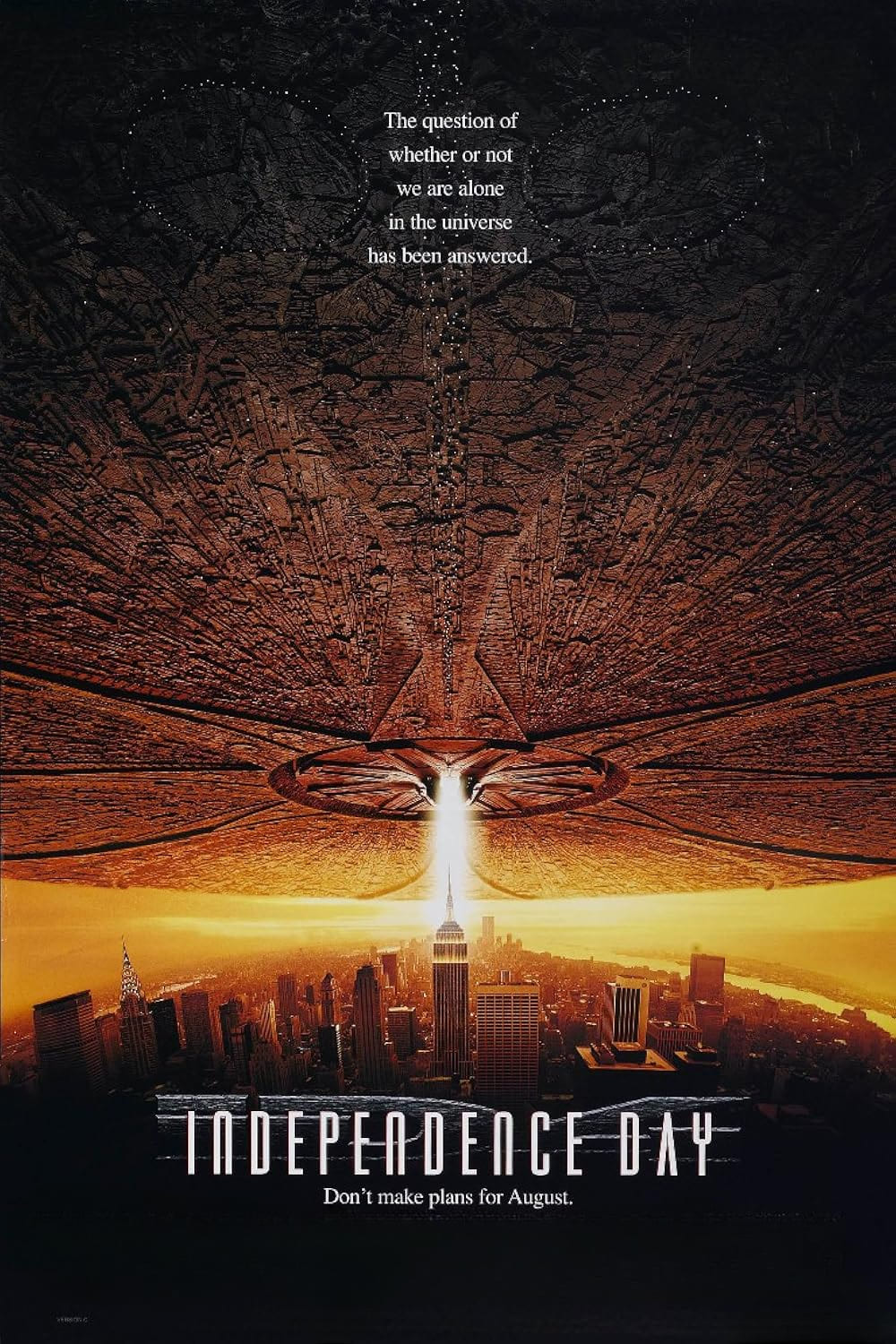
If you were around in the summer of 1996, you already know exactly where you were when you first saw the trailer for Independence Day. There was this massive shadow creeping over the moon, followed by that terrifying, booming sound effect, and then the White House just absolutely getting vaporized by a giant laser beam. It was a cultural moment. Director Roland Emmerich hadn’t really made his mark on Hollywood yet, but with this one movie, he essentially invented the modern summer blockbuster template of destroying famous global landmarks. Looking back at Independence Day almost three decades later, it is honestly wild how well this movie holds up, not as a piece of high art, but as a perfectly calibrated, ridiculously entertaining popcorn machine.
The premise is beautifully simple: massive alien spaceships suddenly appear over Earth’s major cities, they don’t come in peace, and humanity has to figure out how to fight back before we go the way of the dinosaurs. What makes the first act of the movie so effective is the slow build. Emmerich doesn’t just start with explosions; he lets the dread simmer. We see the massive ship hover over New York City, casting a shadow that blocks out the sun, and the sheer scale of the thing is awe-inspiring. Then, when the ships finally initiate their attack sequence, the payoff is spectacular. The practical effects combined with early CGI create these massive, rolling walls of fire that tear through iconic buildings. It is destructive poetry, and as a kid watching it, it was the most incredible thing I had ever seen. Even now, the destruction feels heavy and tactile in a way that modern, entirely computer-generated action sequences often don’t.
But a movie is only as good as its characters, and Independence Day has arguably one of the greatest ensemble casts of the 1990s. You have Will Smith playing Captain Steven Hiller, a fighter pilot who is desperately trying to get promoted while also dealing with his girlfriend, her son, and their dog. Smith is at the absolute peak of his early movie star charm here, delivering some of the most quotable one-liners in action movie history. Punching an alien in the face and yelling “Welcome to Earth!” is the kind of ridiculous machismo that only Smith could pull off without making you cringe. Then you have Jeff Goldblum as David Levinson, an MIT-educated cable repairman and environmentalist who figures out the alien signal is a countdown. Goldblum is basically doing his classic Goldblum thing—stuttering, eccentric, highly caffeinated—but it works perfectly because he serves as the perfect foil to Smith’s brute physicality.
The supporting cast is so deep that it feels like an Ocean’s Eleven of sci-fi tropes. Bill Pullman plays President Thomas J. Whitmore, and he gives the role an earnestness that elevates the material. He’s not an action hero; he’s a former fighter pilot who is clearly in over his head but steps up when his people need him most. You also have Judd Hirsch as Goldblum’s cranky, kvetching father, providing fantastic comic relief. Randy Quaid plays Russell Casse, a traumatized former pilot who was abducted by aliens years ago and is written off as a drunk by his small town, giving the movie an underdog storyline. And you can’t forget Brent Spiner as Dr. Okun, the wildly eccentric Area 51 scientist who gets way too excited about the alien biology. Every single one of these actors is fully committed to the bit, no matter how absurd the situation gets.
Now, if we are being completely honest, we have to talk about the plot, which is essentially held together with scotch tape and sheer willpower. The entire third act revolves around Goldblum and Smith flying a captured alien spacecraft up to the mothership to upload a computer virus using a 1996 Apple PowerBook. Yes, an Earth laptop somehow interfaces perfectly with an advanced extraterrestrial operating system, and yes, the aliens apparently don’t have McAfee, Norton or any kind of firewall to prevent a rudimentary human virus from crippling their entire defense grid. It is monumentally stupid if you think about it for even five seconds. But the secret to Independence Day is that it moves so fast and has so much momentum that you simply do not have time to care. The movie dares you to roll your eyes, but then it immediately distracts you with another massive explosion or a great quip from Will Smith, and you just go along for the ride.
The climax of the movie is a masterclass in cheesy, triumphant blockbuster filmmaking. Before the final aerial assault on the alien ships, President Whitmore gives a speech to the troops that has become completely ingrained in pop culture. “Today we celebrate our Independence Day!” he yells, and it is so incredibly corny, but I challenge you not to get at least a little bit pumped up when the music swells. The dogfight that follows is chaotic and thrilling, culminating in Randy Quaid’s character making the ultimate sacrifice by flying his jet directly into the alien weapon. It is exactly the kind of melodramatic, heroic moment that Emmerich excels at, and it hits the emotional beats it needs to hit, even if you saw it coming from a mile away.
You also have to appreciate how unapologetically intense the movie feels despite skating by with a PG-13 rating. People get vaporized, cities are leveled, and there is a genuine sense of apocalyptic dread that permeates the middle of the film. When the aliens first attack, Emmerich actually takes the time to show the aftermath, including cars blowing up in tunnels and people desperately trying to outrun the fireballs. Harvey Fierstein’s character dramatically dying while just sitting in his car, rolling up the window as if that’s going to stop a giant wall of alien fire, is a weirdly specific, dark comedy beat that you rarely see nowadays. The movie has real stakes, and you genuinely feel like humanity is on the brink of extinction.
It is crazy to think about the legacy of Independence Day and how it changed Hollywood. Before this, disaster movies were mostly relegated to B-movie status or Irwin Allen productions from the 1970s. Emmerich proved that you could blend disaster spectacle with sci-fi action and make an absolute fortune. This movie paved the way for Armageddon, Godzilla, The Day After Tomorrow, and essentially the entire concept of the modern cinematic destruction porn genre. They did eventually make a sequel, Independence Day: Resurgence, in 2016, but it completely missed the point of the original. It was too slick, too reliant on weightless CGI, and it lacked the ragtag, underdog charm that made the first one so special.
At the end of the day, Independence Day is just pure, unadulterated cinema comfort food. It does not demand anything from you as a viewer other than to sit back, suspend your disbelief, and enjoy the fireworks. It captures a very specific mid-90s vibe where movies could be big, dumb, loud, and incredibly fun without taking themselves too seriously. Roland Emmerich has directed a lot of movies since then where he has destroyed the world in various different ways, but he has never quite managed to capture the lightning in a bottle that he did here. Whenever the Fourth of July rolls around, or whenever you just need a reliable, edge-of-your-seat action movie to kill a couple of hours, Independence Day is always there, waiting to welcome you to Earth one more time.
With all the rocking and rolling and metal headbanging the site has been on of late it’s just appropriate that we take a quick intermission with a different sort of rocking and rolling.
The Rock aka Dwayne Johnson will take on the Big One and only one will come out victorious.
San Andreas is set for a May 29, 2015 release date.
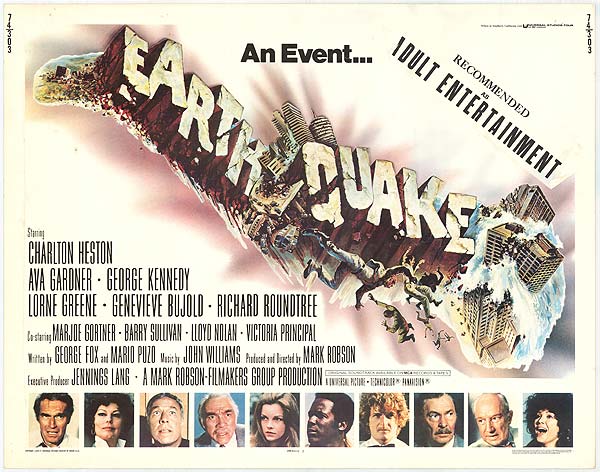
Since it’s impossible for me to talk about anything without somehow relating it to a movie, I guess it makes sense that my reaction to San Francisco winning the World Series was to write a review of the award-winning, 1974 disaster film Earthquake. If the Rangers had won, I would have been obligated to write up a review of No Country For Old Men.
So, Earthquake is one of those movies from the 70s in which a large group of different characters had to deal with some sort of cataclysmic disaster that could, in theory, have happened in reality as well as up on the movie screen. There were apparently about 2,000,000 of these films made between 1970 and 1980 and they all had titles like Hurricane, Tornado, Big Fire, Asbestos, Flash Flood, Lava Flow, Khardashian, Avalanche, and, of course, Earthquake. These movies always featured an “all-star” cast of people that nobody had ever actually heard of and I guess part of the fun was trying to guess who would survive and who would die. Apparently, they were the 1970s version of Dancing With The Stars. Call it Dying With Celebrities.
Earthquake is one of best known of these films. Apparently, it made a lot of money in 1974 and it won Academy Awards for its earthquake effects. Bleh. Whatever. Have you ever really sat down and looked at a list of the movies that have won at least one Academy Award since they first started handing those things out? Earthquake is like a 6 hour movie and Los Angeles doesn’t start shaking until halfway through. The Earthquake itself only lasts for 15 minutes and it’s kind of impressive to watch but it’s 15 minutes out of 360.
Before the earthquake hits, we get to meet the usual cross-section of humanity. Charlton Heston is an architect who is married to Ava Gardner who is the daughter of Heston’s boss, who is played by an actor named Lorne Greene who appears to be younger than either Heston or Gardner. Heston has a mistress who is played by Genevieve Bujold who is really pretty, sweet, and boring. Gardner is none of these things but she is a foul-mouthed alcoholic who fakes suicide attempts so I was pretty much on her side as far as the whole love triangle is concerned. After the Earthquake, Heston and Greene and a bunch of accident-prone extras are stuck in the ruins of sky scraper. Heston grimaces a lot in this film but you know what? Say what you will about Charlton Heston’s politics or his clenched-teeth acting style, the man knew how to wear an ascot.
While Heston is torn between Gardner and Bujold (a plot development that reportedly inspired the famous Sartre play No Exit), Richard Roundtree just wants to jump over stuff on his motorcycle. That’s right — John Shaft is in this movie and we can dig it. He’s a professional daredevil. He’s also a surprisingly dull actor. Who would have guessed that, without a theme song playing, Shaft would turn out to be so boring? Still, there’s a really cool scene where Roundtree tries to ride his motorcycle through Los Angeles in the middle of the earthquake and the film is worth watching for his all-flare stunt daredevil costume if nothing else. Plus, Roundtree’s playing a character named Miles here and I like that name.
There’s another subplot. It involves George Kennedy as a blue-collar cop who does what he has to do to try to maintain the peace before and after the Earthquake. Bleh. I mean, Kennedy actually gives a pretty good performance and he’s probably the most likable character in the film but seriously — Bleh.
And finally, this collection of humanity is rounded out by an aspiring actress (played by actress Victoria Principal who, four years earlier, had made history by being the first woman to successfully seduce actor Anthony Perkins and no, I don’t want to go into how I know that) and the psychopathic grocery store manager who is obsessed with her. The grocery store manager is played by former child evangelist and 70s exploitation icon Marjoe Gortner. Much as in the later film Starcrash, Gortner projects a remarkably unlikable vibe that works well for his character. He also has a really bad perm and a mustache and his performance is so sublimely bad that it’s actually pretty good. As for Principal, her character here is apparently the owner of 1974’s most ginormous afro and, like most women in the 70s, really should have considered wearing a bra. It’s hard to really judge Principal’s performance because any time she’s on-screen, you just start thinking, “Oh my God, she had sex with Norman Bates but somehow, she thinks she’s too good for Marjoe Gortner?”
These are the characters that we follow as Los Angeles is destroyed on-screen. None of them are really much more than cardboard cut outs but there’s something oddly comforting about how shallow and predictable they all are. Add to that, most of them end up dead so if you do dislike them, you’ll find a lot to enjoy. You’ll especially enjoy the film’s final few moments unless, like me, you can’t swim and you’re terrified of drowning. If you’re like me, that scene might give you nightmares.
Flawed as it may be, I still have to recommend this movie as 1) a time capsule and 2) as a quintessential piece of American camp. Every line of dialogue, every performance, every image, and every scene in Earthquake simply screams 1974. I guess the best way to look at Earthquake is to think about it as if the movie’s a time machine. You might not like where the machine takes you but you’re still going to get into the damn thing and, once you find yourself stuck in Iowa in the year 1835, you’ll find someway to force yourself to be entertained because otherwise, you’re just hanging out in Iowa in 1835.