Retro Television Review: Crime Story 1.16 “The Kingdom of Money”


Welcome to Retro Television Reviews, a feature where we review some of our favorite and least favorite shows of the past!  On Mondays, I will be reviewing Crime Story, which ran on NBC from 1986 to 1988.  The entire show can be found on Tubi!
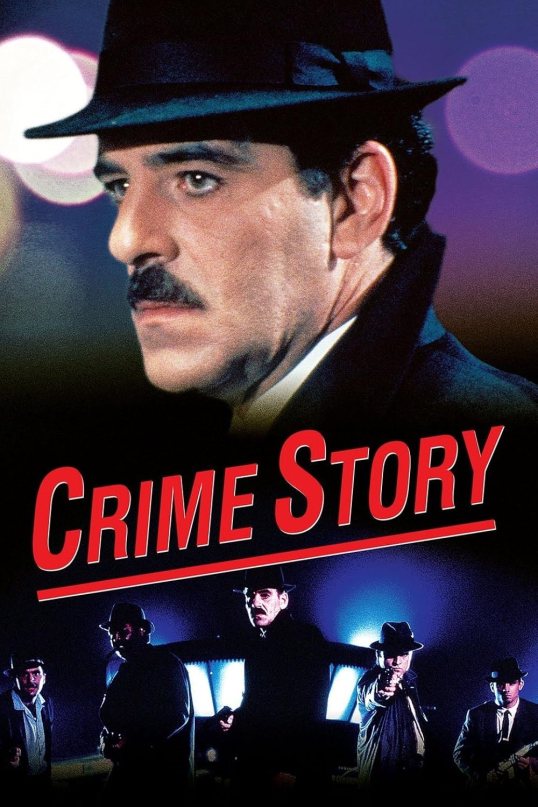
This week, the show changes locations.  We’re going to Vegas and we’re getting new opening credits!

Episode 1.16 “The Kingdom of Money”

(Dir by James A. Contner, originally aired on January 30th, 1987)

Welcome to Las Vegas!

Ray Luca is very happy to be in Vegas. Along with Max Goldman, Pauli, and Steve Kordo (Jay O. Sanders), Ray has taken over a casino and is pushing his way into the local rackets. He gives a speech to the casino’s employees, telling them that from now on everything in the casino will be run honestly and that anyone who steals any money will be fired. He then has a meeting with Max in which they discuss all the ways to skim the profits.

Luca’s wife, Cori (Johann Carlo), isn’t happy about the move. She misses Chicago, so instead of hanging out around the house, Luca goes out and hires a prostitute named Jackie (Debra Feuer). Luca tells Jackie that she will be working exclusively for him from now on. Jackie points out that she already has a “manager.” Luca smirks.

The only problem for Luca is that Mike Torello is in Vegas, and now he’s working for the Justice Department. Luca and his team are headquartered in a small Vegas motel. When David Abrams sees that someone has brought a bowl of Justice Department matchbooks into the motel, he tells Torello’s men to throw them out. “We’re not a recruiting station,” Abrams says.

Torello decides that the best way to get Luca is to go after one of Luca’s Vegas associates, a loan shark named Al (Mike Starr). They visit a diner owner (Graham Beckel) who owes Al money. They convince him to call Al and say that he has Al’s money. When Al comes to collect, Torello will arrest him. Sound like a good plan, right?

Unfortunately, someone is dumb enough to leave behind the bowl of Justice Department matchbooks in the diner. Additionally, it doesn’t occur to Torello to have someone watching the diner 24/7. When Al shows up early and discovers the matchbooks, he guns down not only the owner of the diner but also his wife and 5-year-old son.

Torello’s angry. Well, Torello should be angry. He should also be feeling guilty, seeing as how he and his men basically got the diner owner killed through their own incompetence. Torello decides to go undercover as someone who needs a loan. He and his men even set up a fake strip club where Torello and Al can meet to discuss the terms of the loan. Torello’s attempt to arrest Al falls apart when one of Al’s men pulls a gun and starts firing. Danny takes a bullet in the arm before killing the gunman. As for Al, he runs through the streets of Vegas before Torello guns him down.

Abrams looks down at Al’s body and says that he doesn’t think Al is going to be testifying.

This was a good episode. If the previous Chicago-based episodes emphasized the professionalism of Torello and the impulsivity of Luca, the roles are reversed in Vegas. Luca is in his element, and Torello and his men are the ones who are now having to adjust to a new city. If the previous Chicago-based episodes tended to be cold and gray, this Vegas episode is visually defined by neon and excess. The sallow, grim-faced Torello looks out of place here. This is Luca’s world.

I’m looking forward to seeing how the rest of season one plays out.
Late Night Retro Television Reviews: Freddy’s Nightmares 1.1 “No More Mr. Nice Guy”


Welcome to Late Night Retro Television Reviews, a feature where we review some of our favorite and least favorite shows of the past! On Fridays, I will be reviewing Freddy’s Nightmares, a horror anthology show which ran in syndication from 1988 to 1990. The entire series can be found on Plex!

Having finished up Friday the 13th, I’m not going to take a look at another syndicated horror show that aired around the same time.  Freddy’s Nightmares was an anthology show hosted by Robert Englund, in character as Freddy Krueger.  Each story would take place in Freddy’s hometown of Springwood, Ohio.  Would the show be a dream or a nightmare?  Let’s find out!

Episode 1.1 “No More Mr. Nice Guy”

(Dir by Tobe Hooper, originally aired on October 9th, 1988)

Freddy Krueger has become such a familiar and popular figure that I think it’s sometimes forgotten that, when he first appeared, he was truly a horrifying character.  He was a child molester and a serial killer, one who escaped legal justice only because someone forgot to read him his rights when he was arrested.  He was killed by the citizens of Springwood, Ohio, set on fire in the same boiler room where he killed his victims.  Yes, he was brutally murdered and yes, the respectable people who murdered him covered up their crime.  At the same time, what would you do if a monster like Freddy was loose in your town and stalking your children?  “I’m burning in Hell,” Freddy says and that’s exactly what he deserved.

How did Freddy Krueger then become an oddly beloved pop cultural icon?  Some of that was undoubtedly due to his one-liners, which tended to be a slightly better than the typical slasher film banter.  If Freddy was pure evil in the first three Nightmare on Elm Street films, he became more a homicidal prankster as the series continued.  I think another reason why Freddy became popular is because the actor who first played him, Robert Englund, himself always comes across as being such a nice guy.  Unlike the personable but physically intimidating Kane Hodder, who looked like he could kill you even when he wasn’t playing Jason Voorhees, Englund always comes across as being slightly nerdy and very friendly.  He’s the neighbor who you would trust to get your mail while you’re on vacation.  If Englund hadn’t been cast as Freddy Krueger in 1984, he probably would have spent the 90s playing quirky programmers and hackers in tech thrillers.  The thing with Robert Englund is that seems to have a good sense of humor, he’s at peace with his place in pop culture, and he always seem to be having fun.  (In his autobiography, he even jokes about something that fans had been laughing about for years, the fact that the female lead in A Nightmare In Elm Street 2 looked almost exactly like Meryl Street.)  Those are qualities that bled over into Freddy.

As a result, Freddy became popular enough to host his own horror anthology.  The premiere episode of Freddy’s Nightmares open with Englund, in full Freddy makeup, telling us that we’re not about to see one of our nightmares.  Instead, we’re going to see his nightmare.  The episode gives us Freddy’s origin story, starting with Freddy getting off on a murder charge on a technicality and ending with Freddy getting bloody revenge of the police chief (played by Ian Patrick Williams) who set him on fire.

By almost any standard, it’s a disturbing story.  We open with Freddy on trial and we hear details about an 8 year-old boy that he left in a dumpster.  After the charges against Freddy are dismissed (damn those Carter judges!), Freddy happily gets into an ice cream truck and later, the police chief has a vision of the same truck coming straight at him.  After getting set on fire, Freddy doesn’t waste any time coming back and using his razor-blade gloves to slash his way to vengeance.  I think what’s particularly disturbing about this episode is that the police chief is not a bad guy.  He arrested Freddy as Freddy was trying to attack his twin daughters.  Throughout the episode, Freddy — in both life and death — makes it clear that he’s coming for the man’s daughters.  And in the end, Freddy will probably get them because their father fell asleep in a dentist’s chair and got his mouth drilled by Dr. Krueger.

Agck!  That’s disturbing stuff.  Of course, it would be even more disturbing if the show’s special effects and gore were anywhere close to being a realistic as what was present in the movies.  The show itself looks remarkably cheap.  I would say it almost looks like a community theater production of A Nightmare on Elm Street.  Director Tobe Hooper (of Texas Chainsaw Massacre fame) manages to wring a few jump scares out of the material and a scene where we see one of Freddy’s courtroom fantasies is genuinely horrifying but, for the most part, the budget is low enough that the viewer can safely say, “It’s only a TV show, it’s only a TV show….”  In the end, it’s very much an 80s TV show, right down to the oddly gratuitous scene where the police chief suddenly imagines the dental hygienist in her underwear.

Where will Freddy’s Nightmares lead us?  We’ll find out.  I’m sure it will be bloody, wherever it is!