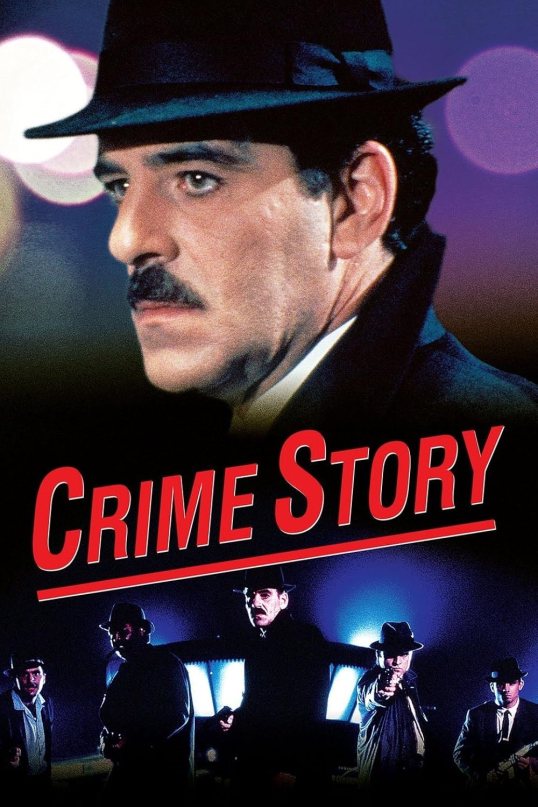
Welcome to Retro Television Reviews, a feature where we review some of our favorite and least favorite shows of the past! On Mondays, I will be reviewing Crime Story, which ran on NBC from 1986 to 1988. The entire show can be found on Tubi!
This week, Homan sings.
Episode 1.13 “Strange Bedfellows”
(Dir by Francis Delia, originally aired on December 26th, 1986)
Homan is in federal custody and he’s telling Breitel all that he knows about Luca and Bartoli. He’s also making up a story about Torello taking a bribe. Even though Homan’s Torello story is pretty shaky, Breitel is looking forward to taking down a crooked cop and launching his political career off of of the publicity.
Bartoli is not amused when he learns that he’s being indicted. However, Luca is able to convince Manny Weisbord to provide him with a top-level defense attorney. Manny also makes it clear that Luca no longer works for Phil. Instead, Luca works with Phil. Lucas has another reason to be happy. When he runs into David Abrams at a bar, he gets some free legal advice. Luca explains that Homan is lying about Torello. Abrams tells Luca that, if they can prove that Homan is lying about Torello, it will be easier to convince a jury that Homan is lying about Luca and Bartoli as well.
Torello, meanwhile, responds to his upcoming indictment by going to Las Vegas and playing some golf. He’s in a great mood until he sees that his indictment is one the front page of the newspaper.
Not much really happened in this episode of Crime Story. That’s not really a complaint. If anything, it was a bit of a nice change-of-pace. We got to watch the characters just be themselves. Luca, who rarely shows emotion, actually smiles when he hears that Torello is about to be indicted along with “his favorite people.” Luca actually has a sense of humor and an appreciation for irony. Who would have guessed? Meanwhile, Torello continues to be just a bit too intense for his own good. Even on vacation, he seems like he’s just one frustration away from snapping.
Welcome to Retro Television Reviews, a feature where we review some of our favorite and least favorite shows of the past! On Mondays, I will be reviewing Crime Story, which ran on NBC from 1986 to 1988. The entire show can be found on Tubi!
In 1986, riding high on the success of Miami Vice, Michael Mann signed on as executive producer of Crime Story, a cop show that Mann imagined would run for five seasons and which would follow a group of cops and gangsters from 1960s Chicago to 1980s Las Vegas. The show was co-created by former Chicago cop Chuck Adamson and it starred another former Chicago cop, Dennis Farina.
Though generally well-received by critics, Crime Story struggled in the ratings. The show’s highly serialized-nature made it difficult for audiences to follow. (This was in the pre-streaming age, when viewers couldn’t just get online and catch up with what they may have missed.) Crime Story only lasted for two seasons but it has since developed a strong cult following and is now regularly listed as one of the best cop shows ever made.
(Dir by Abel Ferrara, originally aired on September 18th, 1986)
In Chicago, on a rainy night in the early 1960s, a group of masked robbers hold up a fancy restaurant and then try to escape with a group of terrified hostages. On the scene is the Major Crimes Unit, led by the grim Lt. Torello (Dennis Farina, a former real-life cop). The end result is that all of the robbers end up dead, the hostages end up traumatized, and one of Torello’s men, the obviously doomed Wes Connelly (William Russ), appears to be losing his mind over the violence that he has to deal with every day.
The plot of the pilot is actually pretty simple. A gang of thieves is holding up restaurants, banks, and stores in Chicago. Torello believes that an ambitious gangster named Ray Luca (Tony Denison) is behind the robberies and Torello is correct. The cool and sociopathic Ray is working with Johnny O’Donnel (David Caruso). O’Donnel may be a childhood friend of Luca’s but his parents are friends with Torello. When gangster Phil Bartoli (Jon Polito) orders Luca to kill O’Donnel after the latter robs one of Bartoli’s jewelry stores, it’s personal all-around.
Plot-wise, it’s pure Michael Mann. The cops and the gangsters are both obsessive. Luca will kill anyone to get ahead in the underworld. Oddly, his only real loyalty seems to be to his dumbest henchman, Pauli Taglia (John Santucci, a real-life former jewel thief who was once arrested by Dennis Farina). Torello may be fighting on the side of the law but he’s often just as quick to resort to violence as Luca. Director Abel Ferrara’s style can be seen in a scene where Torello is visited by the ghost of the recently murdered Wes Connelly. Torello is burned out and paranoid, flying into a rage when he sees his wife, Julie (Darlanne Fluegel), dancing with another man at a wedding. (The man in question turns out to be Torello’s cousin, whom Torello didn’t even recognize because he apparently doesn’t have much of a connection to anyone outside of the police force.) Towards the end of the episode, there’s a shoot-out in a department store and it’s hard not to notice that neither the crooks nor the cops seem to be all that concerned with the innocent bystanders trying to not get caught in the crossfire.
The pilot is dark, gritty, and, in its way, as stylized as any episode of Miami Vice. It never seems to stop raining and, even during the day, the skies are permanently gray and dark. The early 60s are recreated like a fever dream of pop culture, with rock and roll on the soundtrack, cars with tail fins screeching down the street, and Bartoli living in a house that looks more like a tacky diner then a true home. Torello and his men wear their dark suits and trenchcoats the way that soldiers wear their uniforms.
It’s an effective pilot, though we don’t really get to know much about the men working with Torello at the Major Crimes Unit. Bill Smitrovich, in the role Detective Danny Krycheck, establishes himself as being Torello’s second-in-command but that’s about it. Stephen Lang appears in a handful of scenes as David Abrams, a liberal public defender who is the son of a prominent gangster. Both Luca and Torello seem to want to make David into an alley and the episode hints that he will eventually have to make a choice. The episode ends with Luca in sunny Florida, meeting with veteran gangster Manny Weisbord (Joseph Wiseman). Torello, meanwhile, remains in dark Chicago.
The Crime Story pilot was deemed good enough to be released as a feature film in Europe. It also led to a series on NBC, which I will be reviewing here, every Monday! On the basis of the pilot, I’m looking forward to it.
Welcome to Late Night Retro Television Reviews, a feature where we review some of our favorite and least favorite shows of the past! On Thursdays, I will be reviewing Highway to Heaven, which aired on NBC from 1984 to 1989. The entire show is currently streaming on Tubi and several other services!
This week’s episode of Highway to Heaven deals with death and is the best of season 4 so far.
Episode 4.7 “Amazing Man”
(Dir by Michael Landon, originally aired on November 11th, 1987)
When a cop who was trained by Mark is killed in the line of duty, his family becomes Jonathan and Mark’s next assignment. While Lorraine Douglas (Jane Daly) comes to terms with being a widow and a single mother, her young son (Garrette Ratliff Henson) plays with an Amazing Man action figure and seems to be in denial about his father’s death.
This was a surprisingly low-key episode, up until the final few minutes. That’s when Amazing Man came to life, in the form of Michael Landon wearing a super hero costume. It says something about the sincerity and the likable earnestness of this show that this episode still worked despite having Michael Landon turn into a version of Superman. I mean, really, it should have been a ludicrous scene. It should have made my cynicism go into overdrive. Instead, I couldn’t help but smile. Landon’s big heart came through in this episode.
This was a well-done episode and certainly the best of season four so far. That said, the one-year anniversary of my dad’s death is approaching and this episode was about a father dying and, as a result, it left me feeling rather depressed. I don’t particularly want to spend too much more time thinking about this episode because, right now, that’s just going to make me more depressed. That said, the important thing is that show’s the good intentions came through. This was a sweet episode. I hope everyone involved with it was proud of the final result because they had every right to be.
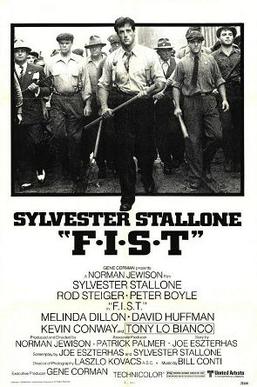
Actually, Stallone plays Johnny Kovak, a laborer who becomes a union organizer in 1939. Working with him is his best friend, Abe Belkin (David Huffman). In the fight for the working man, Abe refuses to compromise to either the bosses or the gangsters who want a piece of union. Johnny is more pragmatic and willing to make deals with ruthless mobsters like Vince Doyle (Kevin Conway) and Babe Milano (Tony Lo Bianco). Over thirty years, both Johnny and Abe marry and start families. Both become powerful in the union. When Johnny discovers that union official Max Graham (Peter Boyle) is embezzling funds, Johnny challenges him for the presidency. When a powerful U.S. senator (Rod Steiger) launches an investigation into F.I.S.T. corruption, both Johnny and Abe end up marked for death.
Obviously based on the life and mysterious disappearance of Jimmy Hoffa, F.I.S.T. was one of two films that Stallone made immediately after the surprise success of Rocky. (The other was Paradise Alley.) F.I.S.T. features Stallone in one of his most serious roles and the results are mixed. In the film’s quieter scenes, especially during the first half, Stallone is surprisingly convincing as the idealistic and morally conflicted Kovak. Stallone is less convincing when Kovak has to give speeches. If F.I.S.T. were made today, Stallone could probably pull off the scenes of the aged, compromised Johnny but in 1978, he was not yet strong enough as an actor. Far better is the rest of the cast, especially Conway, Lo Bianco, and Boyle. If you do see F.I.S.T., keep an eye on the actor playing Johnny’s son. Though he was credited as Cole Dammett, he grew up to be Anthony Keidis of the Red Hot Chili Peppers.
The box office failures of both F.I.S.T. and Paradise Alley led Stallone back to his most famous role with Rocky II. And the rest is history.
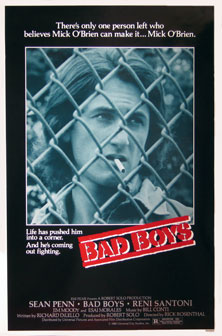
First off, I am not about to review the Michael Bay film where Will Smith and Martin Lawrence shoot people and blow things up. Instead, this Bad Boys is a film from 1983 where Sean Penn doesn’t shoot anyone but that’s mostly because he can’t get his hands on a gun. And, at one point, a radio does blow up. So, perhaps this Bad Boys has more in common with the Michael Bay Bad Boys than I originally realized.
Anyway, Bad Boys is about Mick O’Brien (Sean Penn), who is a 16 year-old criminal from Chicago. One night, when one of his crimes goes wrong, Mick’s best friend (Alan Ruck) is killed and Mick accidentally runs over the brother of rival gang leader, Paco (Esai Morales). Mick is sent to juvenile detention where he and his sociopathic cellmate, Horowitz (Eric Gurry), team up to overthrow the two “leaders” of their block, Viking (Clancy Brown, with scary blonde hair) and Tweety (Robert Lee Rush). Meanwhile, Paco is arrested for raping Mick’s girlfriend, JC (Ally Sheedy), and soon finds himself living on the same cell block as Mick.
And it all leads to … violence!
(In the movies, everything leads to violence.)
Bad Boys is one of those films that seems to show up on cable at the most random of times. I’ve never quite understood why because it’s not like Bad Boys is a particularly great film. It’s hard to see anything about this film that would lead a programmer to say, “Let’s schedule 100 airings of Bad Boys!” If anything, it’s the epitome of a good but not that good film. On the one hand, you have to appreciate a film that attempts to take a serious look at both juvenile crime and the true life consequences of tossing every “lawbreaker” into a cell and locking the door. People fetishize the idea of punishing criminals but they rarely consider whether those punishments actually accomplish anything beyond satisfying society’s obsessive need for revenge. (And it’s interesting to note that the problems of 1983 are not that much different from the problems of 2015.) On the other hand, Bad Boys is way too long, heavy-handed, and repetitive. This was one of Sean Penn’s first roles and, much like the film itself, he’s good without being that good. Watching his performance, you get the feeling that James Dean would say, “Nice try.”
However, the film is saved by two actor. First off, there’s Clancy Brown as the stupid but intimidating Viking. With his bad skin, blonde hair, and a permanent snarl on his face, Brown makes Viking into a character who is both ludicrous and scary. And then there’s Eric Gurry as the small and demonic Horowitz. According to his imdb page, Gurry long ago retired from acting but anybody who sees Bad Boys will never forget him.
 Sylvester Stallone is Jimmy Hoffa!