Welcome to Retro Television Reviews, a feature where we review some of our favorite and least favorite shows of the past! On Mondays, I will be reviewing Crime Story, which ran on NBC from 1986 to 1988. The entire show can be found on Tubi!
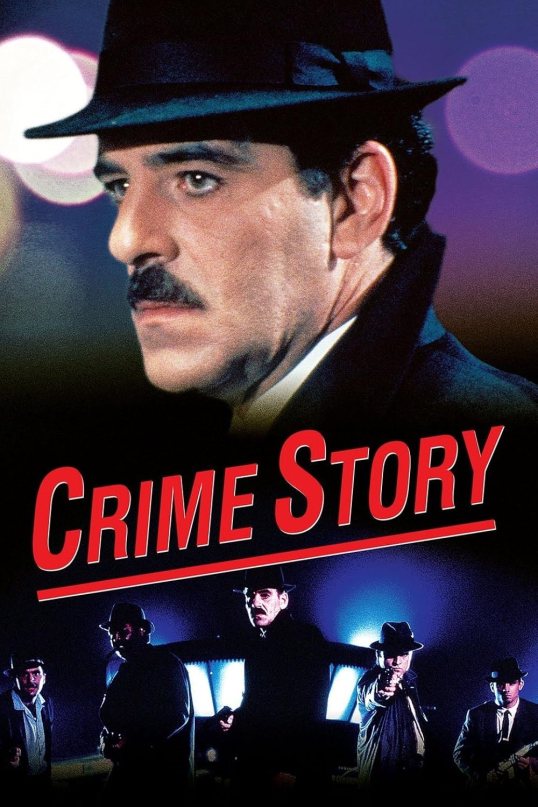
This week, the first season comes to a close.
Episode 1.21 “Gound Zero”
(Dir by Peter Medak, originally aired on March 13th, 1987)
In Las Vegas, the media is focused on two things: the upcoming atomic bomb test at Yucca Flats and the trial of Ray Luca.
Pauli, the star witness, is being kept in an underground bunker at an Air Force base. Danny comments on the fact that, if America and Russia do go to war and an atomic missile hits Nevada, Pauli would probably be the only survivor. It would be up to Pauli to repopulate the planet. Torello eventually allows Pauli’s girlfriend, Donna (Audrey Matson), to start visiting him. Donna says she loves Pauli. Torello shrugs.
Pauli keeps his end of the deal. He testifies against Luca. However, Frank Holman gives an interview outside the courtroom and tells the press that Luca was the king of organized crime in Las Vegas. The next day, the headline of the local newspaper announces that Luca was the “king of crime.” Disguising himself as the waiter assigned to deliver room service to the sequestered jury, Holman makes sure that the jurors see the headline. The trial judge has no choice but to declare a mistrial. As he walks out of the courtroom, Luca stops in front of Pauli and tells him, “You did what you had to do,” and apologizes for raping Donna.
In Vegas, Luca is upset to discover that gangster Nat Martino (James Russo) is moving in on his territory. Luca is prepared to go to war, but Manny Weisbrod informs Luca that he is to work with Martino. Weisbrod no longer has any confidence in Luca’s abilities. At the same time, Torello learns that Martino is actually an informant. Torello arranges for that information to get leaked to Luca. When Luca heads over to Martino’s favorite brothel, Torello and the other members of the MCU are waiting for him.
Breaking into Martino’s room, Luca manages to shoot and kill Martino before taking several bullets himself. Wounded, Luca escapes through a back window. Pauli, having decided that his place is with Luca, is there to pick him up and drive him out of town.
The next day, a bandaged Luca discovers that Pauli has driven him out to his latest hideout, a seemingly abandoned house in the desert. The house is full of mannequins. Luca looks at a chair and sees that it is the property of the Atomic Energy Commission. Realizing that they’re at Yucca Flats, Pauli and Luca run out to Pauli’s car. As they drive through the desert, a mushroom cloud blossoms in the distance.
And the episode ends!
Did Luca and Pauli escape the nuclear test? Hopefully, we’ll find out next week. I hope they did because it’s hard to imagine Crime Story without them. They were a great pair of villains.
The first season was good, if uneven. The pilot was outstanding, but some of the subsequent Chicago episodes seemed to lose their focus. Torello’s domestic drama was never as interesting as the show wanted it to be, and it took me a while to really warm up to David Abrams and his abrasive idealism. The other members of the MCU often felt like ciphers. (Even after 21 episodes, I still don’t feel like I know much about any of them beyond their almost cult-like loyalty to Torello.) But when the show moved to Vegas, things improved immeasurably. The glitz of Vegas worked perfectly for the show’s hyperreal style, and Stephen Lang’s performance in the role of David Abrams improved as well.
That said, Dennis Farina was the main strength of the first season. Farina played Torello as being intense, ruthless, and maybe just a little unhinged. The only real difference between Luca and Torello is that Torello carries a badge and Luca doesn’t have the Constitution holding him back. Otherwise, Luca really does represent Torello’s own dark side. In his pursuit of Luca, Torello isn’t just trying to enforce the law. He’s also trying to destroy the man that, had Torello not joined the police force, he could have become.
Next week, we’ll start the second season!

