Retro Television Review: Crime Story 1.8 “Old Friends, Dead Ends”


Welcome to Retro Television Reviews, a feature where we review some of our favorite and least favorite shows of the past!  On Mondays, I will be reviewing Crime Story, which ran on NBC from 1986 to 1988.  The entire show can be found on Tubi!
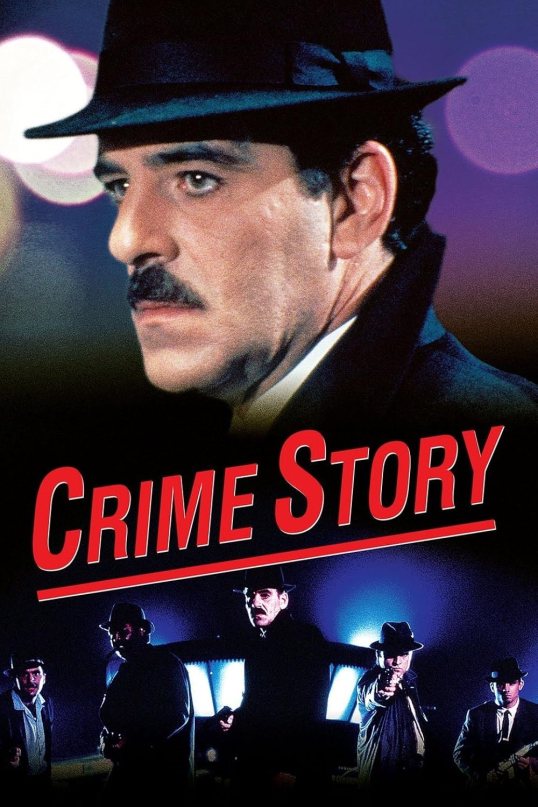
This week, Torello discovers some disturbing facts about an old friend.

Episode 1.8 “Old Friends, Dead Ends”

(Dir by Bobby Roth, originally aired on November 4h, 1986)

Luca has bought a controlling interest in a bottling company so that he can borrow from the pension fund and use that money to purchase casinos in Las Vegas.  He’s brought a reluctant Bartoli in as his partner.  The owner of the company is Ted Kehoe (Mark Hutter), who just happens to be an old friend of Mike Torello’s.  When Kehoe’s business partner, Marilyn Stewart (Dana Wheeler-Nicholson), becomes suspicious of Kehoe’s arrangement with Luca, Bartoli starts to wonder if it’s really worth it to keep Marilyn and Ted around.

This is especially the case after Bartoli’s attorney, Dee (a youngish Eric Bogosian), informs Bartoli that U.S. Attorney Harry Brietel (Ray Sharkey) is planning on indicting both him and Luca for money laundering.  Looking to end Brietel’s case before it can even get started, Luca murders Marilyn Stewart.  Marilyn’s body is later found by two teenagers and–

HEY, IT’S CHRISTIAN SLATER!

This episode does indeed feature an early performance from Christian Slater.  He pays a teenager who is trying to convince his girlfriend to “do it” when they happen to spot Marilyn’s body floating in the river.  Slater’s girlfriend is played by Kim Walker, who was later co-star with Slater in Heathers.

Torello is not happy.  Well, that’s not a surprise.  Torello is never happy.  But this episode gives him even more reasons than usual to be in a foul mood.  Because of his childhood friendship with Ted Kehoe, Brietel suspects that Torello might be corrupt.  After Marilyn is murdered, Brietel seems more interested in trying to pin the murder on Torello than going after Luca.

As for Ted Kehoe, he tells Luca that he’s done working for him.  Kehoe is going to tell the cops everything!  And what is Luca going to do about it?  This episode ends with Kehoe getting thrown out the window of his penthouse and falling several stories down to his death….

Piece of advice: If you’re going to turn on the mob, don’t tell them ahead of time.

This was a good episode!  Torello’s friendship with Kehoe brought some real stakes the story and, once again, we got to see just how ruthless an adversary Ray Luca truly is.  Luca, Bartoli, and the other mobsters can occasionally seem a bit buffoonish.  This episode reminded us that, in Luca’s case, it’s always a mistake to underestimate him.

As for now, Kehoe is dead and Torello is under suspicion.  I look forward to seeing what happens next week!

Retro Television Review: Crime Story 1.7 “Pursuit of a Wanted Felon”


Welcome to Retro Television Reviews, a feature where we review some of our favorite and least favorite shows of the past!  On Mondays, I will be reviewing Crime Story, which ran on NBC from 1986 to 1988.  The entire show can be found on Tubi!

This week, the Torello marriage falls apart.

Episode 1.7 “Pursuit of a Wanted Felon”

(Dir by Aaron Lipstadt, originally aired on October 28th, 1986)

Last week, a recently acquitted man named Hector (Ving Rhames) was arrested after murdering his landlord.  Torello, Danny, and David Abrams were all upset.

This week, they’ve all moved on.  Sorry, Ving Rhames, you were only a one-episode guest star.

David is pursuing his relationship with Suzanne Terry (Pam Grier).  At a cocktail party, Detective Walter Clemmons (Paul Butler), the black member of the Crime Squad, approaches Suzanne and warns her that she shouldn’t be pursuing a relationship with “that white boy.”  Seriously, this is the first time that Walter’s gotten any real dialogue since the show began and it’s basically to tell Suzanne not to pursue an interracial relationship.  “We’re only seven years out from integration,” Clemmons says, an awkward piece of dialogue that is meant to remind viewers that this show takes place in 1963.  The show actually deserves some credit for being realistic about how many people would have viewed David and Suzanne’s budding romance in 1963.  I just find it interesting that the show’s only regular black character is the one who is shown objecting while all of the white Chicago cops don’t have a problem with it.  Who knew the Chicago police force was so progressive in the early 60s?

(I really want to like Stephen Lang’s performance as David but something feels off about it.  It’s not a bad performance.  I stand by my earlier praise.  It’s just that David is such a caricature of an early 60s liberal that it is sometimes hard for me to tell if his character is supposed to be satirical or not.  In episodes like this, where David is portrayed as being a cool hipster, Lang can seem a bit stiff and miscast.  He’s much better when he’s giving an emotional speech in court.)

Luca continues to prove himself indispensable to Manny Weisbrod.  In this episode, he blows up a union leader who doesn’t want to take orders from the mob.

Finally, Mike and Julia Torello split up in this episode.  It’s not really a shock.  Mike Torello is extremely intense and obsessed with his job.  He’s tightly wound, to the point where he seems like he might just randomly shoot someone at any given moment.  An attempt to take a relaxing vacation with Julie is a disaster.  (The motel is tacky.  The service is mediocre.  Mike spends the entire time threatening the staff and complaining.)  As soon as Torello returns to Chicago, he hops on a plane for Cleveland in an unsuccessful attempt to capture Frank Holman.  When Torello returns home, he finds that Julie is preparing to go out with another man.

“You are not going to watch my TV,” Torello says, before grabbing the TV and leaving the apartment with it.

Does that scene sounds familiar?  That’s probably because Michael Mann later reused the scene, almost word-for-word, in Heat.  It’s a good scene.  It’s certainly the most memorable moment in this episode.

Otherwise, this episode felt a bit bland.  Torello’s doomed marriage isn’t really that interesting and I actually kind of got annoyed with David and Suzanne going to a cocktail party when they really should have been trying to get Hector out of prison.  I laughed at Torello’s irritation at the hotel and his line about the TV.  Those were the highlights.  The rest of this installment was forgettable.

Retro Television Review: Crime Story 1.4 “St. Louis Book of Blues”


Welcome to Retro Television Reviews, a feature where we review some of our favorite and least favorite shows of the past!  On Mondays, I will be reviewing Crime Story, which ran on NBC from 1986 to 1988.  The entire show can be found on Tubi!

This week, everyone’s going to Missouri.  Can you blame them?

Episode 1,4 “St. Louis Book of Blues”

(Dir by Leon Ichaso, originally aired on September 30th, 1986)

After Ray Luca discovers that his henchman, Frank Holman (Ted Levine), has been compromised by Torello, he decides to deal with the situation by sending Holman down to St. Louis.  A gangster named Ganz (Raymond Serra) has a home in St. Louis and, according to Ganz’s associate Johnny Fosse (Michael Madsen, doing his slow-talking, cigarette-smoking Madsen thing), there is a book in Ganz’s shelf that contains the name of every bookie, coach, and sports-fixer in America.  Ray, who is hoping to start up his own nationwide gambling syndicate, wants that book.

Far be it for me to question Ray Luca’s strategy but it does seem strange that his response to one of his people screwing up is to give that person an even more important job to do.  I get that Ray is trying to be a manager now and, as a result, he no longer personally robs anyone but Frank really does seem like the last person he should trust to pull this off.

And, to no one’s surprise, Frank doesn’t pull it off.  Torello and his men follow him all the way to St. Louis.  They not only arrest him but they also get their hands on Ganz’s book.  They do this despite the operation nearly being ruined by an ambitious and publicity-hungry sheriff named Hartman (Allen Swfit).

Unfortunately, when Frank offers to inform on the entire “St. Louis mob,” Hartman releases him from jail.  Frank promptly flees town.  When he calls Ray, Ray orders him to stay out of Chicago and instead to go to Cleveland.  Frank replies that if he has to choose between Hell or Cleveland …. he’ll go to Cleveland.  Good thinking, Frank!

(Actually, I’ve never been to Cleveland so I don’t know if it’s really good thinking.  Wasn’t Dennis Kucinich from Cleveland?)

As this episode ends, Ganz is ready to declare war on Luca and it appears that Max Goldman might be the first victim.  The funny thing about Max is that he’s played by a young Andrew Dice Clay and, in every scene in which he appears, Clay’s facial expressions are totally and completely over-the-top, as if Clay was determined to make sure that no one forgot he was in the scene.  I hope that Max survives, just for the sake of entertainment,

This episode returned to the idea of Torelllo being dangerously and tightly wound.  Before he followed Frank to St. Louis, he nearly firebombed a furniture store because the owner hadn’t delivered the table that he had ordered.  Torello was talked out of doing so by his fellow cops but the store owner still got the message.  The table arrived at Torello’s apartment.  Of course, it was the wrong table.  That made me laugh.  People have no idea how close Torello is to snapping and killing everyone around him.

This was a good episode.  It was interesting to see a young Ted Levine, not to mention a young Michael Madsen as well.  The corrupt and incompetent sheriff was identified as being a Democrat. I appreciated that.  I’m looking forward to seeing where this show is going.