Retro Television Review: Crime Story 1.12 “Hide and Go Thief”


Welcome to Retro Television Reviews, a feature where we review some of our favorite and least favorite shows of the past!  On Mondays, I will be reviewing Crime Story, which ran on NBC from 1986 to 1988.  The entire show can be found on Tubi!
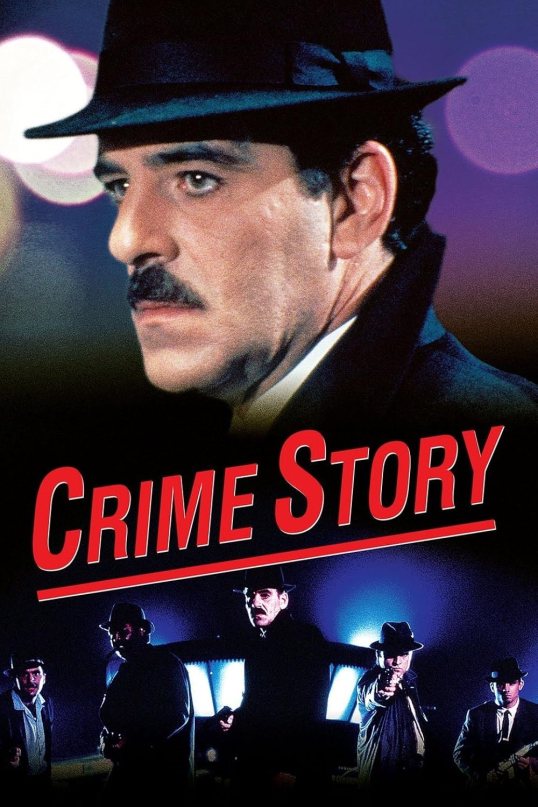
This week, Torello finally tracks down Homan.

Episode 1.12 “Hide and Go Thief”

(Dir by Francis Delia, originally aired on December 12th, 1986)

In Chicago, an unnamed gunman (Paul Guilfoyle) has taken a woman (Lorraine Bracco) hostage and has barricaded himself in a hotel room.  He wants to get on television and he figures that holding a hostage and firing a machine gun out the window is the best way to do it.  The members of the Major Crimes Unit are in the street, ducking behind squad cars whenever the gunman starts firing on them.

It’s definitely a major situation but Torello is more interested in going to Gary, Indiana than exchanging gunfire in Chicago.  Frank Homan (Ted Levine), a former member of Luca’s crew, has been discovered  working as a cook in a Gary diner.  Everyone in Gary knows Frank as “Mike Torello.”  The real Torello is determined to arrest Frank and hopefully use him to take down Luca.  Torello abandons the hostage situation, drives down to Gary, and captures Homan at work.

Finally, some good news for the real Mike Torello, right?  Well, not quite.  After Homan is arrested, U.S. Attorney Harry Brietel (Ray Sharkey) takes custody of him.  Brietel has political ambitions and taking down gangster Manny Weisbord would be a good way for him to make a name for himself.  When Homan is interrogated by Brietel, Homan lies.  He says that he’s never heard of Manny Weisbord.  But, Homan says, he has information that will take down Luca, Phil Bartoli, and a crooked cop.  In exchange for a light sentence and entry into the witness protection program, Homan is willing to testify that Mike Torello is on the take.  Brietel is intrigued.  Fighting police corruption is guaranteed to generate even better press than taking down an actual mobster.

Meanwhile, back in Chicago, Torello rejoins the MCU at the hostage situation.  (Apparently, the gunman has been awake and firing out of his hotel window for two and a half days straight.  One gets the feeling that perhaps it’s wise not to give too much thought to the logistics of this episode’s timeline.)  In a well-shot, slow-motion scene, Torello and his men storm the hotel room and shoot the gunman dead.  The hostage survives.

Significantly, neither the gunman nor the hostage are given names in this episode.  Indeed, Paul Guilfoyle is credited as playing “Deranged Gunman.”  That’s because the gunman and the hostage are really only there to show just how obsessed Torello has become with Luca.  When it comes to destroying Luca and his fledgling criminal empire, all else can wait, even saving an innocent woman from an armed lunatic.

I usually don’t enjoy watching anything that involves a hostage situation because it always seems to lead to the same predictable narrative beats.  Fortunately, this episode avoided most of the usual cliches by making the gunman a total nutcase who never stopped firing his weapon.  The scene where Torello and his men storm the hotel room was stylish enough to verge on being surreal.  As for the Homan plotline, both Ted Levine and Ray Sharkey provided strong performances and I’m looking forward to seeing how Luca and Torello react to being betrayed by the same guy.

All in all, this was a good episode.
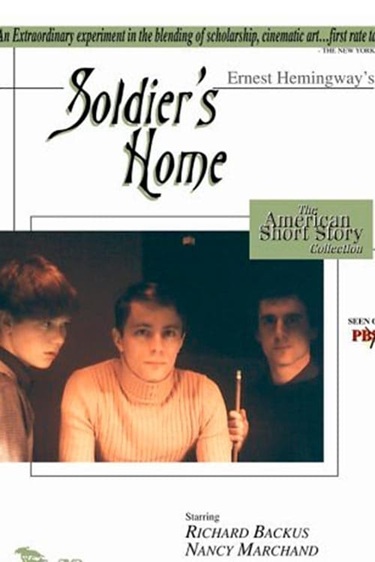
Retro Television Review: The American Short Story #9: Soldier’s Home


Welcome to Retro Television Reviews, a feature where we review some of our favorite and least favorite shows of the past!  On Saturdays, I will be reviewing The American Short Story, which ran semi-regularly on PBS in 1974 to 1981.  The entire show can be purchased on Prime and found on YouTube and Tubi.

This week, we have an adaptation of a short story by Ernest Hemingway.

Episode #9 “Soldier’s Home”

(Dir by Robert Young, originally aired in 1977)

Having gone from attending college to serving in the Army during the Great War, Harold Krebs (Richard Backus) returns home to Oklahoma.  He arrives home later than most of the other soldiers who served.  (He stayed in Europe until 1919.)  As a result, there’s no big parade waiting for him.  Everyone in town seems to have moved beyond the war and they no longer have much of a desire to talk about it.

Harold, who was once a popular and optimistic member of the town’s social set, no longer feels that he fits in.  He feels detached, watching people as they go about their lives but never feeling any desire to join them.  His mother (Nancy Marchand) pushes him to go out and date and have a good time but Harold feels lost, regardless of how much she prays for him.

Ernest Hemingway’s short story was one of the first to realistically deal with the feelings of soldiers returning from combat.  Though Harold doesn’t talk much about his experiences, one can tell that he saw and experienced things that left him scarred.  After surviving the horror of The Great War, there’s no way Harold can just slip back into his normal routine.

The adaptation sticks closely to Hemingway’s story.  Unfortunately, it doesn’t really find the visual style necessary to capture the power of Hemingway’s words.  Hemingway was a deceptively simple storyteller and Robert Young’s film is a fairly straight-forward portrait of a young man who doesn’t want to do anything, one that fails to truly capture the subtext of Hemingway’s story.  Richard Backus’s blank-eyed acting style worked well when he was playing a member of the undead in Deathdream but, in this one, he just makes ennui seem boring and petulant.  Nancy Marchand, not surprisingly, is far stronger in the role of his well-meaning but clueless mother.

As was almost always the case when it came to attempts to adapt Hemingway, it’s best just to read the original.

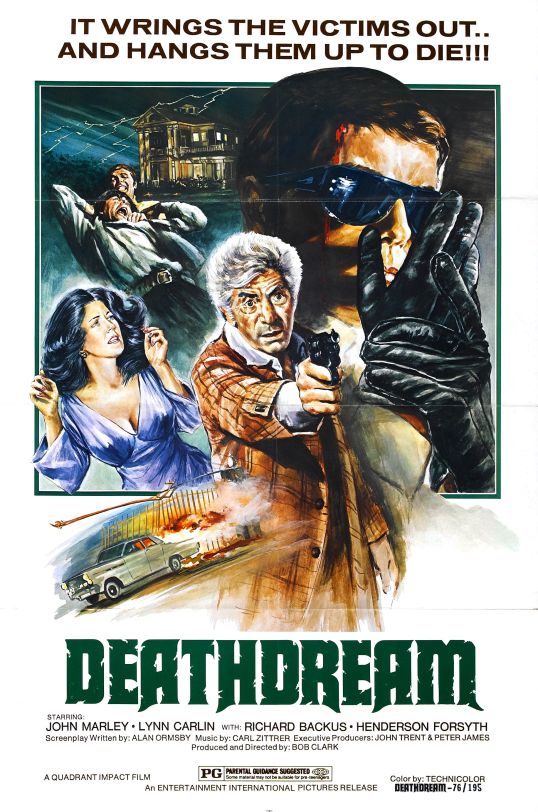
The TSL’s Daily Horror Grindhouse: Deathdream (dir by Bob Clark)


deathdream_poster_01

The 1974 film Deathdream opens with American soldier Andy Brooks (played by Richard Backus) on patrol in Vietnam. When he’s suddenly shot by an unseen sniper, he hears his mother’s voice calling out to him, telling him that he promised to come home. With the voice filling his head, Andy closes his eyes.

Sometime later, back in America, Andy’s family has been informed that Andy was killed in action. His father (John Marley, who you might recognize as the man who played Jack Woltz in The Godfather) and his younger sister (Anya Ormsby) have managed to accept the fact that Andy is dead but his mother (Lynn Carlin) remains in denial. Oddly enough, his mother is apparently proven to be correct in her doubts when Andy suddenly shows up at the front door.

The family (and, eventually, the entire community) welcomes Andy home but it quickly becomes apparent that Andy has returned as a far different person than when he left. Now pasty and emotionless, Andy spends most of his day sitting around listlessly. It’s only at night that Andy seems to have any energy and he spends those hours wandering around town and hanging out in the local cemetery.

It quickly becomes apparent to his father that Andy is no longer quite human. However, his devoted mother continues to insist that nothing is wrong with Andy and, once it becomes apparent just what exactly Andy is doing in order to survive, she becomes just as fanatical about protecting him as his father is about destroying him.

Not surprisingly, Deathdream is more than just a zombie film.  When Andy suddenly shows up on his family’s doorstep, he’s more than just a decaying monster.  He’s also a metaphor for the unease that viewers in the 70s would have felt about the state of American society.  (Of course, in many ways, contemporary viewers share that same unease.)  Andy goes off to war and it literally robs him of his humanity.  I would also argue that, in its way, Deathdream serves as a satire of the type of complacent society that sends young people off to fight for their lives and then expects them to come back exactly the same as they were before they left.  No matter how strange Andy’s behavior becomes, the people around him are willing to either ignore it or make excuses for it.  Andy’s mother emerges as a stand-in for everyone who willfully refuses to acknowledge the human consequences of war.

Deathdream is one of those wonderful horror films that deserves to be better known than it is. Deathdream was an early credit for the legendary effects artist Tom Savini and, while the film itself is not especially gory, Savini’s work can definitely be seen in the scenes where Backus’s body slowly decays. Screenwriter Alan Ormsby and director Bob Clark (who later went on to direct the far different A Christmas Story) perfectly creates and maintains a deceptively low-key atmosphere of perpetual unease while the cast elevates the entire film. Backus makes for an all-too plausible ghoul and Marley is great as a man struggling to understand what his son has become. The film is totally stolen, however, by Lynn Carlin who is both poignant and frightening as Andy’s devoted mother.

If you haven’t discovered Deathdream yet, this Halloween is the perfect season to do so.