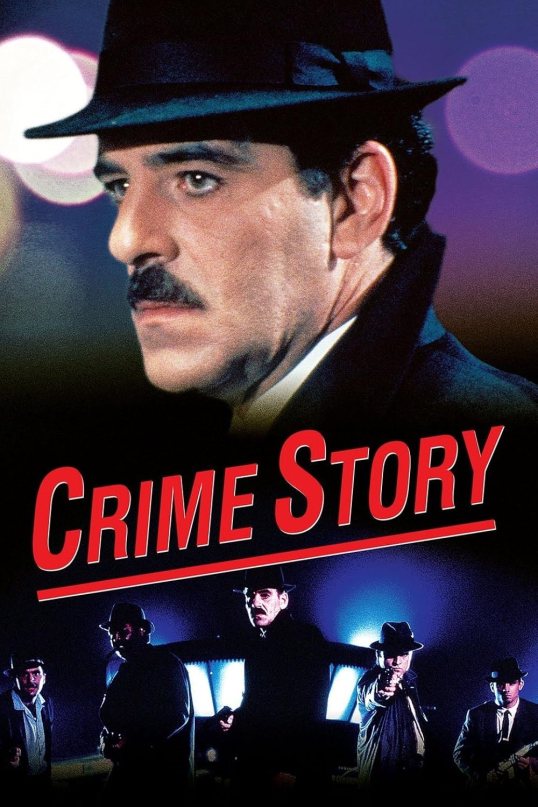
Welcome to Retro Television Reviews, a feature where we review some of our favorite and least favorite shows of the past! On Mondays, I will be reviewing Crime Story, which ran on NBC from 1986 to 1988. The entire show can be found on Tubi!
This week, a future Oscar winner briefly joins the cast.
Episode 1.18 “The Survivor”
(Dir by Alan Myerson, originally aired on February 13th, 1987)
Torello has managed to get an undercover FBI agent into Luca’s casino. Jack Claymore (James Gammon) is a tough, rough-hewn character who immediately befriends Pauli. The only thing that both Torello and Jack worry about is that someone Jack previously busted might get hired at the casino and blow Jack’s cover. Abrams’s assistant, Steve Altman (William Converse-Roberts), has been assigned to keep an eye on who Luca is hiring.
Steve, however, is a bit distracted by the fact that Torello is dating his ex-wife, Lisa (Hannah Cox). When Steve married Lisa, he adopted her teenage daughter, Tracy (played by a very young Julia Roberts). Tracy, however, hates Steve. When Lisa reads Tracy’s diary, she discovers why: Steve spent their entire marriage sexually abusing Tracy.
When Torello confronts Abrams with this information, Abrams offers to kick Steve off the task force, but Torello is worried about the publicity. (Is he worried about Tracy having to testify, or is he worried about the task force being exposed? The episode doesn’t make it clear, but knowing Torello, it’s possible that both things are true.)
For his part, Steve gets so angry and distracted that Jack’s cover is nearly blown when someone he previously arrested shows up at the casino without warning. Luckily, a member of Torello’s old MCU, Nate Grossman (Steve Ryan), just happens to be at the casino, so Jack punches him out and gets himself arrested. Luca is impressed that Jack hit a cop and, as a result, Jack moves up in the casino’s hierarchy.
As for Steve, he has a psychotic break. He breaks into Torello’s apartment and, while holding a tape recorder, demands that Tracy say she was lying about him. Terrified, Tracy does so. However, everything about the way Steve talks to her and the way Tracy reacts proves that she didn’t lie at all. After a high-speed chase with Torello, Steve kills himself in his motel room.
There’s an interesting moment toward the end of the episode where a Las Vegas detective insinuates that Torello murdered Steve and made it look like a suicide. When Abrams and the rest of the former MCU members object, Torello tells them to stop. “He’s just doing what I would do,” Torello says. It’s a moment that reminds us that being a cop means trusting no one.
This is a powerful episode. It was also Julia Roberts’s very first role. There’s not much about her performance that would make you think she was destined to become a big star. She was obviously inexperienced when it came to acting on camera. That said, her awkwardness is perfect for the character.
This episode ends with Lisa and Tracy leaving Vegas. Torello, once again, is alone. His only constant companion is his obsession with Ray Luca.
Welcome to Retro Television Reviews, a feature where we review some of our favorite and least favorite shows of the past! On Mondays, I will be reviewing Crime Story, which ran on NBC from 1986 to 1988. The entire show can be found on Tubi!
This week, Frank Homan returns.
Episode 1.17 “The Battle of Las Vegas”
(Dir by Aaron Lipstadt, originally aired on February 6th, 1987)
The hotel and resort workers of Las Vegas are going on strike, and when union leader Slim Mahoney (Frederick Coffin) tells Luca that the unions have no interest in working with the mob (ha!), Luca responds by having Pauli use a big truck to run Slim over.
With Slim dead, Luca tries to maneuver a mob stooge named Sam Taylor (Lee Ving) into the presidency of the union. When Mahoney’s protégé, Roger Jankowski (Anthony Heald), argues that the union cannot sell out to the mob, Abrams and Torello show up at a union meeting to reveal that Sam is crooked and to lead everyone in a pro-union chant. Really?
Okay, the union stuff was a little bit too on-the-nose and silly. That said, at least Stanley Tucci showed up as a bombmaker who was recruited to make trouble for the striking workers. Unfortunately, for those hoping to see him in future episodes, he ended up getting arrested and apparently hanged himself in his cell.
The highlight of this episode wasn’t any of the union stuff. It was the return of Frank Holman (Ted Levine). When we last saw Holman, he was testifying that Luca was a crime boss (true) and that Torello was on the take (false). When Luca and Pauli come across Holman performing with a rock-and-roll band in Vegas, they have a surprising reaction. They drive Holman out to the middle of the desert and .… forgive him. Of course, Holman does make the claim that the only reason he lied about Torello was so that the case against Luca would fall apart. Could Holman be telling the truth? I doubt it. Holman doesn’t seem to be that smart. But Luca decides that he doesn’t care one way or the other, and he welcomes Holman back into his organization.
Why is Luca so forgiving? My personal theory is that Holman, like Pauli, is a symbol of everything that Luca gave up to become a power in Las Vegas. Luca was probably at his happiest when he was breaking into houses with Pauli and Holman. Now that he’s the boss, he doesn’t get to do the dirty work anymore. And yet, it’s obvious that Luca misses it. He’s a born criminal. For that reason, he’s willing to keep Holman and Pauli around, regardless of how much they screw up. In his way, Luca is the most sentimental character on the show.
Of course, Luca isn’t one to let sentiment get in the way of making money. Some things just take precedence.
Welcome to Retro Television Reviews, a feature where we review some of our favorite and least favorite shows of the past! On Mondays, I will be reviewing Crime Story, which ran on NBC from 1986 to 1988. The entire show can be found on Tubi!
In 1986, riding high on the success of Miami Vice, Michael Mann signed on as executive producer of Crime Story, a cop show that Mann imagined would run for five seasons and which would follow a group of cops and gangsters from 1960s Chicago to 1980s Las Vegas. The show was co-created by former Chicago cop Chuck Adamson and it starred another former Chicago cop, Dennis Farina.
Though generally well-received by critics, Crime Story struggled in the ratings. The show’s highly serialized-nature made it difficult for audiences to follow. (This was in the pre-streaming age, when viewers couldn’t just get online and catch up with what they may have missed.) Crime Story only lasted for two seasons but it has since developed a strong cult following and is now regularly listed as one of the best cop shows ever made.
(Dir by Abel Ferrara, originally aired on September 18th, 1986)
In Chicago, on a rainy night in the early 1960s, a group of masked robbers hold up a fancy restaurant and then try to escape with a group of terrified hostages. On the scene is the Major Crimes Unit, led by the grim Lt. Torello (Dennis Farina, a former real-life cop). The end result is that all of the robbers end up dead, the hostages end up traumatized, and one of Torello’s men, the obviously doomed Wes Connelly (William Russ), appears to be losing his mind over the violence that he has to deal with every day.
The plot of the pilot is actually pretty simple. A gang of thieves is holding up restaurants, banks, and stores in Chicago. Torello believes that an ambitious gangster named Ray Luca (Tony Denison) is behind the robberies and Torello is correct. The cool and sociopathic Ray is working with Johnny O’Donnel (David Caruso). O’Donnel may be a childhood friend of Luca’s but his parents are friends with Torello. When gangster Phil Bartoli (Jon Polito) orders Luca to kill O’Donnel after the latter robs one of Bartoli’s jewelry stores, it’s personal all-around.
Plot-wise, it’s pure Michael Mann. The cops and the gangsters are both obsessive. Luca will kill anyone to get ahead in the underworld. Oddly, his only real loyalty seems to be to his dumbest henchman, Pauli Taglia (John Santucci, a real-life former jewel thief who was once arrested by Dennis Farina). Torello may be fighting on the side of the law but he’s often just as quick to resort to violence as Luca. Director Abel Ferrara’s style can be seen in a scene where Torello is visited by the ghost of the recently murdered Wes Connelly. Torello is burned out and paranoid, flying into a rage when he sees his wife, Julie (Darlanne Fluegel), dancing with another man at a wedding. (The man in question turns out to be Torello’s cousin, whom Torello didn’t even recognize because he apparently doesn’t have much of a connection to anyone outside of the police force.) Towards the end of the episode, there’s a shoot-out in a department store and it’s hard not to notice that neither the crooks nor the cops seem to be all that concerned with the innocent bystanders trying to not get caught in the crossfire.
The pilot is dark, gritty, and, in its way, as stylized as any episode of Miami Vice. It never seems to stop raining and, even during the day, the skies are permanently gray and dark. The early 60s are recreated like a fever dream of pop culture, with rock and roll on the soundtrack, cars with tail fins screeching down the street, and Bartoli living in a house that looks more like a tacky diner then a true home. Torello and his men wear their dark suits and trenchcoats the way that soldiers wear their uniforms.
It’s an effective pilot, though we don’t really get to know much about the men working with Torello at the Major Crimes Unit. Bill Smitrovich, in the role Detective Danny Krycheck, establishes himself as being Torello’s second-in-command but that’s about it. Stephen Lang appears in a handful of scenes as David Abrams, a liberal public defender who is the son of a prominent gangster. Both Luca and Torello seem to want to make David into an alley and the episode hints that he will eventually have to make a choice. The episode ends with Luca in sunny Florida, meeting with veteran gangster Manny Weisbord (Joseph Wiseman). Torello, meanwhile, remains in dark Chicago.
The Crime Story pilot was deemed good enough to be released as a feature film in Europe. It also led to a series on NBC, which I will be reviewing here, every Monday! On the basis of the pilot, I’m looking forward to it.
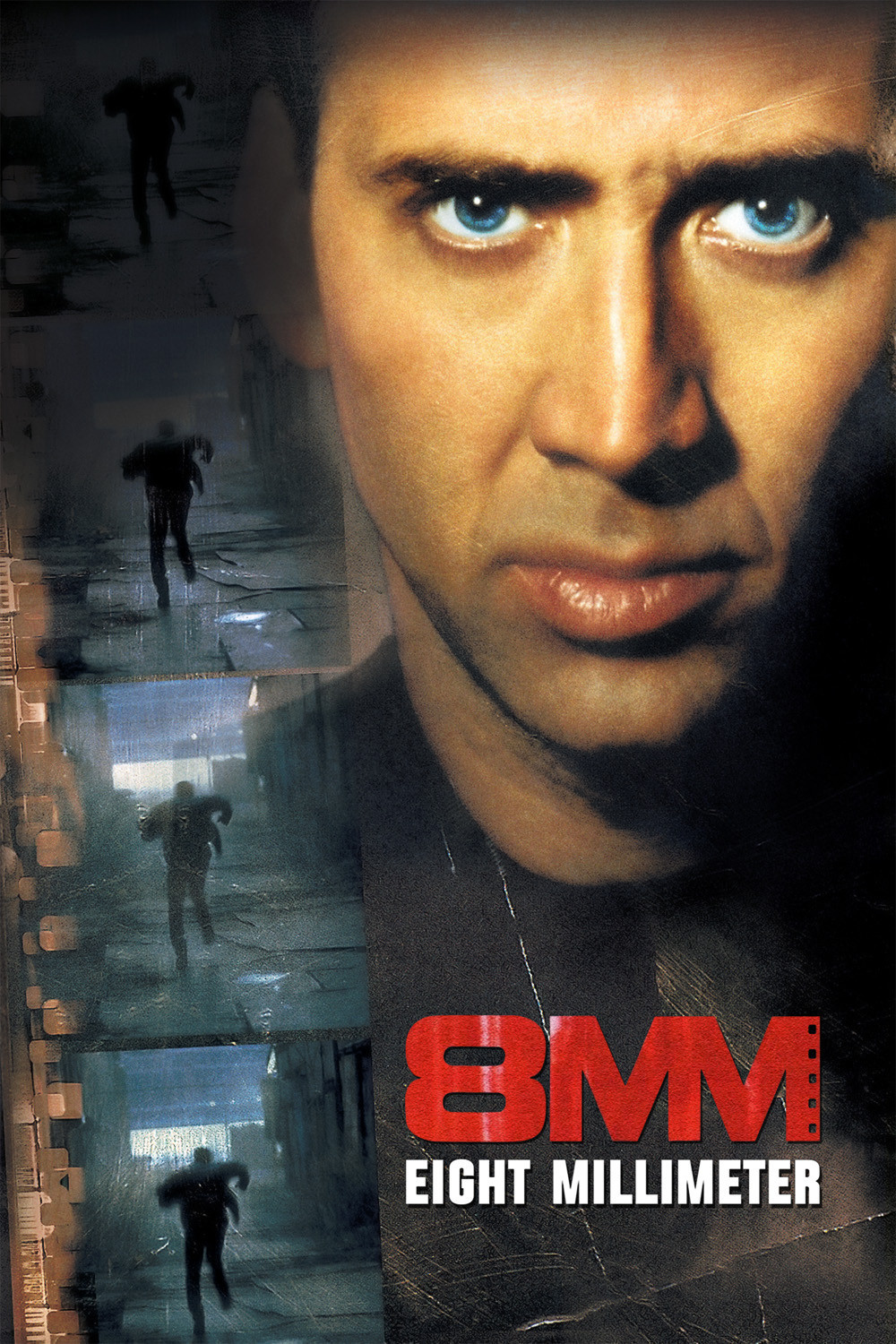
Joel Schumacher’s 8MM (1999) uncoils like a reel of forbidden footage you shouldn’t have found, pulling a buttoned-up private eye into the rancid shadows of underground smut peddlers and whispers of snuff films that may or may not exist. It’s a late-’90s thriller smack in the wake of Se7en and Kiss the Girls, starring Nicolas Cage as Tom Welles, a Harrisburg family man whose crisp suits and steady hands belie the unraveling ahead. Hired by a steel magnate’s widow to verify an 8mm tape depicting a girl’s torture-murder, Welles tumbles down a rabbit hole of L.A. peep shows and New York meatpacking sleaze, his moral compass spinning as the line between fantasy and atrocity blurs. Schumacher crafts a narrative engine that hums with procedural grit, doling out dread in measured doses while mirroring the protagonist’s corrosion, though it occasionally stumbles in its heavier-handed turns.
The setup hooks with surgical efficiency, painting Welles as everydad detective: he buries bodies for a living, kisses his infant daughter goodbye, and screens the tape in a vault-like study that feels like a confessional. Myra Carter’s Mrs. Christian trembles with decorous horror as the projector whirs to life, bathing the room in jaundiced flicker; the footage—grainy, handheld, a pleading teen bound for “Machine’s” blade—lands like a gut punch without lingering on gore. Lawyer Longdale (Anthony Heald, all patrician slime) waves it off as staged porn, but Welles digs anyway, tracing victim Mary Ann Mathews through missing-persons archives to her runaway dreams in Hollywood. Paired with Max California (Joaquin Phoenix), a Sunset Strip tape jockey with pawn-shop cynicism and a Zipperhead tee, they prowl fetish dens where vendors hawk needle-play loops and dismiss snuff as urban legend. Schumacher’s lens, via Robert Elswit, turns these dives into feverish grottos—neon strobes slicing steam, racks of VHS promising the forbidden—building unease through denial upon denial.
That mounting frustration propels the first hour’s finest stretches, a slow immersion where Welles’s calls home grow terse, his wife’s concern (Catherine Keener, quietly anchoring) a lifeline fraying in crosscuts. Max’s street-rat patter—”Snuff? Ain’t no such thing as snuff, man”—leavens the rot without undercutting it, Phoenix layering vulnerability beneath the snark that makes his arc genuinely affecting. Schumacher parcels revelations like a fuse burning short: a Florida trailer confirms Mary Ann’s vanishing, a porn mag scout nods toward “real death” commissions, and suddenly they’re in New York, knocking on Dino Velvet’s door. Peter Stormare vamps as the mulleted auteur of extremity, his studio a cathedral of spotlit chains where Machine (masked, hulking) performs for hidden lenses. The confrontation there explodes into sudden violence and betrayal, shattering assumptions about the tape’s origins and thrusting Welles into a desperate fight for survival, with devastating losses that harden his path forward.
This mid-film rupture peels back layers of the underworld’s machinery, revealing how far some will go to sate forbidden appetites—no vast conspiracy, just raw opportunism turning fantasy lethal. Chaos erupts in a brutal showdown that catapults Welles into lone-wolf payback, though the script’s mechanics creak here, tipping from investigation to vengeance saga with less finesse than its buildup promises. He tracks leads back to L.A., confronting scout Eddie Poole (James Gandolfini) in a derelict factory, beating out confessions amid rusted girders, then facing Machine—unmasked as unassuming accountant George Higgins (Chris Bauer), who shrugs, “I like it”—in a rain-slicked graveyard melee. Schumacher stages the violence as visceral toll, not catharsis: fists land with bone-crunching thuds, blood sprays real, and Welles emerges hollowed, sobbing in his wife’s arms over the unerasable stain. It’s raw consequence over triumph, indicting the watcher as much as the watched.
Cage shoulders the load masterfully, dialing back his manic energy for a portrait of competence curdling into obsession—hesitant stares post-tape, fists unclenching at home, exploding only when the dam breaks. It’s restrained Cage at his peak, the fury earned through incremental fracture, though some beats flirt with overemphasis. Phoenix shines brighter still, turning Max from sidekick gag into soulful foil; his death resonates because Joaquin sells the bravado as fragile armor. Stormare’s Dino struts operatic depravity, a Bond villain in wifebeater, while Gandolfini’s Poole simmers regretful everyman heft—pre-Sopranos groundwork for Tony’s shadows. Heald’s Longdale drips WASP entitlement, and bits like Norman Reedus’s twitchy dealer add lived-in texture. Schumacher elicits extremes without cartooning them, populating the underworld with deviants who feel plausibly human, not pulp cutouts.
Visually, 8MM thrums with Schumacher’s maximalist pulse tamed to noir grit: Elswit’s shadows swallow faces in peep booths’ crimson haze, the snuff reel’s jitter evokes cursed artifacts, and the loft showdown’s spotlights carve brutality like Bosch hellscapes. Mychael Danna’s score slithers—piano sparsity for Welles’s drift, synth throbs for dives—capped by Aphex Twin’s “Come to Daddy” warping a raid into glitch-rage frenzy. Production design nails the era’s analog underbelly: dog-eared tape boxes, industrial decay standing in for L.A. (shot cheap in Florida), all evoking a pre-digital void where evil hides on celluloid. The snuff aesthetic probes voyeurism smartly—we glimpse pleas and steel without exploitation, questioning our gaze alongside Welles’s, though the film’s flirtation with seediness risks tipping into the very prurience it critiques.
Andrew Kevin Walker’s script (fresh off Se7en) structures as moral diptych: procedural probe yields to vigilante spasm, bookended by domestic anchors that underscore the cost. No tidy psychologizing redeems the killers—Higgins kills because appetite wills it, Poole for “business,” others for greed—exposing evil’s flat banality over tortured backstories. The widow’s suicide post-truth, Mary Ann’s mom’s grateful note (“You cared enough to try”), and Welles’s scarred homecoming deny closure; vengeance hardens more than heals, bodies burned sans parade of justice. It’s a gut-punch thesis on film’s limits: some horrors defy capture, watching them unmakes the witness. Schumacher, slumming post-Batman gloss, revels in the ugly, though pacing drags early in porn prowls and the revenge rampage strains credulity.
Yet for all its stumbles—script contrivances like convenient turns, a third act veering punchy over precise—8MM endures as underrated descent, a thriller that stares unblinking into appetite’s void. Cage and Phoenix elevate genre tropes, Schumacher’s design makes depravity stick, and the core query lingers: does filming evil make it real, or us complicit? Flaws aside, it hums with the era’s dark electricity, a flawed reel worth unspooling for its unflinching grind.
There’s a lot of film bloggers out there who have a natural aversion to anything that Jason Reitman is associated with.
And listen, I understand. The fact of the matter is that Jason Reitman probably does owe a lot of his success to the fact that people in the industry know and like his father. And it’s also true that Jason Reitman does tend to specializes in making films that you’re either going to love or you’re going to hate. His films mix drama and comedy and sentiment and snark and sometimes, his refusal to come down firmly on the side of either one can feel like a bit of a cop out. There’s a quirkiness to many of his films and sometimes, it can come across as being a bit cutesy. And I’ll even go as far as to agree with those who say that it’s been a while since Reitman’s made a really good film. The most common complaint I hear about Reitman is that his first four films (Thank You For Smoking, Juno, Up In The Air, and Young Adult) were okay and then he let his good reviews go to his head. Of course, some people — okay, a lot of people — will tell you that, of those four films, Juno’s overrated.
I get all of that and I actually agree with some of those points. Reitman is a director who sometimes seems to have lost his way after his early successes. I think the closest that Reitman’s come to giving us a good film post-Young Adult was with Tully and even then, that felt more like a Diablo Cody film than a Jason Reitman film.
But, with all of that in mind, I still really like Jason Reitman’s early films and I think that he still has the potential to once again be an important and interesting filmmaker. Thank You For Smoking and Juno are better than many give them credit for being. Charlize Theron has never been better than she was in Young Adult. Finally, this morning, I rewatched 2009’s Up In The Air for the first time in a long time and I was pleasantly surprised to see how well it holds up.
Up In The Air features George Clooney and Anna Kendrick. Clooney plays Ryan Bingham, an obsessive traveler who boats about living a life without commitment. Ryan works for a company that hires him out to fire people. If your boss is too much of a pussy to tell you that you’ve been terminated to your face, he hires Ryan to do it for him. Ryan specializes in trying to convince people that being fired is not a tragedy but an opportunity for a new beginning. Ryan also has a side gig as a motivational speaker. His speeches are largely about avoiding commitment and personal baggage.
Anna Kendrick plays Natalie Keener. Natalie works for the same company as Ryan but, at the age of 23 and just out of college, she’s a lot less confident when it comes to destroying people’s livelihoods. (“I’ve worked here for 17 years and I’m being fired by a 7th grader,” is one person’s response to being terminated by Natalie.) Natalie has come up with a new plan where all firings will be done via Skype. That way, the person doing the firing will never have to leave their office and won’t have to deal with the people they’ve fired one-on-one. Ryan says he considers this proposal to be inhumane but mostly, he’s just worried that he’ll lose his traveling privileges if Natalie’s plan is instituted.
Ryan and Natalie travel the country. Ryan teaches Natalie how to fire people and Natalie discovers that it’s not as easy to destroy someone’s life as she thought. Everywhere they go, they deal with people who are facing economic uncertainty. Ryan meets another frequent flyer, Alex (Vera Farmiga) and, after Alex reveals that she’s even less interested in commitment than Ryan, they begin an affair. Ryan starts to fall in love with Alex and even invited her to attend his sister’s wedding with him. However, Alex has a secret of her own.
One thing that I really like about Up in the Air is that Ryan and Natalie never end up sleeping together. I remember, when I first saw the movie, I was convinced that it was going to happen. After all, Ryan is handsome and charming and Natalie is attractive and, after her boyfriend dumps her, vulnerable. I was cringing at the knowledge that there would eventually be some contrived scene where Natalie and Ryan end up getting drunk and then end up waking up in bed together and the end result would be Natalie going from being a well-rounded, multi-dimensional character to just being a plot device in Ryan’s journey to becoming a better man. Well, there is a scene where Natalie and Ryan get drunk at the same time but it doesn’t lead to Natalie and Ryan becoming lovers and I respected Up in the Air for having enough respect for its characters to not do the convenient thing.
The other thing I liked about Up In The Air is that it’s one of the few films to make proper use of George Clooney’s deceptively smooth screen presence. We all know that Clooney is handsome and charming but what makes him an appealing actor is that there’s always been hints that there’s a lot dorkiness and insecurity hiding underneath the suave facade. Ryan may seem like he’s got it all together but, as the film progresses, you come to realize that he’s a lot more insecure and neurotic than he lets on. All of his snarky comments have more to do with his own fear of failure than anything else. Much as how the real life Clooney still sometimes seems as if he hasn’t fully gotten over being dismissed as just being another pretty face in the early days of his career, Ryan has never gotten over his dysfunctional childhood. Instead of taking a risk on love, he instead obsesses on getting frequent flyer miles. (At one point, Sam Elliott pops up out of nowhere and, in a scene that you could really only expect to find in a Jason Reitman film, gives Ryan a pep talk.) There’s a sadness to Ryan, one that seems to come from deep inside of his soul. Clooney does an excellent job of bringing that sadness to the surface while still giving a likable and compelling performance.
Up In The Air was released at a time when America was stuck in what seemed like a never-ending recession. Despite the fact that the news media and the politicians were insisting that things were on the verge of getting better (or, at the very least, boasting that unemployed actors were no longer “job-locked,” whatever the Hell that meant), many people believed that their best days were officially behind them. A lot of the contemporary reviews of the film focused on what it had to say about living in a time of economic uncertainty. That was ten years ago and we’re now living in a strong economy but, even so, Up In The Air still resonates. Reitman includes scenes in which people talk about what it was like to be fired. The majority of these people were not actors but were instead people recruited from the local unemployment office and they were speaking about their own experiences. The pain and resentment on their faces and in their voices is so palpable that it’s actually a bit jarring when J.K. Simmons and Zach Galifianakis show up, playing employees who are “terminated” by Ryan. I guess I should admit that I’ve never actually been fired from a job but, after watching Up In The Air, it’s not something that I would ever want to experience.
Up In The Air holds up well. Reitman’s direction is quirky but effective and he does a good job of mixing comedy in with the drama. (Wisely, whenever he has to make a choice, he emphasizes the drama over the comedy, instead of trying to maintain some sort of mythical 50/50 balance between them.) This film features one of George Clooney’s best performances and he has a really likable chemistry with Vera Farmiga. Anna Kendrick also does a great job with a character who could have become a stereotype in less skilled hands. Finally, along with Juno and The Gift, this film is one of the reasons why I always have a hard time watching Jason Bateman in any film or show where he’s cast as hero. Bateman plays Ryan’s boss and the character is so smarmy (and Bateman does such a good job of playing him) that he’ll make your skin crawl.
It’s been a while since Up In The Air was first released and Jason Reitman’s career has had its ups and downs. Still, regardless of whatever film Reitman makes next, Up In The Air remains a classic of the aughts.