Review: Independence Day (dir. by Roland Emmerich)


“We will not go quietly into the night! We will not vanish without a fight! We’re going to live on! We’re going to survive! Today, we celebrate our Independence Day!” — President Whitmore

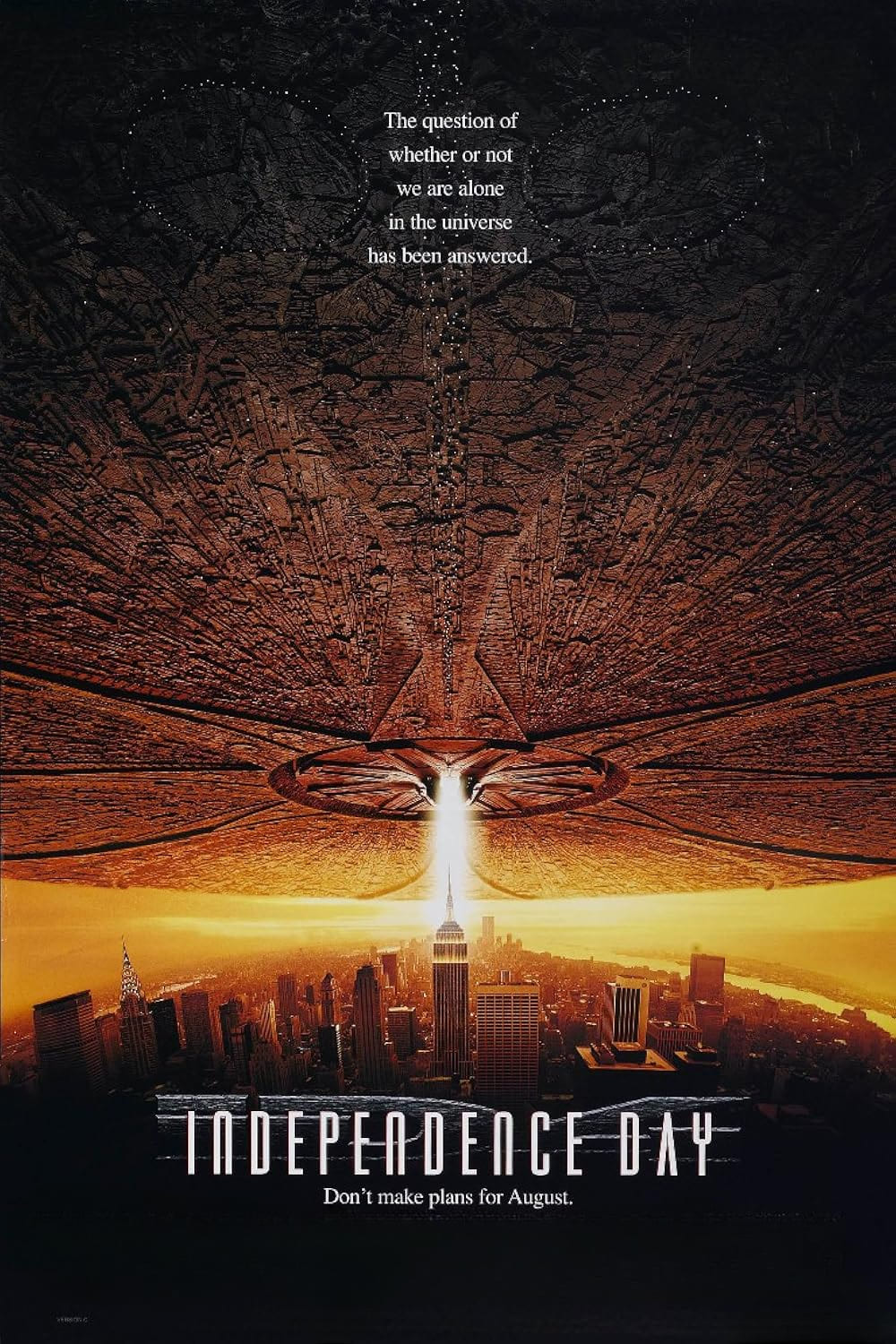
If you were around in the summer of 1996, you already know exactly where you were when you first saw the trailer for Independence Day. There was this massive shadow creeping over the moon, followed by that terrifying, booming sound effect, and then the White House just absolutely getting vaporized by a giant laser beam. It was a cultural moment. Director Roland Emmerich hadn’t really made his mark on Hollywood yet, but with this one movie, he essentially invented the modern summer blockbuster template of destroying famous global landmarks. Looking back at Independence Day almost three decades later, it is honestly wild how well this movie holds up, not as a piece of high art, but as a perfectly calibrated, ridiculously entertaining popcorn machine.

The premise is beautifully simple: massive alien spaceships suddenly appear over Earth’s major cities, they don’t come in peace, and humanity has to figure out how to fight back before we go the way of the dinosaurs. What makes the first act of the movie so effective is the slow build. Emmerich doesn’t just start with explosions; he lets the dread simmer. We see the massive ship hover over New York City, casting a shadow that blocks out the sun, and the sheer scale of the thing is awe-inspiring. Then, when the ships finally initiate their attack sequence, the payoff is spectacular. The practical effects combined with early CGI create these massive, rolling walls of fire that tear through iconic buildings. It is destructive poetry, and as a kid watching it, it was the most incredible thing I had ever seen. Even now, the destruction feels heavy and tactile in a way that modern, entirely computer-generated action sequences often don’t.

But a movie is only as good as its characters, and Independence Day has arguably one of the greatest ensemble casts of the 1990s. You have Will Smith playing Captain Steven Hiller, a fighter pilot who is desperately trying to get promoted while also dealing with his girlfriend, her son, and their dog. Smith is at the absolute peak of his early movie star charm here, delivering some of the most quotable one-liners in action movie history. Punching an alien in the face and yelling “Welcome to Earth!” is the kind of ridiculous machismo that only Smith could pull off without making you cringe. Then you have Jeff Goldblum as David Levinson, an MIT-educated cable repairman and environmentalist who figures out the alien signal is a countdown. Goldblum is basically doing his classic Goldblum thing—stuttering, eccentric, highly caffeinated—but it works perfectly because he serves as the perfect foil to Smith’s brute physicality.

The supporting cast is so deep that it feels like an Ocean’s Eleven of sci-fi tropes. Bill Pullman plays President Thomas J. Whitmore, and he gives the role an earnestness that elevates the material. He’s not an action hero; he’s a former fighter pilot who is clearly in over his head but steps up when his people need him most. You also have Judd Hirsch as Goldblum’s cranky, kvetching father, providing fantastic comic relief. Randy Quaid plays Russell Casse, a traumatized former pilot who was abducted by aliens years ago and is written off as a drunk by his small town, giving the movie an underdog storyline. And you can’t forget Brent Spiner as Dr. Okun, the wildly eccentric Area 51 scientist who gets way too excited about the alien biology. Every single one of these actors is fully committed to the bit, no matter how absurd the situation gets.

Now, if we are being completely honest, we have to talk about the plot, which is essentially held together with scotch tape and sheer willpower. The entire third act revolves around Goldblum and Smith flying a captured alien spacecraft up to the mothership to upload a computer virus using a 1996 Apple PowerBook. Yes, an Earth laptop somehow interfaces perfectly with an advanced extraterrestrial operating system, and yes, the aliens apparently don’t have McAfee, Norton or any kind of firewall to prevent a rudimentary human virus from crippling their entire defense grid. It is monumentally stupid if you think about it for even five seconds. But the secret to Independence Day is that it moves so fast and has so much momentum that you simply do not have time to care. The movie dares you to roll your eyes, but then it immediately distracts you with another massive explosion or a great quip from Will Smith, and you just go along for the ride.

The climax of the movie is a masterclass in cheesy, triumphant blockbuster filmmaking. Before the final aerial assault on the alien ships, President Whitmore gives a speech to the troops that has become completely ingrained in pop culture. “Today we celebrate our Independence Day!” he yells, and it is so incredibly corny, but I challenge you not to get at least a little bit pumped up when the music swells. The dogfight that follows is chaotic and thrilling, culminating in Randy Quaid’s character making the ultimate sacrifice by flying his jet directly into the alien weapon. It is exactly the kind of melodramatic, heroic moment that Emmerich excels at, and it hits the emotional beats it needs to hit, even if you saw it coming from a mile away.

You also have to appreciate how unapologetically intense the movie feels despite skating by with a PG-13 rating. People get vaporized, cities are leveled, and there is a genuine sense of apocalyptic dread that permeates the middle of the film. When the aliens first attack, Emmerich actually takes the time to show the aftermath, including cars blowing up in tunnels and people desperately trying to outrun the fireballs. Harvey Fierstein’s character dramatically dying while just sitting in his car, rolling up the window as if that’s going to stop a giant wall of alien fire, is a weirdly specific, dark comedy beat that you rarely see nowadays. The movie has real stakes, and you genuinely feel like humanity is on the brink of extinction.

It is crazy to think about the legacy of Independence Day and how it changed Hollywood. Before this, disaster movies were mostly relegated to B-movie status or Irwin Allen productions from the 1970s. Emmerich proved that you could blend disaster spectacle with sci-fi action and make an absolute fortune. This movie paved the way for Armageddon, Godzilla, The Day After Tomorrow, and essentially the entire concept of the modern cinematic destruction porn genre. They did eventually make a sequel, Independence Day: Resurgence, in 2016, but it completely missed the point of the original. It was too slick, too reliant on weightless CGI, and it lacked the ragtag, underdog charm that made the first one so special.

At the end of the day, Independence Day is just pure, unadulterated cinema comfort food. It does not demand anything from you as a viewer other than to sit back, suspend your disbelief, and enjoy the fireworks. It captures a very specific mid-90s vibe where movies could be big, dumb, loud, and incredibly fun without taking themselves too seriously. Roland Emmerich has directed a lot of movies since then where he has destroyed the world in various different ways, but he has never quite managed to capture the lightning in a bottle that he did here. Whenever the Fourth of July rolls around, or whenever you just need a reliable, edge-of-your-seat action movie to kill a couple of hours, Independence Day is always there, waiting to welcome you to Earth one more time.

Guilty Pleasure No. 117: Gone in 60 Seconds (dir. by Dominic Sena)


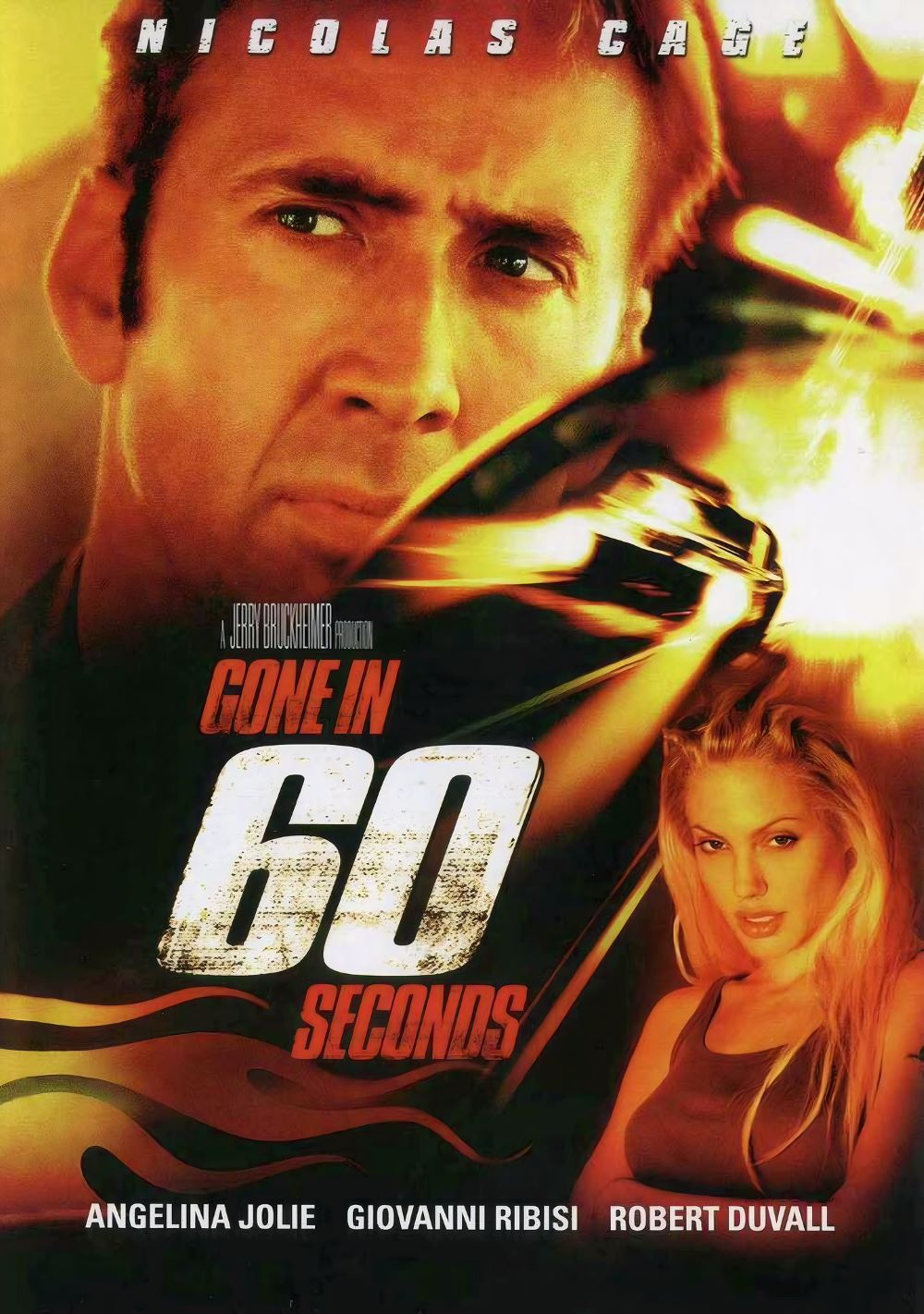
There is a specific, almost alchemical quality to the late 1990s and early 2000s era of Nicolas Cage as an action star. Before the internet turned every one of his performances into a meme and before his financial troubles led him down the rabbit hole of direct-to-video oddities, Cage was genuinely one of the most exciting and weirdly compelling action heroes on the planet. From The Rock in 1996 to Con Air in 1997 and Face/Off in 1997, he delivered a holy trinity of high-octane insanity that no other actor could have pulled off. By the time the calendar flipped to 2000, Cage was at the peak of his powers, and director Dominic Sena’s Gone in 60 Seconds arrived as both a victory lap and a slight exhale. It is not as unhinged as Face/Off nor as tightly wound as The Rock, but it is a perfect snapshot of its moment: a glossy, MTV-infused car heist flick that smells like gasoline, leather, and late-90s hubris. And while it has plenty of shortcomings, Gone in 60 Seconds has earned its place not in the pantheon of great action cinema, but in that more beloved hall of fame: the Guilty Pleasure.

The plot is as simple as a carburetor. Cage plays Randall “Memphis” Raines, a legendary car thief who has supposedly gone straight, now living a quiet life designing hybrid engines. But when his reckless younger brother Kip, played with sweaty desperation by Giovanni Ribisi, botches a job for a ruthless British gangster named Raymond Calitri (Christopher Eccleston at his sleaziest), Memphis is forced back into the life he left behind. The task is absurdly impossible: steal 50 specific luxury cars in a single weekend, or Calitri will kill Kip. That’s right, fifty cars. In three days. The film never really bothers to explain the logistics of storing or delivering that many vehicles, but that’s not the point. The point is the ride, the revving engines, and the way Cage stares at a 1967 Shelby GT500 named Eleanor like she’s the ghost of a lost lover. That car is the real star, and the film knows it.

Dominic Sena, who previously directed Cage in the underrated road thriller Kalifornia, brings a music video sensibility to the proceedings. Gone in 60 Seconds is drenched in late-90s visual tics: slow-motion shots of hubcaps spinning, golden sunsets glaring off polished chrome, and a soundtrack that alternates between nu-metal grooves and bluesy rock. The editing is fast but not confusing, and the heist sequences have a rhythmic, almost choreographed feel. You never believe for a second that Memphis and his crew—a motley collection of oddballs played by Robert Duvall, Vinnie Jones, and a very underutilized Angelina Jolie—can actually pull off fifty thefts without the entire LAPD catching on. But the film operates on movie logic. Cars are hotwired in seconds, police radio chatter is effortlessly avoided, and every chase defies the laws of physics. It is pure fantasy, and that is exactly why it works as a guilty pleasure.

Now, let’s talk about Cage. In 2000, he was still riding the high of that legendary late-90s run, and Gone in 60 Seconds fits neatly into his brand of action star as tortured romantic. Memphis Raines is not the coked-up lunatic Castor Troy or the shouty Stanley Goodspeed. He is weary, melancholic, and trying to be honorable in a dishonorable profession. Cage plays him with a hangdog sincerity that is surprisingly effective. When he talks to Eleanor, stroking her steering wheel and whispering about how she tests her drivers, he is utterly committed. There is no irony, no winking at the camera. That is the secret to Cage’s enduring appeal in this era: he treats absurd material with the same intensity he would bring to a Shakespeare soliloquy. The action sequences—especially the climactic chase where Eleanor leaps over a drawbridge—showcase Cage’s physicality and willingness to do real stunt work. He sells the danger and the desperation. You believe that this man would risk everything for a car, and that belief makes the film’s silliness palatable.

But let’s be honest about the shortcomings, because Gone in 60 Seconds has plenty. The middle act drags considerably. For a movie about stealing fifty cars, there is a surprising amount of standing around in warehouses and having conversations about “respecting the machine.” Angelina Jolie’s character, Sara, is Memphis’s ex-girlfriend and a fellow thief, but she is given almost nothing to do except look cool in leather and exchange tepid romantic banter with Cage. The chemistry between them is nonexistent. Christopher Eccleston’s Calitri is a one-note villain who likes opera and cruelty, and his final defeat is laughably abrupt. Delroy Lindo plays a dogged detective, but he is so incompetent that he never generates real tension. The film’s central gimmick—the ticking clock of fifty cars in three days—is inconsistently tracked, and by the final act, you have no idea how many cars are left or why it still matters. The dialogue is also gloriously corny. Lines like “Ride or die” and “Respect the car, man” are delivered with such straight faces that they circle back around to being endearing.

And yet, Gone in 60 Seconds earns its status as a guilty pleasure because it understands exactly what it is. This is not a sophisticated heist thriller like Heat or a gritty crime drama. It is a shiny, high-budget B-movie about a man and his car, and it leans into that identity without apology. The final twenty-minute chase sequence is genuinely thrilling, with real cars being destroyed and practical stunts that modern CGI could never replicate. Eleanor getting airborne, landing hard, and somehow still running is a moment of pure cinematic joy. The sound design—the roar of that V8 engine, the screech of tires on asphalt—is visceral and satisfying. And Cage’s performance, even when the script lets him down, holds the whole thing together. He is the anchor that keeps the film from floating away into utter nonsense.

Looking back from today’s perspective, Gone in 60 Seconds is a time capsule of a very specific moment. It captures the tail end of the late-90s obsession with extreme sports, tuner culture, and the idea that cars had souls. It also captures Nicolas Cage at a fascinating crossroads: still an A-list action star, still capable of opening a blockbuster, but already showing the signs of the wonderful weirdness that would later define his career. This film is not his best, not by a long shot, but it is one of his most rewatchable. You put it on when you want to turn your brain off, hear some great engine noises, and watch a sweaty, sincere Nic Cage talk to a Shelby like she is his long-lost sweetheart. That is the definition of a guilty pleasure. It is not good in the traditional sense, but it is fun. And sometimes, fun is enough.

Previous Guilty Pleasures

  1. Half-Baked
  2. Save The Last Dance
  3. Every Rose Has Its Thorns
  4. The Jeremy Kyle Show
  5. Invasion USA
  6. The Golden Child
  7. Final Destination 2
  8. Paparazzi
  9. The Principal
  10. The Substitute
  11. Terror In The Family
  12. Pandorum
  13. Lambada
  14. Fear
  15. Cocktail
  16. Keep Off The Grass
  17. Girls, Girls, Girls
  18. Class
  19. Tart
  20. King Kong vs. Godzilla
  21. Hawk the Slayer
  22. Battle Beyond the Stars
  23. Meridian
  24. Walk of Shame
  25. From Justin To Kelly
  26. Project Greenlight
  27. Sex Decoy: Love Stings
  28. Swimfan
  29. On the Line
  30. Wolfen
  31. Hail Caesar!
  32. It’s So Cold In The D
  33. In the Mix
  34. Healed By Grace
  35. Valley of the Dolls
  36. The Legend of Billie Jean
  37. Death Wish
  38. Shipping Wars
  39. Ghost Whisperer
  40. Parking Wars
  41. The Dead Are After Me
  42. Harper’s Island
  43. The Resurrection of Gavin Stone
  44. Paranormal State
  45. Utopia
  46. Bar Rescue
  47. The Powers of Matthew Star
  48. Spiker
  49. Heavenly Bodies
  50. Maid in Manhattan
  51. Rage and Honor
  52. Saved By The Bell 3. 21 “No Hope With Dope”
  53. Happy Gilmore
  54. Solarbabies
  55. The Dawn of Correction
  56. Once You Understand
  57. The Voyeurs 
  58. Robot Jox
  59. Teen Wolf
  60. The Running Man
  61. Double Dragon
  62. Backtrack
  63. Julie and Jack
  64. Karate Warrior
  65. Invaders From Mars
  66. Cloverfield
  67. Aerobicide 
  68. Blood Harvest
  69. Shocking Dark
  70. Face The Truth
  71. Submerged
  72. The Canyons
  73. Days of Thunder
  74. Van Helsing
  75. The Night Comes for Us
  76. Code of Silence
  77. Captain Ron
  78. Armageddon
  79. Kate’s Secret
  80. Point Break
  81. The Replacements
  82. The Shadow
  83. Meteor
  84. Last Action Hero
  85. Attack of the Killer Tomatoes
  86. The Horror at 37,000 Feet
  87. The ‘Burbs
  88. Lifeforce
  89. Highschool of the Dead
  90. Ice Station Zebra
  91. No One Lives
  92. Brewster’s Millions
  93. Porky’s
  94. Revenge of the Nerds
  95. The Delta Force
  96. The Hidden
  97. Roller Boogie
  98. Raw Deal
  99. Death Merchant Series
  100. Ski Patrol
  101. The Executioner Series
  102. The Destroyer Series
  103. Private Teacher
  104. The Parker Series
  105. Ramba
  106. The Troubles of Janice
  107. Ironwood
  108. Interspecies Reviewers
  109. SST — Death Flight
  110. Undercover Brother
  111. Out for Justice
  112. Food Wars!
  113. Cherry
  114. Death Race
  115. The Beast Within
  116. Girl Series

I Watched Touchback (2012, Dir. by Don Handfield)


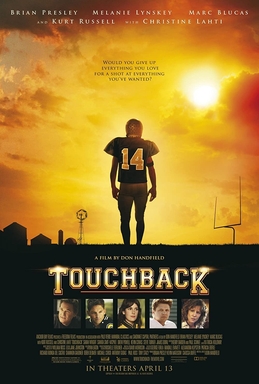
When he was in high school, Scott Murphy (Brian Presley) was nicknamed “Mr. Football.”  He was the best high school player in Ohio and everyone knew he was going to make it far in the NFL.  His dreams of football stardom ended on the night of the big game when his leg was shattered during a running play.  Twenty years later, Scott is still living in his small town.  He owns a farm that he can’t make the payments on and crops that he can’t bring in.  When Scott learns that he is to he honored at the next high school football team for taking the team to the state championship years ago, it causes him to break down.  He attempts to commit suicide but, when he passes out from inhaling carbon monoxide, he doesn’t die.  Instead, he wakes up as a high school student in 1991.

Scott has his second chance.  The championship game is coming up and, if Scott can keep from getting injured, he’ll be able to accept his scholarship to Ohio State and go on to the NFL.  He makes sure to introduce himself to his future wife Macy (Melanie Lynesky) so he won’t lose her.  He befriends the kids that he picked on the first time he was in high school.  When a college scout tells him that his scholarship will not be rescinded if he chooses to sit out the big game, Scott decides to stay on the bench but then his coach (Kurt Russell) explains how much the game means to the people in the town.  Scott realizes he has to play for them but can he get through the game without getting injured a second time?

What would you do if you had a second chance?  That’s something that everyone wonders.  If I had a second chance to relive my senior year of high school, I would take more risks, worry less about the unimportant stuff, and try to be nicer to everyone and not just the members of my social circle.  If I knew I was going to suffer a life-changing injury, I would probably go out of my way to make sure it didn’t happen.  That’s where Touchback loses me because I just don’t think Scott would have played in that game, no matter how eloquent the coach was.  If Scott had sat out the game, the town might have lost the championship but Scott could have gone on to the NFL, still married Macy, and his family wouldn’t be struggling to make ends meet on the family farm.

If I didn’t really believe Scott would have made the decision that he made, there were still parts of Touchback that I liked.  Kurt Russell was a great coach.  I liked the way the town rallied to Scott, even when he was at his lowest and about ready to give up.  That’s one thing I love about close-knit communities.  They take care of each other.

Film Review: Aftermath (dir by Jozsef Gallai and Gergö Elekes)


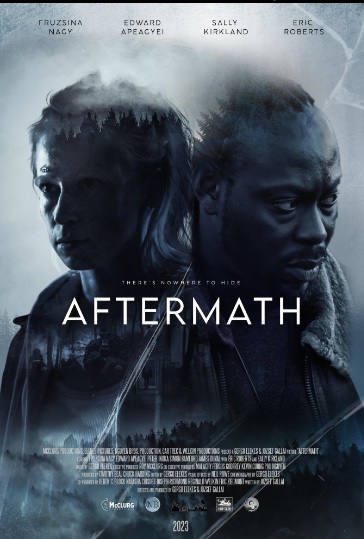
A woman named Kate (Fruzsina Nagy) drives down a road.  We don’t know where she is driving to but we can tell that she’s driving quickly and she’s not in the mood for any delays.  It’s the way that someone drives when they’re trying to escape but they’re not sure where they want to go.  It’s way you drive when you just want to convince yourself that you can somehow leave everything behind.

We hear what sounds like an accident and suddenly, Kate is waking up in a forest.  Her car is nowhere to be seen and Kate has no idea how she came to be in the forest.  In fact, she’s not even sure who she was before she woke up.  She has no memories of her past life, beyond fleeting visions that don’t always seem to fit together.  Eventually, she meets another apparent amnesiac, Bubba (Edward Apeagyei).  Bubba wears a locket around his neck and there’s a picture of a woman in the locket but he doesn’t seem to be quite sure who she was.

Bubba and Kate are not alone in the forest.  There are other wanderers and then there’s a group of men who appear to be soldiers, wearing crude uniforms and gas masks and carrying machine guns.  (The sight of the soldiers, with their crude uniforms, bring to mind the horrific militias that often spring up in the aftermath of a war and attempt to seize power out of the chaos.)  Receiving cryptic orders from their leader (Eric Roberts), the soldiers patrol the forest and execute anyone that they come across.  Their leader repeatedly tells them that they have to track down and execute everyone because the future of the world depends upon it.  Failure is not an option.

Aftermath deals with a very real fear.  The idea of suddenly waking up and discovering that you have not only lost your identity but also control over your own fate is at the heart of many horror stories and it’s also a reflection of the way many people feel about living in today’s world.  One wrong word, thought, or move and you can find yourself exiled into both a real and metaphorical wilderness.  When Kate wakes up with little memory of what the world was like before she ended up in that forest, she’s feeling what a lot of people have felt when they try to remember the world and their lives before the lockdowns of 2020 and all of the political and societal events that followed.  We live in a world that seems to change from day to day and, as result, everyone has had that moment when, like Kate, they’ve struggled to understand what’s happening.  From the minute that Kate wakes up with the feeling that she has no control over what’s happening to her, she becomes an instantly relatable character.  The audience not only wants to know what’s happening to her but they also want her to regain control of her fate.  If Kate can regain control, then those watching in the audience can also regain control.

The film’s cinematography emphasizes both the grandeur and the ominous atmosphere of the forest, making it a place that manages to be beautiful and threatening at the same time and the deliberate pace builds up suspense as Kate tries to discover why she is in the forest.  Fruzsina Nagy and Edward Apeagyei both give sympathetic and relatable performances as Kate and Bubba and the audience does care what happens to them.  Aftermath is both an intriguing thriller and a meditation on life and love.

Aftermath will be released on digital and blu-ray by Bayview Entertainment on January 30th.


Review: The Black Waters Of Echo’s Pond (dir. by Gabriel Bolongna)


I’m going to start this review with a disclaimer.  Yesterday, I nearly died trying to see this movie.  As I was driving to the theater, I nearly collided with another car.  One of us (okay, it me) wasn’t paying attention and ran a stop sign.  We handled the near accident with the usual mix of car horns and profanity and, my heart still racing, I drove on to the theater and saw The Black Waters of Echo’s Pond.

As a result of my near death experience, I sat through this movie with one thought in my head: was seeing it worth losing my life?  While there are some movies (Suspiria, Beyond the Darkness, Zombi 2, and the Living Dead Girl, for example) that I would happily sacrifice a few years in order to see on the big screen, Black Waters is not one of them.

The film actually starts out well with a 9-minute prologue.  An archeological expedition in Turkey discovers an ancient tomb.  Inside the tomb, they find a map that is somehow linked to the Greek God Pan.  For nine minutes, we’re treated to clunky exposition (“Why, it’s what we’ve been here looking for!”  “Professor, do you mean that it’s the ancient map of Pan’s Arcadia?”  “Yes, the same Pan who was the Greek God of fertility and…”) and it seems like this movie might actually turn out to be a fun, cheerfully stupid take on the old Mummy movies that Hammer Studios released in the late 60s.

No such luck.  All the members of the expedition are promptly killed off-screen.  We jump forward to the “present day” and the entire movie quickly goes downhill.

In the present day, nine college friends get together to spend a weekend in an isolated mansion on an even more isolated island.  Why they would want to do this is never really addressed nor do you ever believe that any of the characters have a shared history or would actually be friends if not for the fact that the film demands it.  While there are some talented actors in the cast, they have absolutely no chemistry when they’re on screen together.  Since the rest of the film is pretty much dependent upon us believing that these people are all old friends, this lack of chemistry pretty much dooms the entire movie. 

(Add to that, the men in this group all appear to be having the worst bad hair day in recorded history.)
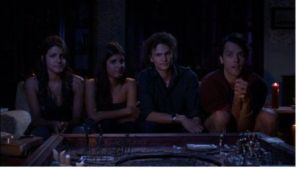
Once they’re in the mansion, the power promptly dies.  While attempting to find a fuse box, one of the friends instead discovers a board game.  Our group proceeds to play the game and soon, they’re seeing visions of murder, illicit sexual activity, and a big-horned demon.  However, none of them find this to be all that curious because they are 1) stoned and 2) incredibly stupid.

As I watched them play this cursed Jumanji death game, I found myself wondering if nobody in this film had ever seen a horror movie before.  Surely, if they had, they would realize that getting together in an isolated location, joking about sex, smoking weed, and then playing with the mysterious game that was previously walled up in the cellar is a good way to guarantee that you’re not going to be alive in the morning. 

To a certain extent, you have to be willing accept a lot of stupidity on the part of the characters in a horror film.  After all, we all know that our poor victims are always going to end up running up a flight of stairs in order to escape the killer (as opposed to going out the front door) and we forgive them for that because we know that if their actions were logical, then there would not be a movie.  However, the victims of the Black Waters of Echo’s Pond simply require us to forgive too much. 

Anyway, the game quickly starts to get weird as everyone draws cards that require them to answer increasingly personal questions.  Old resentments boil up to the surface.  One guy admits to wanting to have sex with both his girlfriend and her sister while the token responsible girl finds herself compelled to flirt with the token slut.  All of this goes on until finally, one member of the group snaps and, while everyone else is busy getting it on, proceeds to cut his best friend in half with a chainsaw.  (And no, nobody in the house hears the screams or the chainsaw because, as I mentioned earlier, they’re all incredibly stupid.)
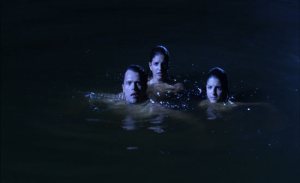
Once that first murder is committed, everyone is soon trying to kill everyone else.  In this regard the film is remarkably similar to Mario Bava’s classic Bay of Blood (a.k.a. Twitch of the Death Nerve).  However, the constant carnage in the Bava film worked because Bava made it clear that his many murderers were all working independently from each other with just their own greed to motivate them.  Whereas in Black Waters, it is made clear from the start that everyone has been possessed by Pan.  In short, the murders have nothing to do with the people being killed or those who do the killing.  And while the murders are nicely brutal and bloody (I hate bloodless horror films), they don’t have any meaning beyond the mechanics of the film.

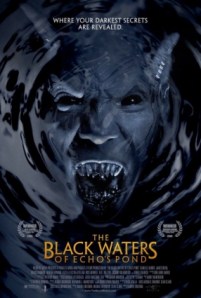
Pan (or at least I assume that its meant to Pan because it looks more like a Minotaur than anything else) shows up fairly early in the movie and he is an impressive creature with a goat’s head that features glowing eyes and long, dirty talons at the end of his fingers.  Still, I think it was a mistake on the part of the filmmaker’s to reveal him as early (and as often) as the film does.  Once Pan shows up, the movie loses all of its mystery.  We now know, for sure, that all the ensuing mayhem is the result of Pan’s supernatural malevolence.  By revealing Pan as early as it does, the film sacrifices whatever chance it may have had to be truly scary.  Instead Pan, just becomes another faceless killer and the movie, which has been advertised as a “psychological thriller,” loses its edge.

Outside of Pan, the cast is largely forgettable and they’re certainly not helped by how unlikable the majority of the characters are.  A few members of the cast do occasionally manage to offer up a few good (or, at least, memorable) moments but their efforts are sabotaged by some of the most leaden dialogue I’ve ever heard.  (It’s not a good sign that the film feels like it was dubbed into English even though it’s not.) 

The Babysitter twins from the Planet Terror segment of Grindhouse show up for instance and, even though their characters are wildly inconsistent, they both bring a lot of energy to their roles.  Incidentally, one of them gets the worst the line of the dialogue in the entire film when she says, “Shakespeare is Shakespeare!  B-movies are porn!”

Robert Patrick plays Pete, the grizzled old-timer who gets to do the whole “Some people say the killer is still out there…” thing.  It’s not much of a role but Patrick has fun with it.

Speaking of horror film tropes, Mircea Monroe plays Veronique, the token slut.  From the minute she shows up on-screen, you know she’s doomed because she’s flirtatious, openly bisexual, and likes to show off her boobs.  (Come to think of it, if I ever find myself in a slasher film, I am fucked!)  It’s a thankless role but Monroe does her best with it and actually give Veronique a personality that goes beyond the puritan stereotype of the slasher film slut.  Her best scene is her last.  The look of mournful resignation on her face make her final fate rather sad and suggests the type of film that Black Waters could have been.

The two nominal leads are played Danielle Harris and James Duval and they both occasionally manage to transcend the shallowness of their roles.  Harris, of course, is a horror film veteran who could play her role in her sleep.  To her credit, she doesn’t.  James Duval is best known for playing Frank the Bunny in Donnie Darko.  Here, he plays ne’er-do-well Rick.  If for no other reason, the movie is worth seeing just for the way Duval delivers the line “Shit!  We’re fucked!”  It’s a line that he repeats several times and he says it with just the right combination of genuine frustration and stoner pathos.
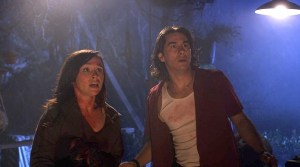
In many ways, Black Waters On Echo’s Pond feels a lot like one Lucio Fulci’s post-Manhattan Baby efforts.  You have no doubt that the movie was made by talented people and you keep wanting it to be better than it actually is.  You find yourself clinging onto the few isolated moments that are actually effective and hoping that maybe they’ll carry you to the light at the end of the tunnel.  Unfortunately, by the end of the movie, you realize that the light was actually the train that’s just bisected you because you were too stupid to jump off the tracks.

Ultimately, the main problem with The Black Waters of Echo’s Pond is that it just is not a scary movie.  I can usually forgive a lot from a horror movie as long as there’s a handful of shocking “jump” moments.  Unfortunately, Black Waters doesn’t feature a single one.  While the gore effects are occasionally impressive, it takes more than blood to make a horror movie.  All the material was there for this to be a fun little B-movie (and not a porno, regardless of what that Babysitter Twin claims) but it just doesn’t happen.

I recently posted some of my feelings about this film over on a message board.  I quickly received a reply from a gentleman who disagreed with me.  He informed me that not only did I not have the slightest idea how difficult it is to make a movie but by criticizing this film, I was failing to support “independent film.”  “Why don’t you just go spend more of your money on Avatar again?” he asked.  Well, for the record, I hated Avatar and I do support independent film.  Just because this movie was made outside of the studios, that doesn’t make it a good film.  If you want to see a good, independent horror and/or fantasy film, go track down Baghead or Primer.  Leave the Black Waters of Echo’s Pond undisturbed.