Welcome to Retro Television Reviews, a feature where we review some of our favorite and least favorite shows of the past! On Mondays, I will be reviewing Crime Story, which ran on NBC from 1986 to 1988. The entire show can be found on Tubi!
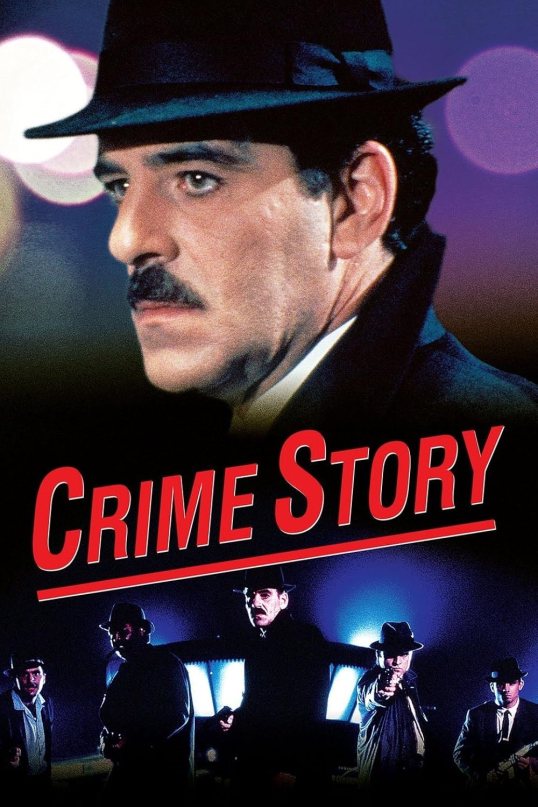
This week, Frank Homan returns.
Episode 1.17 “The Battle of Las Vegas”
(Dir by Aaron Lipstadt, originally aired on February 6th, 1987)
The hotel and resort workers of Las Vegas are going on strike, and when union leader Slim Mahoney (Frederick Coffin) tells Luca that the unions have no interest in working with the mob (ha!), Luca responds by having Pauli use a big truck to run Slim over.
With Slim dead, Luca tries to maneuver a mob stooge named Sam Taylor (Lee Ving) into the presidency of the union. When Mahoney’s protégé, Roger Jankowski (Anthony Heald), argues that the union cannot sell out to the mob, Abrams and Torello show up at a union meeting to reveal that Sam is crooked and to lead everyone in a pro-union chant. Really?
Okay, the union stuff was a little bit too on-the-nose and silly. That said, at least Stanley Tucci showed up as a bombmaker who was recruited to make trouble for the striking workers. Unfortunately, for those hoping to see him in future episodes, he ended up getting arrested and apparently hanged himself in his cell.
The highlight of this episode wasn’t any of the union stuff. It was the return of Frank Holman (Ted Levine). When we last saw Holman, he was testifying that Luca was a crime boss (true) and that Torello was on the take (false). When Luca and Pauli come across Holman performing with a rock-and-roll band in Vegas, they have a surprising reaction. They drive Holman out to the middle of the desert and .… forgive him. Of course, Holman does make the claim that the only reason he lied about Torello was so that the case against Luca would fall apart. Could Holman be telling the truth? I doubt it. Holman doesn’t seem to be that smart. But Luca decides that he doesn’t care one way or the other, and he welcomes Holman back into his organization.
Why is Luca so forgiving? My personal theory is that Holman, like Pauli, is a symbol of everything that Luca gave up to become a power in Las Vegas. Luca was probably at his happiest when he was breaking into houses with Pauli and Holman. Now that he’s the boss, he doesn’t get to do the dirty work anymore. And yet, it’s obvious that Luca misses it. He’s a born criminal. For that reason, he’s willing to keep Holman and Pauli around, regardless of how much they screw up. In his way, Luca is the most sentimental character on the show.
Of course, Luca isn’t one to let sentiment get in the way of making money. Some things just take precedence.
 Everyone knows who Al Capone was but few people remember Frank Nitti. Nicknamed “The Enforcer,” Nitti was Capone’s right-hand man. When Big Al was sent to federal prison for not paying his taxes, Nitti was the one who kept things going in Chicago. While Al was losing his mind in Florida, Nitti was the one who moved the Chicago Outfit away from prostitution and into the labor racket. Today, if anyone remembers Frank Nitti, it is probably because of the scene in Brian DePalma’s The Untouchables where Eliot Ness tosses him off of a building. In real life, Nitti survived the Untouchable era just to become one of the few crime bosses to die by his own hand. In 1943, With the feds closing in on him, Nitti shot himself in a Chicago rail yard.
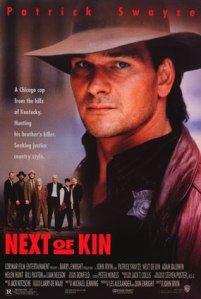 Truman Gates (Patrick Swayze) may have been raised in Appalachia but, now that he lives in Chicago, he’s left the old ways behind. He has a job working as a cop and his wife (Helen Hunt) is pregnant with their first child. When Truman’s younger brother, Gerald (Bill Paxton), shows up in town and asks for Truman’s help, Truman gets him a job as a truck driver. But, on his first night on the job, Gerald’s truck is hijacked by a Sicilian mobster named Joey Rosellini (Adam Baldwin) and Gerald is killed. Truman’s older brother, Briar (Liam Neeson), soon comes to Chicago and declares a blood feud on the mob.
