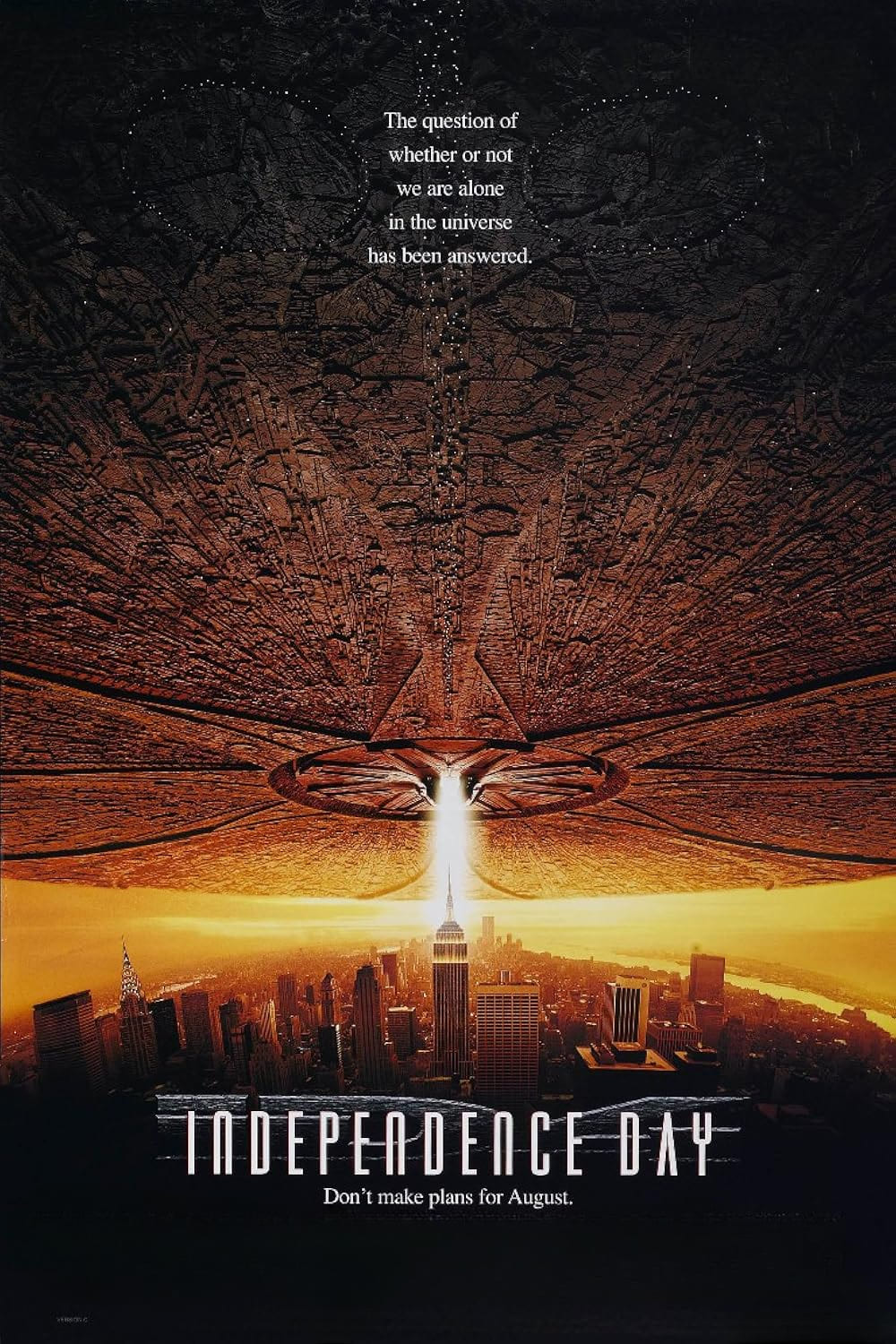
“We will not go quietly into the night! We will not vanish without a fight! We’re going to live on! We’re going to survive! Today, we celebrate our Independence Day!” — President Whitmore
If you were around in the summer of 1996, you already know exactly where you were when you first saw the trailer for Independence Day. There was this massive shadow creeping over the moon, followed by that terrifying, booming sound effect, and then the White House just absolutely getting vaporized by a giant laser beam. It was a cultural moment. Director Roland Emmerich hadn’t really made his mark on Hollywood yet, but with this one movie, he essentially invented the modern summer blockbuster template of destroying famous global landmarks. Looking back at Independence Day almost three decades later, it is honestly wild how well this movie holds up, not as a piece of high art, but as a perfectly calibrated, ridiculously entertaining popcorn machine.
The premise is beautifully simple: massive alien spaceships suddenly appear over Earth’s major cities, they don’t come in peace, and humanity has to figure out how to fight back before we go the way of the dinosaurs. What makes the first act of the movie so effective is the slow build. Emmerich doesn’t just start with explosions; he lets the dread simmer. We see the massive ship hover over New York City, casting a shadow that blocks out the sun, and the sheer scale of the thing is awe-inspiring. Then, when the ships finally initiate their attack sequence, the payoff is spectacular. The practical effects combined with early CGI create these massive, rolling walls of fire that tear through iconic buildings. It is destructive poetry, and as a kid watching it, it was the most incredible thing I had ever seen. Even now, the destruction feels heavy and tactile in a way that modern, entirely computer-generated action sequences often don’t.
But a movie is only as good as its characters, and Independence Day has arguably one of the greatest ensemble casts of the 1990s. You have Will Smith playing Captain Steven Hiller, a fighter pilot who is desperately trying to get promoted while also dealing with his girlfriend, her son, and their dog. Smith is at the absolute peak of his early movie star charm here, delivering some of the most quotable one-liners in action movie history. Punching an alien in the face and yelling “Welcome to Earth!” is the kind of ridiculous machismo that only Smith could pull off without making you cringe. Then you have Jeff Goldblum as David Levinson, an MIT-educated cable repairman and environmentalist who figures out the alien signal is a countdown. Goldblum is basically doing his classic Goldblum thing—stuttering, eccentric, highly caffeinated—but it works perfectly because he serves as the perfect foil to Smith’s brute physicality.
The supporting cast is so deep that it feels like an Ocean’s Eleven of sci-fi tropes. Bill Pullman plays President Thomas J. Whitmore, and he gives the role an earnestness that elevates the material. He’s not an action hero; he’s a former fighter pilot who is clearly in over his head but steps up when his people need him most. You also have Judd Hirsch as Goldblum’s cranky, kvetching father, providing fantastic comic relief. Randy Quaid plays Russell Casse, a traumatized former pilot who was abducted by aliens years ago and is written off as a drunk by his small town, giving the movie an underdog storyline. And you can’t forget Brent Spiner as Dr. Okun, the wildly eccentric Area 51 scientist who gets way too excited about the alien biology. Every single one of these actors is fully committed to the bit, no matter how absurd the situation gets.
Now, if we are being completely honest, we have to talk about the plot, which is essentially held together with scotch tape and sheer willpower. The entire third act revolves around Goldblum and Smith flying a captured alien spacecraft up to the mothership to upload a computer virus using a 1996 Apple PowerBook. Yes, an Earth laptop somehow interfaces perfectly with an advanced extraterrestrial operating system, and yes, the aliens apparently don’t have McAfee, Norton or any kind of firewall to prevent a rudimentary human virus from crippling their entire defense grid. It is monumentally stupid if you think about it for even five seconds. But the secret to Independence Day is that it moves so fast and has so much momentum that you simply do not have time to care. The movie dares you to roll your eyes, but then it immediately distracts you with another massive explosion or a great quip from Will Smith, and you just go along for the ride.
The climax of the movie is a masterclass in cheesy, triumphant blockbuster filmmaking. Before the final aerial assault on the alien ships, President Whitmore gives a speech to the troops that has become completely ingrained in pop culture. “Today we celebrate our Independence Day!” he yells, and it is so incredibly corny, but I challenge you not to get at least a little bit pumped up when the music swells. The dogfight that follows is chaotic and thrilling, culminating in Randy Quaid’s character making the ultimate sacrifice by flying his jet directly into the alien weapon. It is exactly the kind of melodramatic, heroic moment that Emmerich excels at, and it hits the emotional beats it needs to hit, even if you saw it coming from a mile away.
You also have to appreciate how unapologetically intense the movie feels despite skating by with a PG-13 rating. People get vaporized, cities are leveled, and there is a genuine sense of apocalyptic dread that permeates the middle of the film. When the aliens first attack, Emmerich actually takes the time to show the aftermath, including cars blowing up in tunnels and people desperately trying to outrun the fireballs. Harvey Fierstein’s character dramatically dying while just sitting in his car, rolling up the window as if that’s going to stop a giant wall of alien fire, is a weirdly specific, dark comedy beat that you rarely see nowadays. The movie has real stakes, and you genuinely feel like humanity is on the brink of extinction.
It is crazy to think about the legacy of Independence Day and how it changed Hollywood. Before this, disaster movies were mostly relegated to B-movie status or Irwin Allen productions from the 1970s. Emmerich proved that you could blend disaster spectacle with sci-fi action and make an absolute fortune. This movie paved the way for Armageddon, Godzilla, The Day After Tomorrow, and essentially the entire concept of the modern cinematic destruction porn genre. They did eventually make a sequel, Independence Day: Resurgence, in 2016, but it completely missed the point of the original. It was too slick, too reliant on weightless CGI, and it lacked the ragtag, underdog charm that made the first one so special.
At the end of the day, Independence Day is just pure, unadulterated cinema comfort food. It does not demand anything from you as a viewer other than to sit back, suspend your disbelief, and enjoy the fireworks. It captures a very specific mid-90s vibe where movies could be big, dumb, loud, and incredibly fun without taking themselves too seriously. Roland Emmerich has directed a lot of movies since then where he has destroyed the world in various different ways, but he has never quite managed to capture the lightning in a bottle that he did here. Whenever the Fourth of July rolls around, or whenever you just need a reliable, edge-of-your-seat action movie to kill a couple of hours, Independence Day is always there, waiting to welcome you to Earth one more time.


Pingback: Lisa Marie’s Week In Review: 6/29/26 — 7/5/26 | Through the Shattered Lens
Pingback: Guilty Pleasure No. 122: 2012 (dir. by Roland Emmerich) | Through the Shattered Lens