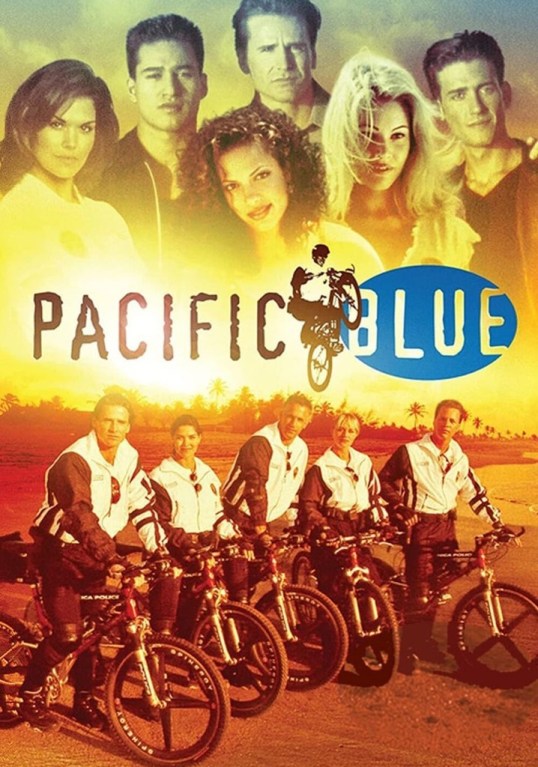
Welcome to Late Night Retro Television Reviews, a feature where we review some of our favorite and least favorite shows of the past! On Tuesdays, I will be reviewing Pacific Blue, a cop show that aired from 1996 to 2000 on the USA Network! It’s currently streaming everywhere, though I’m watching it on Tubi.
This week, Cory makes another stupid mistake.
Episode 4.20 “Trust”
(Dir by Terence H. Winkless, originally aired on April 11th, 1999)
When her best friend is murdered, Cory assumes that the killer is her friend’s ex-boyfriend, Mark (Joel Gretsch). FBI profiler Jerry Beck (Eric Scott Woods) agrees. In fact, he claims that Mark is a serial killer who has been stalking and killing blondes across the country. Cory, who blames herself for her friend’s death and who has recently broken up with Bobby Cruz, works with Jerry to try to stop Mark’s reign of terror. But what if Jerry Beck isn’t who he says he is? What if the real Jerry Beck was murdered and an imposter took on his identity?
This is one of those episodes where Monica pretty much figures out what’s going on but everyone ignores her because both the characters and the show itself seem to have a bizarre hated for her. Every episode in which Monica appears seems to feature Monica doing better detective work than everyone else on the bike patrol and getting absolutely no credit for it. In this case, Cory does eventually admit that Monica was right so I guess that’s progress.
Oh, this was a stupid episode. Having an FBI profiler turn out to actually be a serial killer isn’t a bad idea but having the killer somehow steal the identity of an actual FBI agent without anyone noticing is one of those things that just asks for too much of a suspension of disbelief. Having Cory then fall for the fake FBI agent while she’s supposed to searching for the killer of her best friend was just another example of Cory basically acting like an idiot. That’s been a frequent thing with Cory this season. It’s odd because Cory used to actually be the smart member of the bike patrol.
While Cory is trying to avenge her friend’s death, Granger hooks up with a woman that he meets online. Jamie is skeptical that CyberVixen is going to be the next Mrs. Granger. It’s always funny to me to see television shows that attempted to deal with the Internet in the 90s. You can always tell that they were written by aging boomers who weren’t quite sure what the Internet was and probably expected it to just be a brief fad.
To me, the funniest moment in this episode was the members of Pacific Blue realizing that Cory was alone with a serial killer so, instead of calling a squad car, they all just hopped on their bicycles and rode over to Cory’s apartment. I mean, would it kill them to take a car for once? I imagine they would have gotten over to the apartment quicker.
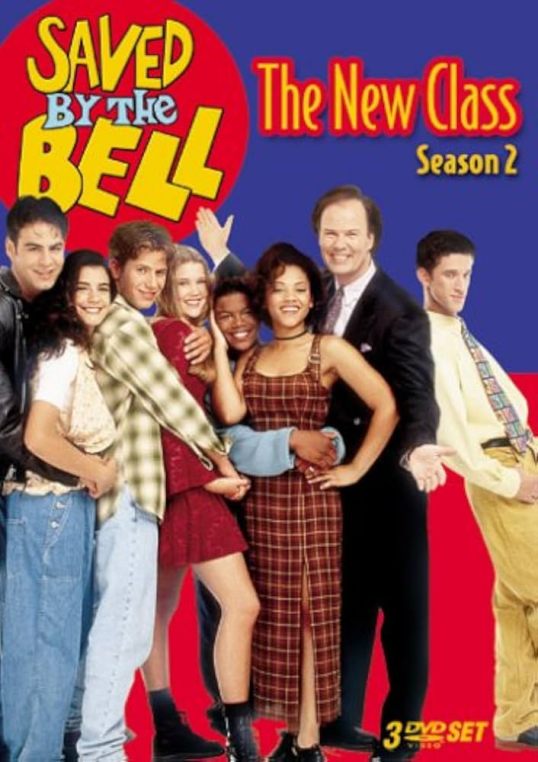
Welcome to Retro Television Reviews, a feature where we review some of our favorite and least favorite shows of the past! On Tuesdays, I will be reviewing Saved By The Bell: The New Class, which ran on NBC from 1993 to 2o00. The show is currently on Prime.
“One thing I’ll never forget is when the writers were too lazy to come up with a new episode so we just did a clip show instead….”
Episode 2.19 “The Class of 2020”
(Dir by Don Barnhart, originally aired on November 19th, 1994)
Screech and Belding are making a documentary to put in the time capsule for the class of 2020. Wow, those 2020 graduates will be amazed to see what the world was like before they were born!
Megan and Bobby are interviewed. Lindsay and Tommy are interviewed. Rachel and Brian are interviewed. There’s a lot of dialogue like “Remember that time we thought we got Mr. Belding fired?” and “I’ll never forget the time my friends helped me out.” Yep, it’s a clip show. One of the clips comes from the previous week’s episode.
Two things of note:
One of Lindsay and Tommy’s clips features Weasel and Scott from the previous season. That makes this episode the only time that anyone during the second season actually acknowledged that Scott, Weasel, and Vicki used to go to Bayside.
Secondly, Rachel and Brian talk about falling in love over the summer at the country club. But this episode ends with Screech and Belding talking about how Screech’s first year as Belding’s administrative assistant is coming to an end. None of the students met Screech until he started working as Belding’s administrative assistant, as the start of the school year. But they all know Screech in the country club episodes. In fact, Screech is the one who hired them. So, the country club episodes have to have taken place during the summer after Screech’s first year as Belding’s academic assistant. So, this clip show apparently includes clips from the future. Maybe Brian and Rachel are time travelers.
“The All-Father wove the skein of your life a long time ago. Go and hide in a hole if you wish, but you won’t live one instant longer. Your fate is fixed. Fear profits a man nothing.” — Herger the Joyous
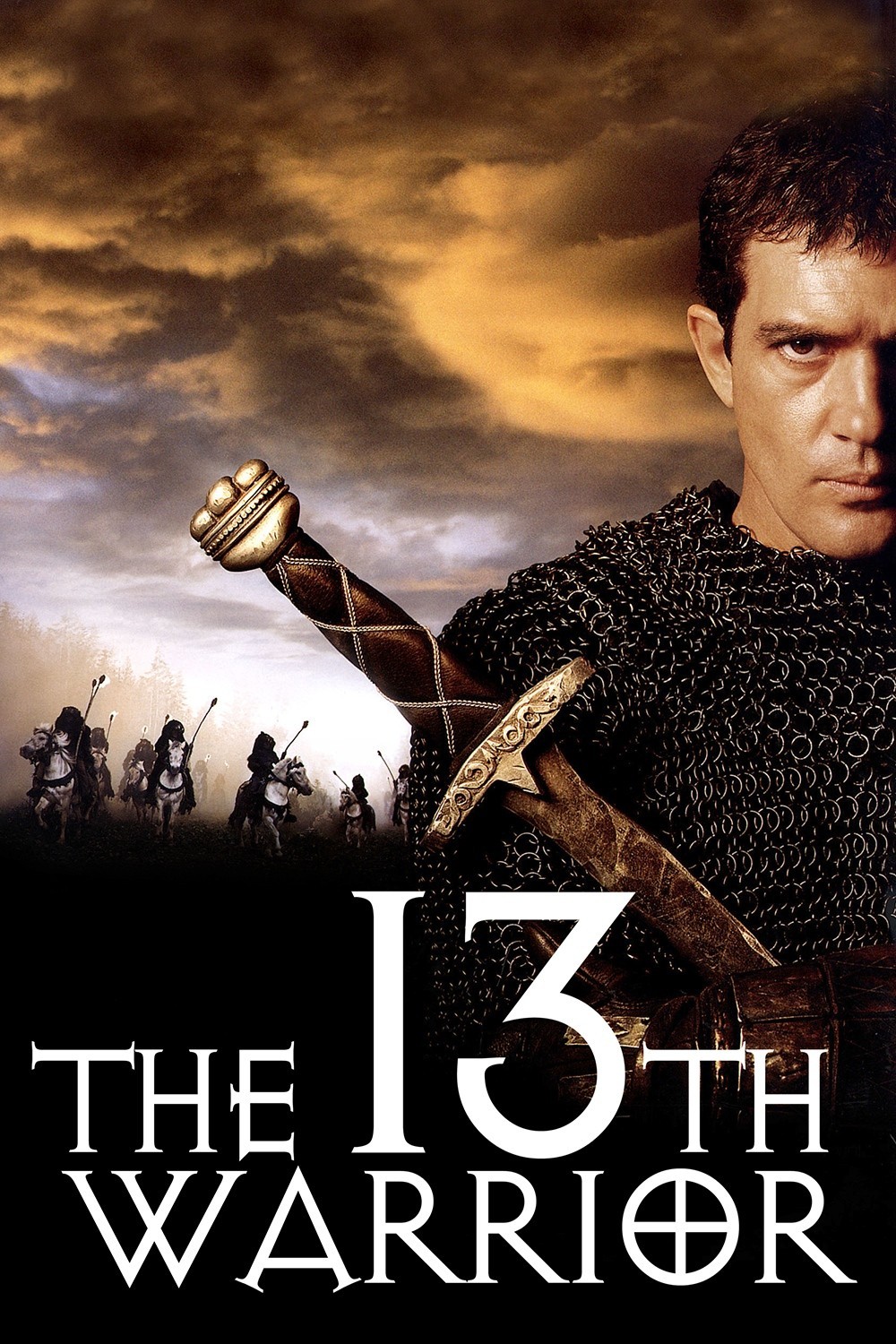
Few films wear the scars of a difficult production as visibly—and as entertainingly—as John McTiernan’s The 13th Warrior. It is messy, truncated, occasionally incoherent, and visibly caught between two competing creative visions. Yet it also has an atmosphere that many more polished historical adventures lack: wet forests, torchlit halls, thick fog, blackened skies, grim Norse rituals, and a band of warriors who look as though they have spent their entire lives sleeping in armor and drinking themselves toward an early grave. It is not a great film, but it is an undeniably entertaining one—and one of the more fascinating guilty pleasures of the late-1990s blockbuster era.
Loosely adapted from Michael Crichton’s novel Eaters of the Dead, which itself plays with the historical legend of Ahmad ibn Fadlan and folds it into a rough retelling of Beowulf, The 13th Warrior begins with Antonio Banderas as Ahmed ibn Fahdlan. Ahmed is an Arab court poet and diplomat banished from Baghdad after an indiscretion involving a powerful man’s wife. He is sent north as an ambassador, where his refined manners, education, and cultivated worldview put him in immediate contrast with the brutal, loud, heavily armed Norsemen he encounters. The movie gets a surprising amount of mileage out of that culture-clash premise. Ahmed is initially horrified by the Vikings’ hygiene, manners, food, and casual relationship with violence, while the Vikings regard him as an odd, under-equipped foreigner who seems far too elegant to be useful in a fight.
The story kicks into gear when a group of Norse warriors is summoned to aid a distant village terrorized by mysterious attackers known as the Wendol. According to prophecy, thirteen men must go—and the thirteenth cannot be a Northman. Ahmed, despite having no real desire to be involved in this nightmare expedition, becomes the required outsider. From there, the film turns into a lean survival-horror adventure: the warriors travel into an isolated northern settlement where people are being abducted and mutilated by enemies who seem to emerge from the darkness itself. The Wendol wear animal skulls, move through the night like ghosts, and are initially presented less as a human army than as something ancient and supernatural.
That eerie buildup is easily the best thing about The 13th Warrior. McTiernan, the director of Die Hard, Predator, and The Hunt for Red October, knew how to make hostile environments feel dangerous. The village is surrounded by dense woods and oppressive mountains, while the interiors are lit by fire, smoke, and shadows. The film often feels as if it is taking place at the edge of the known world. Even when the plot becomes shaky, the mood holds. There is a genuinely creepy quality to the Wendol’s first attacks, especially when horns sound in the distance and figures descend from the hills in the rain. The movie may never fully sell the mythology behind its villains, but it absolutely sells the fear they inspire.
Banderas is a somewhat unconventional choice for Ahmed, and his casting has always been one of the film’s stranger elements. He brings charisma and physical presence, but the accent situation is obviously all over the place. Still, he makes the character’s gradual transformation satisfying. Ahmed begins as a man who sees himself as superior to these crude northerners, only to discover that their apparent barbarism is paired with courage, loyalty, humor, and a practical intelligence he had underestimated. His evolution into a capable warrior is predictable, but it works because Banderas plays the early discomfort well. The famous moment when Ahmed learns the Norse language simply by listening around the campfire is absurdly accelerated, but it is also one of the movie’s most memorable scenes. It tells the audience, with no subtlety whatsoever, that he has crossed into their world.
The supporting cast gives the film much of its appeal. Vladimir Kulich’s Buliwyf is the quiet center of the group, a noble warrior king whose death is basically foretold from the moment he appears. Kulich has the right imposing, mythic presence for the role, and he makes Buliwyf feel like a living folk hero rather than just another stock Viking chief. Dennis Storhøi, Tony Curran, Richard Bremmer, and the rest of the warriors are not always given much individual development, but they create a convincing sense of companionship. Their banter, drinking, ritualized insults, and battle-ready camaraderie help the group feel like a unit with a history long before Ahmed arrived.
The action is another mixed but memorable part of the experience. McTiernan’s best films are often celebrated for their clarity of geography and movement, but The 13th Warrior is much murkier. Some of that is intentional: fights take place at night, in rain, amid smoke, fire, and chaos. But some of it also feels like a byproduct of an uneven post-production process. The movie is often too dark, too quickly edited, and too vague about what is happening from one beat to the next. Even so, there are flashes of real power. Ahmed forging a sword from a Viking weapon is a solid transformation moment, while the climactic infiltration of the Wendol cave has the pulpy appeal of an old adventure serial filtered through mud, blood, and 1990s studio excess.
The behind-the-scenes drama is arguably just as intriguing as the movie itself. The 13th Warrior became infamous for going significantly over budget and for the creative conflict between McTiernan and the studio. The reported disputes centered on the film’s tone, pacing, and specific scenes, with the studio evidently concerned that McTiernan’s version was too dark, too strange, and too inaccessible for a massive summer release. This was not a minor disagreement over a few trims. It became the kind of production struggle that leaves fingerprints all over the finished film. You can feel the tension between a moody, almost horror-driven historical fantasy and a more conventional action-adventure picture trying to break through the same material.
Michael Crichton, the author of Eaters of the Dead and a major force behind the project, eventually stepped in to oversee reshoots and re-editing. That fact alone makes The 13th Warrior unusually fascinating. It is not every day that the author of the source novel takes such a direct role in reshaping a film after its original director has already completed his work. Crichton reportedly pushed for a more straightforward, audience-friendly version, trimming and restructuring the movie in ways meant to clarify the story and increase its commercial appeal. The result is a film that often feels like two versions grafted together: one a grim, unnerving tale about outsiders confronting an almost prehistoric terror, the other a compressed heroic adventure about a reluctant man discovering his warrior spirit.
That conflict helps explain why the finished movie can feel so abrupt. Characters appear and disappear with little explanation, the Wendol mythology is only partially developed, and the final stretch rushes through material that could have supported a longer, more coherent climax. The film is barely over 100 minutes, yet it sometimes feels as though an entire half-hour of connective tissue vanished somewhere between the shoot and the theatrical cut. This is especially frustrating because there is clearly a richer movie buried inside the existing one. The setting, the central premise, the cultural collision, and the supernatural ambiguity all deserved more room to breathe.
Still, those flaws are part of why The 13th Warrior has endured as a cult favorite. It is easy to imagine a cleaner, more successful version, but it is also difficult to imagine that version being as peculiar or as memorable. The finished film has a strange, bruised personality. It carries the weight of a troubled production, but it also has enough great imagery, strong atmosphere, and old-fashioned adventure momentum to overcome its rough edges. It never reaches the level of McTiernan’s best work, and it is certainly not the definitive cinematic take on Beowulf. But as a cult, guilty-pleasure fantasy adventure, The 13th Warrior delivers more than its reputation might suggest.
BLACK RAIN opened on September 22nd, 1989, and I’ve been a big fan since the first time I saw it. Director Ridley Scott creates a visual masterpiece where ethically challenged supercop Nick Conklin (Michael Douglas) and his tragically fated, but fun, partner Charlie Vincent (Andy Garcia) head to Japan to deliver a yakuza murderer to the authorities. When the prisoner gives them the slip, they stay over in the Land of the Rising Son and engage in a clash of cultures with strait laced Japanese cop Masahiro (Japanese cinematic legend Ken Takakura) as they all try recapture their man. Needless to say, things don’t always go well.
I’ve chosen the opening sequence where Michael looks extremely cool riding his motorcycle while Greg Allman sings “I’ll Be Holding On” over some pretty impressive credits. Enjoy my friends.
Today’s scene of the day comes from 1979’s Convoy and it features Kris Kristofferson as the greatest trucker of all time, Rubber Duck. In this scene, Rubber Duck rescues a fellow trucker from jail and lets the authorities know what they can do with their law.
4 Shots From 4 Films is just what it says it is, 4 shots from 4 of our favorite films. As opposed to the reviews and recaps that we usually post, 4 Shots From 4 Films lets the visuals do the talking!
Today, we wish a happy birthday to director John Woo. It’s time for….
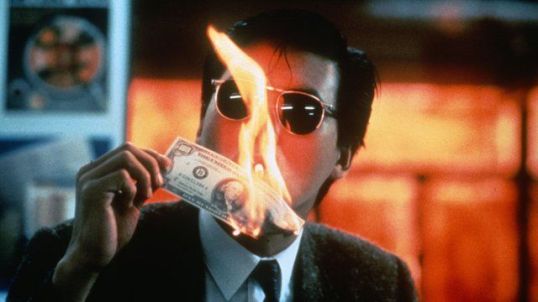
4 Shots From 4 John Woo Films
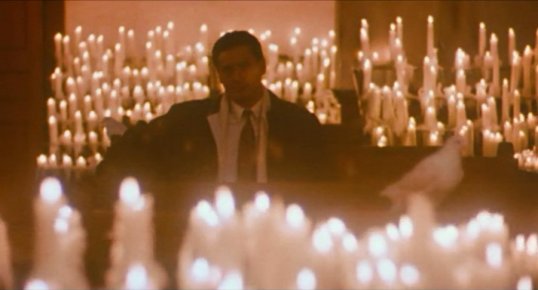
A Better Tomorrow (1986, dir by John Woo, DP: Wing-Hang Wong)
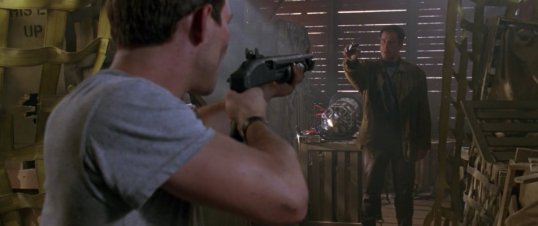
The Killer (1989, dir by John Woo, DP: Peter Pau, Wing-Hang Wong)
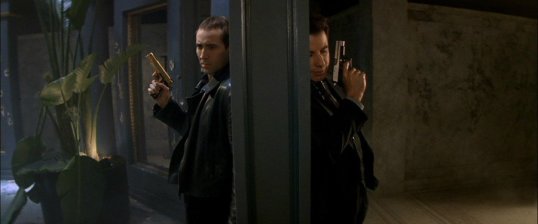
Broken Arrow (1996, dir by John Woo, DP: Peter Levy)
A man drives through the desert in a Thunderbird. A hawk perches in a church. An unknown couple dance the tango. The beach awaits. Yes, this is the video for Mr. Mister’s Broken Wings.
The video was directed by Oley Sassone, who later directed episodes of Hercules and Xena.. According to Sassone, “The subtext of the story and what I wanted the audience to feel was our hero’s own backstory in his mind. The tango dancers, juxtaposed with the images of him getting lost while driving, tossing a map and instead following the hawk overhead was, symbolically, his own soul, his own voice deep inside telling him to carry on – to lead him to a new path, a new beginning.” Personally, I have always thought this song was about someone struggling to recover from a bad breakup.
Broken Wings is a song that epitomizes the mid-1980s so it’s not surprising that it’s also included on the Vice City: Grand Theft Auto soundtrack. Getting chased the a police helicopter while listening to Mr. Mister is a surreal experience.