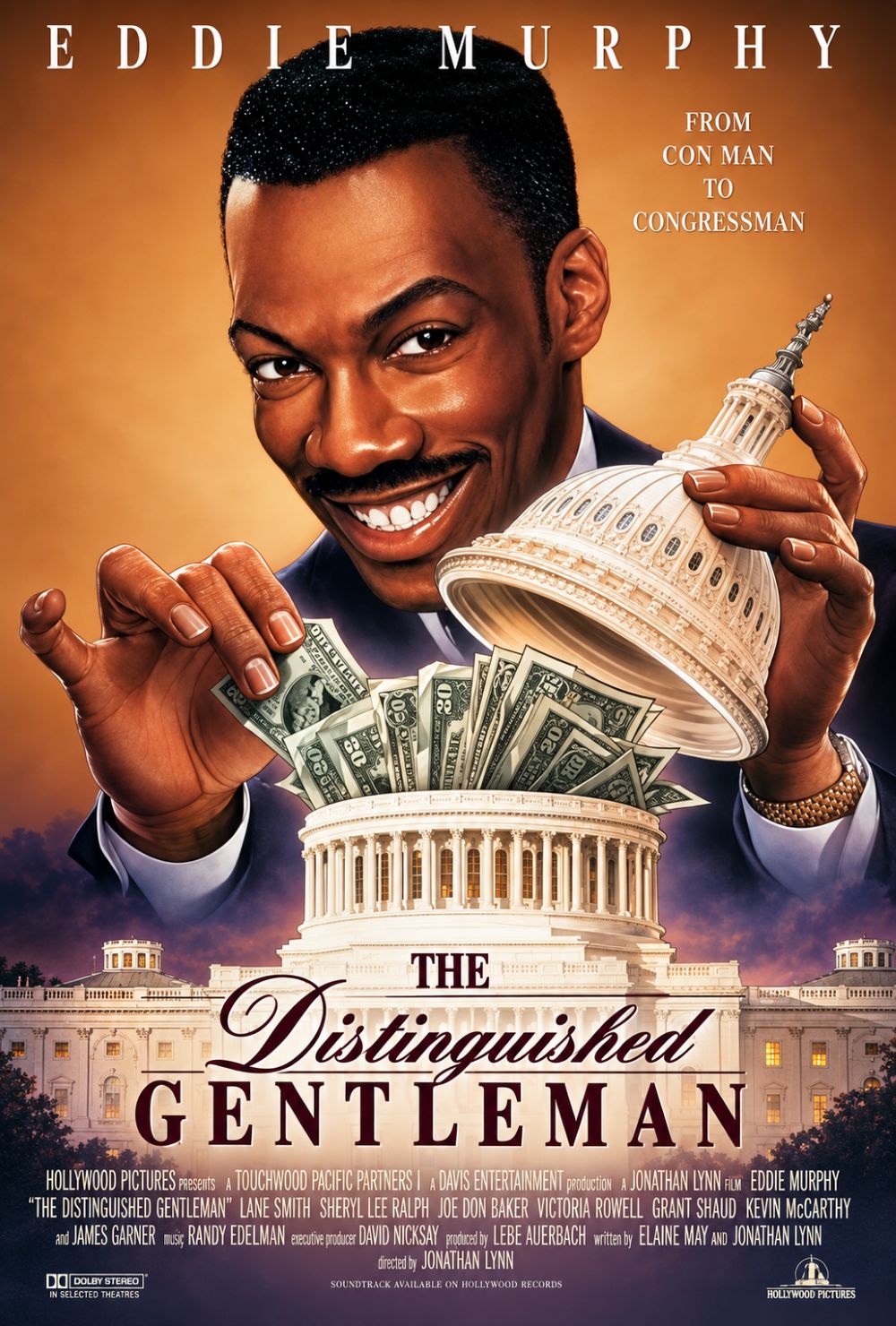
Review: The Distinguished Gentleman (dir. by Jonathan Lynn)


“With all this money coming in from both sides, how does anything ever get done?” — Thomas Jefferson Johnson

The Distinguished Gentleman is an uneven but enjoyable Eddie Murphy comedy whose premise has become more relevant with time. Directed by Jonathan Lynn, the 1992 film casts Murphy as Thomas Jefferson Johnson, a Florida con man who discovers that a recently deceased congressman had the exact same name. Seeing a shortcut to money and status, Johnson runs for the vacant House seat, wins largely on name recognition, and enters Washington with no meaningful political experience. In 1992, that premise played as broad political satire. Today, it carries a more uneasy edge, because its suggestion that image, recognition, and confidence can outrun scrutiny does not seem nearly as far-fetched.

That change in perspective makes the film’s central joke more interesting. Johnson begins as a small-time hustler who understands scams, pressure, ego, and persuasion. Once he reaches Congress, however, he discovers a political world that runs on many of the same instincts. The people around him do not call their dealings scams. They talk about donations, access, relationships, opportunities, and constituent concerns. But Johnson sees the transaction beneath the polished language immediately. The movie’s sharpest idea is that he may be a con man, yet he is not automatically the least honest person in Washington. He merely lacks the expensive suits and professional vocabulary used to make self-interest look respectable.

Murphy is exactly the right actor to make that contradiction work. Thomas Jefferson Johnson has to be selfish enough for the premise to hold together, clever enough to survive in an unfamiliar environment, and charming enough that the audience still wants to follow him after he wins office through deception. Murphy brings all of those qualities to the role. Johnson enjoys the attention, travel, influence, and special treatment attached to public office because he sees Congress as the biggest score he has ever found. At the same time, Murphy gives him enough quickness and warmth that he never becomes unpleasant. Even when Johnson does not understand what is happening around him, he moves through Washington with the confidence of someone who assumes he belongs there.

That confidence drives the movie’s strongest material. Johnson may not know committee procedure, legislative language, or public policy, but he knows people. He can recognize when praise is a setup, when a favor comes with strings attached, and when a supposedly helpful figure is treating him as an investment. This makes him an effective comic guide through Washington’s rituals. He is unqualified in the usual sense, but he is unusually qualified to identify the self-dealing hidden behind political formality. Jonathan Lynn understands the humor in that contrast and keeps the early scenes moving briskly through offices, hearings, fundraisers, press events, and lobbyist meetings. His direction is functional rather than visually distinctive, but it gives Murphy room to work and makes the political setting clear without drowning the comedy in procedure.

The problem is that the movie gradually moves away from the very idea that gives it its satirical bite. Johnson’s election is a pointed joke about name recognition, voter inattentiveness, and political branding. He wins because his name is familiar enough to inspire trust, not because anyone has evaluated his experience, policies, or character. That setup could have supported a more sustained comedy about campaigns, media manipulation, and the ease with which public image can substitute for qualification. Instead, the film shifts into a more conventional pharmaceutical-company corruption plot, giving Johnson an external villain and a clear reason to become more responsible.

That shift is understandable, since the story needs stakes beyond Johnson simply enjoying the perks of Congress. It also gives Murphy a more sympathetic character arc. Once Johnson sees the real-world consequences of corporate influence and political favors, he begins to use his instincts against people whose schemes are more damaging than his own. The change works because he does not become a completely different person. He remains fast-talking, opportunistic, and alert to every available angle. What changes is his sense of scale: his scams are about quick money, while the larger political and corporate schemes around him can hurt ordinary people while remaining hidden behind legal language and respectable appearances.

Still, making the conflict so clear-cut also weakens the satire. The opening suggests that corruption is part of a broader culture of money, access, public relations, and political influence. The later plot makes it easier to imagine that the problem lies mainly with a few especially corrupt people. Lane Smith’s Dick Dodge represents that polished form of corruption effectively. Dodge has the calm authority and practiced respectability of a politician who can make unethical behavior sound like normal procedure. He is a good villain precisely because he does not need to look obviously sinister; he simply treats power as something to be managed for private benefit.

Dodge’s presence becomes more useful because the film gives him a genuine counterweight in Charles S. Dutton’s Congressman Elijah Hawkins. Hawkins is almost Dodge’s opposite: plainspoken, principled, and committed to the idea that public office should mean public service. Dutton gives the role enough strength that Hawkins does not come across as a bland symbol of virtue. He is not there simply to lecture Johnson. Instead, he demonstrates that integrity and competence can exist within the same institution that has rewarded Dodge’s cynicism. Through these two men, Johnson sees both versions of political life: Dodge shows how power can be abused, while Hawkins shows what it is supposed to accomplish.

That contrast helps the film’s best themes land even when the plot becomes more routine. Johnson starts out believing that public office is just another hustle, only with better benefits and larger payouts. Hawkins gives him a reason to see the job differently, while Dodge proves that the cynicism Johnson brought to Washington is not entirely misplaced. Johnson’s eventual decision to push back against corruption therefore feels earned, even if the film resolves the conflict more neatly than its setup deserves. He does not become an idealist so much as a hustler who finally recognizes that the people above him are running a far bigger and more harmful game.

Viewed now, that idea carries more weight than it did in 1992. George Santos’s rise and eventual expulsion from Congress following repeated revelations about his background and finances offered a modern example of political presentation outpacing public scrutiny. Tommy Tuberville’s move from high-profile college-football coach and broadcaster into the U.S. Senate reflects a different but related reality: name recognition built outside politics can be a major electoral asset. The point is not that either man is literally comparable to Thomas Jefferson Johnson. It is that the film’s basic concern—how easily familiarity and confidence can be mistaken for qualification—has become harder to dismiss as mere comic exaggeration.

The same pattern can be seen beyond Congress. Donald Trump reached the presidency after decades as a celebrity businessman and television personality, while Arnold Schwarzenegger’s worldwide fame as a bodybuilder and movie star became a significant advantage in his successful run for governor of California. Celebrity alone never explains an election, and prior careers in sports or entertainment do not automatically make someone unfit for public office. Still, those examples show why the film’s name-recognition joke now feels more pointed. A highly recognizable candidate begins with a built-in audience, a simple public identity, and the kind of familiarity that many traditional candidates spend years trying to earn.

That dynamic has only become more visible as media personalities from different ideological camps seek office. Television hosts, pundits, podcasters, athletes, entertainers, and online figures can launch campaigns with established audiences, fundraising networks, and brand recognition already in place. In that environment, Johnson’s path to office feels less like an impossible gag and more like a deliberately exaggerated version of a real political tendency. The Distinguished Gentleman is not predicting every modern development, but it understands that voters may attach trust to a familiar name or face before they ask harder questions about qualifications, judgment, or policy.

This added relevance does not erase the film’s flaws. The comedy is still inconsistent, and the lobbyists, politicians, and corporate villains are often broader than they are funny. Murphy can make routine scenes entertaining, particularly when Johnson bluffs through official settings with total confidence despite not knowing the rules. But the movie often settles for familiar Washington stereotypes when it could push its satire further. It is rarely dull, yet it repeatedly avoids the messier implications of its best idea.

Even so, The Distinguished Gentleman remains worth revisiting as a mid-tier Murphy vehicle with more ambition than its reputation suggests. It does not have the comic consistency of Trading Places, the invention of Coming to America, or the effortless momentum of Beverly Hills Cop. Its pharmaceutical-company plot is too conventional, and its ending is more reassuring than genuinely sharp. Yet Murphy gives it a strong center, Dutton and Smith create an effective moral and political contrast, and the premise has gained resonance with time. What began as a funny story about a con man finding his way into Congress now plays as a reminder that political satire becomes less comfortable when reality starts catching up to it.
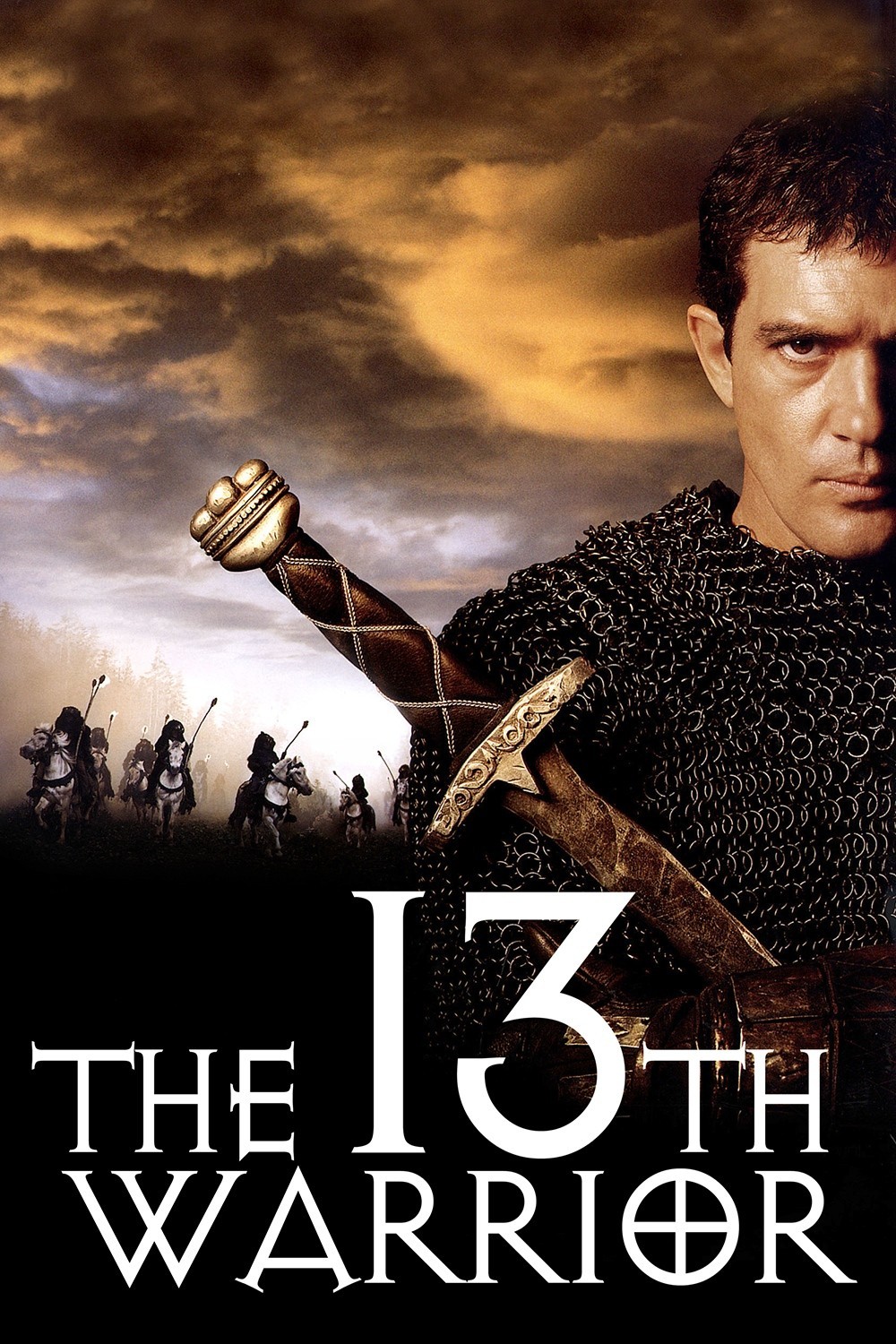
Guilty Pleasure No. 130: The 13th Warrior (dir. by John McTiernan)


“The All-Father wove the skein of your life a long time ago. Go and hide in a hole if you wish, but you won’t live one instant longer. Your fate is fixed. Fear profits a man nothing.” — Herger the Joyous

Few films wear the scars of a difficult production as visibly—and as entertainingly—as John McTiernan’s The 13th Warrior. It is messy, truncated, occasionally incoherent, and visibly caught between two competing creative visions. Yet it also has an atmosphere that many more polished historical adventures lack: wet forests, torchlit halls, thick fog, blackened skies, grim Norse rituals, and a band of warriors who look as though they have spent their entire lives sleeping in armor and drinking themselves toward an early grave. It is not a great film, but it is an undeniably entertaining one—and one of the more fascinating guilty pleasures of the late-1990s blockbuster era.

Loosely adapted from Michael Crichton’s novel Eaters of the Dead, which itself plays with the historical legend of Ahmad ibn Fadlan and folds it into a rough retelling of Beowulf, The 13th Warrior begins with Antonio Banderas as Ahmed ibn Fahdlan. Ahmed is an Arab court poet and diplomat banished from Baghdad after an indiscretion involving a powerful man’s wife. He is sent north as an ambassador, where his refined manners, education, and cultivated worldview put him in immediate contrast with the brutal, loud, heavily armed Norsemen he encounters. The movie gets a surprising amount of mileage out of that culture-clash premise. Ahmed is initially horrified by the Vikings’ hygiene, manners, food, and casual relationship with violence, while the Vikings regard him as an odd, under-equipped foreigner who seems far too elegant to be useful in a fight.

The story kicks into gear when a group of Norse warriors is summoned to aid a distant village terrorized by mysterious attackers known as the Wendol. According to prophecy, thirteen men must go—and the thirteenth cannot be a Northman. Ahmed, despite having no real desire to be involved in this nightmare expedition, becomes the required outsider. From there, the film turns into a lean survival-horror adventure: the warriors travel into an isolated northern settlement where people are being abducted and mutilated by enemies who seem to emerge from the darkness itself. The Wendol wear animal skulls, move through the night like ghosts, and are initially presented less as a human army than as something ancient and supernatural.

That eerie buildup is easily the best thing about The 13th Warrior. McTiernan, the director of Die Hard, Predator, and The Hunt for Red October, knew how to make hostile environments feel dangerous. The village is surrounded by dense woods and oppressive mountains, while the interiors are lit by fire, smoke, and shadows. The film often feels as if it is taking place at the edge of the known world. Even when the plot becomes shaky, the mood holds. There is a genuinely creepy quality to the Wendol’s first attacks, especially when horns sound in the distance and figures descend from the hills in the rain. The movie may never fully sell the mythology behind its villains, but it absolutely sells the fear they inspire.

Banderas is a somewhat unconventional choice for Ahmed, and his casting has always been one of the film’s stranger elements. He brings charisma and physical presence, but the accent situation is obviously all over the place. Still, he makes the character’s gradual transformation satisfying. Ahmed begins as a man who sees himself as superior to these crude northerners, only to discover that their apparent barbarism is paired with courage, loyalty, humor, and a practical intelligence he had underestimated. His evolution into a capable warrior is predictable, but it works because Banderas plays the early discomfort well. The famous moment when Ahmed learns the Norse language simply by listening around the campfire is absurdly accelerated, but it is also one of the movie’s most memorable scenes. It tells the audience, with no subtlety whatsoever, that he has crossed into their world.

The supporting cast gives the film much of its appeal. Vladimir Kulich’s Buliwyf is the quiet center of the group, a noble warrior king whose death is basically foretold from the moment he appears. Kulich has the right imposing, mythic presence for the role, and he makes Buliwyf feel like a living folk hero rather than just another stock Viking chief. Dennis Storhøi, Tony Curran, Richard Bremmer, and the rest of the warriors are not always given much individual development, but they create a convincing sense of companionship. Their banter, drinking, ritualized insults, and battle-ready camaraderie help the group feel like a unit with a history long before Ahmed arrived.

The action is another mixed but memorable part of the experience. McTiernan’s best films are often celebrated for their clarity of geography and movement, but The 13th Warrior is much murkier. Some of that is intentional: fights take place at night, in rain, amid smoke, fire, and chaos. But some of it also feels like a byproduct of an uneven post-production process. The movie is often too dark, too quickly edited, and too vague about what is happening from one beat to the next. Even so, there are flashes of real power. Ahmed forging a sword from a Viking weapon is a solid transformation moment, while the climactic infiltration of the Wendol cave has the pulpy appeal of an old adventure serial filtered through mud, blood, and 1990s studio excess.

The behind-the-scenes drama is arguably just as intriguing as the movie itself. The 13th Warrior became infamous for going significantly over budget and for the creative conflict between McTiernan and the studio. The reported disputes centered on the film’s tone, pacing, and specific scenes, with the studio evidently concerned that McTiernan’s version was too dark, too strange, and too inaccessible for a massive summer release. This was not a minor disagreement over a few trims. It became the kind of production struggle that leaves fingerprints all over the finished film. You can feel the tension between a moody, almost horror-driven historical fantasy and a more conventional action-adventure picture trying to break through the same material.

Michael Crichton, the author of Eaters of the Dead and a major force behind the project, eventually stepped in to oversee reshoots and re-editing. That fact alone makes The 13th Warrior unusually fascinating. It is not every day that the author of the source novel takes such a direct role in reshaping a film after its original director has already completed his work. Crichton reportedly pushed for a more straightforward, audience-friendly version, trimming and restructuring the movie in ways meant to clarify the story and increase its commercial appeal. The result is a film that often feels like two versions grafted together: one a grim, unnerving tale about outsiders confronting an almost prehistoric terror, the other a compressed heroic adventure about a reluctant man discovering his warrior spirit.

That conflict helps explain why the finished movie can feel so abrupt. Characters appear and disappear with little explanation, the Wendol mythology is only partially developed, and the final stretch rushes through material that could have supported a longer, more coherent climax. The film is barely over 100 minutes, yet it sometimes feels as though an entire half-hour of connective tissue vanished somewhere between the shoot and the theatrical cut. This is especially frustrating because there is clearly a richer movie buried inside the existing one. The setting, the central premise, the cultural collision, and the supernatural ambiguity all deserved more room to breathe.

Still, those flaws are part of why The 13th Warrior has endured as a cult favorite. It is easy to imagine a cleaner, more successful version, but it is also difficult to imagine that version being as peculiar or as memorable. The finished film has a strange, bruised personality. It carries the weight of a troubled production, but it also has enough great imagery, strong atmosphere, and old-fashioned adventure momentum to overcome its rough edges. It never reaches the level of McTiernan’s best work, and it is certainly not the definitive cinematic take on Beowulf. But as a cult, guilty-pleasure fantasy adventure, The 13th Warrior delivers more than its reputation might suggest.

Previous Guilty Pleasures

  1. Half-Baked
  2. Save The Last Dance
  3. Every Rose Has Its Thorns
  4. The Jeremy Kyle Show
  5. Invasion USA
  6. The Golden Child
  7. Final Destination 2
  8. Paparazzi
  9. The Principal
  10. The Substitute
  11. Terror In The Family
  12. Pandorum
  13. Lambada
  14. Fear
  15. Cocktail
  16. Keep Off The Grass
  17. Girls, Girls, Girls
  18. Class
  19. Tart
  20. King Kong vs. Godzilla
  21. Hawk the Slayer
  22. Battle Beyond the Stars
  23. Meridian
  24. Walk of Shame
  25. From Justin To Kelly
  26. Project Greenlight
  27. Sex Decoy: Love Stings
  28. Swimfan
  29. On the Line
  30. Wolfen
  31. Hail Caesar!
  32. It’s So Cold In The D
  33. In the Mix
  34. Healed By Grace
  35. Valley of the Dolls
  36. The Legend of Billie Jean
  37. Death Wish
  38. Shipping Wars
  39. Ghost Whisperer
  40. Parking Wars
  41. The Dead Are After Me
  42. Harper’s Island
  43. The Resurrection of Gavin Stone
  44. Paranormal State
  45. Utopia
  46. Bar Rescue
  47. The Powers of Matthew Star
  48. Spiker
  49. Heavenly Bodies
  50. Maid in Manhattan
  51. Rage and Honor
  52. Saved By The Bell 3. 21 “No Hope With Dope”
  53. Happy Gilmore
  54. Solarbabies
  55. The Dawn of Correction
  56. Once You Understand
  57. The Voyeurs 
  58. Robot Jox
  59. Teen Wolf
  60. The Running Man
  61. Double Dragon
  62. Backtrack
  63. Julie and Jack
  64. Karate Warrior
  65. Invaders From Mars
  66. Cloverfield
  67. Aerobicide 
  68. Blood Harvest
  69. Shocking Dark
  70. Face The Truth
  71. Submerged
  72. The Canyons
  73. Days of Thunder
  74. Van Helsing
  75. The Night Comes for Us
  76. Code of Silence
  77. Captain Ron
  78. Armageddon
  79. Kate’s Secret
  80. Point Break
  81. The Replacements
  82. The Shadow
  83. Meteor
  84. Last Action Hero
  85. Attack of the Killer Tomatoes
  86. The Horror at 37,000 Feet
  87. The ‘Burbs
  88. Lifeforce
  89. Highschool of the Dead
  90. Ice Station Zebra
  91. No One Lives
  92. Brewster’s Millions
  93. Porky’s
  94. Revenge of the Nerds
  95. The Delta Force
  96. The Hidden
  97. Roller Boogie
  98. Raw Deal
  99. Death Merchant Series
  100. Ski Patrol
  101. The Executioner Series
  102. The Destroyer Series
  103. Private Teacher
  104. The Parker Series
  105. Ramba
  106. The Troubles of Janice
  107. Ironwood
  108. Interspecies Reviewers
  109. SST — Death Flight
  110. Undercover Brother
  111. Out for Justice
  112. Food Wars!
  113. Cherry
  114. Death Race
  115. The Beast Within
  116. Girl Series
  117. Gone in 60 Seconds
  118. Swordfish
  119. Marked For Death
  120. The Internship
  121. The Angry Red Planet
  122. 2012
  123. Old School
  124. No Escape
  125. In Death Series
  126. Alligator
  127. Little Annie Fanny
  128. Wicked Wanda
  129. Congo