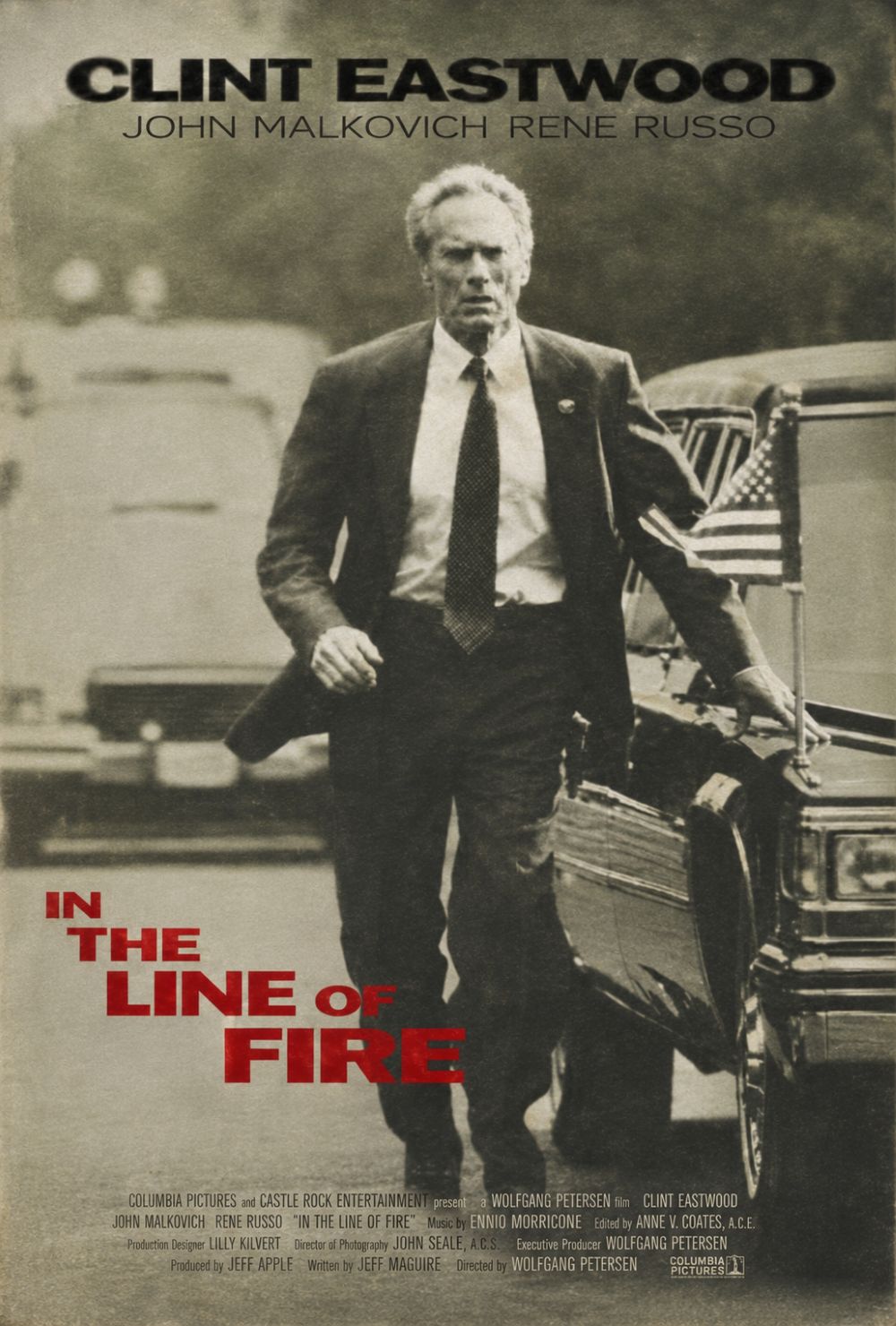
Film Review: In the Line of Fire (dir. by Wolfgang Petersen)


“Are you willing to trade your life for his, or is life too precious?” — Mitch Leary

In the Line of Fire is the kind of thriller that makes doing the basics well look like a lost art. Wolfgang Petersen’s 1993 film has a troubled hero, a frightening villain, a clear threat, and enough confidence to let conversations generate as much suspense as the action. There’s nothing especially revolutionary about its setup, but that’s part of the pleasure. This is polished Hollywood entertainment that knows exactly what it wants to deliver. Its greatest strength is tension, particularly when Clint Eastwood and John Malkovich are simply talking, each trying to find the weakness the other would rather keep hidden.

Eastwood plays Frank Horrigan, a veteran Secret Service agent still carrying the emotional weight of John F. Kennedy’s assassination. He was there in Dallas, and decades later, he hasn’t stopped wondering whether he could have done something differently. When a potential assassin threatens the current president, Frank sees more than another assignment. He sees a chance to confront the moment that has defined his life. Screenwriter Jeff Maguire gives the familiar redemption story a useful psychological hook: Frank isn’t just afraid of failing again. He’s afraid that his worst suspicions about himself might finally be confirmed.

What makes Eastwood so effective is that he doesn’t treat Frank’s age as an inconvenience the movie needs to ignore. It’s part of the character’s personality, his professional situation, and the way other people respond to him. He has the stubborn confidence of someone who has survived plenty, but also the bruised pride of someone who knows he can’t keep going forever. Eastwood gets plenty of mileage out of dry humor and that familiar, unimpressed stare, yet the performance becomes more interesting when those defenses slip. Frank’s guilt gives the tough-guy routine a vulnerability that keeps him from feeling like a recycled action hero.

Then there’s Malkovich, who turns the would-be presidential assassin into the movie’s most unsettling presence. His character, Mitch Leary, also calls himself Booth, and he takes an intensely personal interest in Frank. A former CIA assassin, he understands violence, preparation, and the usefulness of getting inside somebody’s head. Malkovich doesn’t need to shout to dominate a scene. His calm delivery is often more disturbing than a conventional villain’s threats would be. He sounds amused, curious, even companionable, which makes the cruelty underneath that voice feel worse. You never mistake his intelligence for wisdom, but you immediately understand why Frank can’t dismiss him.

Their phone conversations are the film’s real engine. Leary doesn’t merely announce what he plans to do; he turns Frank’s history into a weapon, pushing him to revisit questions he has spent years trying to bury. There’s a nasty intimacy to these exchanges. The two men occupy opposite sides of the same professional world, both shaped by institutions that demand loyalty and offer little comfort afterward. Petersen keeps that connection disturbing without pretending they’re morally interchangeable. Frank’s pain has made him difficult and withdrawn; Leary uses his grievances to justify murder. Their similarities sharpen the conflict rather than excuse the villain.

Petersen’s direction is wonderfully assured because he understands that suspense needs more than constant movement. He gives the audience time to anticipate danger, then makes the practical business of protecting a president feel like a series of potential disasters. Crowds, public appearances, and the sheer difficulty of identifying one determined attacker become more threatening than any elaborate action gimmick. When the film does pick up speed, the excitement has a psychological dimension: Frank’s physical vulnerability and his obsession with stopping Leary matter as much as the immediate chase. The action advances the relationship instead of temporarily replacing it.

Rene Russo brings a welcome change of rhythm as fellow agent Lilly Raines. Her scenes with Eastwood introduce flirtation, skepticism, and a little room to breathe between threats. The romance is also one of the film’s more conventional elements: Frank gets the younger colleague who can challenge him while recognizing the wounded man beneath the attitude. Still, Russo has enough presence to make their exchanges enjoyable rather than merely functional. She doesn’t act as though Frank’s reputation automatically makes him irresistible, and that resistance helps. Their teasing rapport also gives Eastwood a chance to be funny without turning Frank into a walking punchline.

The film isn’t flawless. Leary’s ability to stay ahead of everyone occasionally feels a little too convenient, and the redemption framework leaves relatively little doubt about the emotional destination. Some supporting characters exist mainly to question Frank’s judgment or complicate his assignment. But those familiar ingredients rarely become distracting because the central conflict remains so engaging. Maguire’s screenplay builds its suspense around character rather than relying entirely on surprise. Knowing roughly what kind of showdown is coming doesn’t ruin the experience; the pleasure lies in watching the pressure accumulate and wondering how much Frank will sacrifice to reach it.

In Petersen’s career, In the Line of Fire marked the beginning of a remarkable run of Hollywood hits. Its success led into Outbreak, Air Force One, The Perfect Storm, and Troy, a streak that established him as a dependable director of large-scale commercial entertainment. That momentum finally broke with his 2006 remake Poseidon, which disappointed at the box office. A decade-long absence from directing followed before he returned with the German crime comedy Four Against the Bank in 2016. Seen within that run, this earlier thriller stands out for how much excitement Petersen creates through actors and carefully managed anticipation.

What sticks with you about In the Line of Fire isn’t just whether Frank can stop an assassination, but how easily Leary can get under his skin with a phone call. That personal edge gives the movie its bite, even when the plot follows familiar thriller territory. Eastwood lets the cracks show without losing his screen presence, while Malkovich makes a quiet voice sound like the worst possible news. Petersen knows when to let them spar and when to turn up the heat. The result is a crowd-pleaser with enough personality to outlast its twists—and a villain who makes answering the phone seem like a terrible idea.
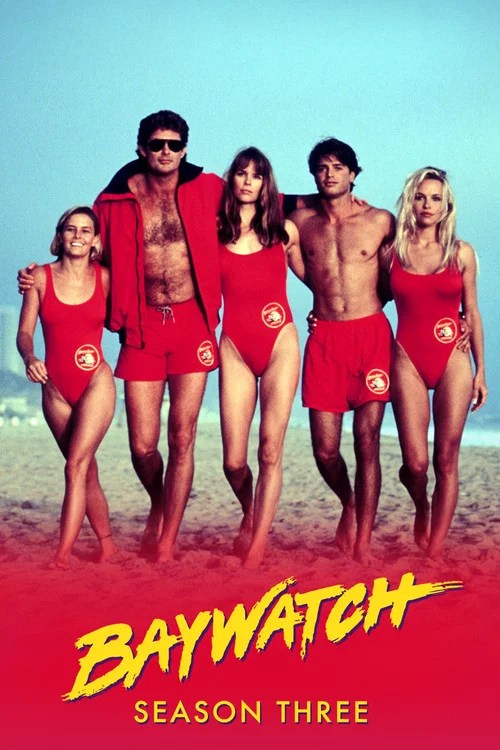
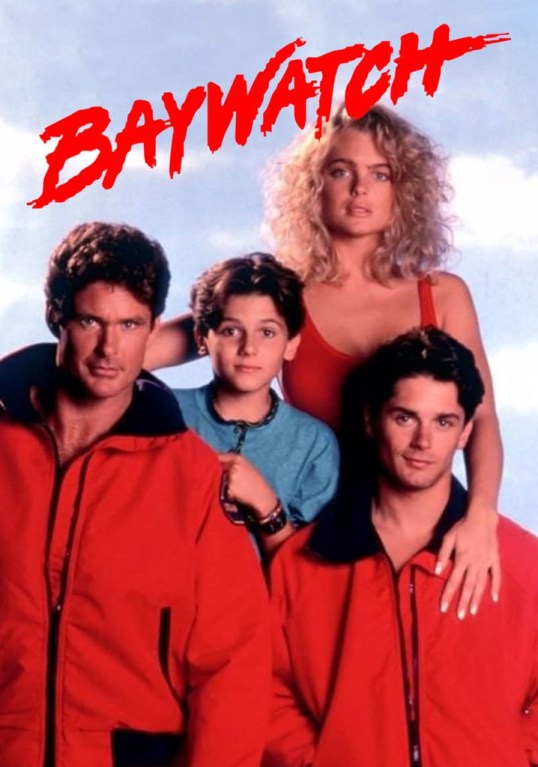
Retro Television Review: Baywatch 3.3 “Tequila Bay”


Welcome to Retro Television Reviews, a feature where we review some of our favorite and least favorite shows of the past!  On Saturdays, I will be reviewing Baywatch, which ran on NBC and then in syndication from 1989 to 2001.  The entire show can be viewed on Tubi.

This week, two new regulars join the cast.

Episode 3.3 “Tequila Bay”

(Dir by Lyndon Chubbuck, originally aired on September 27th, 1992)

Despite not having graduated from lifeguard school yet, Brody is given an undercover assignment by Mitch. Someone has been attacking surfers who try to surf the waters off Tequila Bay, and Brody is sent in to find out who is responsible.

Gee, who could it be? How about that gang of angry-looking teenagers standing on the rocks and glaring as Matt and another surfer, Jimmy Slade (Kelly Slater), greet each other in the water? It is pretty easy to see that the gang is trying to keep other surfers off “their” beach. What I find strange is that the gang consists of about seven people, but only two of them are carrying surfboards. What are the other five getting out of this?

As for Jimmy Slade, he is a philosophical surfer who thinks the water belongs to everyone. He lives in a van. He does not have a phone, but he does have a board, and his life is all about the waves. When he sees Brody paddling in the ocean, he greets him not as a potential rival but as a fellow surfer. And when the evil surf gang tries to run Brody and Slade off, Slade throws a few hard punches of his own.

Jimmy Slade is played by Kelly Slater, a professional surfer who joined Baywatch for its third season. In the Summerfest special, Slater said he joined the cast because he wanted to introduce surfing to the world. I have read a more recent interview in which he says he joined at the urging of his agent and regretted it almost immediately. Not only did fellow surfers give him a hard time about selling out, but Slater also read a script for an episode that featured a surfboard-stealing octopus.

And indeed, Slater gives a performance in this episode that suggests he had already figured out acting was not for him. He delivers his lines stiffly and without much personality. Slater himself abandoned acting after his time on Baywatch. He is a far better surfer than an actor.

Slade does agree to teach Summer how to surf, though the Tequila Bay gang again tries to ruin things by putting barbed wire in the ocean. Slade ends up with a few bad cuts, but it looks as if he will also get a girlfriend. As for the gang, they are arrested by Garner and Mitch.

Meanwhile, the new lieutenant shows up at Baywatch to replace the promoted Captain Thorpe. Mitch is stunned when his new boss turns out to be Stephanie Holden (Alexandra Paul), a woman with whom he once had a torrid affair. She broke his heart when she failed to meet him at Catalina. How badly did she hurt Mitch? Badly enough that he tells Ben he feels like Humphrey Bogart in Casablanca. Wow, Mitch. Overdramatic much?

Overdramatic is the word for David Hasselhoff in this episode. If the first two seasons featured Hasselhoff as an easygoing beach bum, this one features him as an angry, emotionally wounded ex-lover. Unfortunately, Hasselhoff is at his least convincing when he is playing anger. He comes across as petulant. Alexandra Paul may not play Stephanie with much depth, at least not in her first episode, but you still feel sorry for her, because Mitch is being such a jerk.

However, when Stephanie and Mitch work together on the beach to save a drowning man, Mitch realizes that Stephanie is good at her job. He has been asked to write a letter to Captain Thorpe about whether Stephanie should be assigned to Baywatch. Mitch writes that she should definitely be his boss. Could this mean love for Mitch? Let’s hope so!

This episode was way too overdramatic to be taken seriously. The Tequila Bay gang was made up of some of the least intimidating baddies ever to show up on Baywatch. Seriously: the ocean is for everyone.

Retro Television Review: Baywatch 3.0 “Summerfest Special”


Welcome to Retro Television Reviews, a feature where we review some of our favorite and least favorite shows of the past!  On Saturdays, I will be reviewing Baywatch, which ran on NBC and then in syndication from 1989 to 2001.  The entire show can be viewed on Tubi.

This week, the third of Baywatch begins with a special!

Episode 3.0: “Summerfest Special”

(Originally aired September 13, 1992)

“Hi, I’m David Hasselhoff, here to welcome you to the Summerfest special.”

The third season of Baywatch starts not with a story about Mitch Buchannon and his fellow lifeguards, but with a breezy special about the California lifestyle and what viewers can expect from the upcoming season. David Hasselhoff stands on the beach in his Baywatch uniform and earnestly talks about how important lifeguards are and how the show is all about celebrating their heroism.

“Life’s a beach,” Hasselhoff says, “and everyone’s life is at the beach.”

“We’ll be back with the latest in barely legal swimwear!” announcer Sean “Hollywood” Hamilton says as the special goes to commercial. Yes, that is the actual line.

In between shots of beachgoers in bikinis, the Summerfest Special features interviews with the cast members joining Baywatch in season 3. Susan Anton talks about being dramatically taller than her on-screen daughter, Nicole Eggert. David Charvet is introduced as “Baywatch’s newest bad boy.” Alexandra Paul says that maybe her character and Mitch will hook up, then laughs. Kelly Slater says that he’s not really an actor, but he joined the cast to show the world what “surfing is all about.” Pamela Anderson says that she’s looking forward to playing a “metaphysical character” because she’s very metaphysical herself. Gregory Alan Williams, who is being promoted to regular status in season 3, talks about saving a bystander during a riot because “I don’t like mobs.”

In between even more shots of beachgoers in bikinis, Hasselhoff talks about his music career and says that Baywatch is a show the entire family can watch. He adds, “Skimpy apparel is a part of the appeal.” This is followed by a montage of women in bikinis.

The Summerfest Special isn’t streaming on Tubi or Prime, but it is available on YouTube. The version I watched included all of the commercials that aired with the show. There weren’t any pharma commercials, which I appreciated. In America, we don’t really realize how bombarded we are with commercials for medicine with potentially deadly side effects until we get a chance to watch a complete broadcast from a time when no one in their right mind would think of advertising prescription medication on television.

Instead, I got a lot of commercials for local businesses and special musical compilation albums. There was a commercial for a Dodge dealership that bragged about how their vehicles came with airbags. In the middle of a commercial for a gospel album, a preacher said, “Who the hell left the gate open?” and everyone in the church cheered. A woman quit her job with confidence because of her Secret deodorant. “I’ll borrow my mother’s scarf,” a young woman who reminded me of myself declared, “but my mother’s tampons? No way!” A bunch of teen soccer players announced they’d rather drink “Sunny D” than “soda” or “purple stuff.” I’m from the South, so it always sounds weird to hear people refer to Coke as soda. It’s even weirder to see people preferring an orange drink to it.

If I seem to be spending a lot of time on the commercials, that’s because they felt like little mini time machines. Watching them was like taking a 30-second trip back to the early ’90s. As for the rest of the special, it was essentially a lengthy commercial for Baywatch and bikinis, but everyone interviewed seemed to be in a really good mood. They were having fun, and that’s the important thing.


Retro Television Review: Baywatch 2.22 “Summer of ’85”


Welcome to Retro Television Reviews, a feature where we review some of our favorite and least favorite shows of the past!  On Saturdays, I will be reviewing Baywatch, which ran on NBC and then in syndication from 1989 to 2001.  The entire show can be viewed on Tubi.

This week, season 2 comes to an end!

Episode 2.22 “Summer of ’85”

(Dir by Michael Berk, originally aired on May 18th, 1992)

This was the second-season finale, and it is an odd note to end on. David Hasselhoff is billed and never appears. Baywatch without Mitch is already a strange choice for a season finale; making the hour an Eddie-and-Shauni murder-mystery-slash-old-flame reunion makes it stranger. Tom McTigue’s Harvey has a prominent role in this episode but Hasselhoff, the show’s center of gravity is missing, and you feel it.

As for the plot: frustrated by life on a cramped boat and partly at Harvey’s urging, Shauni drags Eddie to a psychic named Rosalind (the one and only Toni Basil!). Eddie is a skeptic. When Rosalind tells him he will soon meet his first true love, Eddie says that Shauni already is. Rosalind disagrees.

Soon afterward, Eddie spots a woman sketching on a sailboat who looks painfully familiar. He is sure she is Lorna Cosgrove (Michelle Rogers). Eddie was fifteen when he first met her while vacationing at a friend’s place on Nantucket. Lorna asked if she could paint him. He agreed. Eventually he lost his virginity to her but, later that night, he saw an older man at her door, got jealous and never spoke to her again.

When Eddie approaches the woman, she denies being Lorna and calls herself Caitlin. The next day, she pays a boy to deliver a copy of the painting to Eddie’s tower. That not only proves she is Lorna; it also proves she was a terrible painter. I have seen motel art more impressive than her portrait of Eddie fishing.

Shauni is suspicious, and with good reason. There is a warrant for Lorna’s arrest. The same night Eddie slept with her, her husband was shot, and Lorna was the prime suspect. Can Eddie prove she is innocent?

That continuity, for those who care about that sort of thing, in this episode is a mess. In “Point of Attack,” Eddie claimed he did not even see the ocean until he was nineteen.  The first season established that he was Philadelphia street kid who grew up in the foster system.  And yet, in this episode, here he is at fifteen, on Nantucket, fishing, posing, and losing his virginity in a beach house. As well, this episode plants Shauni and Eddie on a houseboat, with Shauni announcing that they have to get an apartment. The previous episode, “Game of Chance,” had just moved her onto that boat after a fight with her father. Earlier in the season, though, the show had already treated them as live-in partners, sometimes in an apartment. Continuity be damned, I guess.  It’s almost as if the show’s writers just didn’t care.

In the end, Baywatch without Hasselhoff is pointless. That said, Toni Basil is amusing as Rosalind.  This is definitely a case of a performer giving a better performance than the material deserved.

That closes the first syndicated season of Baywatch, and the second season of the series overall. For the most part, season 2 was dumb and fun. The best episodes used Hasselhoff’s innate earnestness. The worst got too cutesy, especially “Now Sit Right Back and You’ll Hear a Tale,” the one where Eddie dreams he is on Gilligan’s Island. Billy Warlock and Erika Eleniak were both adequate as Eddie and Shauni, but neither was happy with the show’s turn once it entered syndication, and that unhappiness often showed.

Next week, we start season 3!

Retro Television Review: Baywatch 2.19 “The Lost Treasure of Tower 12”


Welcome to Retro Television Reviews, a feature where we review some of our favorite and least favorite shows of the past!  On Saturdays, I will be reviewing Baywatch, which ran on NBC and then in syndication from 1989 to 2001.  The entire show can be viewed on Tubi.

This week, Harvey gets to do something.

Episode 2.19 “The Lost Treasure of Tower 12”

(Dir by Cliff Bole, originally aired on April 27th, 1992)

After a season of appearing in the opening credits and rarely anywhere else, Harvey (Tom McTigue) finally gets a storyline. Because Mitch is going on a camping trip, he has Harvey replace him as the teacher of a windsurfing class. Harvey is excited because the students all attend a local girls’ school. That would presumably mean they’re teenagers, while Harvey appears to be in his thirties.

As Ben correctly deduces, Harvey has no idea how to windsurf. This becomes obvious as soon as Harvey and Ben meet the bikini-clad students on the beach. (Harvey tells all the girls to write down their phone numbers. Again: the girls are teenagers, and Harvey is definitely not.) After watching Harvey struggle with the basics, the students start to walk away. Ben steps up and announces that he can teach them. What follows is a montage of the girls windsurfing while a dejected Harvey stares straight at the camera.

That’s the B-plot. The A-plot features Michael Bendetti as Ian, a poet who lives on the beach and finds a box of stolen jewels a thief buried in the sand. Ian uses the jewelry to bankroll his courtship of Shauni. (Ian has a crush.) The thieves aren’t happy about that.

This episode just felt off. With his obsessive crush on Shauni, Ian comes across as a stalker, and yet I think we were supposed to be charmed by how relentless he was. There’s even an extended fantasy sequence in which Ian imagines dancing with Shauni under a chandelier suspended above the beach. Meanwhile, the main thief is so cruel that he throws the episode out of whack. It’s hard to reconcile a scene of Newmie and Eddie pulling a dead body out of the ocean with the lightweight humor of Harvey trying to windsurf.

This episode confirms something I’ve suspected from the moment I started reviewing this show. The early seasons of Baywatch worked best when they focused on David Hasselhoff’s somewhat corny but undeniably earnest portrayal of Mitch Buchannon. Whenever Hasselhoff isn’t in an episode (or appears in just one scene), the cynicism at the heart of the show — and the emptiness of its style-heavy approach — is much harder to ignore.

In short, Baywatch needed the Hoff.

Retro Television Review: Baywatch 2.14 “War of Nerves”


Welcome to Retro Television Reviews, a feature where we review some of our favorite and least favorite shows of the past!  On Saturdays, I will be reviewing Baywatch, which ran on NBC and then in syndication from 1989 to 2001.  The entire show can be viewed on Tubi.

This week, some people stand in the darkness, afraid to move into the light.

Episode 2.14 “War of Nerves”

(Dir by Douglas Schwartz, originally aired on February 3rd, 1992)

Drug lord Mason Sato (Cary-Hiroyuki Tagawa) has just gotten out of prison and he wants revenge of Mitch.  For reasons that aren’t really explained beyond a shot of a newspaper headline that reads, “Hero Lifeguard Helps Police Take Down Drug Lord,” Mason blames Mitch for his arrest,  Do lifeguards make arrests?

Mason stalks Mitch, Hobie, and Mitch’s girlfriend, Kaye (Pamela Bach).  At first, Mitch doesn’t tell either Hobie or Kaye what’s going on.  But when Mason asks Hobie to teach him how to use a boogie board, Mitch loses it and punches Mason out.  Mason later kidnaps both Hobie and Kaye.  This leads to a fight in an abandoned warehouse.  Once the fight moves into the ocean, Mason nearly drowns but Mitch saves his life so he can go back to prison.

Meanwhile, Shauni asks Ben to teacher her how to surf.  We never actually see Ben teaching her anything but we do get a lengthy montage as Ben remembers his days as a surfing lifeguard.  Myself, I’m wondering how Ben, who we’ve been told can no longer swim because of a leg injury, suddenly stops limping in this episode.

Cary-Hiroyuki Tagawa was a magnetic villain but otherwise, this was Baywatch at its cheapest.  The plot was by-the-book and it mostly seemed to exist so that Hasselhoff could play the action hero.  This episode felt like a dry run for the first, non-supernatural season of Baywatch Nights.  How many lifelong enemies has Mitch managed to make?

The life of the lifeguard is a dangerous one.

Retro Television Review: Baywatch 2.13 “Now Sit Right Back And You’ll Hear A Tale”


Welcome to Retro Television Reviews, a feature where we review some of our favorite and least favorite shows of the past!  On Saturdays, I will be reviewing Baywatch, which ran on NBC and then in syndication from 1989 to 2001.  The entire show can be viewed on Tubi.

This week, Eddie suffers a serious injury.

A quick note, before we begin: this episode was actually the 16th episode to air during the second season but apparently, it was originally meant to be the 13th episode and, in reruns, it usually airs after the Reunion episode.  I’ve decided to go with the production order for the purpose of these reviews.  Of course, it really doesn’t matter because it’s not like Baywatch had any use for continuity to begin with.

Episode 2.13 “Now Sit Right Back and You’ll Hear a Tale”

(Dir by Douglas Schwartz, originally aired on February 24th, 1992)

After rescuing a jet skier who ran out of fuel in the middle of the ocean, Eddie and Shauni discover a previously unchartered island.  (Or, at least, that’s what we’re told.  The beach that Eddie and Shauni explore is obviously the same beach from last week’s Reunion episode.)  On the beach, they find Gilligan (Bob Denver) and Mary Ann (Dawn Wells), who have been stranded on the island ever since the 60s.  Eddie and Shauni take them back to civilization.

Captain Thorpe is so impressed with Gilligan and Mary Ann’s story that he decides that he’s going to start his own media company and produce a miniseries about their life on the Island.  He also thinks that it would be a good idea to go back to the island and rescue the other castaways.  (Gee, you think?)  He arranges for a three-hour expedition to the island.  Garner will serve as the skipper.  Eddie will be the first mate.  Harvey is coming along as a professor, for some reason.  Shauni wants to star in the miniseries so she decides to dress up like a movie star and come on the tour as well.

Uh-oh, there’s a storm!  Everyone ends up washed up on the island.  Eddie finds himself torn between Mary Ann and Shauni but then he realizes that Gilligan is the one who truly loves Mary Ann….

No, I’m not making this up.  Stop it, I swear I’m not.

Eventually, Eddie wakes up in Baywatch Headquarters.  It turns out that he slipped and hit his head earlier and the entire episode has been a dream.  (Shocker!)  It sound like Eddie probably has a severe concussion but no one seems to be too concerned about that.

Hasselhoff appears for a few minutes at the start and the end of the episode.  Apparently, he knew better than to board the boat.

Oh God, this episode.  Well, actually, this episode makes sense once you learn that Douglas Schwartz (who both directed this week and also served as executive producer of the show) was the nephew of Sherwood Schwartz, the producer of Gilligan’s Island.  It’s a silly episode but Baywatch is a silly show so that’s to be expected.  The episode’s main mistake is that it opens with Eddie watching an episode of Gilligan’s Island and then it shows us Eddie slipping and hitting his head.  As a result, we pretty much know the whole episode is a dream from the start and we spend the entire episode waiting for Eddie to wake up.  It’s kind of boring.

Next week …. oh, who knows?  I’m sure it’ll be something involving a lot of slow motion running on the beach.

Retro Television Review: Baywatch 2.10 “The Trophy, Part Two”


Welcome to Retro Television Reviews, a feature where we review some of our favorite and least favorite shows of the past!  On Saturdays, I will be reviewing Baywatch, which ran on NBC and then in syndication from 1989 to 2001.  The entire show can be viewed on Tubi.

This week, Baywatch concludes the two storylines that began in the previous episode.  Will Mitch get over his guilt?  Will Eddie be able to keep his job?  Who will star in this week’s slow motion monologue?  These are the important questions that come with saving lives for a living.

Episode 2.10 “The Trophy, Part Two”

(Dir by Douglas Schwartz, originally aired on November 18th, 1991)

The beach is in chaos!

Bitter over being in a wheelchair and also being single, Turner continues to take dangerous risks.  At one point, he decides to go hang-gliding to prove that not being able to walk doesn’t have to keep anyone from flying.  At another point, we get one of those priceless Baywatch montages where Turner imagines himself being able run down the beach.

Mitch still feels guilty over Turner’s condition but eventually, even Mitch has to kneel down beside the guy and say that enough is enough.  And really, that’s all it takes.  Turner accepts that his ex, Megan, is now dating a hunky marine biologist named Ross and he moves on.  Megan was played by Vanessa Angel and, according to the imdb, this was her final appearance on Baywatch.  This was also Daniel Quinn’s final appearance as Turner.  So I guess that storyline’s now over.  Mitch still seemed to be feeling pretty guilty but he’ll have to learn how to deal with that on his own because Eric Turner is out of here!

(Quinn would go on to play two other characters on Baywatch and he also had a role in the Baywatch spin-off, Pacific Blue.  I guess someone in the head office really liked him.)

Meanwhile, Eddie is bitter because, after being arrested for statutory rape, he’s been suspended from being a lifeguard.  Well, Eddie, that’s life.  That’s pretty much what would happen to any lifeguard in those circumstances.  Eddie spends a lot of time on this show demanding to be treated like everyone else and then getting angry when it happens.

When Eddie’s accuser, Caroline (played by a young A.J, Langer), attempts to commit suicide by jumping off the pier, Shauni is there to rescue her.  Having been rescued from drowning, Caroline confesses that she made up the story about Eddie because she wanted to impress her friends on the beach.  Eddie is reinstated and Caroline says that she’s going to return home to Pennsylvania and get some psychiatric help.

This episode was pretty anti-climatic.  For all the dramatic potential of Mitch’s guilt, Caroline’s accusations, and Eddie’s bitterness, both stories pretty much just ended with the sources of all the drama agreeing to live somewhere other than California.  If only life was always that simple!

In the end, this episode was typical Baywatch.  Yes, there was some drama.  But the most important thing was always getting the next montage.


Retro Televison Review: Baywatch 2.9 “The Trophy: Part One”


Welcome to Retro Television Reviews, a feature where we review some of our favorite and least favorite shows of the past!  On Saturdays, I will be reviewing Baywatch, which ran on NBC and then in syndication from 1989 to 2001.  The entire show can be viewed on Tubi.

This week, Eddie in trouble!

Episode 2.9 “The Trophy: Part 1”

(Dir by Douglas Schwartz, originally aired on November 11th, 1991)

Awkward teenager Caroline Larkin (A.J. Langer) doesn’t have any friends because her family’s poor and she’s from Ohio.  The only person on the beach who shows her any kindess is Eddie the lifeguard.  When Caroline tries to impress the rich girls on the beach by claiming to have been seduced by Eddie, the main mean girl makes sure that Caroline’s father finds out.  Eddie is shocked when he’s arrested and charged with statuatory rape …. despite the fact the fact that almost the same thing happened to Craig during the first season of the show.  

What makes thing particularly awkward is that Eddie is arrested just as he and Shauni are getting ready to go to a chairty gala.  Shauni finally got Eddie into a tux and then Eddie gets the handcuffs slapped on.

Meanwhile, parapalegic lifeguard Eric Turner (Daniel Quinn) returns.  He’s still in love with Megan (Vanessa Angel), the Australian lifeguard.  But he’s also bitter about having to use a wheelchair.  This is one of those stories that would be compelling if we had the slightest idea who Turner and Megan were before this episode aired.  This is also one of those episodes where totally new people show up and everyone acts as if they were there from the start of the series.  (In all fairness, Megan has appeared on the show before but her role has never been particularly large.)  Everyone else know who Eric Turner but we, the viewers, have never heard of him before.

Anyway, this is a two-part episode so neither storyline is resolved.  Since I’m taking next week off for America’s 250th birthday celebration, Eddie’s going to have to wait in jail for a while.  However, two weeks from now, we’ll see if Eddie can clear his name!


Retro Television Review: Baywatch 2.8 “Thin Or Die”


Welcome to Retro Television Reviews, a feature where we review some of our favorite and least favorite shows of the past!  On Saturdays, I will be reviewing Baywatch, which ran on NBC and then in syndication from 1989 to 2001.  The entire show can be viewed on Tubi.

This week, Mitch rescues a dog and Shauni and Eddie rescue an outsider.

Episode 2.8 “Thin or Die”

(Dir by Douglas Schwartz, originally aired on November 4th, 1991)

Mitch rescues an adorable dog that is swimming in the middle of the ocean!  Awwww!

The dog is so cute!  But Mitch has a date that night and the dog seems to be determined to ruin it.  Can Mitch adopt the dog?  Actually, didn’t Mitch already adopt a dog?  Didn’t almost this exact same thing happen during the first season?  Seriously, whatever happened to the first dog!?

Fortunately, the dog helps Mitch track down its owner.  It turns out that she’s being held hostage on her own boat.  This, of course, allows for a minor action sequence.  One thing that I always find interesting about Baywatch is that the lifeguards were apparently also cops.  Garner Ellerbee may have been actual badge-carrying cop but he still didn’t do anything without asking a lifeguard to accompany him.

While Mitch is dealing with the dog situation, Eddie and Shauni are having relationship issues.  When Shauni claims that she and Eddie don’t have anything in common, Eddie decides to ask out Nicole, the woman who works at his message service.  (Apparently, message services were an early 90s thing.)  Eddie has never met Nicole.  He just knows that he digs her sultry voice and apparently, he’s sick of Shauni always yelling at him.  Hey, remember when Eddie and Shauni got engaged?  The show just kind of forgot about that.

Nicole (Melinda Reimer) shows up on the beach and she’s fat!  I don’t include the exclamation mark to be cruel.  I include it because that’s how the show presents her weight issue.  Not only is Eddie kind of cheating on Shauni but he’s also doing it with a fat girl!  Feeling insecure on the beach, Nicole later tries to walk into the ocean.  Can Eddie and Shauni help her realize that she shouldn’t give up hope?  Of course, they can!  That said, it’s pretty safe to say that Nicole will never show up on another episode of Baywatch.  You do have to feel a bit sorry for actress Melinda Reimer, who gives about as good a performance as anyone could with a Baywatch script.  That said, the show definitely makes clear that the main lesson is that you should never judge anyone solely by their voice.  Because they might be fat.

This episode was basically two half-baked stories mashed together.  Yes, there was the hostage situation.  And there was Nicole’s weight problem.  But despite all of that, there really wasn’t any drama.  Everything played out a low-key, laid-back pace.  This was an episode that understood the assignment: Come up with just enough of a story to justify your existence but mostly just feature hot people on the beach.