Retro Television Review: Baywatch 2.4 “Money, Honey”


Welcome to Retro Television Reviews, a feature where we review some of our favorite and least favorite shows of the past!  On Saturdays, I will be reviewing Baywatch, which ran on NBC and then in syndication from 1989 to 2001.  The entire show can be viewed on Tubi.
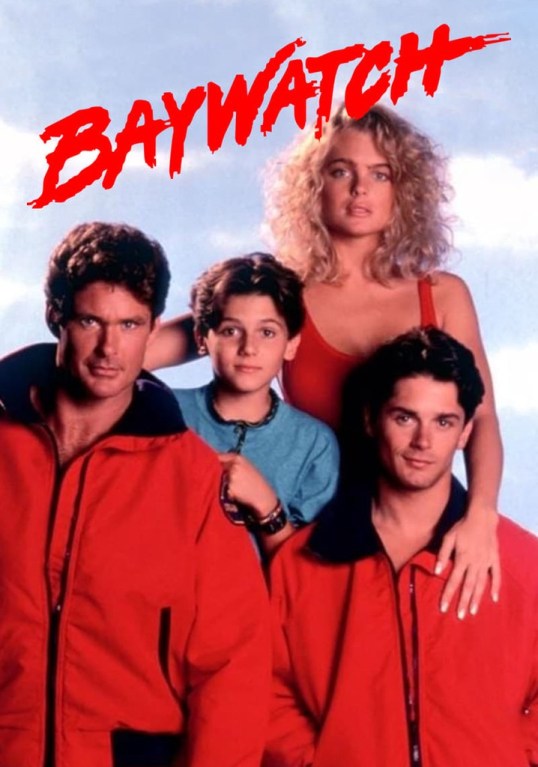
This week is pretty pointless.

Episosde 2.4 “Money, Honey”

(Dir by Monte Markham, originally aired on October 7th, 1991)

When Mitch and Eddie are hired to serve as lifeguards at a Hollywood party, film producer Dita (Leslie Easterbrook) is impressed when she sees Mitch respond to a boating accident.  She decides to make Mitch into a movie star.  Everyone knows that Mitch can swim and run in slow motion but can he deliver scripted lines?  Dita doesn’t care.  She just wants to sleep with him.  That goes against Mitch’s ethics so his film career ends before it even begins.  Meanwhile, Shauni puts together a benefit to protect a sea lion habitat.  At first, it looks like Shauni won’t be able to raise the money but then Mitch donates his movie paycheck to the cause.

This was a montage episode of Baywatch.  There really wasn’t much of a plot but there certainly were a lot of montages.  Watch as Mitch nervously sits in the makeup chair.  Watch as a bunch of bikini-clad beachgoers gather for Shauni’s benefit.  Listen to the music.  Watch the images.  Don’t worry about a thing….

In short, this was a pretty pointless episode.  That said, the sea lions were cute and the scene where Captain Thorpe tried to teach Mitch how to audition did make me smile.  It’s interesting that it took only four episodes for the syndicated version of Baywatch to fall into the pattern that would definite it for the next ten years.

Retro Television Review: Baywatch 2.3 “The One That Got Away”


Welcome to Retro Television Reviews, a feature where we review some of our favorite and least favorite shows of the past!  On Saturdays, I will be reviewing Baywatch, which ran on NBC and then in syndication from 1989 to 2001.  The entire show can be viewed on Tubi.

This week, you can do anything in a montage!

Episode 2.3 “The One That Got Away”

(Dir by Gus Trikonis, originally aired on September 30th, 1991)

After Megan (Vanessa Angel), a lifeguard who we’ve never seen before, is attacked by a maniac (Rick Dean), she has to conquer her fears of being attacked again so that she can lure him out of hiding so that he can be arrested.

Meanwhile, Shauni is burned out on being a lifeguard so she and Eddie spend a weekend just enjoying the beach and presumably ignoring anyone who might be drowning.

This is pretty much the epitome of a syndicated episode of Baywatch and it’s interesting to see that the formula was pretty much determined and locked in even this early into the show’s syndicated run.  There’s a serious storyline about a maniac attacking women on the beach but the cameraman spends as much time leering at Vanesa Angel as the man stalking her.  Shauni is tired of doing her job and instead of telling her to find a new job, it’s suggested that she just spend a weekend looking at the sunset with her boyfriend.

But the most important thing is that, regardless of the beach maniac and Shauni’s depression, there’s plenty of time for endless musical montages.  That’s what this episode is really all about.  Shauni gets a frustration montage.  She gets a happy montage.  Lifeguard Harvey gets an acting like a jackass montage.  Each montage takes up about five minutes of screentime so that probably definitely helped when it came to writing the script for this episode.

David Hasselhoff, oddly enough, is barely in this episode.  It’s only the second episode of the show’s syndicated run and the Hoff was already taking the week off?  I guess you can do that when you’re syndicated.

Retro Television Review: Baywatch 2.1 and 2.2 “Nightmare Cove”


Welcome to Retro Television Reviews, a feature where we review some of our favorite and least favorite shows of the past!  On Saturdays, I will be reviewing Baywatch, which ran on NBC and then in syndication from 1989 to 2001.  The entire show can be viewed on Tubi.

This week, we start season 2 of Baywatch.  Canceled by NBC, Baywatch found a new home in syndication.  The show was re-launched with a special two-hour premiere.  (For subsequent re-airings, the premiere was split into two episodes.)

Episode 2.1 and 2.2 “Nightmare Cove”

(Dir by Gregory J. Bonnan, originally aired on September 23rd, 1991)

A year and half after the final episode of Bayside’s network run, the show returns to the beach.

On the one hand, the basic idea is the same.  David Hasselhoff plays Mitch Buchanan, a divorced father who loves nothing more than being a lifeguard.  Eddie (Billy Warlock) and Shauni (Erika Eleniak) are two young lifeguards who are in love (though their engagement from the previous season is not mentioned).  Don Thorpe (Monte Markham) is Mitch’s no-nonsense boss. The sunsets are still beautiful.  The beaches are still inviting.

And yet, there are a few differences:

  1. Craig, Cort, Gina, Garner, and Trevor are nowhere to be seen.  (Craig, Cort, and Garner will all eventually return.  Gina and Trevor will never be mentioned again.)
  2. Hobie, Mitch’s son, is now played by Jeremy Jackson.
  3. Richard Jaeckel, who played doomed life guard Al Edwards in the pilot film, is now playing Ben Edwards, who apparently is meant to be the same character as Al.  (Mitch specifically mentions that Ben broke his leg when the pier collapsed, retconning Al’s heroic death into a mere injury.)
  4. Cort may be gone but there’s a new money-hungry lifeguard named Harvey (Tim McTigue).
  5. The second season premiere features even more musical montages than appeared in the first season.
  6. The second season premiere features a lot of random shots of women in skimpy bikinis.
  7. The red Baywatch one-piece swimsuits are back but now, they’re considerably tighter and more high-cut.
  8. The new Baywatch was airing in syndication.

I get the feeling that the Baywatch cameraman probably got together and all chanted, “Syndication, baby!” before running out onto the beach.  Even though the second season premiere is still far from what Baywatch would eventually become, one can already see the development of the aesthetic that led to it becoming the number one show for 90s frat boys and dads suffering from a midlife crisis.

As for this episode, there are rumors of an underwater monster and everyone wants in on the action.  Mitch saves an underwater photographer and falls in love for an episode.  Hasslehoff’s then-wife, Pamela Bach, plays a reporter whose editor wants sensationalized stories about the “beast of the bay.”  Of course, the beast of the bay is actually just the creation of an offshore oil company who wants to drill and ruin the environment because why not?  Luckily, one of the lifeguard, Devon (Andrea Thompson), is also an environmental activist.  Of course, Andrea Thompson is not listed in the opening credits so I imagine we’ll never see Devon again.

While Mitch is investigating the monster, Shauni rescues a little girl from drowning and then gets involved in the family’s life.  The family is black and the little girl’s brother is being recruited by a street gang so the very white Shauni arranges from him to join the junior lifeguards instead.  Shauni’s critical father (Albert Stratton) is impressed but I have to admit that I found the storyline to be a bit condescending.  Like a lot of 90s shows, Baywatch was at its weakest when it tried to deal with real-life issues.  It’s hard not to notice that whenever a guest actor who wasn’t white showed up on episode of Baywatch, they were always either being tempted or pressured to join a gang or they were trying to get out of the gang lifestyle.

In this episode, there’s an odd moment when Hobie decides to go into a storm drain and pretend to be the monster, which leads to a panic on the beach and monster hunters showing up with guns.  Mitch shows up and ends the situation before it gets too out-of-hand but you really do have to wonder if maybe Hobie would be better off with his mother.  I mean, seriously, Mitch — what are you doing here?  Your son is apparently an idiot who never learned anything from the dozen or so times his life was put in danger during the first season.

Finally, Thorpe gets promoted and he wants Mitch to take his place as chief.  Mitch argues that the new chief should be Ben Edwards.  Since apparently Ben has the power to come back from the dead, I can see Mitch’s logic.  In the end, Thorpe agrees.

And that’s it for this episode.  It’s definitely Baywatch but it’s still not quite as fun as the show would eventually become once it fully embraced just how ludicrous things could get in syndication.  This episode — and I imagine the rest of this season — feels like a show that is still making the transition from network television to anything-goes syndication.  Eventually, the show will get David Charvet, Pamela Anderson, and David “The Bulge” Chokachi.  During season 2, it was still just Billy Warlock and Erika Eleniak.

Back to School #78: Boyhood (dir by Richard Linklater)


boyhood0612

I hate to admit it but it actually took me a day or two to really warm up to Boyhood.  

When I first saw it, I knew that I was watching a great film and it was a movie that I had a good deal of respect for.  By now, we’ve all heard the story of how the film was made and how director Richard Linklater first started the film in 2002 when star Ellar Coltrane was only 6 years old.  Over the next 12 years, Linklater would spend a few weeks out of each year filming.  The script was written on a year-by-year basis, allowing the story to develop organically and often taking into account whatever was happening in Coltrane’s life at the time.  The end result is that Coltrane grows up on screen in much the same way that Mason, the character he’s playing, does.  As I watched Boyhood, I knew that Linklater had somehow managed to turn what could have been a mess into an undeniably effective movie.

But yet, in the hours immediately following the showing, I had a nagging feeling.  I realized that, as much I respected the film and as much as I wanted to love the film, there was a part of me that was slightly disappointed.  In some ways, it made sense.  Richard Linklater is a director whom I absolutely revere and, as a result, I am always going to watch his movies with extremely high (and occasionally unrealistic) expectations.  As for the film itself, Boyhood is the most acclaimed film of the year so far.  For the longest time, it had a perfect 100% rating over at Rotten Tomatoes.

And, when you’re continually told that a film is the greatest movie ever made, it’s going to be a challenge to then judge the film on its actual merits.

And so, I was content to think of Boyhood as being one of those undeniably important films that I respected more than I enjoyed.

But then something happened.

Boyhood stuck with me.  Boyhood is a film that has stuck with me more than almost any other film this year.  (Interestingly enough, perhaps the only 2014 film that I’ve seen so far that has stuck with me more was Guardians of Galaxy, which in many ways is the exact opposite of Boyhood.)  There are scenes in Boyhood that are still as fresh in my mind as they were when I first saw them.  Interestingly enough, they’re not big, dramatic scenes.  (Indeed, Boyhood is memorable for just how determined it is to avoid the big, dramatic scenes that usually appear in coming-of-age films.)  Instead, what stuck with me were the little details.

I remembered how, when Mason was 6 and his family was moving down to Houston, his best friend rode by on a bicycle and waved goodbye, never to be seen again in the film but definitely destined to be remembered by both Mason and the audience.

I remembered how, from the minute that Mason’s mom (Patricia Arquette), met and married the seemingly friendly Bill (Marco Perella), I knew that the marriage wasn’t going to work.  I remembered the scenes of Mason and his sister (Lorelei Linklater) trying not upset Bill and failing every time.  Years later, when Arquette marries yet again, I knew that it wasn’t going to work out any better.  By that point, Mason knew it too but what can you do when you’re only 16?

I remembered how Mason, after having been moved to San Marcos, had an awkward conversation with a girl from his school.  The girl obviously liked Mason and Mason obviously liked the girl but neither one had a clue how to say it.

I remembered feeling stunned when, over the course of just one scene break, Mason went from being an innocent-looking 14 year-old to a skinny and angrily sullen 15 year-old.  It’s hard for me not to feel that, in that regard, Boyhood serves as a warning of what’s probably in store for me once I actually have kids.

I also remember being surprised when Mason’s Dad (Ethan Hawke) went from being the guy who ranted about George W. Bush in 2004 to a 2011 newlywed who asks his children to come to church with him.  But then again, in retrospect, was it that much of a shock or, like Mason, did I unfairly expect his Dad to remain a rebel for the rest of his life?

(One of the most interesting things about the film is that, since it was literally filmed while the story was occurring, Boyhood serves as a time capsule of life and culture throughout the beginning on this century.  While the scenes set in 2004 and 2008 are dominated by Mason’s father enthusiastically talking about politics, he never mentions anything about the presidential election in 2012.  And it actually makes sense because was anyone enthusiastic about 2012?)

That’s the thing that sets Boyhood apart from other coming-of-age films.  Many of the events that would be major scenes in other teen films — like losing one’s virginity or learning to drive — happen off-screen in Boyhood.  Instead, Boyhood is just about watching life unfold.  Many questions are not answered.  Characters come and go, playing their part in Mason’s life and then disappearing as Mason moves on.

Some of them, like Mason’s stepbrother and step sister who are both left behind when his mother leaves Bill, we wonder about, just as surely as Mason wonders about them too.  But life is rarely neat enough to provide all the answers and Boyhood, if nothing else, is about life.

And that, ultimately, it why Boyhood sticks with you.  Looking back on the film, you can see how Mason the 6 year-old who had to be forced to leave behind his best friend eventually grew up to be Mason the 18 year-old who is almost insensitive in his eagerness to leave behind his mother and drive himself to college.  But, and this is the key, you have to be willing to look back on the film to truly understand at.  Trying to figure out how the pieces of puzzle fit together while watching the film will only leave you frustrated, as life often does while you’re living it.  It’s only after the film that you can truly understand what it all means.  It’s only when you look back that you realize just how much Richard Linklater has accomplished with Boyhood.

As such, Boyhood is not an easy film.

But it is a great one.

22boyhood_ss-slide-7UMX-jumbo