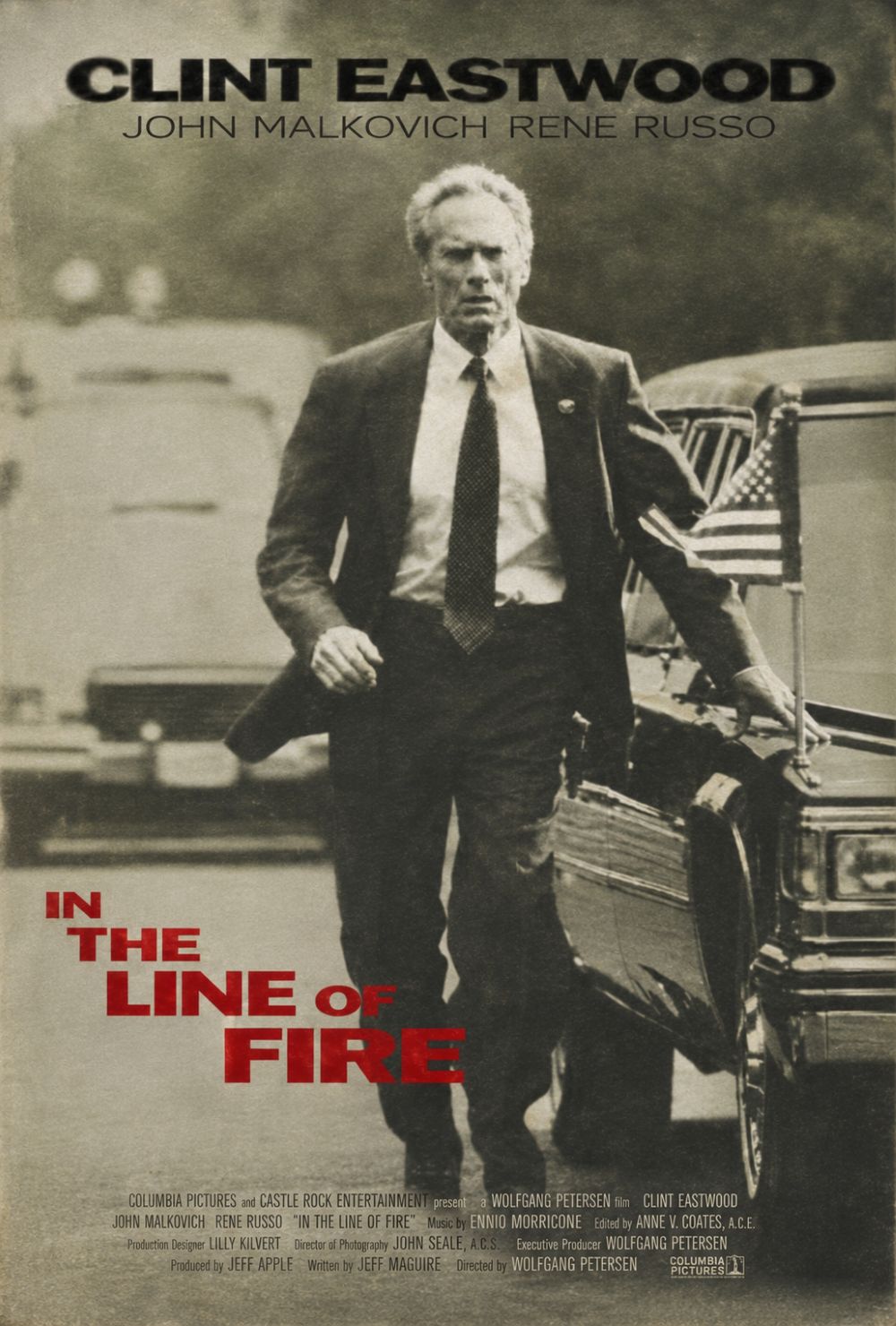
Film Review: In the Line of Fire (dir. by Wolfgang Petersen)


“Are you willing to trade your life for his, or is life too precious?” — Mitch Leary

In the Line of Fire is the kind of thriller that makes doing the basics well look like a lost art. Wolfgang Petersen’s 1993 film has a troubled hero, a frightening villain, a clear threat, and enough confidence to let conversations generate as much suspense as the action. There’s nothing especially revolutionary about its setup, but that’s part of the pleasure. This is polished Hollywood entertainment that knows exactly what it wants to deliver. Its greatest strength is tension, particularly when Clint Eastwood and John Malkovich are simply talking, each trying to find the weakness the other would rather keep hidden.

Eastwood plays Frank Horrigan, a veteran Secret Service agent still carrying the emotional weight of John F. Kennedy’s assassination. He was there in Dallas, and decades later, he hasn’t stopped wondering whether he could have done something differently. When a potential assassin threatens the current president, Frank sees more than another assignment. He sees a chance to confront the moment that has defined his life. Screenwriter Jeff Maguire gives the familiar redemption story a useful psychological hook: Frank isn’t just afraid of failing again. He’s afraid that his worst suspicions about himself might finally be confirmed.

What makes Eastwood so effective is that he doesn’t treat Frank’s age as an inconvenience the movie needs to ignore. It’s part of the character’s personality, his professional situation, and the way other people respond to him. He has the stubborn confidence of someone who has survived plenty, but also the bruised pride of someone who knows he can’t keep going forever. Eastwood gets plenty of mileage out of dry humor and that familiar, unimpressed stare, yet the performance becomes more interesting when those defenses slip. Frank’s guilt gives the tough-guy routine a vulnerability that keeps him from feeling like a recycled action hero.

Then there’s Malkovich, who turns the would-be presidential assassin into the movie’s most unsettling presence. His character, Mitch Leary, also calls himself Booth, and he takes an intensely personal interest in Frank. A former CIA assassin, he understands violence, preparation, and the usefulness of getting inside somebody’s head. Malkovich doesn’t need to shout to dominate a scene. His calm delivery is often more disturbing than a conventional villain’s threats would be. He sounds amused, curious, even companionable, which makes the cruelty underneath that voice feel worse. You never mistake his intelligence for wisdom, but you immediately understand why Frank can’t dismiss him.

Their phone conversations are the film’s real engine. Leary doesn’t merely announce what he plans to do; he turns Frank’s history into a weapon, pushing him to revisit questions he has spent years trying to bury. There’s a nasty intimacy to these exchanges. The two men occupy opposite sides of the same professional world, both shaped by institutions that demand loyalty and offer little comfort afterward. Petersen keeps that connection disturbing without pretending they’re morally interchangeable. Frank’s pain has made him difficult and withdrawn; Leary uses his grievances to justify murder. Their similarities sharpen the conflict rather than excuse the villain.

Petersen’s direction is wonderfully assured because he understands that suspense needs more than constant movement. He gives the audience time to anticipate danger, then makes the practical business of protecting a president feel like a series of potential disasters. Crowds, public appearances, and the sheer difficulty of identifying one determined attacker become more threatening than any elaborate action gimmick. When the film does pick up speed, the excitement has a psychological dimension: Frank’s physical vulnerability and his obsession with stopping Leary matter as much as the immediate chase. The action advances the relationship instead of temporarily replacing it.

Rene Russo brings a welcome change of rhythm as fellow agent Lilly Raines. Her scenes with Eastwood introduce flirtation, skepticism, and a little room to breathe between threats. The romance is also one of the film’s more conventional elements: Frank gets the younger colleague who can challenge him while recognizing the wounded man beneath the attitude. Still, Russo has enough presence to make their exchanges enjoyable rather than merely functional. She doesn’t act as though Frank’s reputation automatically makes him irresistible, and that resistance helps. Their teasing rapport also gives Eastwood a chance to be funny without turning Frank into a walking punchline.

The film isn’t flawless. Leary’s ability to stay ahead of everyone occasionally feels a little too convenient, and the redemption framework leaves relatively little doubt about the emotional destination. Some supporting characters exist mainly to question Frank’s judgment or complicate his assignment. But those familiar ingredients rarely become distracting because the central conflict remains so engaging. Maguire’s screenplay builds its suspense around character rather than relying entirely on surprise. Knowing roughly what kind of showdown is coming doesn’t ruin the experience; the pleasure lies in watching the pressure accumulate and wondering how much Frank will sacrifice to reach it.

In Petersen’s career, In the Line of Fire marked the beginning of a remarkable run of Hollywood hits. Its success led into Outbreak, Air Force One, The Perfect Storm, and Troy, a streak that established him as a dependable director of large-scale commercial entertainment. That momentum finally broke with his 2006 remake Poseidon, which disappointed at the box office. A decade-long absence from directing followed before he returned with the German crime comedy Four Against the Bank in 2016. Seen within that run, this earlier thriller stands out for how much excitement Petersen creates through actors and carefully managed anticipation.

What sticks with you about In the Line of Fire isn’t just whether Frank can stop an assassination, but how easily Leary can get under his skin with a phone call. That personal edge gives the movie its bite, even when the plot follows familiar thriller territory. Eastwood lets the cracks show without losing his screen presence, while Malkovich makes a quiet voice sound like the worst possible news. Petersen knows when to let them spar and when to turn up the heat. The result is a crowd-pleaser with enough personality to outlast its twists—and a villain who makes answering the phone seem like a terrible idea.

Late Night Retro Television Review: Saved By The Bell 1.13 “The Babysitters”


Welcome to Late Night Retro Television Reviews, a feature where we review some of our favorite and least favorite shows of the past!  On Saturdays, I will be reviewing Saved By The Bell, which ran on NBC from 1989 to 1993.  The entire show is currently streaming on Prime and Tubi!

This week, Kelly is irresponsible.

Episode 1.13 “The Babysitters”

(Dir by Don Barnhart, originally aired on December 1st, 1990)

This episode stresses me out.

Kelly’s parents go off on a ski vacation and leave Kelly with the responsibility of taking care of her infant brother.  (Really?)  When they get stranded at the lodge, Kelly has to bring the baby to school.  She asks her idiot friends to help look after him.

Of course, Zack loses the baby.  Fortunately, Mr. Belding finds him but still…

Seriously, I hate this episode.  I hate that Kelly’s parents are irresponsible enough to abandon their baby so that they can go skiing.  I hate that Kelly has to find someone to take care of the baby while she goes to cheerleader practice.  I hate that Zack is dumb enough to lose the baby.  I hate that no one ever says, “Wow, this whole situation is really messed up.”  This is the one episode that I always turned off whenever I came across it on TV.

This episode, I just can’t take it.


Guilty Horror Pleasure #87: The ‘Burbs (dir by Joe Dante)


1989’s The ‘Burbs takes place in …. well, it’s right there in the title.

Welcome to the suburbs!  It’s place with big houses, green lawns, and neighbors who often don’t have much to do other than watch each other and gossip.  Ray Peterson (Tom Hanks) lives with his wife, Carol (Carrie Fisher), and is friends with Art Weingartner (Rick Ducommun) and Mark Rumsfield (Bruce Dern).  Ricky Butler (Corey Feldman) is the local teenager.  It’s a nice neighborhood …. at least, until the Klopeks move in.

The Klopeks are viewed with suspicion from the minute they show up.  They’re from a different country, they always seem to be burying something in their backyard, and Dr. Werner Klopek (Henry Gibson) is oddly stand-offish.  When Walter Seznick (Gale Gordon) disappears and the the Klopeks are seen around Walter’s house and with Walter’s dog, Ray and his friends start to suspect that their new neighbors might be ritualistic murderers!

Oh, how I love The ‘Burbs.  The film’s portrait of the suburbs as being a hotbed of paranoia may be a familiar one but it doesn’t matter when you’ve got actors like Tom Hanks and Bruce Dern throwing themselves into their roles.  As always, Hanks is the glue that holds the film and its disparate parts together, giving a likable performance as a man who goes from being the voice of reason to being convinced that his neighbors are cannibals.  Bruce Dern gleefully sends up his own image as a paranoid Vietnam vet but there’s also a sweetness to Dern’s performance that really makes it stand out.  Dern’s character might be a little crazy but he does truly care about his neighbors.

Just as he did with Piranha and The Howling, Dante balances humor with suspense.  He does such a good job of telling the story and getting good performances from his cast, that even the film’s big twist works far better than one might expect.  It’s an 80s film so, of course, a few things explode towards the end of it.  The film’s character-based humor is replaced with some broader jokes but no matter.  The Burbs is an entertaining trip to the heart of suburban paranoia.

As the saying goes, just because you’re paranoid, that doesn’t mean that they aren’t out to get you.

Previous Guilty Pleasures

  1. Half-Baked
  2. Save The Last Dance
  3. Every Rose Has Its Thorns
  4. The Jeremy Kyle Show
  5. Invasion USA
  6. The Golden Child
  7. Final Destination 2
  8. Paparazzi
  9. The Principal
  10. The Substitute
  11. Terror In The Family
  12. Pandorum
  13. Lambada
  14. Fear
  15. Cocktail
  16. Keep Off The Grass
  17. Girls, Girls, Girls
  18. Class
  19. Tart
  20. King Kong vs. Godzilla
  21. Hawk the Slayer
  22. Battle Beyond the Stars
  23. Meridian
  24. Walk of Shame
  25. From Justin To Kelly
  26. Project Greenlight
  27. Sex Decoy: Love Stings
  28. Swimfan
  29. On the Line
  30. Wolfen
  31. Hail Caesar!
  32. It’s So Cold In The D
  33. In the Mix
  34. Healed By Grace
  35. Valley of the Dolls
  36. The Legend of Billie Jean
  37. Death Wish
  38. Shipping Wars
  39. Ghost Whisperer
  40. Parking Wars
  41. The Dead Are After Me
  42. Harper’s Island
  43. The Resurrection of Gavin Stone
  44. Paranormal State
  45. Utopia
  46. Bar Rescue
  47. The Powers of Matthew Star
  48. Spiker
  49. Heavenly Bodies
  50. Maid in Manhattan
  51. Rage and Honor
  52. Saved By The Bell 3. 21 “No Hope With Dope”
  53. Happy Gilmore
  54. Solarbabies
  55. The Dawn of Correction
  56. Once You Understand
  57. The Voyeurs 
  58. Robot Jox
  59. Teen Wolf
  60. The Running Man
  61. Double Dragon
  62. Backtrack
  63. Julie and Jack
  64. Karate Warrior
  65. Invaders From Mars
  66. Cloverfield
  67. Aerobicide 
  68. Blood Harvest
  69. Shocking Dark
  70. Face The Truth
  71. Submerged
  72. The Canyons
  73. Days of Thunder
  74. Van Helsing
  75. The Night Comes for Us
  76. Code of Silence
  77. Captain Ron
  78. Armageddon
  79. Kate’s Secret
  80. Point Break
  81. The Replacements
  82. The Shadow
  83. Meteor
  84. Last Action Hero
  85. Attack of the Killer Tomatoes
  86. The Horror At 37,000 Feet

Film Review: In The Line of Fire (dir by Wolfgang Petersen)


Earlier today, it was announced that director Wolfgang Petersen had passed away.  He was 81 years old and had been suffering from pancreatic cancer.  Though Petersen started his career making films in his native Germany (and his 1981 film, Das Boot, remains the most Oscar-nominated German film of all time), Petersen eventually relocated to Los Angeles and established himself as a very successful director of thrillers and star-filled action films.

Last month, I watched one of Petersen’s films.  First released in 1993, In The Line of Fire stars Clint Eastwood as Frank Horrigan.  Frank is a veteran member of the Secret Service, still serving at a time when almost all of his colleagues have either retired or died.  When we first meet Frank, he and his new partner, Al (Dylan McDermott), are arresting a gang of counterfeiters and Frank (and the then 63 year-old Eastwood) is proving that he can still take down the bad guys.

But is Frank still up to protecting the President?  Of the agents that were with President Kennedy when he was assassinated in 1963, Frank Horrigan is the last one standing.  He’s the only active secret service agent to have lost a president and he’s haunted by what he sees as being his failure to do his job and the feeling that America has never recovered from Kennedy’s death.  Also obsessed with Frank’s history is a mysterious man who calls himself Booth.  Booth (played by John Malkovich, who received an Oscar nomination for his performance) starts to call Frank.  He informs Frank that he’s planning on assassinating the president, who is currently traveling the country as a part of his reelection bid.  Booth views Frank as being a worthy adversary and Frank, looking for redemption, requests to be returned to the Presidential Protective Division.

While Frank struggles to keep up with both the President and the younger agents, Booth slowly and methodically puts his plan in motion.  He builds his own wooden gun and tries it out on two hunters who are unfortunate enough to stumble across him.  Making a heart-breaking impression in a small role, Patrika Darbo plays the bank teller who, unfortunately, comes a bit too close to uncovering Booth’s secret identity.  Booth is friendly and sometimes apologetic and he quickly shows that he’s willing to kill anyone.  It’s a testament to both the skill of Malkovich’s performance and Petersen’s direction that the audience comes to believe that there’s a better than average chance that Booth will succeed.  He just seems to have such a strong belief in himself that the audience knows that he’s either going to kill the President or that he’s going to willingly die trying.

Meanwhile, no one believes in Frank.  The White House Chief of Staff (Fred Dalton Thompson, later to serve in the Senate and run for President himself) views Frank as being a nuisance.  The head of the detail (Gary Cole) thinks that Frank should be put out to pasture.  Only Lilly Raines (Rene Russo), another agent, seems to have much faith in Frank.  While Frank is hunting Booth, he falls in love with Lilly and she with him.  (Fortunately, even at the age of 63, Eastwood still had enough of his old Dirty Harry charisma that the film’s love story is credible, despite the age difference between him and Russo.)  The hunt for Booth reawakens something in Frank.  Just as Booth has a psychological need to be pursued and challenged, Frank needs an enemy to which he can re-direct all of his guilt and self-loathing.  Frank becomes a stand-in for everyone who fears that, because of one particular incident or tragedy, America will never regain the strength and promise that it once had.  (In Frank’s case, that strength is symbolized by his idealized memories of JFK.)  Defeating Booth is about more than just saving America.  It’s about redeeming history.

It all makes for an very exciting thriller, one in which Eastwood’s taciturn style of acting is perfectly matched with Malkovich’s more cerebral approach.  Just as the two characters are challenging each other, Eastwood and Malkovich also seem to challenge each other as actors and it leads to both men giving wonderful performances.  Wolfgang Petersen not only does a good job with the action scenes but also with generating some very real suspense.  The scene in which Malkovich attempts to assemble his gun under a table is a masterclass in directing and evidence that Petersen had not only watched Hitchcock’s films but learned from them as well.

As directed by Petersen and performed by Malkovich and Eastwood, In The Line of Fire emerges as a film that was more than just an exciting thriller.  It was also a mediation on aging, guilt, love, redemption, and the national traumas of the past.  It’s a film that stands up to multiple rewatches and as a testament to the talent of the man who directed it.

Cleaning Out The DVR: Cradle Swapping (dir by Michael Feifer)


(Hi there!  So, as you may know because I’ve been talking about it on this site all year, I have got way too much stuff on my DVR.  Seriously, I currently have 186 things recorded!  I’ve decided that, on January 15th, I am going to erase everything on the DVR, regardless of whether I’ve watched it or not.  So, that means that I’ve now have only have a month to clean out the DVR!  Will I make it?  Keep checking this site to find out!  I recorded Cradle Swapping off of Lifetime on May 7th, 2017!)

This year, there was a surprisingly large number of Lifetime films about babies either getting kidnapped or switched at birth.  If Lifetime films tend to use to melodrama to bring to life the fears of its audiences, 2017 was a year when everyone was scared about who or what their baby would grow up to be.

In Cradle Swapping, Grandma (played by Patrika Darbo) takes one look at the baby that her daughter has brought home from the hospital and announces that it doesn’t look anything like her supposed parents.  Needless to say, neither Alicia (Amanda Clayton) or Ray (Brandon Barash) are happy to hear this.  They argue that all babies look the same.

No, Grandma says, all of her babies looked exactly like her.

Of course, that’s not the only time that Grandma points this out.  Later, after Alicia and Ray have just returned from the hospital with their baby, Grandma takes another look at it and announces that the baby still looks nothing like her mother or father.  This time, Alicia gets even more upset about it.  “Way to go,” everyone tells Grandma.

Grandma actually has a pretty good point but it’s understandable why Alicia doesn’t want to hear it.  Alicia already has a lot to deal with.  Baby Hannah refuses to look her in the eye.  Baby Hannah refuses to breastfeed.  Baby Hannah is always crying.  When Alicia and Ray take Hannah to the hospital, a doctor demands to know if Alicia has ever used drugs.  “Just in college,” Alicia replies, “experimenting.”

It turns out that Hannah is going through opioid withdrawal!

At first, Ray blames Alicia for taking prescription medication.  Alicia blames Ray for not being supportive.  Maybe they should be redirecting their blame at hospital…

See, it turns out that Hannah is not their baby.  Instead, their baby was taken by the incredibly sleazy Tony (Tyler Johnson), who left another baby in her place.  Getting little help from the hospital or the authorities, Alicia and Ray take matters into their own hands, setting out to track down Tony and find their baby.  However, what they don’t know is that Tony is involved in a much bigger conspiracy than they even suspect….

I have to admit that I liked Cradle Swapping more than I thought I would.  Amanda Clayton and Brandon Barash were sympathetic as the parents and they were easy to relate to.  I appreciated the fact that they started the movie in over their heads and they were still in over their heads when the movie ended.  They never turned into action heroes or superhuman investigators.  Instead, they were just two ordinary parents trying to find their baby.  You want them to succeed and the end result is an above average Lifetime film.