“Are you willing to trade your life for his, or is life too precious?” — Mitch Leary
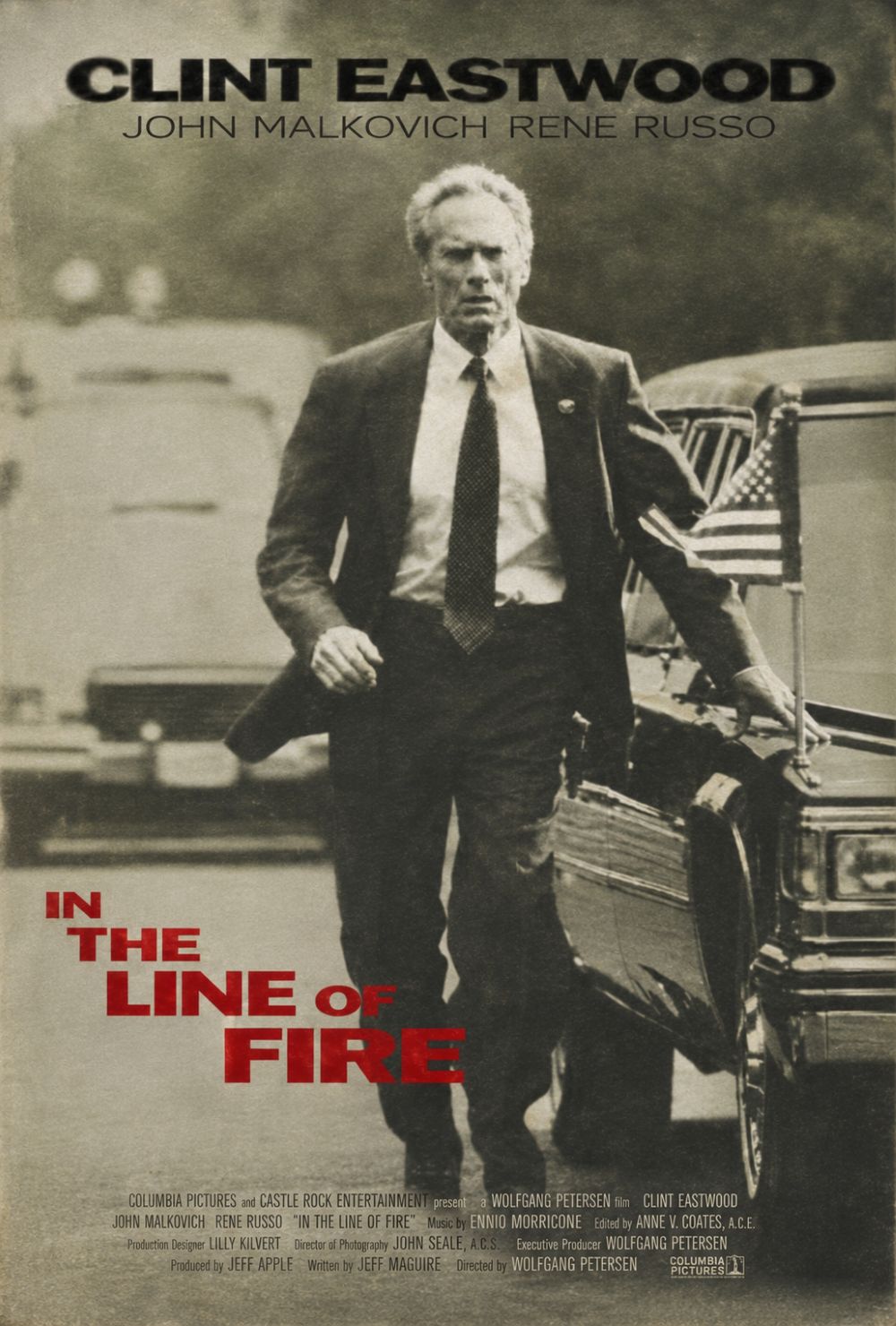
In the Line of Fire is the kind of thriller that makes doing the basics well look like a lost art. Wolfgang Petersen’s 1993 film has a troubled hero, a frightening villain, a clear threat, and enough confidence to let conversations generate as much suspense as the action. There’s nothing especially revolutionary about its setup, but that’s part of the pleasure. This is polished Hollywood entertainment that knows exactly what it wants to deliver. Its greatest strength is tension, particularly when Clint Eastwood and John Malkovich are simply talking, each trying to find the weakness the other would rather keep hidden.
Eastwood plays Frank Horrigan, a veteran Secret Service agent still carrying the emotional weight of John F. Kennedy’s assassination. He was there in Dallas, and decades later, he hasn’t stopped wondering whether he could have done something differently. When a potential assassin threatens the current president, Frank sees more than another assignment. He sees a chance to confront the moment that has defined his life. Screenwriter Jeff Maguire gives the familiar redemption story a useful psychological hook: Frank isn’t just afraid of failing again. He’s afraid that his worst suspicions about himself might finally be confirmed.
What makes Eastwood so effective is that he doesn’t treat Frank’s age as an inconvenience the movie needs to ignore. It’s part of the character’s personality, his professional situation, and the way other people respond to him. He has the stubborn confidence of someone who has survived plenty, but also the bruised pride of someone who knows he can’t keep going forever. Eastwood gets plenty of mileage out of dry humor and that familiar, unimpressed stare, yet the performance becomes more interesting when those defenses slip. Frank’s guilt gives the tough-guy routine a vulnerability that keeps him from feeling like a recycled action hero.
Then there’s Malkovich, who turns the would-be presidential assassin into the movie’s most unsettling presence. His character, Mitch Leary, also calls himself Booth, and he takes an intensely personal interest in Frank. A former CIA assassin, he understands violence, preparation, and the usefulness of getting inside somebody’s head. Malkovich doesn’t need to shout to dominate a scene. His calm delivery is often more disturbing than a conventional villain’s threats would be. He sounds amused, curious, even companionable, which makes the cruelty underneath that voice feel worse. You never mistake his intelligence for wisdom, but you immediately understand why Frank can’t dismiss him.
Their phone conversations are the film’s real engine. Leary doesn’t merely announce what he plans to do; he turns Frank’s history into a weapon, pushing him to revisit questions he has spent years trying to bury. There’s a nasty intimacy to these exchanges. The two men occupy opposite sides of the same professional world, both shaped by institutions that demand loyalty and offer little comfort afterward. Petersen keeps that connection disturbing without pretending they’re morally interchangeable. Frank’s pain has made him difficult and withdrawn; Leary uses his grievances to justify murder. Their similarities sharpen the conflict rather than excuse the villain.
Petersen’s direction is wonderfully assured because he understands that suspense needs more than constant movement. He gives the audience time to anticipate danger, then makes the practical business of protecting a president feel like a series of potential disasters. Crowds, public appearances, and the sheer difficulty of identifying one determined attacker become more threatening than any elaborate action gimmick. When the film does pick up speed, the excitement has a psychological dimension: Frank’s physical vulnerability and his obsession with stopping Leary matter as much as the immediate chase. The action advances the relationship instead of temporarily replacing it.
Rene Russo brings a welcome change of rhythm as fellow agent Lilly Raines. Her scenes with Eastwood introduce flirtation, skepticism, and a little room to breathe between threats. The romance is also one of the film’s more conventional elements: Frank gets the younger colleague who can challenge him while recognizing the wounded man beneath the attitude. Still, Russo has enough presence to make their exchanges enjoyable rather than merely functional. She doesn’t act as though Frank’s reputation automatically makes him irresistible, and that resistance helps. Their teasing rapport also gives Eastwood a chance to be funny without turning Frank into a walking punchline.
The film isn’t flawless. Leary’s ability to stay ahead of everyone occasionally feels a little too convenient, and the redemption framework leaves relatively little doubt about the emotional destination. Some supporting characters exist mainly to question Frank’s judgment or complicate his assignment. But those familiar ingredients rarely become distracting because the central conflict remains so engaging. Maguire’s screenplay builds its suspense around character rather than relying entirely on surprise. Knowing roughly what kind of showdown is coming doesn’t ruin the experience; the pleasure lies in watching the pressure accumulate and wondering how much Frank will sacrifice to reach it.
In Petersen’s career, In the Line of Fire marked the beginning of a remarkable run of Hollywood hits. Its success led into Outbreak, Air Force One, The Perfect Storm, and Troy, a streak that established him as a dependable director of large-scale commercial entertainment. That momentum finally broke with his 2006 remake Poseidon, which disappointed at the box office. A decade-long absence from directing followed before he returned with the German crime comedy Four Against the Bank in 2016. Seen within that run, this earlier thriller stands out for how much excitement Petersen creates through actors and carefully managed anticipation.
What sticks with you about In the Line of Fire isn’t just whether Frank can stop an assassination, but how easily Leary can get under his skin with a phone call. That personal edge gives the movie its bite, even when the plot follows familiar thriller territory. Eastwood lets the cracks show without losing his screen presence, while Malkovich makes a quiet voice sound like the worst possible news. Petersen knows when to let them spar and when to turn up the heat. The result is a crowd-pleaser with enough personality to outlast its twists—and a villain who makes answering the phone seem like a terrible idea.

