The count (John Carradine) has been traveling across the frontier, feasting on settlers and stagecoach riders. When he comes to a town in the middle of nowhere, he poses as the uncle of saloon owner Betty Bentley (Melinda Plowman). Using the name Mr. Underhill, Dracula hopes to make Betty into his latest bride. Everything about Mr. Underhill indicates that he is a vampire but Betty refuses to believe it. Even when she’s told that Mr. Underhill doesn’t cast a reflection, Betty dismisses it as just being “the old vampire test.” Two German servants recognize her uncle as being a vampire and Betty again refuses to believe them. Betty’s fiancé, Billy the Kid (Chuck Courtney), realizes that there is something wrong with Mr. Underhill but can he save his future wife?
The idea of vampires in the old west is one that has inspired a surprising number of movies, most of which are considerably better than Billy The Kid Versus Dracula. In this movie, Chuck Courtney plays one of the old west’s most notorious outlaws but he’s portrayed as being one of the most upstanding members of his community. John Carradine plays the world’s most notorious vampire but just comes across as being a grouchy old man. Chuck Courtney is a convincing westerner but not a very interesting actor. John Carradine sleepwalks through the role and later said Billy The Kid Versus Dracula was the only one of his many films that he actively disliked. The movie was shot in 8 days and it looks like it.
This was also the final film of director William Beaudine, who had directed his first film 51 years earlier. The film was released on a double feature with Beaudine’s Jesse James Meets Frankenstein’s Daughter. Everyone ended up in the old west eventually.
The 2022 film, Night of the Zodiac, takes place in Detroit.
In its heyday, Detroit represented the industrial boom of America in the 20th Century. It was a city where cars were made and music was recorded and the future seemed bright. Today, of course, Detroit is viewed as being the ultimate symbol for just how much life has declined in the cities of America. It’s a city that is often used to epitomize the death of the American dream. It’s a city with a permanent atmosphere of decay and decline and, as a result, it’s a city that is practically begging for horror filmmakers to make use of it.
Richard Gantz (played by Philip Digby) is one such filmmaker. He lives in a small, one-room apartment. The walls are covered in posters for horror and action movies from the 1980s. Though he answers his landline phone with an authoritative, “Gantz Video,” Richard hasn’t had much luck as a filmmaker. He’s behind on his rent. He’s behind on his credit card payments. Even the local video store keeps ringing him up and demanding to know when he’s going to return his overdue tapes. Richard dreams of making his own movie but he can find neither the inspiration nor the money.
Then he gets a phone call, from an older gentleman who claims to be the infamous (and never officially identified) Zodiac Killer. The man who claims to be Zodiac offers Richard money if he’ll just just go to a park and accept a package from a homeless man. Richard does so and he discovers that Zodiac has sent him his very own cipher. He’s also sent Richard some cash. Solving each cipher leads to Richard finding his inspiration as a filmmaker. Soon, Richard is filming himself as he brutally murders random people across Detroit. He starts out by imitating the Zodiac’s crimes but soon, he starts to add his own spin to things. “I’m a psychopath!” Richard shouts at one point, apparently happy to finally have some sort of direction in his life.
Just as Richard speaks of his admiration for straight-to-video directors like Todd Farmer and shoots his film on an ancient video camera, Night of the Zodiac duplicates the grainy look of an old VHS tapes. The image is full of deliberate scratches and moments where the scene skips or goes out of focus. It’s actually rather artfully done, making the film feel like something that the viewer really might have found in the clearance section of their favorite used book store. It’s a cheap film that looks even cheaper but the filmmakers have enough self-awareness to turn that into an asset. Even the film’s meandering plot, amateurish acting, and moments of illogic feel more like an appropriate homage than a flaw. This was a film that was made by people who obviously love amateur horror films and that love shines through. Obviously, it’s not a film for everyone. Personally, I thought it went on for a bit too long and the film’s action often felt a bit repetitive. That said, it’s hard not to respect the filmmaker’s dedication to recreating the shot-on-videotape aesthetic of the later 80s and early 90s. As scummy a character as Richard was, I imagine many amateur directors will probably be able to relate to the scene where he looks over his footage and suddenly realizes that, for all of his work and effort, the film that he’s shooting doesn’t really have a point.
Of course, the most interesting thing about this film is that it imagine what happened to the Zodiac Killer after he left Los Angeles. A good deal of the reason why the Zodiac continues to intrigue people is the fact that he was never caught. I imagine that he’s probably dead by now. (In 1969, it was believed that he was already in his 30s or 40s.) But you have to wonder how someone can go from being the Zodiac Killer to being just some guy living in a house, mowing the lawn, and going to the grocery store every few days. How does one live an everyday life with the knowledge of being responsible for those crimes?
In the end, Night of the Zodiac is a film that has enough self-awareness to overcome its flaws.
First noted by the author Stendhal, Stendhal Syndrome is something that happens when one is confronted by a sight that they never expected to see in person. Usually, it’s a work of great art that triggers the condition and the viewer becomes so overwhelmed by the sight of it that they’re left disorientated and even dizzy. People have reported it happening while visiting museums or historical cities. Recently, a few teenagers made the news when they claimed to have felt the syndrome’s symptoms while at a Taylor Swift concert.
I know that it’s a real thing because I’ve actually experienced Stendhal Syndrome. I was in Florence, the summer after I graduated from high school. One minute, I was fine and even feeling a little bratty, as one does when they’re 18 and they have their entire future ahead of them. But then I looked up at the sky and I saw the skyline of Florence, with its mix of the ancient and the modern and I suddenly became aware that I was in one of the oldest cities in the world and that I was standing on a street that had existed for centuries and I was looking at buildings and statues and paintings that most people would never get a chance to see in person and suddenly, the entire world seemed to be spinning around me. I had to actually sit down for a few minutes to catch my breath because I was so overwhelmed with emotion. My sisters assumed I was having an asthma attack but, even then, I understood that I was feeling something far different. At that moment, history become very real for me and I understood that I existed in the same universe as every great artist and writer. We were all a part of the same existence.
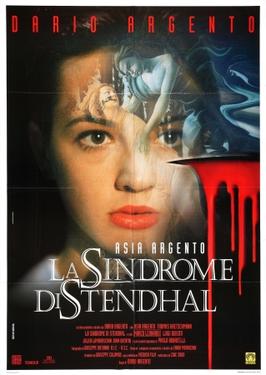
Dario Argento’s 1996 film, The Stendhal Syndrome, also takes place in Florence and features Asia Argento as Anna Mani, a police detective who is sent to the city to capture a serial killer. When Anna visits a museum, she is overwhelmed by what she sees. When she looks at Botticelli’s The Birth of Venus, she hears the wind that blows Venus’s hair. When she views Bruegel’s Landscapes With The Fall Of Icarus she, perhaps significantly, becomes Icarus and flies through the air before crashing into the water below, where she shares a passionate kiss with a fish. In the museum, Anna faints. She drops her purse, giving Alfredo Grossi (Thomas Kretschmann) time to not only steal her gun but also the key to her hotel room.
Dazed and not even sure of who she is, Anna returns to her hotel. A copy of Rembrandt’s The Night Watch turns into a doorway, which she steps through. Finding herself on a rainy city street, Anna is reminded that she’s a detective and that she’s in Florence to catch a vicious killer. When Anna steps back into her room, she discovers that she’s not alone. Alfredo grabs her, rapes her, and abducts her. Anna manages to escape and runs through the streets of Florence while a naked and blood-covered Alfredo screams in the night, which is one of the most disturbing scenes that Dario Argento has ever given us. Alfredo continues to stalk Anna while Anna goes through some changes herself, buying a blonde wig and pursuing a relationship with a French art student (Julien Lambroschini).
The Stendhal Syndrome was the first of Argento’s film to feature CGI, not just in the scenes in which Anna enters the paintings but also in scenes where were literally follow the pills that she’s taken down her throat and where a bullet is seen to enter the face of one of Alfredo’s victims. (Alfredo looks through the resulting bullet holes and winks at Anna on the other other side.) Sometimes, the CGI is effective and sometimes it’s a bit too cartoonish for its own good. At its most effective, the CGI inspires us to wonder if Anna is seeing reality or if she’s still trapped in her Stendhal Syndrome-inspired fantasy world. The scene where disturbing graffiti comes to life may not exactly look real but it’s still undeniably effective. At other times, the special effects just come across as being a bit self-indulgent on Argento’s part.
The film is at its best when it concentrates on the cat-and-mouse game between Anna and Alfredo. As played by Thomas Kretschmann, Alfredo is one of the most terrifying characters to ever appear in an Argento film, a handsome and seemingly charming man who is actually fueled by pure evil and hate. Alfredo is a villain who takes a definite pride in his ability to hide his true nature from the rest of the world. At first, Anna seems almost too physically frail and emotionally open to be believable as a police detective but she soon proves herself to be far tougher than anyone realizes. Anna, it turns out, has secrets of her own. Shot roughly around the same time that Asia Argento was being victimized by Harvey Weinstein, the scenes where Alfredo attacks Anna are difficult to watch, as they should be. Dario Argento took a lot of criticism (particularly from his former partner, Daria Nicolodi) for casting his daughter in a role where she is assaulted but the film itself is fully on Anna’s side.
The second half of the film loses its way a bit, though I can’t go into too much details without spoiling the plot. Several of the first half’s intriguing ideas are abandoned. Asia Argento gives a strong performance during the second half of the film, one that features some of her bravest and most revealing work. That said, despite the strength of Asia’s performance, many of Anna’s actions still don’t make sense no matter how much the film tries to convince us that they do. That said, the final scenes still carries an impact.
In the end, the film uses Stendhal Syndrome as a gimmick. If you want to see a realistic film about Stendhal Syndrome, you’re probably out of luck because it’s not a condition that’s easy to capture cinematically. But, as a thriller, The Stendhal Syndrome holds up well. This is an uneven film but ultimately, what does work outweighs what doesn’t.
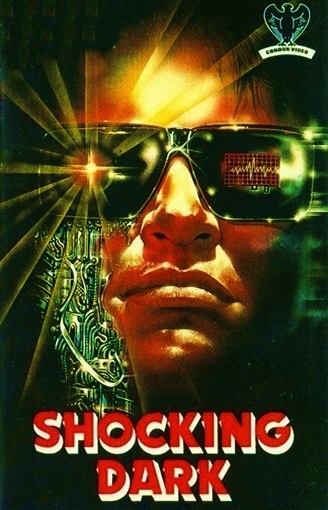
1989’s Shocking Dark opens with shots of my favorite Italian city, Venice! Unfortunately, a voice-over informs us that, due to the rising sea levels, Venice will no longer be inhabitable in the near future and instead, most of it will be underwater by the year 2000.
(For the record, everything seemed fine when I was there. I went to Italy the summer after I graduated from high school and I absolutely loved Venice. My first night in Venice, there was a thunderstorm and I can still remember standing underneath an awning while it rained and watching as the lightening was reflected in the waters of the Venice canals.)
Something strange has happened at one of Venice’s undersea labs. The scientists who were working on a top secret project have almost all disappeared and the only known survivor is ranting like a maniac. The Tubular Corporation arranges for a group of Megaforce Marines (seriously, that’s what their called) to enter the lab and discover what has happened. The Megaforce Marines, which include a tough-talking woman from New York and a joke-making hick from down South, claim that there is nothing they haven’t been trained to handle.
The marines may start out cocky but they soon find themselves being attacked by metallic monsters that nest inside of their victims and appear to be unstoppable. The only survivor of the monster’s attack is a young girl named Samantha (Dominica Coulson) who bonds with Sara (Haven Tyler), a member of the expedition. The marines also discover that a member of the expedition is actually a killer robot who has been sent by the Tubular Corporation to protect its interests.
Does all of this sound familiar? Like a lot of Italian horror films, Shocking Dark was released under several different titles. Here’s a few of them: Terminator II, Shocking Dark — Terminator 2, Aliens 2, Alienator, and Contanimator. Shocking Dark sold itself as being a sequel to every successful film that James Cameron had directed up until that point and it did so despite the fact that Cameron had nothing to do with the film. (Indeed, Terminator 2: Judgement Day came out two years after the release of Shocking Dark.) Shocking Dark rips off both Aliens and The Terminator, with the first half of the film being dominated by the tough-talking Marines and the second half being dominated by a relentless cyborg killer. Even by the standards of the Italian film industry, Shocking Dark is utterly shameless in the way it blatantly rips off Cameron’s two previous films.
Not surprisingly the film was directed by Bruno Mattei and written by Claudio Fragasso, a pair who made a very lucrative career out of making cheap versions of expensive American sci-fi and horror films. (Fragasso would go on to achieve his own immortality by directing Troll 2.) As with many of the Mattei/Fragasso collaborations, the dialogue is crude, profane, and fequently nonsensical. (Fragasso’s idea of writing like an American was to have the characters randomly insult and threaten each other.) The plot has an appealingly ramshackle feel. Towards the end of the film, two characters just happen to stumble across a time machine because …. hey, why not!? At least it allowed for a few scenes to be shot in what was then modern-day Venice.
As with many of the Mattei/Fragasso collaborations, the saving grace here is that Bruno Mattei directs with the confident swagger of someone who truly believes that he can rip-off James Cameron with half the budget and come up with something better than either Terminator or Aliens. The fact that Mattei fails to better either of those films is beside the point. What’s important is that Mattei seems to believe that he has. Mattei’s direction is shameless and unapologetic and, as a result, the film is far more watchable than perhaps it should be. It’s a film that the viewer enjoys, even though they might not want to.
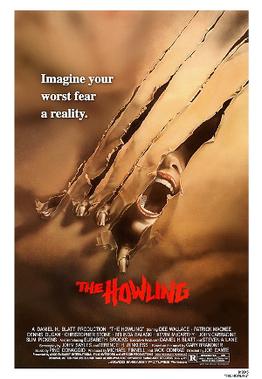
The 1981 film, The Howling, takes place at The Colony.
The Colony is a lovely place, a nice resort out in the middle of the countryside. It’s a place that celebrity therapist George Waggener (Patrick Macnee) sends his clients so that they can recover from trauma. It’s a bit of a grown-up version of the ranch to which Dr. Phil used to send juvenile delinquents. Of course, the Colony is full of adults and they’re an eccentric bunch. I mean, one of them — named Erle Kenton — is actually played by John Carradine! That’s just how eccentric the place is. Sheriff Sam Newfield (Slim Pickens) keeps an eye on the place but everyone knows that there’s nothing to worry about when it comes to The Colony. Dr. Waggner does good work.
Karen White (Dee Wallace) is a Los Angeles news anchor who was held hostage by a serial killer named Eddie Quist (Robert Picardo). While she was with Eddie, she was forced to not only watch videos of Eddie’s crimes but she also saw something happen with Eddie that terrified her to such an extent that she has blocked it from her mind. Karen was rescued by the police but she is haunted by nightmares. Dr. Waggner arranges for Karen and her husband, Bill Neill (Christopher Stone, who was married to Dee Wallace when they co-starred in this film), to spend some time at the Colony.
Bill loves the Colony, especially after he attracts the eye of Marsha (Elisabeth Brooks), the resort’s resident seductress. Karen, however, is less enamored of the place. The Colony feels off to her and she’s not happy about the howling in the distance or the fact that Bill has suddenly started to grow distant from her. Could it be that The Colony is actually crawling with werewolves and that Bill has become one of them? (It’s totally possible and, to The Howling‘s credit, it doesn’t waste any time letting us know that.) Karen’s friend, Terry Fisher (Belinda Balanski), and her boyfriend, Chris Halloran (Dennis Dugan), do some research of their own into Eddie Quist, The Colony, and whether or not werewolves exists and they meet a helpful bookstore owner named Walter Paisley (Dick Miller).
To understand the approach that director Joe Dante and screenwriter John Sayles take to The Howling, one needs to only consider the names of some of the characters. George Waggner. Bill Neill. Terry (which can be short for Terence) Fisher. Fred (or is that Freddie) Francis. Erle Kenton. Sam Newfield. Jerry Warren. All of these characters are named after horror film directors. This is the type of werewolf film where Chris Halloran has a copy of The Three Little Pigs sitting on his desk. Veteran actors like Kevin McCarthy, John Carradine, Slim Pickens, and Kenneth Tobey show up in small roles. Roger Corman mainstay Dick Miller plays yet another character named Walter Paisley and he kicks Forrest J. Ackerman out of his bookstore. Roger Corman himself plays a man making a phone call. After a werewolf is shot on live TV, the program immediately cuts to a dog food commercial and we see a blank-faced child telling his unconcerned parents that someone just turned into a wolf. The Howling was made by people who obviously love B-horror and that love is present in every frame of the film.
Like Dante’s Piranha, The Howling is a film with a sense of humor but it’s not a comedy. The werewolves are still impressive, even forty-two years after the film was first released. The character of Eddie Quist (“I’m going to give you a piece of my mind”) is a terrifying monster and the sight of his signature smiley face will fill you with dread, especially when it shows up in a place where it really shouldn’t be. The film cynically ends on a note of noble sacrifice that will apparently not make much difference, with the suggestion being that human beings are either too distracted or too jaded to realize that there are monsters among them. The Howling is a fast-paced and well-directed homage to B-horror and it’s still terrifically entertaining.
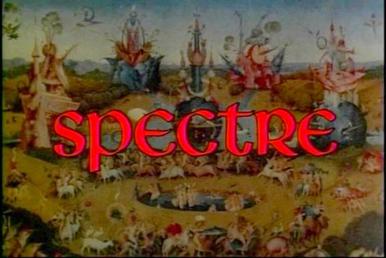
Produced by Gene Roddenberry and directed by Clive Donner, 1977’s Spectre was a pilot film for a television series about an occult detective (Robert Culp) who solved supernatural mysteries while dealing with a curse that had been put on him by the demon, Asmodeus.
In this film, Culp’s William Sebastian and his associate, Dr. Ham Hamilton (Gig Young) travel to the UK to investigate a supernatural case involving an old family. Despite the efforts of a succubus and a cursed airplane, Sebastian and Ham are determined to solve the mystery. John Hurt appears as a member of the cursed family.
This pilot was not picked up and developed into a series but it was popular enough that it was released as a theatrical film in Europe.
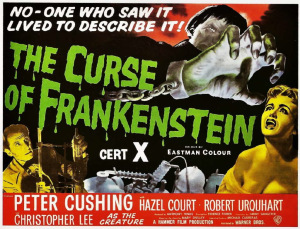
First released in 1957 and one of the films that put Britain’s Hammer Films on the map, The Curse of Frankenstein opens in Switzerland in the 19th century. It’s a time of superstitious villagers, judgmental priests, aristocrats who dabble in science, and lots of cleavage. It’s also a time when justice is harsh. That’s something that Baron Victor Frankenstein (Peter Cushing) has discovered as he sits in a cell in prison, awaiting his execution date.
Baron Frankenstein has been convicted of the murder of a maid named Justine and the public is eager to see this haughty and eccentric aristocrat put to death. Victor, however, claims that he is innocent of Justine’s murder. As Victor explains to a visiting priest (Alex Gallier), he is guilty of many things but he didn’t kill Justine.
The story that Frankenstein tells the priest is a familiar one. Victor inherited the Frankenstein estate when he was fifteen and, having always been interested in science, his hires a scientist named Paul Krempe (Robert Urquhart) to mentor him and ultimately collaborate with him on his experiments. Even as he falls in love with and become engaged to his cousin, Elizabeth (Hazel Court), Victor becomes obsessed with the idea of creating a human being from perfect parts collected from the dead.
Victor puts his creation together, piece by bloody piece. He has no trouble using a the body of a robber and the hands and eyes that purchases from the workers at the local morgue. But when it come time to pick a brain, he wants to use the mind of a distinguished scientist. Unfortunately, the scientist is still alive so Victor pushes him over a bannister. That kills the professor but the removal of the brain does not go quite as smoothly as Victor was hoping. The brain gets damaged when it’s removed. The Creature (an intimidating Christopher Lee) is eventually brought to life but, with that damaged brain, all it wants to do is destroy and kill. Victor isn’t happy about that but soon, he discovers that having a killer Creature has its uses.
As opposed to the well-meaning but obsessed version of the character that Colin Clive played in the original Frankenstein, The Curse of Frankenstein presents us with a Baron who is rather unstable from the start. It’s not just that the Baron is obsessed with bringing the dead back to life. It’s that he is fully willing to kill people for his experiment. Perhaps his only redeeming quality could have been his love for Elizabeth but he screws up even that by having an affair with the ill-fated Justine (Valerie Gaunt). From the start, the Baron’s main obsession is with his own power. Elizabeth is ultimately just another pawn for him to control.
Considering how evil this film’s version of Baron Frankenstein is, it’s a good thing that he’s played by Peter Cushing. Cushing gives an intense but charismatic performance as the Baron, capturing not only the character’s ruthlessness but also his fierce intelligence. The tragedy of the film’s version of the story is not that the Baron’s experiment goes wrong but that the Baron did actually have the potential to do a lot of good for the world. He’s smart and he’s determined but he’s lacking a conscience. If anything, the Creature he builds is a representation of his own dark thoughts and desires. The Baron is an aristocrat and the Creature is built out of common thieves and people who died in debt but they’re both different sides of the same coin.
Gory and fast-paced, The Curse of Frankenstein was a huge hit and it made stars out of both Cushing and Lee. I tend to prefer Hammer’s Dracula films to its Frankenstein film but The Curse of Frankenstein holds up well as a portrait of what happens when madness and science collide.
What’s an Insomnia File? You know how some times you just can’t get any sleep and, at about three in the morning, you’ll find yourself watching whatever you can find on cable or streaming? This feature is all about those insomnia-inspired discoveries!
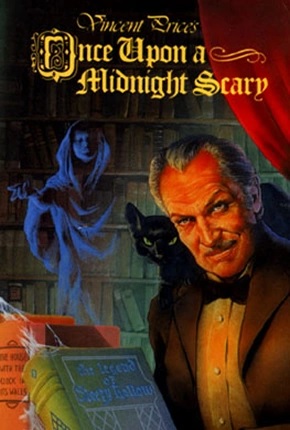
If you were having trouble getting to sleep last night, you could have gone over to YouTube and watched 1978’s Once Upon A Midnight Scary.
Made for CBS and featuring Vincent Price as the sardonic, cape-wearing host, Once Upon A Midnight Scary was a special designed to encourage young viewers to pick up a book and read. Price introduced three different stories, each centering around ghosts and each based on a book. In the first story, based on the book The GhostBelonged To Me, a young farmboy discovers a ghost hiding in a barn and becomes a hero when the ghost warns him about an impending disaster. The second story is an adaptation of The Legend of Sleepy Hollow and it features Rene Auberjonois as a rather neurotic Ichabod Crane, who finds himself being pursued by the headless horsemen. The third and longest story is an adaptation of The House With A Clock In Its Walls, featuring Severn Darden and a rather annoying child actor.
One thing you immediately notice about this show is that the special doesn’t actually reveal how any of the stories end. Instead, each story is basically a recreation of the most exciting or interesting parts of the larger story but, whenever it appears that we’re heading for a conclusion, Vincent Price suddenly appears and says, “What happened next, you ask? Read the book!” This special basically casts Vincent Price as the world’s most devilish book salesman and while that might be annoying if you’re watching the special because you want to see how the stories turn out, it’s a lot of fun if you’re just watching the show to watch Vincent Price act like Vincent Price. Vincent is not in the special as much as you might want but he still shows off his unique charm. It’s impossible to be in a bad mood while watching Vincent Price.
It’s a rather low-rent place, full of empty warehouses, vacant lots, and deserted streets. With the exception of the Sovereign Leader (David Krist), everyone seems to live in a bland apartment. It’s a world where people have neither personalities nor names. Instead, people are identified by their identification numbers. Few people can really remember what the world was like before the Sovereign Leader came to power but almost everyone seems to believe that it was not a good place to live. The Sovereign Leader says so and why would he lie? The people are united by one belief when it comes to their Leader. “If he is for us, who can be against us?”
There are a few people who refuse to accept the words of the Sovereign Leader. They hide in the wilderness and in the city and they read forbidden books. The Leader has his own fanatical, paramilitary force who spend their time tracking down and executing these so-called “Defiants.” This group of executioners is known as the Peace Team because, after all, that’s what they’re doing, right? They’re making sure that no one disturbs the peace.
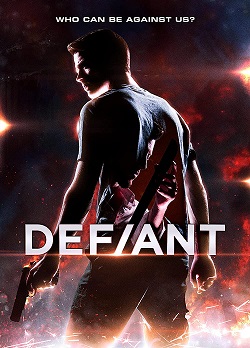
This is the world of the 2019 film, Defiant.
Defiant tells the story of A51-317 (Luke Krist), who begins the film as one of the most fanatical members of the Sovereign Leader’s Peace Team. Perhaps the reason why A51-317 is so quick to announce his loyalty to the Sovereign Leader is because he is suffering from his own doubts. He has dreams and occasional flashbacks to a time before the Sovereign Leader comes to power and much of what he sees stands in contrast to what he’s been told about the old world. A51-317 wonders why he can’t remember much about his past. He wonders why so many people are willing to be executed rather than follow the Sovereign Leader. He wonders who he was before he just became a number.
And soon, he’s wondering why he’s been framed for the attempted murder of the Sovereign Leader. After the Leader is shot in the head, he’s believed to be dead for three days. Then, suddenly, the Leader reveals that he’s not only alive but he also announces himself to be the Supreme Leader. He makes it clear that all Defiants must now be executed. A51-317 find himself on the run as he becomes one of the people who he used to hunt.
It’s a familiar story, one that’s been featured in a countless number of faith-based “final days” movies. That said, Defiant is a well-made and surprisingly well-acted film, one that does a good job of creating a believable atmosphere of fear and paranoia. The Sovereign Leader has much in common with the dictators and megalomaniacs of today and the scenes in which the Peace Team track down the Defiants and accuse them of being insobordinate for not blindly supporting the policies of the Leader feel even more relevant today than they did in 2019. Whether one buys into the film’s faith-based message or not, Defiant is a film that feels undeniably relevant to today’s world.
The 1991 film, Popcorn, tells the story of what happens when an experimental film goes wrong.
In the late 60s, a freaked-out hippie named Lanyard Gates directed a short film called Possessor. Possessor featured footage of him apparently preparing to sacrifice a woman on an altar. Gates declined to film a third act conclusion to the film. Instead, he murdered his family on stage and in front of a terrified audience. The resulting panic caused a fire to break out, killing almost everyone at the Dreamland Theater. As a result, Possessor has become a legendary film, one that is believed lost. Of course, it’s not lost, as a group of film students and their professor find out over the course of Popcorn.
Years later, one of those film students, an aspiring screenwriter named Maggie (Jill Schoelen), has been having disturbing nightmares about being caught in a fire and being pursued by a madman. When she sees Possessor, she realizes that much of the imagery in her dreams comes from the film. When Maggie attempts to talk to her mother about all of this, Suzanne (Dee Wallace) denies knowing anything about Possessor or Lanyard Gates but it’s not hard to tell that she’s lying.
Still, Maggie does have other things to worry about. Her school’s film department has been hit by budget cuts and neither she nor her classmates will be able to make their student films unless they raise some money. One of the students, Toby (Tom Villard), suggests holding a fundraiser at the Dreamland Theater, where they could show old movies and even recreate some of the old gimmicks that were used to promote those movies. Professor Davis (Tony Roberts) thinks that is a great idea! Why, he could even control the giant, remote-controlled bug that was used to promote Mosquito!
Filmed in Jamaica (and featuring a somewhat random performance by a reggae band), Popcorn was originally offered to director Bob Clark. However, Clark didn’t want to return to the horror genre so, instead, it was Clark’s frequent collaborator, Alan Ormsby, who was hired to direct the film. Reportedly, Ormsby was replaced a few weeks into filming by Mark Herrier, with the assumption being that the producers felt that Ormsby was spending too much time on filming the three fake movies that are screened during the fund raiser. Those films are Mosquito, The Attack of the Electrified Man, and a dubbed Japanese film called The Stench. In the film’s credits, Ormsby is credited with directing the three fake film while Mark Herrier is credited with directing the “modern” scenes.
Perhaps not surprisingly, the three fake film are actually the best thing about Popcorn. If Alan Ormsby was taking a lot of time to shoot the fake films, it obviously paid off because all three of them perfectly capture the feel of the era when they were supposedly shot and all of them are filled with the type of details that only a true fan of old horror movies would think to include. Mosquito is a giant bug film that feels as if it could have come straight from 1957. The Amazing Electrified Man feels like one of the films that poor Lon Chaney Jr. would have found himself starring in after leaving Universal. And The Stench is the perfect import — slow-moving, a bit pompous, and terribly dubbed.
As for the rest of Popcorn, it’s a well-made slasher film. Mark Herrier did a good job directing the “modern” scenes, with a scene in which the killer’s face seems to literally melt after he kisses one of his victims being a definite creepy highlight. The kills are reasonably creative and, in one case involving electrocution, rather disturbing. Jill Schoelen is a likable heroine, Derek Rydall is cute as her hapless boyfriend, and Tom Villard’s uninhibited performance gives the film a much-needed jolt of energy. Though the old films may be the highlight of Popcorn, the “modern” scenes hold up as well.
 Dracula comes to the old west!