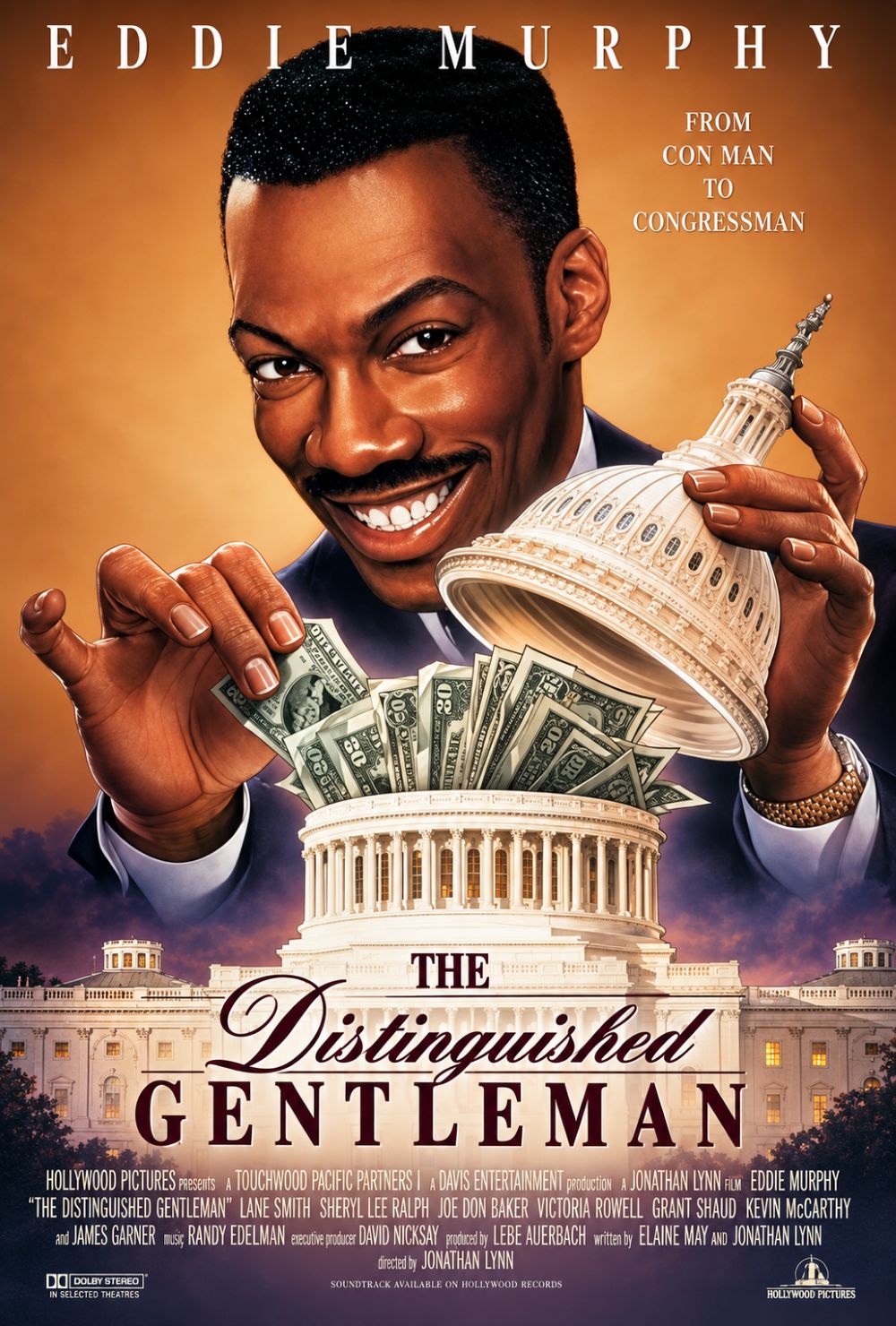
Review: The Distinguished Gentleman (dir. by Jonathan Lynn)


“With all this money coming in from both sides, how does anything ever get done?” — Thomas Jefferson Johnson

The Distinguished Gentleman is an uneven but enjoyable Eddie Murphy comedy whose premise has become more relevant with time. Directed by Jonathan Lynn, the 1992 film casts Murphy as Thomas Jefferson Johnson, a Florida con man who discovers that a recently deceased congressman had the exact same name. Seeing a shortcut to money and status, Johnson runs for the vacant House seat, wins largely on name recognition, and enters Washington with no meaningful political experience. In 1992, that premise played as broad political satire. Today, it carries a more uneasy edge, because its suggestion that image, recognition, and confidence can outrun scrutiny does not seem nearly as far-fetched.

That change in perspective makes the film’s central joke more interesting. Johnson begins as a small-time hustler who understands scams, pressure, ego, and persuasion. Once he reaches Congress, however, he discovers a political world that runs on many of the same instincts. The people around him do not call their dealings scams. They talk about donations, access, relationships, opportunities, and constituent concerns. But Johnson sees the transaction beneath the polished language immediately. The movie’s sharpest idea is that he may be a con man, yet he is not automatically the least honest person in Washington. He merely lacks the expensive suits and professional vocabulary used to make self-interest look respectable.

Murphy is exactly the right actor to make that contradiction work. Thomas Jefferson Johnson has to be selfish enough for the premise to hold together, clever enough to survive in an unfamiliar environment, and charming enough that the audience still wants to follow him after he wins office through deception. Murphy brings all of those qualities to the role. Johnson enjoys the attention, travel, influence, and special treatment attached to public office because he sees Congress as the biggest score he has ever found. At the same time, Murphy gives him enough quickness and warmth that he never becomes unpleasant. Even when Johnson does not understand what is happening around him, he moves through Washington with the confidence of someone who assumes he belongs there.

That confidence drives the movie’s strongest material. Johnson may not know committee procedure, legislative language, or public policy, but he knows people. He can recognize when praise is a setup, when a favor comes with strings attached, and when a supposedly helpful figure is treating him as an investment. This makes him an effective comic guide through Washington’s rituals. He is unqualified in the usual sense, but he is unusually qualified to identify the self-dealing hidden behind political formality. Jonathan Lynn understands the humor in that contrast and keeps the early scenes moving briskly through offices, hearings, fundraisers, press events, and lobbyist meetings. His direction is functional rather than visually distinctive, but it gives Murphy room to work and makes the political setting clear without drowning the comedy in procedure.

The problem is that the movie gradually moves away from the very idea that gives it its satirical bite. Johnson’s election is a pointed joke about name recognition, voter inattentiveness, and political branding. He wins because his name is familiar enough to inspire trust, not because anyone has evaluated his experience, policies, or character. That setup could have supported a more sustained comedy about campaigns, media manipulation, and the ease with which public image can substitute for qualification. Instead, the film shifts into a more conventional pharmaceutical-company corruption plot, giving Johnson an external villain and a clear reason to become more responsible.

That shift is understandable, since the story needs stakes beyond Johnson simply enjoying the perks of Congress. It also gives Murphy a more sympathetic character arc. Once Johnson sees the real-world consequences of corporate influence and political favors, he begins to use his instincts against people whose schemes are more damaging than his own. The change works because he does not become a completely different person. He remains fast-talking, opportunistic, and alert to every available angle. What changes is his sense of scale: his scams are about quick money, while the larger political and corporate schemes around him can hurt ordinary people while remaining hidden behind legal language and respectable appearances.

Still, making the conflict so clear-cut also weakens the satire. The opening suggests that corruption is part of a broader culture of money, access, public relations, and political influence. The later plot makes it easier to imagine that the problem lies mainly with a few especially corrupt people. Lane Smith’s Dick Dodge represents that polished form of corruption effectively. Dodge has the calm authority and practiced respectability of a politician who can make unethical behavior sound like normal procedure. He is a good villain precisely because he does not need to look obviously sinister; he simply treats power as something to be managed for private benefit.

Dodge’s presence becomes more useful because the film gives him a genuine counterweight in Charles S. Dutton’s Congressman Elijah Hawkins. Hawkins is almost Dodge’s opposite: plainspoken, principled, and committed to the idea that public office should mean public service. Dutton gives the role enough strength that Hawkins does not come across as a bland symbol of virtue. He is not there simply to lecture Johnson. Instead, he demonstrates that integrity and competence can exist within the same institution that has rewarded Dodge’s cynicism. Through these two men, Johnson sees both versions of political life: Dodge shows how power can be abused, while Hawkins shows what it is supposed to accomplish.

That contrast helps the film’s best themes land even when the plot becomes more routine. Johnson starts out believing that public office is just another hustle, only with better benefits and larger payouts. Hawkins gives him a reason to see the job differently, while Dodge proves that the cynicism Johnson brought to Washington is not entirely misplaced. Johnson’s eventual decision to push back against corruption therefore feels earned, even if the film resolves the conflict more neatly than its setup deserves. He does not become an idealist so much as a hustler who finally recognizes that the people above him are running a far bigger and more harmful game.

Viewed now, that idea carries more weight than it did in 1992. George Santos’s rise and eventual expulsion from Congress following repeated revelations about his background and finances offered a modern example of political presentation outpacing public scrutiny. Tommy Tuberville’s move from high-profile college-football coach and broadcaster into the U.S. Senate reflects a different but related reality: name recognition built outside politics can be a major electoral asset. The point is not that either man is literally comparable to Thomas Jefferson Johnson. It is that the film’s basic concern—how easily familiarity and confidence can be mistaken for qualification—has become harder to dismiss as mere comic exaggeration.

The same pattern can be seen beyond Congress. Donald Trump reached the presidency after decades as a celebrity businessman and television personality, while Arnold Schwarzenegger’s worldwide fame as a bodybuilder and movie star became a significant advantage in his successful run for governor of California. Celebrity alone never explains an election, and prior careers in sports or entertainment do not automatically make someone unfit for public office. Still, those examples show why the film’s name-recognition joke now feels more pointed. A highly recognizable candidate begins with a built-in audience, a simple public identity, and the kind of familiarity that many traditional candidates spend years trying to earn.

That dynamic has only become more visible as media personalities from different ideological camps seek office. Television hosts, pundits, podcasters, athletes, entertainers, and online figures can launch campaigns with established audiences, fundraising networks, and brand recognition already in place. In that environment, Johnson’s path to office feels less like an impossible gag and more like a deliberately exaggerated version of a real political tendency. The Distinguished Gentleman is not predicting every modern development, but it understands that voters may attach trust to a familiar name or face before they ask harder questions about qualifications, judgment, or policy.

This added relevance does not erase the film’s flaws. The comedy is still inconsistent, and the lobbyists, politicians, and corporate villains are often broader than they are funny. Murphy can make routine scenes entertaining, particularly when Johnson bluffs through official settings with total confidence despite not knowing the rules. But the movie often settles for familiar Washington stereotypes when it could push its satire further. It is rarely dull, yet it repeatedly avoids the messier implications of its best idea.

Even so, The Distinguished Gentleman remains worth revisiting as a mid-tier Murphy vehicle with more ambition than its reputation suggests. It does not have the comic consistency of Trading Places, the invention of Coming to America, or the effortless momentum of Beverly Hills Cop. Its pharmaceutical-company plot is too conventional, and its ending is more reassuring than genuinely sharp. Yet Murphy gives it a strong center, Dutton and Smith create an effective moral and political contrast, and the premise has gained resonance with time. What began as a funny story about a con man finding his way into Congress now plays as a reminder that political satire becomes less comfortable when reality starts catching up to it.
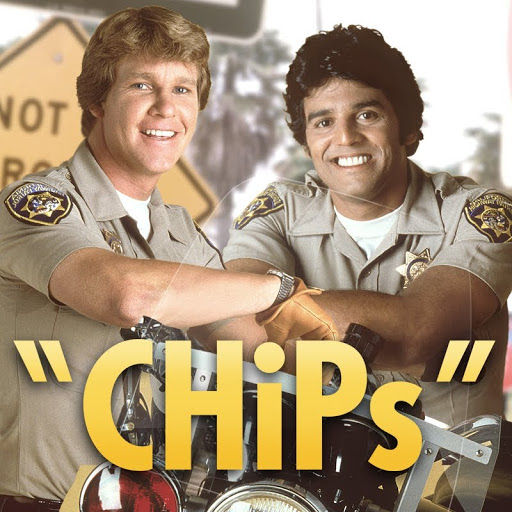

Late Night Retro Television Review: CHiPs 5.9 “Finders Keepers”


Welcome to Late Night Retro Television Reviews, a feature where we review some of our favorite and least favorite shows of the past!  On Mondays, I will be reviewing CHiPs, which ran on NBC from 1977 to 1983.  The entire show is currently streaming on Prime!

This week is just a mess.

Episode 5.9 “Finders Keepers”

(Dir by John Peyser, originally aired on November 29th, 1981)

Oh, it’s a Steve McLeish episode!

These episodes are fun because they were so obviously written and re-written to try to cover up the fact that Caitlyn Jenner was a terrible actor.  In this episode, we learn that Steve is into rare flowers and that he drives a pretty snazzy convertible.  And yet, despite these character details, Steve still doesn’t really have a personality beyond being kind of twitchy and always hesitating before delivering his lines.  Jenner seemed to be made out of charisma anti-matter and it’s bizarre to see a public figure with absolutely zero screen presence.

This episode is a mess.  Two teens steal a car and come into possession of some stolen money.  Steve searches for the stolen car.  An eccentric bounty hunter (Noble Willingham) drives from Texas to California in a pink Cadillac and gets in everyone’s way as he chases a fugitive.  Oscar nominee Amy Madigan appears as a country singer who would really like to get it on with Baker but Baker always ends up running late.  Ponch makes three brief appearances in this episode.  It’s explained that he’s preparing to testify in a huge trial and that’s why Baker and Steve are temporary partners.  None of the storylines really feel complete or connected.  One gets the feeling that three different scripts were just randomly crammed together.

This episode had two effective car crashes and it was somewhat amusing to watch as Baker always showed up just a minute or two after Amy Madigan stopped singing.  That said, this episode didn’t add up to much.  The only thing that really made it watchable was Jenner’s bizarre performance.

There’s a part of me that kind of hopes that Ponch never comes back!  Of course, if that happened, it would no longer be….

Horror On The Lens: Where Have All The People Gone? (dir by John Llewellyn Moxey)


In the creepy 1974 film, Peter Graves plays a father who goes on a camping trip with his two teenage children (one of whom is played by Kathleen Quinlan).  A sudden earthquake and a solar flare causes the trio to try to return to civilization, where they discover that almost everyone has been reduced to a powdery substance and there are only a few crazed survivors.  They try to make their way back to their home in Malibu, facing danger at every leg of their journey.

(It’s almost a low-budget and far more dramatic version of Night of the Comet.)

Effective despite its made-for-TV origins, Where Have All The People Gone? was obviously mean to serve as a pilot for a television series.  The series didn’t happen but, even with a somewhat open-ended conclusion, the movie still works.


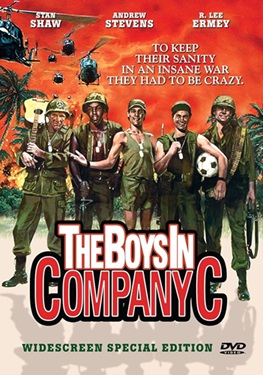
The Boys In Company C (1978, directed by Sidney J. Furie)


In 1967, a group of young men arrive at the Marie Corp. Recruit Depot in San Diego.  Tyrone Washington (Stan Shaw) is a drug dealer from Chicago who tells everyone not to mess with him and who soon emerges as a natural born leader.  Dave Brisbee (Craig Wasson) is a long-haired hippie who tried to feel to Canada and who shows up for induction in handcuffs.  Vinny Fazio (Michael Lembeck) is a cocky and streetwise kid from Brooklyn.  Billy Ray Pike (Andrew Stevens) is a country boy from Texas.  Alvin Foster (James Canning) is an aspiring writer who keeps a journal of his experiences.  Sgt. Loyce (R. Lee Ermey, making his film debut) molds them into a combat unit before they leave for Vietnam, where they discover that all of their training hasn’t prepared them for the reality of Vietnam.

The Boys In Company C has the same basic structure as Stanley Kubrick’s Full Metal Jacket, right down to R. Lee Ermey playing the tough drill sergeant.  The sharp discipline of basic training is compared to the chaos of Vietnam.  Ermey always said that he was playing a bad drill sergeant in Full Metal Jacket because he tore down the recruits but never bothered to build them back up.  In The Boys In Company C, Ermey plays a good drill sergeant, one who is tough but fair and who helps Washington reach his potential.  It doesn’t make any difference once the company arrives in Vietnam, though.  Both The Boys In Company C and Full Metal Jacket present the war in Vietnam as being run by a collection of incompetent officer who have no idea what it’s like for the soldiers who are expected to carry out their orders.

Of course, The Boys In Company C is nowhere near as good as Full Metal Jacket.  Full Metal Jacket was directed by Stanley Kubrick and it’s a chilling and relentless look at the horrors of combat.  The Boys In Company C was directed by Sidney J. Furie, a journeyman director who made a lot of movies without ever developing a signature style.  The basic training scenes are when the film is at its strongest.  When the company arrives in Vietnam, Furie struggles with the story’s episodic structure and it can sometimes be difficult to keep track of the large ensemble cast.  The Vietnam sequences are at their best when the emphasis is on the soldiers grumbling and bitching as their officers send them on one pointless mission after another.  The soccer game finale tries to duplicate the satire of the football game that ended Robert Altman’s M*A*S*H but it does so with middling results.  The Boys in Company C is a collection of strong moments that never manage to come together as a cohesive whole.

The movie is still important as one of the first major films to be made about the war in Vietnam.  However, it’s since been overshadowed by The Deer Hunter, Apocalypse Now, Platoon, and, of course, Full Metal Jacket.


Shattered Politics: Harry’s War (dir by Kieth Merrill)


It’s Tax Day, which means that it’s a good day to remember that the IRS is not your friend.

That can sometimes be hard to forget, with all the talk of making people “pay their fair share” and all the drama that seems to accompany any suggestion that federal bureaucracy should be reduced.  Back in 2003, there was a big story about how the IRS was going to hire 3,000 new employees and it amazed me how the media tried to frame this as being a good thing to which no one could possibly object.  Whenever I turned on the news, I would see government official bragging about how they were going to bring in even more IRS agents to make “the billionaires” pay their fair share.  (They may say “billionaires” but one can be sure that those 3,000 IRS agents weren’t going to anyone near anyone who donated to the right people.)  In the recent election, I was always amused by analysts who were shocked to discover that many voters, especially those were struggling to pay their bills, weren’t enthusiastic about the idea of a supercharged IRS.

The fact of the matter is that people hate the IRS.  The IRS exists to make people’s live difficult.  The IRS exists to take our money away from us, money that we earned but which we are apparently not worthy of keeping.  The IRS is an agency that demands that you do you own taxes but then threatens to throw you in jail if you make a mistake.  When people hear 3,000 new IRS agents, they imagine 3,000 more people looking to take their money and toss them in prison for forgetting to carry the one.  I often think that if the IRS simply sent people a bill every year, people would actually get a lot less upset about having to pay taxes.  I get a property tax bill from the country and I have no problem paying it because it gives me an exact amount.  Instead, the IRS says, “We know how much you owe but we’re not going to tell you.  If you pay too much, you won’t get a refund and if you pay too little, we’ll destroy your life.”

On days like this, watching a film like 1981’s Harry’s War can be a cathartic experience.  The film stars Edward Herrmann (yes, the History channel guy) as Harry, a postman who was raised by Beverly Payne (Geraldine Page), an eccentric woman who collects military memorabilia and whose property is listed as being a church and is therefore tax exempt.  In her will, Beverly has named Harry as her heir.  Arrogant IRS district director Ernie Scelera (David Ogden Stiers) is convinced that Beverly is hiding a fortune from the IRS and he proceeds to harass both her and Harry in court until Beverly drops dead of a heart attack.  Harry inherits Beverly’s property and also her tax bill.  However, Harry has also inherited all of her military stuff and soon, he’s crashing Ernie’s press conference with a tank and then engaging in a lengthy stand-off with the government.  The film is a dramedy and you never really doubt that Harry will somehow triumph (even if his victory is ultimately a symbolic one) but the film still reminds us of how quickly the government will turn on its citizens when it’s being defied and the final few moments bring to mind some of the worst ATF and FBI excesses of the past 30 years.  That said, Harry is quick to point out that he’s not waging war on the government.  He’s waging war on the unelected bureaucrats who have forgotten that civil servants are supposed to work for the people and not against them.  “All that power in one place,” Harry says scornfully about the IRS and it’s hard to deny that he has a point.  It’s hardly a perfect film but, in this day and age, it’s a film that will leave you cheering.


COWARD OF THE COUNTY – the boundary pushing country song turned into a TV movie


When I was a kid our family loved Kenny Rogers.  I remember listening to songs like “Lucille,” “The Gambler,” “Daytime Friends,” “She Believes in Me,” and “Lady” on my dad’s vinyl records. I would have been no older than second or third grade, and me and my siblings would really belt out “You picked a fine time to leave me, Lucille.” But the one Kenny Rogers song that affected me more than any of the others was the “Coward of the County.” If you know the lyrics of the song, then you know what I’m talking about.  As a kid of around 8 years old, the story about Tommy, Becky and the Gatlin Boys was a little more mature than what I was used to. I remember not even being sure what exactly happened to Becky, but I knew it was bad.  I also remember a TV movie based on the song starring Kenny Rogers, so you know our family watched it.

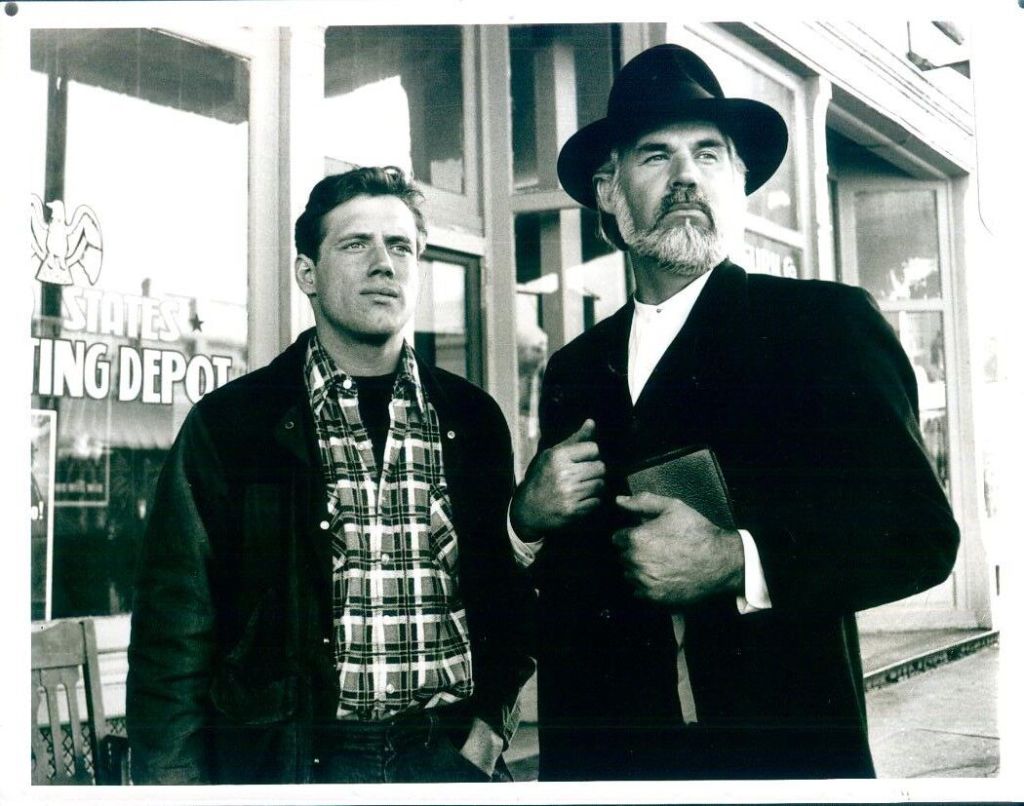
The TV movie premiered in 1981 and stars Kenny Rogers as Matt, a preacher who likes to drink, gamble, and cavort with the ladies. His nephew Tommy (Fredric Lehne) is a nice young man who already seems to have a bit of a reputation as someone you can push around. We learn this about Tommy at the town Christmas carnival when Jimmy Joe Gatlin wins a cake at a cake-walk (do y’all remember those things?) and proceeds to shove it in Tommy’s face. Tommy grabs Jimmy Joe by the arm to make him stop, but then he walks away without fighting back. It’s right after this confrontation between Tommy and Jimmy Joe that Matt makes an announcement to the crowd that the Japanese have just bombed Pearl Harbor, placing our story in 1941. Immediately the young men of the town, including Jimmy Joe Gatlin, start making their plans to join the military and head out for boot camp. And I tell you, this Jimmy Joe is a real jerk. Before he leaves, he tells the local beauty Becky that she’s “his” girl whether she likes it or not even though she’s telling him she’s not his girl. Jimmy Joe also stops to call Tommy a coward and ask him why he’s standing there with the men when he hasn’t even joined the military. We soon learn that Tommy has a very specific reason for not fighting. You see, his dad died in prison. He had to go to prison for killing another man in a fight, and before he passed he away, he asked his son to promise him that he would never fight. With the bully Jimmy Joe out of town, Tommy and Becky begin seeing each other and fall in love. That part of his life is happy, but everywhere Tommy goes he’s reminded that young men are fighting and dying for their country while he’s still at home. He really wants to keep his promise to his dad not to fight, but he feels he should fight for his country. After eight weeks, Jimmy Joe returns and tries to reclaim Becky as his girl. Becky tells him that she loves Tommy and they are getting married. Jimmy Joe doesn’t take the news well so he heads out and starts drinking. Full of drunken courage, he and his brothers head back to Becky’s house and he forces himself on her. When Tommy finds out what happened to Becky, he’s finally had enough and he confronts Jimmy Joe Gatlin and his brothers. He breaks his promise to his dad and beats the crap out of the Gatlin brothers. As the words of the song would say, “sometimes you have to fight to be a man.” Soon after, Tommy enlists in the service because with Becky he truly has something at home worth fighting for.

I’ll just start out by addressing the elephant in the room that Becky was raped by Jimmy Joe, and that’s what it took for Tommy to finally fight. I sure wish the cake to the face or the many times the Gatlin boys called him yellow would have been enough, but unfortunately it took something that horrible. I didn’t really understand all of this in 1981, and it’s pretty crazy that a mainstream country song told this story to be honest. Also, you might be surprised that Kenny Rogers is more of a peripheral character as the wandering preacher of the story. The main character, Tommy, is played by Fredric Lehne. He’s a likable actor who’s still very busy to this day on TV. I enjoyed seeing Lehne because he was very good in a movie that was filmed here in Arkansas called GREATER back in 2016. The movie tells the tragic, but inspirational story of Brandon Burlsworth, a former walk-on who became an All-American offensive lineman for the Razorbacks. Sadly, he died in a car accident in 1999 after being drafted to play professional football for the Indianapolis Colts. Lehne played an important role as a coach who helped get the very best out of Burlsworth. As a frequent attendee of Razorbacks home football games, I watched Burlsworth play many times in person and the whole state loved him. The news was devastating to our state, and the movie about his short, but very meaningful life is very special to me.

There were a couple of other things that I found interesting about COWARD OF THE COUNTY. First, I wondered if it was just a coincidence that the bad guys were the Gatlin Boys, especially considering that Larry Gatlin and his brothers were contemporary country music stars along with Kenny Rogers. According to the songwriters, they thought the Gatlin boys had a great ring to it and worked great for the song, better than anything else they could come up with. According to Larry Gatlin, he thinks they should have chosen a different name, but he was also a good friend with Kenny Rogers. Finally, the movie was partially filmed in Covington, GA, which has a very unique Courthouse with a large clock tower. Covington, which is about 35 miles east of Atlanta, is affectionately known as the “Hollywood of the South” due to the large number of movies and TV shows filmed there. To name just a few, THE CANNONBALL RUN, MY COUSIN VINNY, and the TV show THE VAMPIRE DIARIES were all filmed in Covington. My wife and I stayed the night in Covington on our way to Myrtle Beach in 2020 and visited the downtown area before we headed on. As soon as I saw that clock tower in COWARD OF THE COUNTY, I knew that it was filmed in Covington.

Introducing #Sunday Shorts, with BLIND FURY!


Since Sunday is a day of rest for a lot of people, I’m introducing #SundayShorts, a weekly mini review about a movie I’ve recently watched.

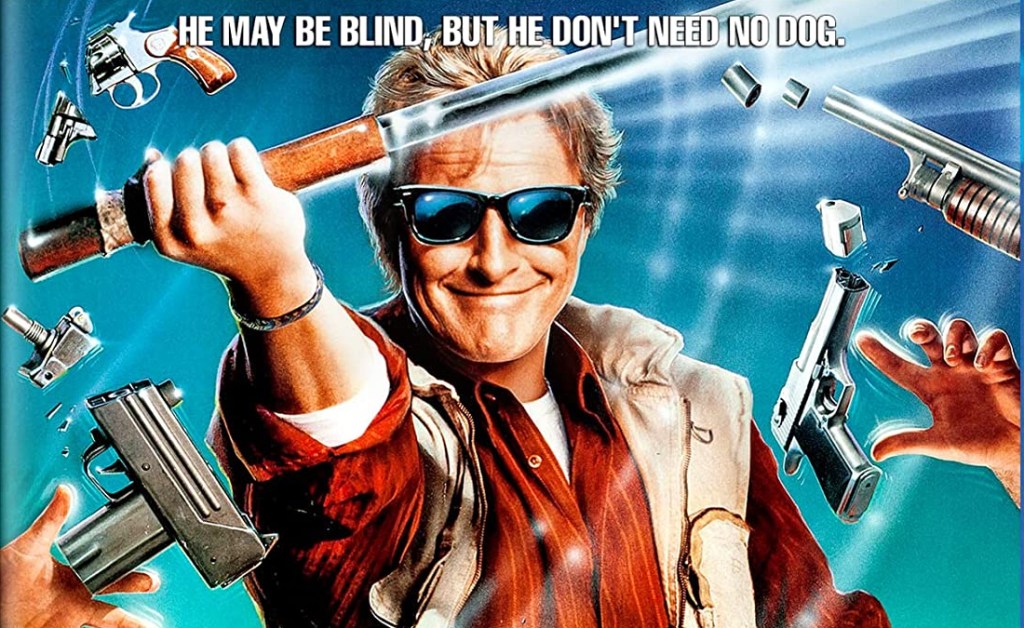
In BLIND FURY, Rutger Hauer does his best Zatoichi impersonation in a loose remake of a 1967 Japanese film called ZATOICHI CHALLENGED. The movie’s strongest quality is its ability to be both a kickass action film and a comic action film. That’s a fine line to walk and BLIND FURY does it exceedingly well.

Fast Facts:

  1. Star Rutger Hauer is probably the greatest Dutch actor of all time where he often starred in the films of director Paul Verhoeven. My favorite of Hauer’s foreign movies is SOLDIER OF ORANGE.
  2. ZATOICHI CHALLENGED, the inspiration for BLIND FURY, stars legendary Japanese actor Shintaro Katsu as a blind masseuse named Zatoichi. Katsu would play this amazing character in 26 films and 100 TV episodes between 1962 and 1989. You owe it to yourself to search out these films.
  3. Former heavyweight boxer Randall “Tex” Cobb plays a heavy in BLIND FURY. In his time, he beat Leon Spinx and went the distance with Larry Holmes.
  4. Australian director Phillip Noyce directed BLIND FURY. He’s an underrated director whose other credits include DEAD CALM, PATRIOT GAMES, and THE BONE COLLECTOR.

I highly recommend BLIND FURY!

Late Night Retro Television Review: Highway to Heaven 1.24 & 1.25 “Thoroughbreds”


Welcome to Late Night Retro Television Reviews, a feature where we review some of our favorite and least favorite shows of the past!  On Thursdays, I will be reviewing Highway to Heaven, which aired on NBC from 1984 to 1989.  The entire show is currently streaming on Freevee and several other services!

This week, season one concludes with a two-part episode.

Episodes 1.24 and 1.25 “Thoroughbreds”

(Dir by Michael Landon, originally aired on May 1st and 8th, 1985)

For their last assignment of the first season, Jonathan and Mark are sent to work at a stable owned by the wealthy Mr. Armstong (Stephen Elliott).  Lizzy MacGill (a young Helen Hunt) is the daughter of one of Amrstrong’s employees (Noble Willingham) and has practically grown up at the stables.  She loves horses and, as the first episode progresses, she also falls in love with Mr. Armstrong’s spoiled son, Garth (John Hammond).

Garth falls in love with Lizzie as well, learning how to be both a better horseman and just a better man from his interactions with her.  Despite his father’s threat to disown him, Garth breaks off his engagement to Ms. Richy McSnobby Snob (that may not have been her actual name) and he elopes with Lizzie.

Yay!

Except …. Lizzie has cancer and she doesn’t know it!  The test comes back on the exact same day that she runs off with Garth.  Part one ends with two fathers in tears, though each for different reasons.

At the start of Part Two, Jonathan tracks down Lizzie and informs her of her diagnosis.  Without telling Garth what’s going on, she returns home and is informed that 1) she must start chemotherapy immediately and 2) she’s pregnant.  Her doctor (Richard Bull) tells Lizzie that she’ll have to have an abortion if she wants to start treatment.  Lizzie runs from the hospital.

As for Garth, he naturally wants to know what’s going on.  Lizzie lies to him and tells him that she only wanted him for his father’s money and since he’s now cut-off, they might as well just call off the marriage as well.  Heart-broken, Garth decides to marry RIchy McSnobby Snob.

Worst ending ever, right?  Well, don’t worry, it’s not over yet.  Jonathan and Mark crash the wedding (and Jonathan tells a lie to get into the church, which I thought was a no-no for angels) and Jonathan causes A FIRE TO BREAK OUT IN THE CHURCH’S BASEMENT!  Again, this does not seem like good angel behavior.  Anyway, all the smoke gives Garth time to realize that he actually does love Lizzie and, after Mark informs him about why Lizzie actually left him, Garth rushes back to Lizzie and they go to the local Justice of the Peace to get married.  Fortunately, Jonathan is able to convince Mr. Elliott to come to that wedding as well.

The episode ends with a flashforward,  in which we see Lizzie and Garth’s toddler son playing outside while an apparently healthy Lizzie watches.

Yay!

It’s not a bad way to end the first season, though I do think the story could have just as easily been told in one episode as opposed to two.  (The first episode especially feels padded out.)  Helen Hunt and John Hammond made for a perfectly adorable couple and their chemistry ensured that the show’s signature mix of sentimentality and melodrama never felt too cloying.  All in all, this was a good ending to a fairly strong first season.

Next week, season 2 begins!

Horror Film Review: The Howling (dir by Joe Dante)


The 1981 film, The Howling, takes place at The Colony.

The Colony is a lovely place, a nice resort out in the middle of the countryside.  It’s a place that celebrity therapist George Waggener (Patrick Macnee) sends his clients so that they can recover from trauma.  It’s a bit of a grown-up version of the ranch to which Dr. Phil used to send juvenile delinquents.  Of course, the Colony is full of adults and they’re an eccentric bunch.  I mean, one of them — named Erle Kenton — is actually played by John Carradine!  That’s just how eccentric the place is.  Sheriff Sam Newfield (Slim Pickens) keeps an eye on the place but everyone knows that there’s nothing to worry about when it comes to The Colony.  Dr. Waggner does good work.

Karen White (Dee Wallace) is a Los Angeles news anchor who was held hostage by a serial killer named Eddie Quist (Robert Picardo).  While she was with Eddie, she was forced to not only watch videos of Eddie’s crimes but she also saw something happen with Eddie that terrified her to such an extent that she has blocked it from her mind.  Karen was rescued by the police but she is haunted by nightmares.  Dr. Waggner arranges for Karen and her husband, Bill Neill (Christopher Stone, who was married to Dee Wallace when they co-starred in this film), to spend some time at the Colony.

Bill loves the Colony, especially after he attracts the eye of Marsha (Elisabeth Brooks), the resort’s resident seductress.  Karen, however, is less enamored of the place.  The Colony feels off to her and she’s not happy about the howling in the distance or the fact that Bill has suddenly started to grow distant from her.  Could it be that The Colony is actually crawling with werewolves and that Bill has become one of them?  (It’s totally possible and, to The Howling‘s credit, it doesn’t waste any time letting us know that.)  Karen’s friend, Terry Fisher (Belinda Balanski), and her boyfriend, Chris Halloran (Dennis Dugan), do some research of their own into Eddie Quist, The Colony, and whether or not werewolves exists and they meet a helpful bookstore owner named Walter Paisley (Dick Miller).

To understand the approach that director Joe Dante and screenwriter John Sayles take to The Howling, one needs to only consider the names of some of the characters.  George Waggner.  Bill Neill. Terry (which can be short for Terence) Fisher.  Fred (or is that Freddie) Francis.  Erle Kenton.  Sam Newfield.  Jerry Warren.  All of these characters are named after horror film directors.  This is the type of werewolf film where Chris Halloran has a copy of The Three Little Pigs sitting on his desk.  Veteran actors like Kevin McCarthy, John Carradine, Slim Pickens, and Kenneth Tobey show up in small roles.  Roger Corman mainstay Dick Miller plays yet another character named Walter Paisley and he kicks Forrest J. Ackerman out of his bookstore.  Roger Corman himself plays a man making a phone call.  After a werewolf is shot on live TV, the program immediately cuts to a dog food commercial and we see a blank-faced child telling his unconcerned parents that someone just turned into a wolf.  The Howling was made by people who obviously love B-horror and that love is present in every frame of the film.

Like Dante’s Piranha, The Howling is a film with a sense of humor but it’s not a comedy.  The werewolves are still impressive, even forty-two years after the film was first released.  The character of Eddie Quist (“I’m going to give you a piece of my mind”) is a terrifying monster and the sight of his signature smiley face will fill you with dread, especially when it shows up in a place where it really shouldn’t be.  The film cynically ends on a note of noble sacrifice that will apparently not make much difference, with the suggestion being that human beings are either too distracted or too jaded to realize that there are monsters among them.  The Howling is a fast-paced and well-directed homage to B-horror and it’s still terrifically entertaining.

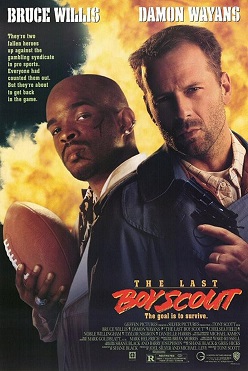
Holiday Film Review: The Last Boy Scout (dir by Tony Scott)


My God, what a violent holiday season!

Like the majority of the films that have been written and/or directed by Shane Black, The Last Boy Scout takes place in December.  It’s not quite as Christmas-y as some of Black’s other films.  I think that I may have spotted a few decorations in the background of some of the scenes.  And there’s a scene where private investigator Joe Hallenbeck (Bruce Willis) discovers that his daughter (played by a very young Danielle Harris) has been drawing pictures of “Satan Claus.”  Otherwise, there’s not a lot of Christmas to be found in this December-set film and perhaps that’s for the best.  Seriously, this movie is violent!  Not even the comedic relief characters are safe from getting a bullet to the head.  This is a film that actually begins with a football player shooting three other players during a game and then saying, “Ain’t life a bitch,” before shooting himself in the head.

The film’s plot isn’t always easy to follow.  Joe is a private investigator who drinks too much and whose partner has just been blown up in front of his house.  (His partner was also sleeping with Joe’s wife so guess who is now a suspect!)  Joe is also hired to act as a bodyguard for a stripper named Cory (Halle Berry).  Cory is dating Jimmy Dix (Damon Wayans), a former quarterback who used to be Joe’s hero.  Then Jimmy got kicked out of the league for gambling and Joe stopped watching football.  Cory says that she has a tape recording that will get Joe back into the NFL.  But then, Cory is brutally gunned down in the middle of the street and the tape is accidentally destroyed by Joe’s crappy tape player.  It’s time for Jimmy and Joe to team up, trade one liners, and uncover the conspiracy.

It all links back to the efforts of football team owner Shelley Marcuse (Noble Willingham) to legalize gambling.  Senator Calvin Baynard (Chelcie Ross) is standing in Marcuse’s way because Marcuse didn’t offer him a big enough bribe.  Marcuse is planning to assassinate the senator and he’s going to frame Joe for the crime because, in an amazing coincidence, Joe used to be a secret service agent until he caught Senator Baynard torturing a sex worker.  Of course, the actual assassination will be carried out by Marcuse’s chief henchman, Milo (Taylor Negron, who is absolutely chilling in the role).  Milo rarely shows emotion and always refers to everyone by their formal name.  (Joe is called Joseph.  Jimmy is called James.)  Milo is also a total sociopath, one who will shoot anyone in the head without a second thought.

Shane Black, who is a genius regardless of what I may think of this particular film, has said that he wrote The Last Boy Scout after he broke up with a longtime girlfriend and he was suffering from depression.  Disillusionment hangs over almost every frame of the movie.  Joe did the right thing and lost his career.  Jimmy lost his family on the same night that he played the best game of his career.  The Senator is opposed to Marcuse’s scheme solely because he’s not getting enough of a cut.  Marcuse is a respected businessman who thinks little of killing strangers.  Jimmy and Joe are heroes not because they’re particularly good but because everyone else around them is just so bad.  This is also very much a movie about guys doing guy things.  I watched it with my brother-in-law and I have to say that I think he got a bit more out of the film than I did.  Then again, I also think my sister Megan also got more out of it than I did so maybe I just wasn’t in the mood to watch so many people get shot in the head.  It happens.

The Last Boy Scout was directed by Tony Scott so, no matter what else you might want to say about it, the movie looks great.  Willis seems a bit bored with the film and Wayans sometimes struggles with the more dramatic moments.  In many ways, the film feels like a precursor to Shane Black’s The New Guys, though Willis and Wayans never have the same chemistry as Russell Crowe and Ryan Gosling did in that underrated film.  However, The Last Boy Scout’s action moves quickly and the screen is always full of neon lights.  It’s a well-made action movie though, unlike Lethal Weapon, Die Hard, and The Nice Guys, it’s not one that really sticks around in your head after the end credits roll.  Personally, I think it needed a little more holiday spirit.