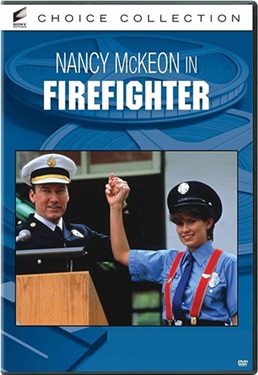
Nancy McKeon gives a good performance as Cindy Fralic, the first woman to become a firefighter in Los Angeles County. The film follows her as she takes the written exam, passes the physical exam (becoming the first woman to do so in the 60 years history of the Los Angeles Fire Department), and proves herself as both a firefighter and paramedic. She also finds love after her unsupportive husband divorces her.
Firefighter‘s story is bookended by a scene of Cindy telling a group of kids about what it is like to be a female firefighter. The film was made to inspire more women to pursue a career as a firefighter and sometimes, it seems like it pulls its punches when it comes to portraying just how difficult it probably was for the real-life Cindy to be Los Angeles’s first female firefighter. With the exception of her husband and one sexist captain, every man on the force is portrayed as being open-minded and rooting for Cindy from the start. No one at the firehouse has any trouble adjusting to a woman suddenly sharing their quarters. Almost everyone is supportive. The only time Cindy gets truly upset is when she has to get her hair cut. Sometimes, the film makes it seems like it was almost too easy for Cindy to be a groundbreaker.
It’s a good for what it is, though. Nancy McKeon gives a good performance. Ed Lauter plays her supportive boss and Amanda Wyss plays her best friend. It’s a made-for-TV movie so don’t go into it expecting a raging inferno. Instead, it’s just a sincere story about a woman who made history and who can maybe inspire others to do the same.
“There comes a time when a man has to stand up and be counted.” — Zack Carey
The 1984 action‑drama Tank is a small‑town parable dressed up as a military gimmick picture: an aging Army sergeant major, a battered old Sherman tank, and a corrupt sheriff. At its best, the film leans into James Garner’s quiet charisma and the absurdly specific “one man versus a whole county” premise; at its worst, it staggers under inconsistent tone and a plot that veers between heartfelt family‑drama and almost cartoonish vigilantism. Taken as a product of the early‑mid‑1980s, however, Tank holds up as a reasonably entertaining, if not especially deep, genre hybrid that works more through Gardner’s presence and a few solid set pieces than through psychological complexity or formal ambition.
James Garner plays Zack Carey, an Army sergeant major who moves his family to a small Georgia town near a training base, where he has acquired a battle‑worn M4A3 Sherman tank as a personal hobby and morale project. The setup is already a little out of the ordinary: an enlisted man whose side hustle is maintaining a World War II relic, while his wife LaDonna (played by Shirley Jones) quietly pushes back against the constraints of Army life and small‑town politics. The film’s opening stretches the believability of that scenario thin, but Garner’s easygoing authority and dry humor sell the idea that Zack is exactly the kind of practical, no‑nonsense soldier who would grow attached to a tank and treat it like a second family member. The script uses this setup to position the vehicle not just as hardware, but as a symbol of the character’s livelihood, dignity, and sense of duty.
The trigger for the conflict is an incident at a local bar, where Zack intervenes when a local deputy, who also moonlights as a pimp, roughs up a teenage prostitute named Sarah. The sheriff, Eugene Buelton (played with oily menace by C. Thomas Howell), is deeply corrupt and runs the town like a fiefdom, using his deputies to intimidate anyone who crosses him. When Zack’s teenage son, Billy, is later framed for a crime and thrown into a primitive prison camp, the fuse is lit. The film’s moral map is deliberately simple: Buelton is cartoonishly evil, Buelton’s deputies are unreliable tools of his will, and the Careys are painted as upright, essentially decent people caught in an unjust system. That simplicity works in Garner’s favor, because it lets the film focus on emotional stakes—father‑son loyalty, a wife’s fear for her family—rather than intricate political nuance.
What gives Tank much of its energy is the moment Zack decides to fight back with the only weapon he truly controls: his Sherman. The image of a lone, aging non‑commissioned officer rolling down country roads in a clanking World War II tank is inherently cinematic, and director Marvin J. Chomsky milks it for both action and symbolism. The scenes where Zack smashes through the sheriff’s office, disrupts the local jail, and later drives straight into the work farm to free Billy are played with a pulpy, almost comic‑strip bravado. The tank becomes a rolling moral absolutist: clumsy, loud, and impossible to ignore, cutting through the town’s layers of bureaucracy and intimidation in a way that mirrors Zack’s own frustration with a justice system that refuses to protect his son. The film’s action sequences are not particularly innovative by modern standards, but they benefit from the authenticity of the M4A3 and the straightforward choreography that lets the vehicle feel like a physical presence rather than a CGI abstraction.
Where Tank runs into trouble is in its fluctuating tone and some of its secondary choices. The subplot involving Sarah, the teenage prostitute, is handled with mixed success. On one hand, it adds a layer of social commentary about exploitation and small‑town complicity; on the other, it sometimes feels tacked on, introduced more as a narrative convenience than a fully developed character arc. The film wants to position her as a sympathetic victim who finds a kind of makeshift family inside the tank, but the material doesn’t dive deep into her background or inner life, leaving her more of a device than a rounded personality. This uneven handling reflects a broader issue: the movie vacillates between being a gritty crime drama, a family‑centric tearjerker, and a lighthearted action‑comedy. At times it feels like a made‑for‑television movie with a slightly bigger budget, hit by the same kind of tonal indecision that often plagued mid‑tier 1980s genre pictures.
Garner’s performance is the single element that keeps Tank consistently watchable. His Zack Carey is neither a cartoon hero nor a brooding anti‑hero; he’s a working‑class soldier approaching the end of his career, tired of compromise and willing to push back when pushed too far. Garner underplays the action‑hero theatrics, relying instead on quiet resolve, a dry sense of humor, and a lived‑in weariness that makes Zack feel like someone you might have actually met in an Army post or small town. Shirley Jones, as his wife, brings a grounded warmth to the domestic scenes, and the dynamic between Zack and his son Billy feels occasionally sentimental but never entirely false. The relationship between father and son anchors the film’s more outlandish elements, turning the tank chase into a visible metaphor for a father’s desperation to protect his child in a system that treats both as expendable.
Visually, Tank is workmanlike rather than stylish. The Georgia countryside is shot in broad daylight, with an emphasis on wide shots that showcase the tank moving through fields, back roads, and small towns. The tank itself is the film’s most vivid visual motif, a hulking, almost anachronistic machine that looks slightly out of place in a 1980s setting, yet somehow believable as the relic of a bygone era carried forward by a man who still believes in clear‑cut notions of right and wrong. The production favors practical effects and real locations over glossy stylization, which gives the material a modest, sometimes cheap‑looking quality but also lends it a concrete, lived‑in feel. The score, composed by Lalo Schifrin, adds a number of flavors—military marches, light jazz, and even a faintly disco‑tinged theme—further underscoring the film’s genre‑mixing instincts without always achieving cohesion.
Thematically, Tank leans heavily on the idea of individual resistance against corrupt authority. The sheriff’s abuse of power, the rigged legal process, and the near‑absence of any higher‑level oversight all feed into a classic American underdog narrative: one man, one tank, and a small band of allies taking on a system that has long since stopped pretending to be fair. The film stops short of overtly political commentary, but it clearly sympathizes with the notion that ordinary people sometimes have to go outside official channels when those channels are rigged against them. At the same time, the movie softens its edges with a crowd‑pleasing finale that reframes Zack and his allies as folk heroes, welcomed by a gathering of onlookers at the Tennessee border. This turn toward feel‑good spectacle undercuts some of the grittier implications of the earlier material, but it also fits the early‑1980s appetite for triumphant, crowd‑friendly resolutions.
As a time capsule of 1980s genre filmmaking, Tank is more interesting than it is groundbreaking. It is neither a forgotten masterpiece nor a laughably bad curio; it sits somewhere in the middle, powered by James Garner’s steady presence and the appealingly simple conceit of a World War II tank as a one‑man war machine. The film’s weaknesses—a schematic morality play, uneven tone, and underdeveloped secondary characters—are real, but they don’t completely erase its modest strengths. If viewed as a straightforward, mid‑tier action‑drama with a strong central performance and a memorable mechanical co‑star, Tank emerges as a fair, unpretentious, and occasionally rousing piece of 1980s entertainment.
Welcome to Retro Television Reviews, a feature where we review some of our favorite and least favorite shows of the past! On Mondays, I will be reviewing Miami Vice, which ran on NBC from 1984 to 1989. The entire show can be purchased on Prime!
This week, Caitlin makes a fateful return to Miami, an old enemy emerges from the shadows, and Crockett crosses a line that he never thought he would cross. Will he ever be able to come back?
Episode 4.21 “Deliver Us From Evil”
(Dir by George Mendeluk, originally aired on April 29th, 1989)
At the end of this week’s episode, Crockett executes a man in cold blood!
Whoa!
Now, I should note that the guy that Crockett killed was really, really bad. Frank Hackman (Guy Boyd) was a hitman who was previously on Death Row for killing one of Crockett’s former partners. Hackman, who was pretending to be born again and seeking redemption, tricked Crockett into “proving” his innocence and getting his conviction overturned. Only as Frank left the prison did he smirk at Crockett and reveal that all of the “new” evidence was faked. It was one of Miami Vice’s darkest episodes.
Frank went back to his old ways, committing crimes and killing families. Crockett made it his mission to take down Frank but, during a shootout with Frank’s gang, Frank’s wife was caught in the crossfire. Crockett blamed himself, even though the bullet that killed her came from Frank’s gun. Frank also blamed Crockett and, while Crockett was struggling with whether or not he wanted to remain a member of the Vice Squd, Frank plotted his revenge.
Caitlin Davies, Crockett’s wife, returned from her European tour. Unfortunately, her homecoming concert was abruptly ended when she was shot by a sniper. She died in Crockett’s arms, bringing to an end a marriage that never really made much sense to begin with.
Crockett spent a few days drinking on his boat and then rejoined the Vice Squad, determined to track down Frank. Castillo did that thing where he narrowed his eyes and looked vaguely concerned but he still allowed Crockett to work the case. After Crockett and Tubbs learned that Frank was living on a nearby island, Crockett confronted him alone.
“You wouldn’t shoot an unarmed man,” Frank said, smiling while lounging by the pool.
BANG!
Frank was wrong.
It was a powerful moment but one that was diminished by one final shot that showed Frank had been holding a gun in his hand when he was shot. From what I’ve been able to uncover online, this was apparently added at the insistence of the network, who did not want Crockett to become a cold-blooded killer. I doubt that would be an issue for the networks today.
Season 4 has been pretty uneven but this was a powerful episode. As it ended, it definitely seemed as if Crockett had crossed a line and that he would never again be the same. Who knows what that might mean for next week’s season finale?
Welcome to Retro Television Reviews, a feature where we review some of our favorite and least favorite shows of the past! On Mondays, I will be reviewing Miami Vice, which ran on NBC from 1984 to 1989. The entire show can be purchased on Prime!
This week’s episode took me by surprise!
Episode 3.11 “Forgive Us Our Debts”
(Dir by Jan Eliasberg, originally aired on December 12th, 1986)
Frank Hackman (Guy Boyd) has a date with Florida’s electric chair. Even though he claims that he’s innocent of killing one of Sonny Crockett’s former partners, Hackman says that he’s guilty of killing others and, having become a Christian while on Death Row, he is prepared to pay the ultimate price. He even suggests that his execution should be televised.
At first, Sonny is all for Hackman being executed. But then, a priest calls the Vice Squad and tells them that one of his parishioners confessed to having evidence that could prove that Hackman was actually in Vegas when the murder occurred. Sonny and the Squad track down Gus Albierro (Val Bisoglio), an auto mechanic who is dying of cancer and who says that he’s telling the truth to clear his conscience. Not long after Gus talks to Crockett, Gus is executed in his garage.
Convinced that Hackman is innocent, Sonny and Tubbs have one day to find the other person who was with Gus and Hackman in Vegas. That man turns out to be in the witness protection agency and, at first, he refuses to talk. Then Crockett takes him outside and beats him up.
Long story short: After having had his head shaved for his date with the electric chair, Hackman’s life is saved and he leaves prison a free man….
Now, up until this point, I felt that this episode was just another rather heavy-handed diatribe against the death penalty. Miami Vice, as a show, always leaned towards the Left and this episode features two smarmy Florida politicians who are eager to prove how tough they are on crime. I thought the whole episode was a bit too obvious in its storytelling and I thought my review would focus on the hypocrisy of Miami Vice criticizing the death penalty when almost every episode has ended with the bad guys being taken down in a hail of bullets.
(On a personal note, I’m against the death penalty because I think there is too much of a risk of an innocent person being executed. But, still, I’m not a fan of heavy-handed storytelling, regardless of whether I agree with the larger point or not.)
But this episode had one final twist waiting up its sleeve. Hackman steps out of prison and sees Sonny waiting for him. Sonny is feeling pretty proud of himself. He saved an innocent man, right? Wrong! Hackman proceeds to tell Sonny that he actually did kill Sonny’s former partner and that Gus lied in return for Hackman’s friends sending money to his family. That guy in witness protection who, at first, refused to testify? He was working with Hackman, too.
“I won’t need this anymore,” Hackman says, yanking off the cross that was hanging out around his neck.
And that’s how the episode ends! The bad guys triumph and it’s pretty much all Sonny’s fault! This was the most cynical episode of Miami Vice yet. The ending totally took me by surprise and it made me realize that, rather than being a heavy-handed and polemical, this episode was actually extremely clever and perfectly put together. Just as Hackman fooled Sonny, Miami Vice fooled the viewer (in this case, me). This turned out to be an excellent episode and certainly the best of season 3 so far.
Because of the holidays, this is my last Miami Vice review of 2024. My reviews of Miami Vice will resume on January 6th, 2025!
What’s an Insomnia File? You know how some times you just can’t get any sleep and, at about three in the morning, you’ll find yourself watching whatever you can find on cable or streaming? This feature is all about those insomnia-inspired discoveries!
If you were having trouble getting to sleep last night, you could have gone over to YouTube and watched 1978’s Once Upon A Midnight Scary.
Made for CBS and featuring Vincent Price as the sardonic, cape-wearing host, Once Upon A Midnight Scary was a special designed to encourage young viewers to pick up a book and read. Price introduced three different stories, each centering around ghosts and each based on a book. In the first story, based on the book The GhostBelonged To Me, a young farmboy discovers a ghost hiding in a barn and becomes a hero when the ghost warns him about an impending disaster. The second story is an adaptation of The Legend of Sleepy Hollow and it features Rene Auberjonois as a rather neurotic Ichabod Crane, who finds himself being pursued by the headless horsemen. The third and longest story is an adaptation of The House With A Clock In Its Walls, featuring Severn Darden and a rather annoying child actor.
One thing you immediately notice about this show is that the special doesn’t actually reveal how any of the stories end. Instead, each story is basically a recreation of the most exciting or interesting parts of the larger story but, whenever it appears that we’re heading for a conclusion, Vincent Price suddenly appears and says, “What happened next, you ask? Read the book!” This special basically casts Vincent Price as the world’s most devilish book salesman and while that might be annoying if you’re watching the special because you want to see how the stories turn out, it’s a lot of fun if you’re just watching the show to watch Vincent Price act like Vincent Price. Vincent is not in the special as much as you might want but he still shows off his unique charm. It’s impossible to be in a bad mood while watching Vincent Price.
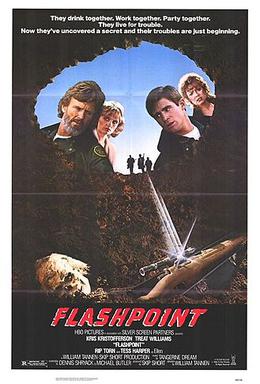
November 22, 1963. While the rest of the world deals with the aftermath of the assassination of John F. Kennedy in Dallas, a man named Michael Curtis drives a jeep across the South Texas desert, heading for the border. In the jeep, he has a $800,000 and a high-powered rifle. When the jeep crashes, the man, the rifle, and the money are left undiscovered in the desert for 21 years.
1984. Two border patrol agents, Logan (Kris Kristofferson) and Wyatt (Treat Williams), are complaining about their job and hoping for a better life. It looks like they might get that opportunity when they come across both the jeep and the money. A bitter Vietnam vet, Logan wants to take the money and run but Wyatt is more cautious. Shortly after Wyatt runs a check on the jeep’s license plate, a FBI agent (Kurtwood Smith) shows up at the station and both Logan and Wyatt discover their lives are in danger.
Though it was made seven years before Oliver Stone’s JFK, Flashpoint makes the same argument, that Kennedy was killed as the result of a massive government conspiracy and that the conspirators are still in power and doing whatever they have to do keep the truth from being discovered. The difference is that Flashpoint doesn’t try to convince anyone. If you’re watching because you’re hoping to see a serious examination of the Kennedy conspiracy theories, Flashpoint is not for you. Instead, Flashpoint is a simple but effective action film, a modern western that uses the assassination as a MacGuffin. Though Kris Kristofferson has never been the most expressive of actors, he was well-cast as the archetypical gunslinger with a past. Rip Torn also gives a good performance as a morally ambiguous sheriff and fans of great character acting will want to keep an eye out for both Kevin Conway and Miguel Ferrer in small roles.
For tonight’s trip into the world of televised horror, we have an episode from a 1986 attempt to revive The Twilight Zone.
This episode is a remake of one of my favorite episodes of the original series, Shadow Play. That’s the one where the guy is on death row but he says he’s not worried about being executed because he knows he’s just having a reoccuring nightmare. Of course, this kind of freaks out some of the people around him because, if he’s just having a dream, what happens to them when the dream ends?
While the remake is nowhere near as good as the original, it’s still fairly well done. Plus, it’s on YouTube and the original isn’t.
This episode was directed by Paul Lynch, the Canadian director who also directed the original Prom Night.
On the hundredth year anniversary of a battle between the U.S. Calvary and the Blackfeet Indians, the residents of small Montana town decide to reenact the battle and hopefully bring in some tourist dollars. The white mayor (Bill McKinny) and the sheriff (Jerry Hardin) both think that it is a great idea. Even the local Indian leader, Ben Cowkiller (Dennis Banks, in real-life a founder and leader of the American Indian Movement), thinks that it will be a worthwhile for the Indians to participate. The Calvary’s guns will be full of blanks. The Indians will play dead. However, as the result of a bar brawl the previous night, one of the local rednecks, Calvin Morrisey (Kevyn Major Howard), shows up with a gun full of bullets. After he shoots one of the Indians, Calvin ends up with a tomahawk buried in his head. Three Indian teenagers, Warren (Tim Sampson), Skitty (Kevin Dillon), and Sonny (Billy Wirth), flee into the wilderness. Thirsty for revenge, a white posse heads off in pursuit.
War Party is an underrated and surprisingly violent movie. Franc Roddam brings the same sensitivity to his portrayal of alienated Indians that he brought to portraying alienated Mods in Quadrophenia. Though, at first, Kevin Dillon seems miscast as an Indian, he, Wirth, and Sampson all give good performances, as does Dennis Banks. The movie is often stolen by M. Emmett Walsh and Rodney A. Grant, playing renowned trackers who are brought in to help the posse chase down the three youths. That Grant’s character is a member of the Crow adds a whole extra layer of meaning to his role. Even though the setup often feels contrived and heavy-handed and anyone watching should be able to easily guess how the movie is going to end, War Party still packs a punch.
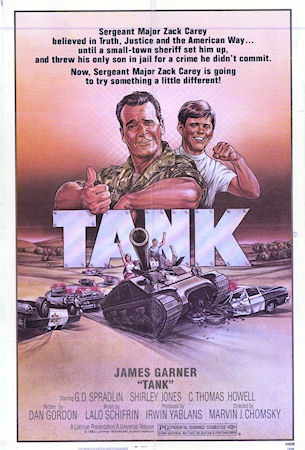
If you had just moved to a small town in Georgia and your teenage son was framed for marijuana possession and sentenced to years of hard labor, what would you do?
Would you hire a good lawyer and file appeal after appeal?
Would you go to the media and let them know that the corrupt sheriff and his evil deputy are running a prostitution ring and the only reason your son is in prison is because you dared to call them out on their corruption?
Or would you get in a World War II-era Sherman tank and drive it across Georgia, becoming a folk hero in the process?
If you are Sgt. Zack Carey (James Garner), you take the third option. Sgt. Carey is only a few months from retirement but he is willing to throw that all away to break his son (C. Thomas Howell) out of prison and expose the truth about Sheriff Buelton (G.D. Spradlin) and Deputy Euclid Baker (James Cromwell, playing a redneck). Helping Sgt. Carey out are a prostitute (Jenilee Harrison), Carey’s wife (Shirley Jones), and the citizens of Georgia, who lines the road to cheer the tank as it heads for the Georgia/Kentucky border. It’s just like the O.J. Bronco chase, with James Garner in the role of A.C. Cowlings.
The main thing that Tank has going for it is that tank. Who has not fantasized about driving across the country in a tank and blowing up police cars along the way? James Garner is cool, too, even if he is playing a role that would be better suited for someone like Burt Reynolds. Tank really is Smoky and the Bandit with a tank in the place of that trans am. Personally, I would rather have the trans am but Tank is still entertaining. Dumb but entertaining.
One final note, a piece of political trivia: According to the end credits, the governor of Georgia was played by Wallace Willkinson. At first, I assumed this was the same Wallace Wilkinson who later served as governor of Kentucky. It’ not. It turns out that two men shared the same name. It’s just a coincidence that one played a governor while the other actually became a governor.
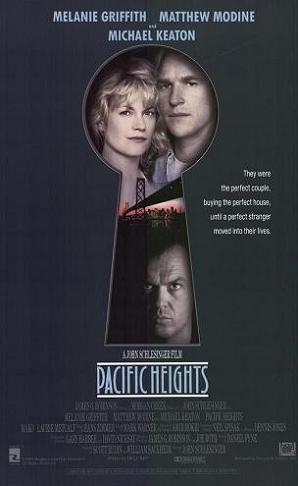
Michael Keaton is the tenant from Hell in Pacific Heights.
In San Francisco, Patty (Melanie Griffith) and Drake (Matthew Modine) have just bought an old and expensive house that they can not really afford. In order to keep from going broke, they rent out two downstairs apartments. One apartment is rented by a nice Japanese couple. The other apartment is rented by Carter Hayes (Michael Keaton). Carter convinces Patty and Drake not to check his credit by promising to pay the 6 months rent up front. The money, he tells them, is coming via wire transfer.
The money never arrives but Carter does. Once he moves into the apartment, Carter changes the locks so that no one but him can get in. At all hours of the day and night, he can be heard hammering and drilling inside the apartment. Even worse, he releases cockroaches throughout the building. When Drake demands that Carter leave, the police back up Carter. After goading Drake into attacking him, Carter gets a restraining order. Drake is kicked out of his home, leaving Patty alone with their dangerous tenant.
Pacific Heights is the ultimate upper middle class nightmare: Buy a house that you can not really afford and then end up with a tenant who trashes the place to such an extent that the property value goes down. As a thriller, Pacific Heights would be better if Drake and Patty weren’t so unlikable. (When this movie was first made, people like Patty and Drake were known as yuppies.) Much like Drake’s house, the entire movie is stolen by Michael Keaton’s performance as Carter Hayes. Carter was not an easy role to play because not only did he have to be so convincingly charming that it was believable that he could rent an apartment just by promising a wire payment but he also had to be so crazy that no one would doubt that he would deliberately infest a house with cockroaches. Michael Keaton has not played many bad guys in his career but his performance as Carter Hayes knocked it out of the park.
One final note: Keep an eye out for former Hitchcock muse (and Melanie Griffith’s mother) Tippi Hedren, playing another one of Carter’s potential victims. Her cameo here is better than her cameo in In The Cold of the Night.
 Nancy McKeon gives a good performance as Cindy Fralic, the first woman to become a firefighter in Los Angeles County. The film follows her as she takes the written exam, passes the physical exam (becoming the first woman to do so in the 60 years history of the Los Angeles Fire Department), and proves herself as both a firefighter and paramedic. She also finds love after her unsupportive husband divorces her.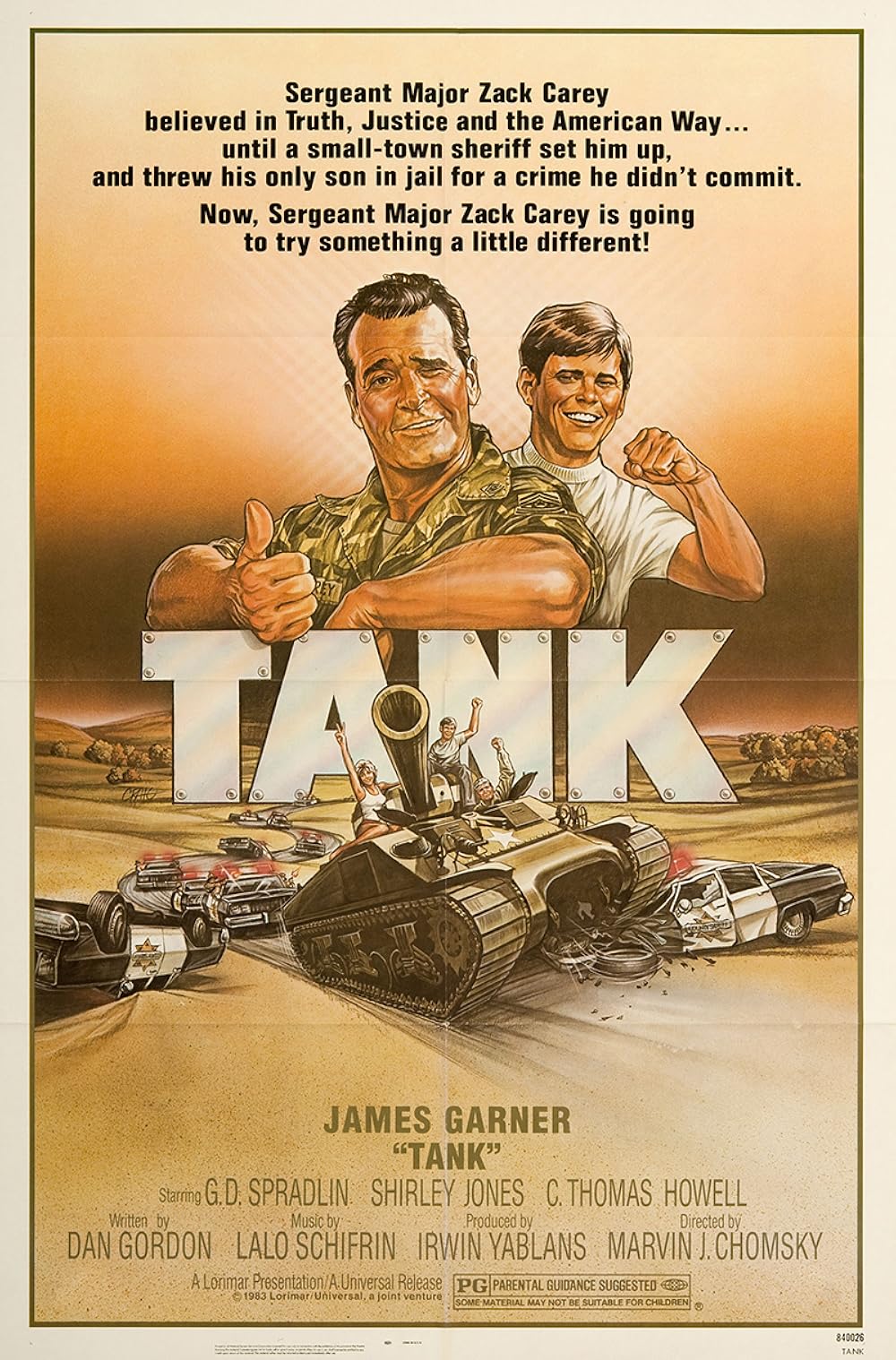


 November 22, 1963. While the rest of the world deals with the aftermath of the assassination of John F. Kennedy in Dallas, a man named Michael Curtis drives a jeep across the South Texas desert, heading for the border. In the jeep, he has a $800,000 and a high-powered rifle. When the jeep crashes, the man, the rifle, and the money are left undiscovered in the desert for 21 years.
 On the hundredth year anniversary of a battle between the U.S. Calvary and the Blackfeet Indians, the residents of small Montana town decide to reenact the battle and hopefully bring in some tourist dollars. The white mayor (Bill McKinny) and the sheriff (Jerry Hardin) both think that it is a great idea. Even the local Indian leader, Ben Cowkiller (Dennis Banks, in real-life a founder and leader of the American Indian Movement), thinks that it will be a worthwhile for the Indians to participate. The Calvary’s guns will be full of blanks. The Indians will play dead. However, as the result of a bar brawl the previous night, one of the local rednecks, Calvin Morrisey (Kevyn Major Howard), shows up with a gun full of bullets. After he shoots one of the Indians, Calvin ends up with a tomahawk buried in his head. Three Indian teenagers, Warren (Tim Sampson), Skitty (Kevin Dillon), and Sonny (Billy Wirth), flee into the wilderness. Thirsty for revenge, a white posse heads off in pursuit.
 If you had just moved to a small town in Georgia and your teenage son was framed for marijuana possession and sentenced to years of hard labor, what would you do?
 Michael Keaton is the tenant from Hell in Pacific Heights.
