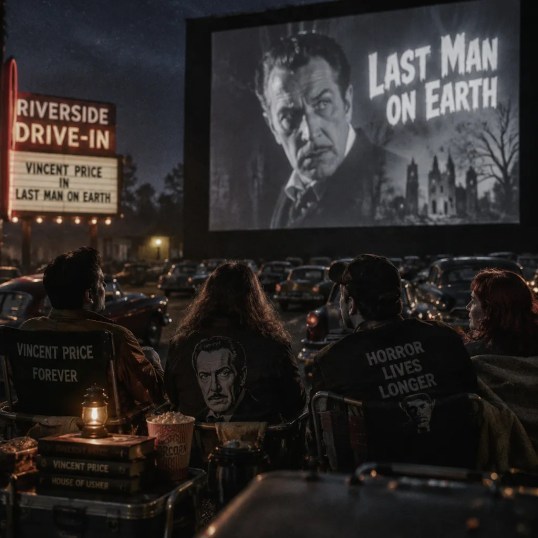
Today, I present to you one of the most important films in horror history. Though it wasn’t appreciated when it was first released back in 1964, The Last Man On Earth was not only the 1st Italian horror film but George Romero has also acknowledged it as an influence on his own Night of the Living Dead.
It’s easy to be a little bit dismissive of The Last Man On Earth. After all, the low-budget is obvious in every scene, the dubbing is off even by the standards of Italian horror, and just the name “Vincent Price” in the credits leads one to suspect that this will be another campy, B-movie. Perhaps that’s why I’m always surprised to rediscover that, taking all things into consideration, this is actually a pretty effective film. Price does have a few over-the-top moments but, for the most part, he gives one of his better performances here and the black-and-white images have an isolated, desolate starkness to them that go a long way towards making this film’s apocalypse a convincing one. The mass cremation scene always leaves me feeling rather uneasy.
The film is based on Richard Matheson’s I Am Legend and no, it’s nowhere as good as the book. However, it’s still a worthy adaptation and one that stays true to the tone of the text, including the fact that Price’s main tormenter was also once his neighbor and best friend. This is one of those films that just hits differently in the wake of 2020’s COVID hysteria.
And now, it’s time for The Last Man On The Earth….
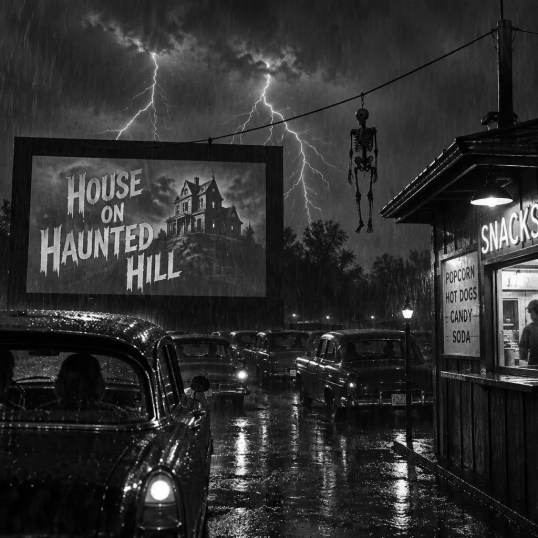
Watching the original House on Haunted Hill is a bit of a Halloween tradition here at the Shattered Lens.
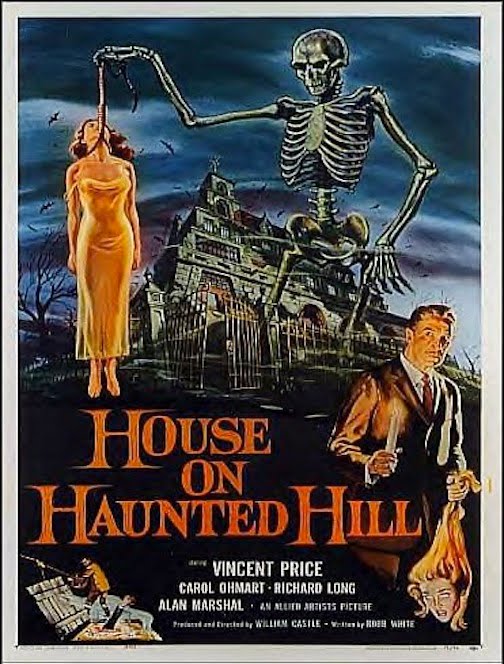
First released in 1959, The House on Haunted Hill features Vincent Price as a millionaire who invites five people to a party that he and his wife are throwing in a supposedly haunted house. Price explains that anyone who can actually make it through the entire night will receive $10,000. (That’s the equivalent of a $110,000 today.) Is the house truly haunted? The groundskeeper (Elisha Cook, Jr.) certainly seems to think so!
This is a classic haunted house movie, featuring Price at his best and a number of genuinely fun twists. Even if you’ve seen it a hundred times, you need to watch it again. Here is …. THE HOUSE ON HAUNTED HILL!
Today’s horror scene that I love comes from 1959’s House on Haunted Hill. As the film opens, Vincent Price takes a moment to speak directly to the audience and introduce the characters who are coming to spend the night at the house. Price, who is one of the patron saints of October, delivers his lines with such relish that it’s impossible not to stick around to see who survives the night.
Here to help you get into the holiday spirit is Vincent Price, reading Edgar Allan Poe’s The Raven. This scene comes from a 1985 television special that was called The Teller and the Tale.
“Men sometimes have strange motives for the things they do.” — Matthew Hopkins
In the pantheon of folk horror, few antagonists are as unsettling as Matthew Hopkins, brought to life with chilling restraint by Vincent Price in Michael Reeves’s 1968 masterpiece, Witchfinder General. While Hopkins was a very real historical figure who terrorized 17th-century England, Price’s portrayal reimagines him not as a raving religious zealot, but as a shockingly mundane monster. He navigates the war-torn countryside with a terrifying blend of sleaze and sophistication. It is precisely this departure from the supernatural madman archetype—replacing it with a grounded, opportunistic con artist—that makes Price’s Hopkins such a uniquely repellent figure. He is a villain who doesn’t haunt your dreams with dark magic, but rather with the cold, calculated reality of systemic corruption.
The “urbane” quality of Price’s Hopkins is his most disarming weapon. Dressed immaculately and speaking with a measured, aristocratic cadence, he brings a veneer of courtly civility to the muddy, blood-soaked villages he targets. He does not shout or rave about the devil; instead, he politely asks for lodging, drinks wine, and discusses his gruesome work with the detached professionalism of a bureaucrat. This refinement creates a jarring cognitive dissonance for the audience. Hopkins isn’t some wild-eyed backwoods fanatic; he is an educated, well-groomed gentleman, which makes his descent into barbarism feel all the more invasive. His urbane nature acts as a mask, legitimizing his presence in the homes of both the gentry and the peasantry, allowing him to get close to his victims before the trap springs shut.
Yet, beneath this polished exterior lies a profound and inescapable sleaziness. Price imbues Hopkins with a predatory, voyeuristic gaze that transforms his legal authority into a tool for personal gratification. This is most evident in his interactions with Sara Lowes, where his polite requests quickly curdle into thinly veiled threats of sexual coercion. He uses his position to isolate vulnerable women, leveraging their fear of torture and death to extract sexual favors under the guise of “interrogation.” Furthermore, his method of operation—finding a woman accused of witchcraft, accepting bribes from her terrified relatives to spare her, and then executing her anyway to collect the standard fee from the local magistrate—is the epitome of sleazy grifting. He is a lecher and an extortionist hiding behind the cloak of the law.
What truly cements Hopkins’ status as a villain, however, is his complete lack of genuine belief in the very witchcraft he prosecutes. Unlike so many cinematic inquisitors driven mad by religious fervor or a sincere desire to purge evil, Hopkins is a pure opportunist. He views the mass hysteria of the era merely as an untapped market. Witchfinding is not a holy crusade for him; it is a lucrative business model. He carries a manual that dictates exactly how much he can charge per town, treating human life as a commodity to be tallied in a ledger. By stripping away any ideological justification for his actions, Reeves and Price reveal a far more terrifying truth: the greatest evils are often committed not by true believers, but by cynical men who exploit the beliefs of others for power and profit.
In a profoundly unsettling way, Hopkins’ brand of opportunistic parasitism has not been consigned to the history books; if anything, characters exactly like him are even more prevalent in today’s society. We are surrounded by modern-day “witchfinders”—sleazy yet urbane grifters, pundits, and political operatives who latch onto powerful men and disruptive ideologies like parasites. They feed on societal fears, anxieties, and moral panics, weaponizing the culture wars not because they genuinely care about the causes they champion, but to further their own agendas, sell books, and secure lucrative media contracts. Just as Hopkins peddled false accusations of Satanism to line his pockets amid the chaos of the English Civil War, today’s opportunists monetize outrage and exploit divisions for clout and capital. Vincent Price’s brilliant, restrained performance endures because it holds up a dark, timeless mirror to human nature, reminding us that the most dangerous monsters are rarely the true believers, but rather the charming, well-dressed opportunists profiting off the fears of everyone else.
4 Shots from 4 Films is just what it says it is, 4 shots from 4 of our favorite films. As opposed to the reviews and recaps that we usually post, 4 Shots from 4 Films lets the visuals do the talking!
Today is Vincent Price’s birthday! This edition of 4 Shots From 4 Films is dedicated to him, his memory, and his career!
4 Shots From 4 Vincent Price Films
The Last Man on Earth (1964, dir by Ubaldo Ragona)
The Masque of the Red Death (1964, dir by Roger Corman)
Dr. Goldfoot and the Girl Bombs (1966, dir by Mario Bava)
The Witchfinder General (1968, dir by Matthew Reeves)
Today’s scene that I love is from the 1961 Roger Corman-directed Edgar Allan Poe adaptation, The Pit and The Pendulum!
Not only is that pendulum nightmarish as Hell but check out that set design! One can see that Corman definitely took some inspiration from the work being done in the UK by Hammer. Watching this scene, it is easy to see why Corman devoted so much of the early 60s to directing Vincent Price in various Edgar Allan Poe adaptations.
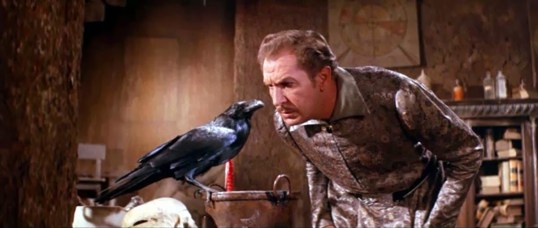
Halloween’s coming to an end. Actually, here in America, it’s come to an end everywhere except on the west coast. What better way to bring our annual Horrorthon to a close than spending a few minutes with Vincent Price and the Raven?
Unfortunately, I don’t know exactly when this was filmed. But no matter! It’s Vincent Price reading Edgar Allen Poe!
Today, I present to you one of the most important films in horror history. Though it wasn’t appreciated when it was first released back in 1964, The Last Man On Earth was not only the 1st Italian horror film but George Romero has also acknowledged it as an influence on his own Night of the Living Dead.
It’s easy to be a little bit dismissive of The Last Man On Earth. After all, the low-budget is obvious in every scene, the dubbing is off even by the standards of Italian horror, and just the name “Vincent Price” in the credits leads one to suspect that this will be another campy, B-movie. Perhaps that’s why I’m always surprised to rediscover that, taking all things into consideration, this is actually a pretty effective film. Price does have a few over-the-top moments but, for the most part, he gives one of his better performances here and the black-and-white images have an isolated, desolate starkness to them that go a long way towards making this film’s apocalypse a convincing one. The mass cremation scene always leaves me feeling rather uneasy.
The film is based on Richard Matheson’s I Am Legend and no, it’s nowhere as good as the book. However, it’s still a worthy adaptation and one that stays true to the tone of the text, including the fact that Price’s main tormenter was also once his neighbor and best friend. This is one of those films that just hits differently in the wake of 2020’s COVID hysteria.
And now, it’s time for The Last Man On The Earth….
I saw that today is the 100th birthday of one of the few men to have actually earned the right to be called the “King of Late Night,” Johnny Carson. In honor of the occasion and the month, here’s Johnny interviewing Vincent Price.
This clip is from the September 27th, 1973 episode of The Tonight Show. Vincent was on the show to promote his upcoming movie, Theatre of Blood. During the interview, he also discussed Boris Karloff and Peter Lorre. This clip features two class acts at their best.