The TSL Horror Grindhouse: The Phantom of the Opera (dir by Dwight H. Little)


1989’s The Phantom of the Opera opens in what was then-modern day Manhattan.

Christine Day (Jill Schoelen) is a young opera singer who is searching for the perfect audition piece.  Her friend, Meg (Molly Shannon), suggests that she use an obscure opera piece called Don Juan Triumphant.  The opera was written by Erik Destler, a mysterious composer who was accused of murdering several opera singers in the 1800s.  That morbid fact only makes Christine all the more convinced that she should use the piece in her audition and you know what?  I would probably feel the same way.  If nothing else, it would certainly appeal to my subversive side.

Even after Christine imagines seeing blood seeping off the pages of the opera, she remains committed to auditioning with it.  Unfortunately, at the audition, a sandbag falls on her head.  She’s knocked unconscious and, when she wakes up, she finds herself in 1885 London.  She’s an understudy for a diva named La Carlotta (Sharon Lawrence).  Carlotta has skill and technique but her singing lacks emotion.  She hits each note perfectly but she brings no deeper meaning to her performances.  Christine may lack Carlotta’s polish but she sings with emotion.  For that reason, Carlotta is jealous of Christine.  Meanwhile, Erik Destler (Robert Englund), who lives in the sewers of London’s opera house and who wears a mask over his disfigured face, feels that Christine is the only one who can do his work justice and he’s willing to go to any length to make sure that she’s the one who performs on stage.

At the time he made The Phantom of the Opera, Robert Englund was still regularly playing Freddy Krueger.  The film’s version of Erik Destler does owe a bit to Krueger.  Erik is as ruthless as Freddy, he’s good with a quip, he’s just as willing to kill, and, needless to say, he also has a face that will haunt your nightmares.  That said, Erik is also a creative artist, which is something that Freddy never was.  If Freddy was motivated by revenge, Erik is motivated by a desire to see his work come to life the way that he’s always imagined it.  Erik murders to help Christine (regardless of whether or not Chrsitine actually wants the help) whereas Freddy killed because he enjoyed it.  Englund gives a good performance as Erik, occasionally playing the role with the type of broadness that is to expected from a B-horror film but also still offering hints of the artist that Erik once was.  Englund is well-matched with Jill Schoelen, who brings a likable energy to Christine.

Produced by Menahem Golan and Harry Alan Towers, The Phantom of the Opera is an entertaining B-movie, one that is obviously not meant to be taken too seriously.  Director Dwight H. Little keeps the action moving at a steady pace, the sets and the costumes are to die for, the kills are unapologetically bloody, and the film even manages to put an interesting twist on the whole “it was all dream!” thing.  The Phantom of the Opera is an enjoyably macabre showcase for two of the best horror performers of the 80s and 90s, Jill Schoelen and Robert Englund.
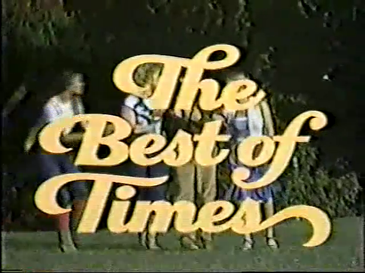
 

Retro Television Review: The Best Of Times


Welcome to Retro Television Reviews, a feature where we review some of our favorite and least favorite shows of the past!  This Thursday, I will be reviewing The Best Of Times, which aired its only episode on ABC in 1981.  The show can be found on YouTube!

Episode 1.1 “Pilot”

(Dir by Don Mischer, originally aired on July 31st, 1981)

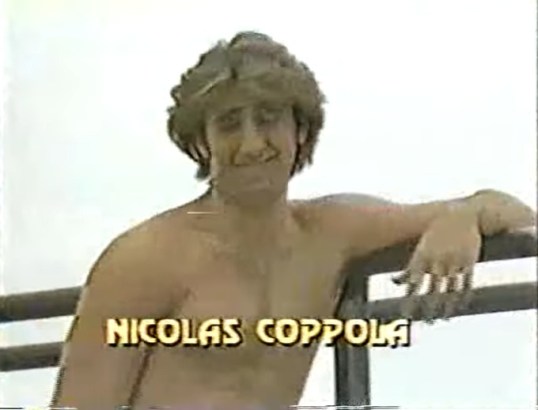
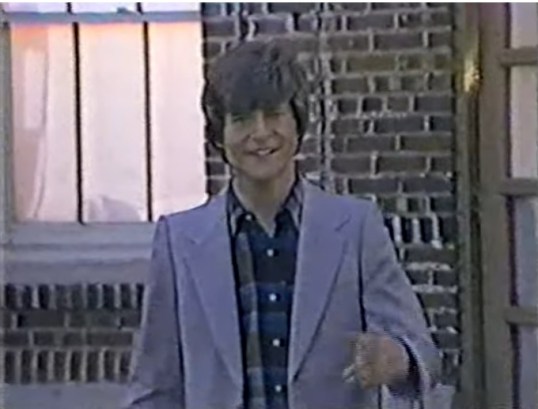
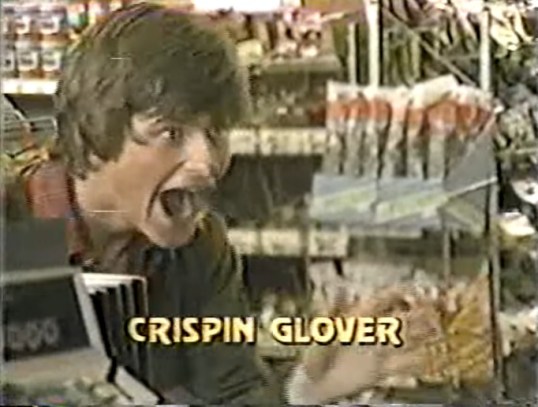
The Best of Times opens with a teenage Crispin Glover in his bedroom. Looking straight at the camera, he introduces himself as “Crispin.” His unseen mother starts to yell at him about cleaning his room. Crispin smiles nervously and then introduces us to the kids he hangs out with. There’s Jill Schoelen, Julie Piekarski, Kevin Cortes, Lisa Hope Ross, David Rambo, Janet Robin, and “my friend” Nicolas Coppola.

Nicolas Coppola, of course, would soon be better known as Nicolas Cage. Both Cage and Glover made their screen debuts in The Best of Times. While Glover spends his time talking directly to the camera and smiling awkwardly, Cage spends his time exercising at the beach and talking about sports. The big school dance is coming up, and all of Crispin’s friends are either trying to find dates or the perfect pair of jeans or else they’re trying to join a band. Nicolas Cage, however, isn’t worried about any of that. He’s confident and smooth.

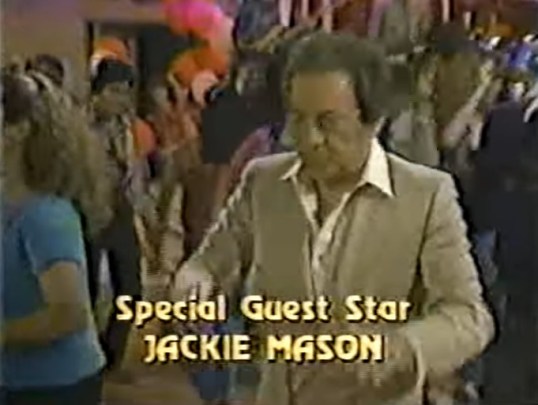
The plot of The Best of Times is not easy to summarize. The show was executive-produced by George Schlatter, the creator of Laugh-In, and it tries to imitate that classic show’s format, just with teenagers in the ’80s. There are quick blackout sketches. There’s a lot of corny one-liners. There’s a surprisingly large number of musical numbers. Crispin Glover puts on a pair of jeans, and all the girls in the cast start singing “Heartbreaker.” “Special guest star” Jackie Mason plays Mr. O’Reilly and rolls his eyes about the kids nowadays. Crispin looks at the camera and tries to explain why teenagers get a little crazy sometimes. “Try to remember,” he tells the parents watching, “when you were our age.”

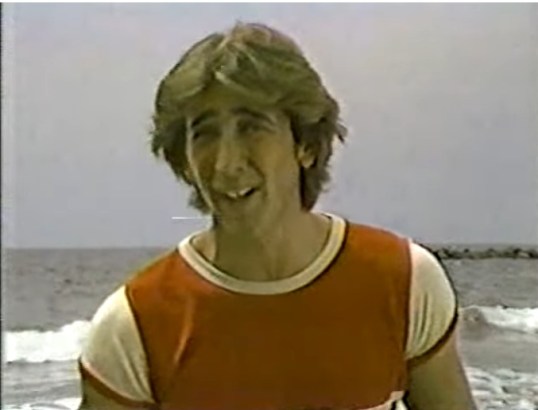
There’s one dramatic moment. Nicolas Cage stands on the beach and gives a dramatic monologue about how, if war breaks out in El Salvador, he’ll serve his country. His father served in Korea and still suffers from PTSD. Nic hopes that there isn’t a war, but if there is, he’ll be there.

The Best of Times is energetic and relentless, and it’s also rather corny and predictable. It may have been made by the guy behind Laugh-In, but it feels more like a lesser episode of MADtv. (“Tonight, Mad TV looks at teenagers!”) With the exception of Crispin Glover and Nicolas Cage, most of the members of the cast are interchangeable. This show features not one but two dorky guys who can’t get dates to the big dance. That might be realistic, but it still feels like overkill.

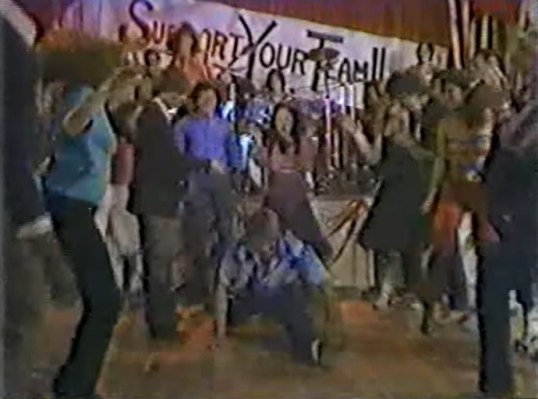
That said, it is a pilot starring a young Nicolas Cage. Compared with the actor he would become, Cage is fairly restrained here. He’s likable, but he’s also clearly an actor carefully following direction. The only time he really gets to let loose is at the school dance. His moves are killer.

The Best of Times was not turned into a regular series. Nicolas, Crispin, and Jill Schoelen went on to become beloved cult actors. As for the rest of the cast, David Rambo is now an award-winning playwright, and Janet Robin is an acclaimed composer and guitarist. I doubt any of them remember much about this pilot, but I’m glad they’ve gone on to live the best of times.

October Hacks: Popcorn (dir by Mark Herrier and Alan Ormsby)


The 1991 film, Popcorn, tells the story of what happens when an experimental film goes wrong.

In the late 60s, a freaked-out hippie named Lanyard Gates directed a short film called Possessor.  Possessor featured footage of him apparently preparing to sacrifice a woman on an altar.  Gates declined to film a third act conclusion to the film.  Instead, he murdered his family on stage and in front of a terrified audience.  The resulting panic caused a fire to break out, killing almost everyone at the Dreamland Theater.  As a result, Possessor has become a legendary film, one that is believed lost.  Of course, it’s not lost, as a group of film students and their professor find out over the course of Popcorn.

Years later, one of those film students, an aspiring screenwriter named Maggie (Jill Schoelen), has been having disturbing nightmares about being caught in a fire and being pursued by a madman.  When she sees Possessor, she realizes that much of the imagery in her dreams comes from the film.  When Maggie attempts to talk to her mother about all of this, Suzanne (Dee Wallace) denies knowing anything about Possessor or Lanyard Gates but it’s not hard to tell that she’s lying.

Still, Maggie does have other things to worry about.  Her school’s film department has been hit by budget cuts and neither she nor her classmates will be able to make their student films unless they raise some money.  One of the students, Toby (Tom Villard), suggests holding a fundraiser at the Dreamland Theater, where they could show old movies and even recreate some of the old gimmicks that were used to promote those movies.  Professor Davis (Tony Roberts) thinks that is a great idea!  Why, he could even control the giant, remote-controlled bug that was used to promote Mosquito!

Filmed in Jamaica (and featuring a somewhat random performance by a reggae band), Popcorn was originally offered to director Bob Clark.  However, Clark didn’t want to return to the horror genre so, instead, it was Clark’s frequent collaborator, Alan Ormsby, who was hired to direct the film.  Reportedly, Ormsby was replaced a few weeks into filming by Mark Herrier, with the assumption being that the producers felt that Ormsby was spending too much time on filming the three fake movies that are screened during the fund raiser.  Those films are Mosquito, The Attack of the Electrified Man, and a dubbed Japanese film called The Stench.  In the film’s credits, Ormsby is credited with directing the three fake film while Mark Herrier is credited with directing the “modern” scenes.

Perhaps not surprisingly, the three fake film are actually the best thing about Popcorn.  If Alan Ormsby was taking a lot of time to shoot the fake films, it obviously paid off because all three of them perfectly capture the feel of the era when they were supposedly shot and all of them are filled with the type of details that only a true fan of old horror movies would think to include.  Mosquito is a giant bug film that feels as if it could have come straight from 1957.  The Amazing Electrified Man feels like one of the films that poor Lon Chaney Jr. would have found himself starring in after leaving Universal.  And The Stench is the perfect import — slow-moving, a bit pompous, and terribly dubbed.

As for the rest of Popcorn, it’s a well-made slasher film.  Mark Herrier did a good job directing the “modern” scenes, with a scene in which the killer’s face seems to literally melt after he kisses one of his victims being a definite creepy highlight.  The kills are reasonably creative and, in one case involving electrocution, rather disturbing.  Jill Schoelen is a likable heroine, Derek Rydall is cute as her hapless boyfriend, and Tom Villard’s uninhibited performance gives the film a much-needed jolt of energy.  Though the old films may be the highlight of Popcorn, the “modern” scenes hold up as well.

Horror Movie Review: When A Stranger Calls Back (dir by Fred Walton)


The 1993 film, When A Stranger Calls Back, opens with the recreation of an urban legend.

A teenager babysitter named Julia Jenz (Jill Schoelen) arrives at a big suburban house for a routine baby-sitting gig.  The two children are already asleep in bed.  All Julia has to do is sent in the living room and do her homework until the parents return from their party.  Julia settles in.  She gets one mysterious phone call but hangs up.

Then, someone knocks on the door.

The man on the other side of the door explains that his car has broken down and he asks if he can come inside to call his auto club.  (This is one of those films that could have only worked in the age of landline phones.)  Julia doesn’t want to let the man into the house but the man is insistent that he needs Julia’s help.  Finally, Julia says that she’ll call the auto club for him but, when she goes to the phone, she finds that the line is dead.  Rather than tell the man the truth, Julia lies to him and says that she called the auto club.  The man thanks Julia and says that he’s returning to his car.

(What is an auto club?)

Eventually, the man returns, knocking on the door and asking if Julia really called the auto club.  Julia continues to lie, even as the man becomes increasingly belligerent.  What Julia doesn’t know but soon discovers is that the man is not outside talking to her but he’s actually inside of the house.  And he’s abducted the children!

The opening scene, which of course harkens back to the original When A Stranger Calls, is a genuinely well-done and suspenseful sequence.  Again, much like as if with the first film, the opening of When A Stranger Calls Back is so strong that the rest of the film can’t really keep up.

When A Stranger Calls Back is indeed a sequel to When A Stranger Calls, which means that, after Julia’s terrifying night of babysitting, the film jumps forward five years.  The children are never found and the man who knocked on the door is never identified.  Julia is now a college student but she’s still traumatized by the night and has a difficult time trusting anyone.  When she starts to suspect that someone has been in her apartment, she turns to Jill Johnson (Carol Kane), who is a counselor at the college and also the protagonist from When A Stranger Calls.  Jill helps Julie out, teaching her how to shoot a gun and also calling in the man who killed her stalker, John Clifford (Charles Durning).  Clifford figures out that Julia’s stalker is probably a ventriloquist.  Personally, I think the film made a huge mistake by making the stalker a ventriloquist instead of the ventriloquist’s dummy.

Despite strong performances from Carol Kane, Charles Durning, and Jill Schoelen, When A Stranger Calls Back suffers from the same problem as When A Stranger Calls.  After a scary and effective opening sequence, the rest of the film just feels like a letdown.  The killer in When A Stranger Calls Back is not quite as wimpy as the phlegmatic British guy from the first When A Stranger Calls but still, how intimidated can you be by a ventriloquist?  An even bigger problem is that When A Stranger Calls Back cheats at the end, suddenly revealing that a character who we had every reason to believe to be dead is actually alive.  It feels a bit as cop out on the part of the film, an attempt to slap an improbable happy ending on a film that would otherwise be pretty dark.

These films make me happy that I was never responsible enough to be a babysitter.

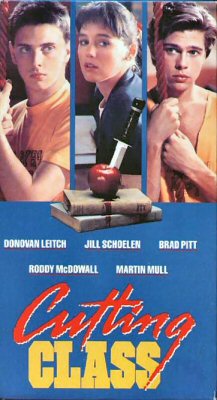
The TSL’s Horror Grindhouse: Cutting Class (dir by Raspo Pallenberg)


Someone is murdering the students and the teachers at the local high school and it’s up to Paula Carson (Jill Schoelen), the studious daughter of the local DA (Martin Mull), to figure out who is responsible!

Though the principal (Roddy McDowall, who seemed to be cast as a lot of bizarre school employees during the latter half of his career) is a perv and the janitor (Robert Glaudini) fancies himself as being some sort of bizarre ninja with a mop, it soon becomes apparent that there’s really only two viable suspects. One of them is Brian Woods (Donavon Leitch), who has just returned home after spending several months in a mental hospital where he was regularly given electroshock therapy. The other is Dwight Ingalls (Brad Pitt), the alcoholic jock who is under tremendous pressure to win a basketball scholarship and who also happens to be Paula’s boyfriend! Brian and Dwight were friends when they were younger. Now, Dwight spends all of his time bullying Brian and Brian spends all of his time staring at Paula. Who could the murderer be!?

Actually, you won’t be surprised at all when the identity of the murderer is revealed. You’ve probably already guessed who the killer is. A campy slasher film from 1989, Cutting Class doesn’t exactly win any points for originality. If Cutting Class is remembered for anything, it’s for providing Brad Pitt with an early leading role. Pitt, it should be said, is totally convincing as Dwight. On the one hand, he’s such a jerk that it’s difficult to really like him but, on the other hand, he looks like Brad Pitt so you totally can’t blame Paula for putting up with him. For that matter, both Leitch and Schoelen give convincing performances as well. When you’ve got a trio as talented as these three, it’s kind of a shame that Cutting Class wasn’t a better film.

Cutting Class tries to mix horror and comedy but the comedy is too broad (Roddy McDowall leers like a cartoon wolf) while the horror is not quite horrific enough and, as such, the film never really settles on a consistent or an interesting tone. Whenever the film starts to get into a horror grove, Martin Mull shows up like a character in an overplayed Saturday Night Live skit. Whenever the film starts to find itself as a comedy, someone is horribly murdered and you’re totally taken out of the mood. This is also another one of those films where the characters randomly switch from being ludicrously stupid to unnaturally intelligent from scene-to-scene. The killer, for instance, is diabolically clever until the film’s final moments, at which point the murderer suddenly gets very talky and very easily fooled.

Cutting Class is occasionally interesting as a time capsule. It’s from 1989, after all. And it’s interesting to see Brad Pitt playing the type of character one would more likely expect to see on a very special episode of Saved By The Bell. Otherwise, this one is fairly forgettable.

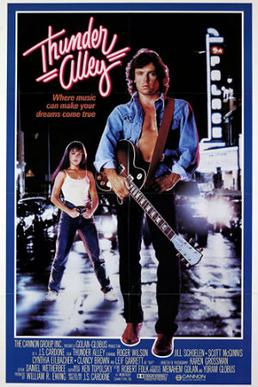
Thunder Alley (1985, directed by J.S. Cardone)


Richie (Roger Wilson) is an Arizona farm boy who can play the guitar like a riot and who, after he joins a band called Magic, discovers that success is a hideous bitch goddess.

Thunder Alley was a Cannon production and it features all of the usual rock movie clichés.  Though Richie is reluctant to join Magic and leave his family behind, he soon emerges as the most talented member of the band and he starts to overshadow the arrogant lead singer, Skip (Leif Garrett).  Donnie (Scott McGinnis), who is Richie’s best friend in the band, gets hooked on cocaine while Richie struggles to resist groupie temptation and remain loyal to his sweet girlfriend, Beth (Jill Schoelen).  The band depends on their road manager, Weasel (Clancy Bown), to get them on stage in time and to protect them from dishonest club owners.

As predictable as it may be, Thunder Alley is one of the better films to be distributed by Cannon Films in the 80s, which is saying something when you consider that Thunder Alley doesn’t feature Michael Dudikoff, Chuck Norris, or Charles Bronson.  The thing that sets Thunder Alley apart from so many other similar films is that, when you actually see Magic perform and hear their music, you actually believe that the band could be a success.  This isn’t one of those films where everyone is feigning enthusiasm for a band that sounds terrible.  Instead, Magic actually sounds like a band that could have gone all the way in 1985.  The scenes of them going from one cheap motel to another while coming together as a band feel as authentic and real as the scenes of Skip angrily realizing that Richie has replaced him as the face of Magic.

Though he was probably cast because he was one of the stars of Porky’s, Roger Wilson was also an actual musician and he’s credible whenever he’s performing on stage.  The same can be said of former teen pop idol Leif Garrett, who plays an actual rock and roller in Thunder Alley and who is surprisingly convincing in the role.  Sporting an impressive beard, Clancy Brown is the ideal road manager while Jill Schoelen brings a lot of life to her small role as Richie’s loyal girlfriend.

For a film that is all about sex, drugs, and rock and roll, Thunder Alley has an innocent side.  Even after he becomes a star and he’s got groupies going crazy every time he steps up to a microphone, Richie’s main concern is making sure that he gets home in time to help his father with the harvest.  Thunder Alley not only asks how far you would go to be a star but also suggests that there’s nothing wrong with choosing, instead, to be a loyal boyfriend or a good son.  Thunder Alley brings it own earnest approach to all of the usual rock and roll clichés and suggests that, with the right combination of talent and hard work, you can have it all, the farm and the stage.

Of course, it helps if you’ve got Clancy Brown looking out for you.


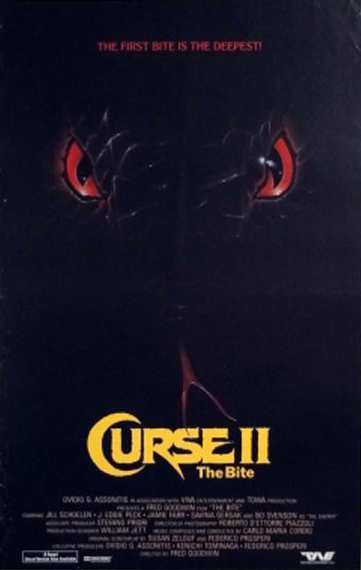
Snakes On A Vacation: Curse II: The Bite (1989, directed by Frederico Prosperi)


Clark (J. Eddie Peck) and his girlfriend, Lisa (Jill Schoelen), are vacationing in New Mexico.  It’s a romantic getaway, except for all of the snakes.  Clark manages to save Lisa from one snake through the use of his trusty rifle but then he himself gets bitten once they go to a motel.  Luckily, traveling salesman Harry Morton (Jamie Farr!) has a suitcase that’s full of anti-snake venom antidotes.  Unfortunately, the one that Harry gave to Clark doesn’t do much good because not only does the bite on Clark’s arm get worse but it starts to turn into a snake!  In fact, his entire body is full of snakes, just trying to slither out!  It’s a vacation from Hell as Lisa tries to find a cure for Clark, Clark tries to control his serpent-like instincts, and Harry tries to find the young couple so that they don’t sue him.

This is an unrelated sequel to a film called The Curse.  In fact, it’s probable that this film was just called The Bite until the first Curse did slightly better at the box office than anyone expected.  The two films share not a single character or plot point in common.  There’s not really even a curse in this so-called sequel!  Clark’s problems are all due to the snake being radioactive.  (Once again, science is to blame.)  It’s a typically cheesy, low-budget 80s horror film but it does have a few things to recommend it.  The special effects range between being enjoyably cheap and effectively gross.  Jamie Farr is entertaining as Harry Morton and seems to be happy to not be playing Klinger again.  The truckers that Harry enlists to help him search for Lisa and Clark are all colorful characters and they are a little more interesting than the usual horror movie canon fodder.  Bo Svenson also has a good cameo as the sheriff.

Best of all, the film features one the greatest scream queens of the late 80s and early 90s, Jill Schoelen.  Schoelen is best remembered for her role in The Stepfather but she actually appeared in several horror movies between 1987 and 1993.  As she was in almost all of her roles, Jill Schoelen is both sexy and believable in The Bite.  She had a talent for making even the worse dialogue sound natural and that was a talent that The Bite gave her many chances to display.

The Bite is hardly a great film but, by the standards of late 80s cable fare, it’s undeniably entertaining.


Horror Film Review: The Stepfather (dir by Joseph Ruben)


Who is Jerry Blake?

That is the question at the heart of the classic 1987 horror thriller, The Stepfather.

Most of the people who know Jerry (brilliantly played by Terry O’Quinn) would say that he’s just a really nice guy.  He’s responsible.  He’s a good employee.  He can be trusted.  He works in real estate and spends his days selling perfect homes to perfect families.  Jerry always has a friendly smile and hearty manner.  He’s the perfect neighbor, precisely because he’s so boring.  You don’t have to worry about Jerry not taking care of his yard or throwing a loud party or … well, doing anything anyone else would do.  Sure, Jerry seems to be a little bit old-fashioned and sure, sometimes he’s a little bit too good to be believed.  But what’s wrong with that?  I mean, the man makes birdhouses!  Jerry is so dedicated to creating perfect families that he even tries to make the perfect home for the birds in his back yard!

In fact, the only person who seems to have any doubts about Jerry is his new stepdaughter, Stephanie (Jill Schoelen).  Stephanie is a teenager so, occasionally, she’s less than perfect.  Sometimes, she gets into a fight at school.  Sometimes, she talks back.  To be honest, to me, nothing she does seems like it’s really that big of a deal.  But Jerry simply cannot handle the fact that Stephanie is making his new family just a little less than perfect.  When Jerry catches Stephanie and her boyfriend sharing a very chaste kiss, he freaks out.  KISSING!?  Why that could only lead to one thing…

But it’s not just that Jerry is kind of controlling and seems to be living in a 1950s sitcom.  There’s also the fact that sometimes, Jerry goes down in the basement and just starts yelling and throwing stuff.  That’s what Jerry does when he gets angry.  He hides in the basement and he totally loses control.  When Stephanie overhears him, Jerry just gives her a bland smile and says that he was blowing off some steam.

Stephanie suspects that something’s wrong with Jerry but, of course, no one believes her.  However, we know that Stephanie’s right to be suspicious.  At the start of the film, we saw Jerry walking out of his old house, leaving behind the dead bodies of his wife and children.  At that time, of course, Jerry’s name was Henry Morrison.  Henry’s previous family disappointed him so he killed them and then vanished, changing his identity and marrying Stephanie’s mother, Susan (Shelley Hack).

Jerry wants everything to be perfect.  He’s an old-fashioned guy with old-fashioned values and, whenever anyone disappoints him, he kills them and changes his identity once again.  He’s the type who will kill you but then make sure that your seat belt is fastened when he puts you back in your car.  “Buckle up for safety,” Jerry says.

There’s a 2009 remake of The Stepfather.  For some reason, it regularly shows up on Lifetime.  Ignore the remake and track down the original.  Long before he played John Locke on Lost, Terry O’Quinn gave a simply amazing performance in the role of Jerry Blake.  Jerry is so friendly and likable that, even though we know he’s a murderer, it’s still hard not to fall under his spell.

Why, we wonder, can’t the world be as perfect as Jerry wants it to be?

Because Jerry’s world is not the real world.  In the real world, family are never perfect but they love each other anyway.  In Jerry’s world, it’s more important that things appear to be perfect than that anyone actually be honest or, for that matter, happy.

The Stepfather is a chillingly effective thriller, featuring a brilliant performance from Terry O’Quinn.  If you haven’t seen it, see it!

A Movie A Day #131: Rich Girl (1991, directed by Joel Bender)


Courtney Wells (Jill Schoelen) is a rich girl (hence, the title).  Realizing that she is 21 years old and has yet to really experience life, Courtney declares her independence.  She breaks up with her cheating fiancée and tells her industrialist father (Paul Gleason, of course) that she no longer wants to go into the family business.  When her father responds by cutting her off, the rich girl becomes a poor girl.  Though she struggles at first, Courtney eventually trades her Ferrari for a reasonable car, finds a cheap apartment, and gets a job working as a waitress at a trendy Los Angeles nightclub, which is owned by Rocco (Ron Karabastos, of course).  She falls in love with aspiring musician Rick (Don Michael Paul) but he is already involved with his cokehead lead singer (Cherie Currie) and Courtney’s father will do anything to keep her and Rick apart.

In the early 1990s, Rich Girl was a late night HBO mainstay.  There is nothing surprising about the movie and Rick’s band has a sound that was already dated by 1991.  (While the rest of America is learning to love grunge, Rick and his band are still playing Bon Jovi cover tunes in the garage.)  However, Rich Girl does star the always gorgeous Jill Schoelen, which makes it a hundred times better than every other low-budget film that showed up on HBO in the early 90s.  Whatever happened to her?

Look familiar?

Here’s why.

Horror On The Lens: Cutting Class (dir by Rospo Pallenberg)


Cutting_Class_film_poster

it’s been said that, early in the career of every Oscar nominee, there’s a film or two that he probably wishes would be forgotten.  Today’s movie is one of those films, 1989’s Cutting Class.

Cutting Class is, in many ways, a fairly standard 1980s slasher comedy hybrid.  It features a stronger heroine than most and it does a bit of a better job than expected at making you guess who the killer is but, for the most part, Cutting Class is mostly memorable for being one of Brad Pitt’s first major roles.

The bad news is that the character he’s playing here is kind of an asshole and not even the fact that he looks like Brad Pitt can make him likable.

The good news is that Brad Pitt has always been hot.

And here’s the proof…