His Private Secretary (1933, directed by Phil Whitman)


Business tycoon Mr. Wallace (Reginald Barlow) is sick and tired of his hard-drinking, hardy-partying son refusing to act in a responsible manner.  Hoping to teach Dick Wallace about the value of hard work, Mr. Wallace sends Dick to a small town with instructions to collect a debt from the local preacher (Alec B. Francis).  Dick, however, is more interested in the preacher’s daughter, Marion (Evelyn Knapp).  After Dick finally convinces Marion that he’s not as bad his reputation, they got married.  Mr. Wallace is disgusted and refuses to meet his new daughter-in-law, convinced that she’s a golddigger.  Without revealing his true identity, Marion gets a job as Mr. Wallace’s private secretary and attempts to repair the relationship between father and son.

This is a creaky romantic comedy from the early days of sound film and it would probably be forgotten if not for the fact that Dick Wallace is played by John Wayne.  Wayne was 26 when he played Dick Wallace and already a screen veteran, though most of his roles had been in B-westerns and had featured Wayne riding a horse and carrying a gun.  Wayne actually gives a pretty good performance as Dick.  He’s better and more natural here than he was in many of the singing cowboy films that he was making at the time and this film suggests an alternate timeline where Wayne become known as a romantic comedy star instead of a screen cowboy.  Wayne is especially good in the early scenes, when he’s still a no-good, hard-drinking, no-account lout.  I get the feeling he enjoyed not having to be the upright hero for once.

His Private Secretary definitely shows its age but it’s worth watching for a chance to see a young John Wayne in an unexpected role.

March True Crime: The Hunt For The Unicorn Killer (dir by William A. Graham)


Who started Earth Day?

There are a lot of names that get mentioned.  Some people give all the credit to U.S. Senator Gaylord Nelson of Wisconsin, who was  an environmentalist before it was trendy and who proposed a day-long “teach-in” in 1970.  (According to Norman Mailer, Hunter Thompson, and Gary Hart, Gaylord Nelson was also George McGovern’s personal pick for his running mate in 1972 but ultimately, Nelson didn’t get the spot because it was felt people would make fun of his first name.  Considering how things went with Thomas Eagleton, one imagines that McGovern probably ended up wishing he had the courage to go with his first instinct.)  A peace activist named John McConnell also proposed the idea of an Earth Day in 1969 but there’s some debate whether his proposed Earth Day became the actual Earth Day.  Like all things, many people have taken credit for the idea behind Earth Day.

Ira Einhorn was one of those people.  A prominent member of Pennsylvania’s counter-culture, Einhorn was a self-styled New Age environmentalist and he did speak at the first Earth Day event in Philadelphia.  Einhorn went on to become a prominent guru, providing his services to several corporations that were looking to shake off their stodgy image.  He led protests against nuclear energy.  He wrote articles about CIA duplicity.  He was, for a while, a popular figure and, due to his last name, he was nicknamed “The Unicorn.”  He always claimed that he was instrumental in starting Earth Day but the organizers behind the event have always been quick to say that he had little do with it.

It’s understandable that the people behind Earth Day would rather not be associated with Ira Einhorn.  Einhorn presented himself as being a quirky, fun-loving hippie but, in private, he was known for having both a violent temper and a misogynistic streak.  In 1977, Einhorn’s ex-girlfriend, Texas-born Holly Maddux, disappeared.  In 1979, her mummified remains were found in a box that Einhorn kept in his closet.  Arrested for her murder and defended in court by future U.S. Sen. Arlen Specter, Einhorn claimed that he was innocent and that he had no idea how Holly Maddux ended up in his closet.  (He suggested the CIA might be responsible.)  With the help of his wealthy friends, Einhorn fled the United States and ended up in Europe.  He lived in Europe for nearly 20 years until he was finally arrested in France.  Einhorn’s claim that he was being framed for his anti-nuclear advocacy found a sympathetic audience amongst certain members of the French intellectual community.  Eventually, though, Ira Einhorn was extradited to Pennsylvania.  He spent the rest of his life in prison, eventually dying in 2020.  To the end, he had his supporters despite the fact that he was clearly guilty.

Made for television in 1999, The Hunt For The Unicorn Killer tells the story of Ira (Kevin Anderson), Holly (a pre-Mulholland Drive Naomi Watts), and Holly’s father, Fred (Tom Skerritt).  It does a good job of telling the disturbing story of Ira Einhorn and it features good performances from its main stars.  Tom Skerritt especially does a good job as a father determined to get justice for his daughter.  The film shows how so many of Ira’s friends rationalized his actions, not wanting to admit that their nostalgia for the 60s and the counterculture was blinding them to the monster in their midst. It’s a portrait of how one evil man was able to take advantage of the idealism of others.

The Hunt For The Unicorn Killer‘s original running time was 163 minutes and it was aired over two nights.  It was later edited down to 90 minutes for syndication.  The uncut version is available on YouTube and that’s definitely the one to see.

Guilty Pleasure No. 78: Armageddon (dir by Michael Bay)


Remember that time that Bruce Willis and a team of oil drillers saved all of humanity from a giant asteroid that was apparently the size of Texas?

Sure, you do!  Everyone remembers Armageddon!

1998’s Armageddon is a film that doesn’t get a lot of respect but which everyone remembers.  There’s been a lot of movies made about giant asteroids on a collision path with the Earth.  Ever since scientists announced that a collision with a comet or an asteroid probably killed the dinosaurs, there’s been a somewhat irrational fear that the same thing could happen to us.  Back in 1978, Sean Connery and Karl Malden tried to stop a Meteor (and failed).  In 1998, the same year that Armageddon came out, Morgan Freeman, Robert Duvall, and Elijah Wood tried to stop an asteroid from causing a Deep Impact (and failed).  Adam McKay made an entire film about everyone saying, “Don’t Look Up,” in an attempt to promote increased panic about climate change (and failed).  (“I’m so scared!” Leonardo DiCaprio shouted and audiences responded, “Oh, calm down.”)  And yet, it’s Armageddon — ridiculed by critics, endlessly parodied by other movies — that people use as their go-to source for commenting on the prospect of a mass extinction event.  Mostly because, in Armageddon, humanity didn’t fail.  Bruce Willis showed that asteroid who was boss!

Why do we love Armageddon?  A lot of it has to do with the cast.  Not only do you have Bruce Willis battling an asteroid but you’ve also got Steve Buscemi, Owen Wilson, Ben Affleck, Will Patton, Michael Clarke Duncan, Peter Stormare, William Fichtner, and a host of others working with him.  You’ve got Billy Bob Thornton working ground control.  You’ve got Liv Tyler, somehow managing to give a decent performance even while Ben Affleck attacks her with animal crackers.  It’s not just the cast is full of familiar and likable actors.  It’s that the members of the cast know exactly what type of film that they’re appearing in and they all give exactly the right type of performance for that film.  They deliver their lines with conviction while not making the mistake of taking themselves too seriously.  Bruce Willis announces that his crew will destroy that asteroid in return for never having to pay taxes again and he announces with just the slightest hint of a smirk, knowing that the audience is going to cheer that moment.

But really, the real reason why Armageddon has survived that test of time is because it’s just so utterly shameless.  Director Michael Bay will never be accused of being a subtle director but Bay instinctively understood that Armageddon was not a film that demanded subtlety.  Armageddon is a film that demands that constantly moving camera and all of those carefully composed scenes that were clearly made so they could be included in the trailer.  It’s a film about big moments and big emotions.  Unlike something like Deep Impact, it doesn’t get bogged down in trying to be better than it actually is.  Unlike Don’t Look Now, it doesn’t degenerate into a bunch of histrionic speeches.  Armageddon exists to make the audience cheer and it succeeds.  It takes guts to include a slow motion scene of a bunch of kids celebrating in front of a faded Kennedy For President poster but Bay is exactly the type of director who can pull that off.  Michael Bay’s style is not right for a lot of films.  But it was perfect for Armageddon.

As I sit here typing this, there are some people panicking because there’s speculation that a meteor is going approach the Earth in the 2030s.  It’ll probably miss us but who knows?  But you know what?  I’m not worried at all.  I’ve seen Armageddon.  So, on this International Earth Day, let’s remember the courageous men who saved this planet back in 1998.

Previous Guilty Pleasures

  1. Half-Baked
  2. Save The Last Dance
  3. Every Rose Has Its Thorns
  4. The Jeremy Kyle Show
  5. Invasion USA
  6. The Golden Child
  7. Final Destination 2
  8. Paparazzi
  9. The Principal
  10. The Substitute
  11. Terror In The Family
  12. Pandorum
  13. Lambada
  14. Fear
  15. Cocktail
  16. Keep Off The Grass
  17. Girls, Girls, Girls
  18. Class
  19. Tart
  20. King Kong vs. Godzilla
  21. Hawk the Slayer
  22. Battle Beyond the Stars
  23. Meridian
  24. Walk of Shame
  25. From Justin To Kelly
  26. Project Greenlight
  27. Sex Decoy: Love Stings
  28. Swimfan
  29. On the Line
  30. Wolfen
  31. Hail Caesar!
  32. It’s So Cold In The D
  33. In the Mix
  34. Healed By Grace
  35. Valley of the Dolls
  36. The Legend of Billie Jean
  37. Death Wish
  38. Shipping Wars
  39. Ghost Whisperer
  40. Parking Wars
  41. The Dead Are After Me
  42. Harper’s Island
  43. The Resurrection of Gavin Stone
  44. Paranormal State
  45. Utopia
  46. Bar Rescue
  47. The Powers of Matthew Star
  48. Spiker
  49. Heavenly Bodies
  50. Maid in Manhattan
  51. Rage and Honor
  52. Saved By The Bell 3. 21 “No Hope With Dope”
  53. Happy Gilmore
  54. Solarbabies
  55. The Dawn of Correction
  56. Once You Understand
  57. The Voyeurs 
  58. Robot Jox
  59. Teen Wolf
  60. The Running Man
  61. Double Dragon
  62. Backtrack
  63. Julie and Jack
  64. Karate Warrior
  65. Invaders From Mars
  66. Cloverfield
  67. Aerobicide 
  68. Blood Harvest
  69. Shocking Dark
  70. Face The Truth
  71. Submerged
  72. The Canyons
  73. Days of Thunder
  74. Van Helsing
  75. The Night Comes for Us
  76. Code of Silence
  77. Captain Ron

Insomnia File #67: Heist (dir by Scott Mann)


What’s an Insomnia File? You know how some times you just can’t get any sleep and, at about three in the morning, you’ll find yourself watching whatever you can find on cable or streaming? This feature is all about those insomnia-inspired discoveries!

If you find yourself awake later tonight, you can always go over to Tubi and watch the 2015 direct-to-video action thriller, Heist.

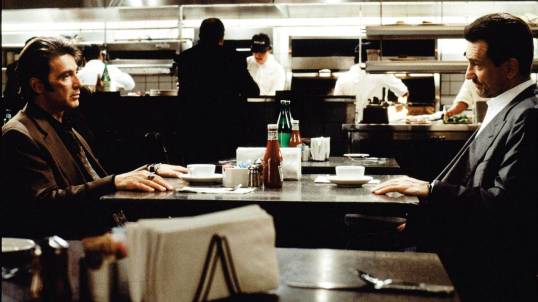
Heist takes place in Louisiana.  Francis “The Pope” Silva (Robert De Niro) is a mobster and businessman who owns a riverboat casino.  The Pope lives his life according to a set of simple but very specific rules.  He doesn’t lend money.  He doesn’t forgive people who betray him.  If you steal from him, he will track you down and he will get his money back and he will make you regret your decision.  Working as his main henchman is the sadistic Dog (Morris Chestnut).  The Pope’s former main henchman was a man named Luke Vaughn (Jeffrey Dean Morgan) but Luke grew tired of the violence and walked away from it all.  Now, Luke works as a dealer in The Pope’s casino.  His daughter is sick and Luke desperately needs $300,000 to pay her medial bills.  When The Pope refuses to give him the money, Luke teams up with security guard Jason Cox (Dave Bautista) and sets out to rob the place.

The robbery is carefully planned by Luke but, inevitably, things go wrong.  A security guard shows up earlier than he was supposed to.  A shootout leads to Jason’s best friend, Dante (Stephen Cyrus Sepher), getting shot.  The getaway driver panics and drives off, leading to Luke, Cox, and Dante hijacking a bus.  Cox orders the bus driver (D.B. Sweeney) to take them to Galveston but Luke is more concerned with getting the money to his daughter.  Meanwhile, two police officers — Kris Bajos (Gina Carano) and Detective Marconi (Mark-Paul Gosselaar) — follow the bus, each pursuing their own agenda.

Considering that this film is basically a low budget rip-off of Speed (albeit without a bomb threatening to take out the cast), Heist has an impressive cast and they all do a good job of elevating the film above its B-movie origins.  Don’t get me wrong.  There are hundreds of plot holes to be found in Heist.  The film’s big twist really doesn’t make much sense when you think about it.  But, in the end, Heist is an entertaining thrill ride that moves quickly enough that most viewers really won’t have time to obsess on all the lapses of logic.  Morgan plays his role with just enough heart that you want his criminal to succeed.  De Niro brings some extra layers to a role that could have been a caricature.  There’s a brief scene in which he meets his estranged daughter (Kate Bosworth) and, as a result, you suddenly see his character in an entirely new light.  As a character who seems like a much more sinister version of Zach Morris, Mark-Paul Gosselaar keeps you guessing.  And finally, Gina Carano — years before her cancellation — gives an earnest performance that works despite her character being rather inconsistently written.

Heist is an entertaining and fast-paced action film with a good cast and an interesting story.  If you can’t sleep, you might as well be entertained.

Previous Insomnia Files:

  1. Story of Mankind
  2. Stag
  3. Love Is A Gun
  4. Nina Takes A Lover
  5. Black Ice
  6. Frogs For Snakes
  7. Fair Game
  8. From The Hip
  9. Born Killers
  10. Eye For An Eye
  11. Summer Catch
  12. Beyond the Law
  13. Spring Broke
  14. Promise
  15. George Wallace
  16. Kill The Messenger
  17. The Suburbans
  18. Only The Strong
  19. Great Expectations
  20. Casual Sex?
  21. Truth
  22. Insomina
  23. Death Do Us Part
  24. A Star is Born
  25. The Winning Season
  26. Rabbit Run
  27. Remember My Name
  28. The Arrangement
  29. Day of the Animals
  30. Still of The Night
  31. Arsenal
  32. Smooth Talk
  33. The Comedian
  34. The Minus Man
  35. Donnie Brasco
  36. Punchline
  37. Evita
  38. Six: The Mark Unleashed
  39. Disclosure
  40. The Spanish Prisoner
  41. Elektra
  42. Revenge
  43. Legend
  44. Cat Run
  45. The Pyramid
  46. Enter the Ninja
  47. Downhill
  48. Malice
  49. Mystery Date
  50. Zola
  51. Ira & Abby
  52. The Next Karate Kid
  53. A Nightmare on Drug Street
  54. Jud
  55. FTA
  56. Exterminators of the Year 3000
  57. Boris Karloff: The Man Behind The Monster
  58. The Haunting of Helen Walker
  59. True Spirit
  60. Project Kill
  61. Replica
  62. Rollergator
  63. Hillbillys In A Haunted House
  64. Once Upon A Midnight Scary
  65. Girl Lost
  66. Ghosts Can’t Do It

The Sea Spoilers (1936, directed by Frank R. Strayer)


Bob Randall (John Wayne) is a coast guard boatswain, headquartered in Alaska where he and the members of his crew battle evil seal poachers like oily Phil Morgan (Russell Hicks).  When Randall returns to port after his latest patrol, he has to deal with two disappointments.  First off, he is passed over for a promotion to commanding officer, even though everyone knows that he deserves it.  Instead, the promotion goes Lt. Commander Mays (William Blakewell), the son of a commander (George Irving).  Mays doesn’t even want the job.  He’s scared of the water and he’d rather fly airplane as a part of the Coast Guard’s aviation force.  Bob is disappointed but he’s a professional and he’s going to support Mays.  Secondly, Bob’s girlfriend (Nan Grey) witnesses a murder and is kidnapped by Phil Morgan.  Bob and his sidekick (dependable western mainstay Fuzzy Knight) go undercover as fisherman to try to find her.

The Sea Spoilers was the first of six B-movies that John Wayne did for Universal.  Wayne, who had been stuck in the B’s for a while, was trying to prove that he was more than just a singing cowboy so, in this one, he plays a tough and ready sailor.  Wayne is convincing in the role, even if the movie is really just a western set in what was then modern day Alaska.  Though only 30, Wayne shows the no-nonsense professionalism that would become his trademark once he became one of the world’s biggest movie stars.  Unlike some of Wayne’s early films, it’s possible to see the icon that John Wayne would eventually become while watching him here.  The Sea Spoilers is only 66 minutes long but fans of the Duke should enjoy it.

Finally, The Sea Spoilers was written by George Waggner.  Waggner would later go on to direct the original Wolf Man.

Film Review: Precious Cargo (dir by Max Adams)


2016’s Precious Cargo tells the story of Jack (Mark-Paul Gosselaar) and his ex-wife Karen (Claire Forlani).

Karen is a professional thief who has botched a robbery for her former lover, crime boss Eddie Filosa (Bruce Willis).  Eddie wants Karen dead so, of course, Karen flees down to the Florida everglades, where she finds Jack living in a swamp shack and making love to his latest girlfriend, Jenna (Lydia Hull).  Karen tells them to go ahead and finish up and she’ll just wait out in the kitchen.  Jack in not particularly happy to see Karen again but then he notices that she has a baby bump.  “Always use a condom,” Karen tells Jenna.  Eddie’s men, led by Simon (Daniel Berhardt), attack and it all leads to a boat chase that is surprisingly exciting when you consider that Precious Cargo is a low-budget, direct-to-video offering.

It turns out that Jack can save Karen from Eddie’s wrath by planning and executing a heist for the crime boss.  Jack assembles his crew, Jack gets ready for the heist …. uh-oh, it’s time for a double cross!  The plot is nothing special.  It’s identical to a hundred other low-budget crime films that you’ve seen recently.  It’s the type of thing that Michael Mann could have turned into a metaphor for American ennui but, in this film, it’s just a typical heist.  The viewer enjoys it while it’s happening and then forgets about it two minutes afterwards.

That said, Precious Cargo is not quite as bad as the typical direct-to-video film.  Mark-Paul Gosselaar — yes, Zack Morris himself — gives a reasonably compelling performance as Jack.  To a certain group of people, he’s always be Zack and I imagine he’s sick of people asking him about whether or not he still has his giant phone but, as he’s gone from teen idol to adult actor, Gosselaar has shown himself to be a talented actor.  (For the record, Zack lost his phone in the drunk driving episode.  I know some people say that episode doesn’t count because it was a Tori episode but I say that it does.  So there.)  Claire Forlani is actually more compelling in these direct-to-video films than she ever was in any of the big budget studio films that she used to appear in.

Of course, I imagine that the main selling point for this film was meant to be Bruce Willis.  This is one of the direct-to-video films that dominated the last fourth of Willis’s career.  When Willis retired due to aphasia, there was a general assumption that all of Willis’s direct-to-video films were made as a result of his condition.  I don’t know if that’s quite true.  (It’s entirely possible that he just wanted a quick payday.)  But it is true that Willis only has a few minutes of screentime in Precious Cargo and that several shots involving Eddie were accomplished with a stand-in.  That said, in this film, Willis still brings some energy to the part.  He’s an effective villain, even if I think everyone prefers to see Willis saving the day.  Even in the direct-to-video era, Bruce Willis still had a definite presence.

Precious Cargo is predictable and ultimately forgettable but it’s still entertaining enough for 90 minutes.

Film Review: Lay The Favorite (dir by Stephen Frears)


2012’s Lay the Favorite is a movie about gambling.

Rebecca Hall stars as Beth Raymer, a dancer in Florida who makes her money by giving private shows and lap dances to paying customers.  Bored and disillusioned with her life, she follows the advice of her father (Corbin Bernsen) and decides to pursue her lifelong dream of becoming a Las Vegas cocktail waitress.

(Really, that’s your dream?  I mean, my mom occasionally worked as a waitress because she was essentially taking care of four girls by herself and she needed the extra money but it was hardly a lifelong dream.)

Vegas is a union town, which means that Beth can’t just walk in and start serving drinks.  Instead, she gets a job working with Dink Heimowitz (Bruce Willis), a big-time gambler who hires other people to place bets for him.  Dink is surprisingly nice for a professional gambler and it’s not long before Beth finds herself falling for him.  Dink’s wife, Tulip (Catherine Zeta-Jones), is not happy about that.  Tulip need not worry about Beth eventually ends up falling in love with a journalist named Jeremy (Joshua Jackson) and the two of them quickly become one of the most boring couples that I’ve ever seen in my life.  Eventually, Tulip does demand that Dink fire Beth and Beth ends up in New York, working for a decadent gambler named Rosy (Vince Vaughn).  Uh-oh — bookmaking’s illegal in New York!

Rebecca Hall is one of those performers who tends to act with a capitol A.  There’s not necessarily a bad thing.  Hall has given some very strong and very memorable performances, in films like Vicky Christina Barcelona, Please Give, and the heart-breaking Christine.  However, when Hall is miscast — as she is in this film — her style of acting can seem overly mannered.  Hall plays Beth as being a collection of quirks and twitches and nervous mannerisms and embarrassed facial expressions and the end result is that Beth comes across not as being the endearing ditz that the film wants her to be but instead as just a very annoying and very immature human being.  It’s actually perfectly understandable why Tulip would demand that Dink fire her.  What’s less understandable is why we should care.  Myself, I wanted someone to warn Joshua Jackson because I don’t think he knew what he was getting into.

Lay The Favorite is yet another film that tries to use Las Vegas as a metaphor for American culture.  That’s not a bad idea.  David Lynch made great use of Vegas in Twin Peaks: The Return.  Martin Scorsese did the same with Casino.  However, Lay The Favorite was directed by the British Stephen Frears and, as happens so often whenever a European director tries to understand American culture, the entire film leaves you feeling as if you’re on the outside looking in.  Lynch and Scorsese, for instance, both understood that Las Vegas represents both the ultimate risk and the ultimate second chance.  If you have the courage, you can bet every asset that you have.  And if you’re lucky, you might win.  If you lose, you know you can still rebuild.  Whether it’s grounded in reality or not, it’s a very American idea.  Lay The Favorite, on the other hand, can’t see beyond the glitz of the strip and the harsh concrete reality of a nearby apartment complex.  It’s portrait of Vegas is as superficial as a tourist’s postcard.  Thematically, Lay The Favorite feels as empty and predictable as its double entendre title.

On the plus side, Bruce Willis, Vince Vaughn, and Catherine Zeta-Jones all gave better performances that the film probably deserved.  Willis, especially, gives a poignant performance as temperamental, henpecked, and good-natured Dink.  Bruce Willis spent so much time as an action star that it was often overlooked that he was a very good character actor.  Even in a bad film like this one, Willis came through.

Maker Of Men (1931, directed by Edward Sedgwick)


Bob Dudley (Richard Cromwell) is the wimpy son of Coach Dudley (Jack Holt), who is in charge of the local college’s football team.  Bob joins the team out of a sense of family obligation but he turns out to be a cowardly player who would rather fumble the ball than take a hard hit.  Coach Dudley is disgusted with his son.  Bob’s girlfriend (Joan Marsh) dumps him.  Bob drops out of school and disappears for two years and no one seems to care. Then, on the day of a big game, Bob reappears playing for another college.  Despite Coach Dudley’s team being led by All-American Dusty Rhoades (John Wayne!), Bob leads the rival team to victory.  He’s won Coach Dudley’s respect.  Coach Dudley is probably going to get fired.

This was one of the weirdest sports films that I’ve ever seen.  Usually, you would expect Coach Dudley to bring out the best in his son or to understand that his son is just not meant to be a football player.  Instead, Bob is forced to drop out of college!  Bob returns just so he can defeat his father.  The slight Richard Cromwell is not a convincing football player.  On the other hand, John Wayne is a convincing football player but his role is tiny.  The movie is a little over an hour long and 20 minutes of that running time is taking up with grainy footage of an actual football game.

The best thing about the film?  It reminds us that everyone, even John Wayne, had to start somewhere.

Film Review: Deepwater Horizon (dir by Peter Berg)


2016’s Deepwater Horizon tells the story of the 2010 explosion that led to the biggest oil spill in American history.

Owned by British Petroleum, the Deepwater Horizon was an oil rig sitting off the coast of Louisiana and Texas.  A series of explosions, which were found to be the result cost-cutting and negligence on the part of BP, killed eleven men, injured countless others, and led to an 87-day oil spill that leaked 210 million gallons of oil into the Gulf of America (or the Gulf of Mexico, as it was known back then.  I know, it can be heard to keep track).  I can still remember when the disaster happened.  It was seen as an early test of the “government-can-fix-anything” philosophy of the Obama era and it pretty much proved the opposite.  Private citizens (including Kevin Costner) offered to help and were rebuffed.  The governor of Louisiana was criticized for ordering the construction of barrier islands, even though they were more effective than was that the federal government was offering up.  The CEO of British Petroleum issued a self-pitying apology.  For a generation coming of political age in 2010, witnessing the government’s ineffective attempts to deal with the oil spill was as radicalizing a moment as the COVID lunacy would be for people coming of age in 2020.

In all the chaos surrounding the oil spill, it was often overlooked that 11 people died in the initial explosion.  In all the rightful criticism that was directed towards British Petroleum, the heroic efforts of the workers on the Deepwater Horizon, all of whom risked their lives to try to prevent the disaster from getting worse, were also often overlooked.  To an extent, Deepwater Horizon corrects that oversight, paying tribute to the men on that rig while also portraying the extent of the environmental disaster caused by BP’s negligence.

The film centers of Jimmy Harrell (Kurt Russell) and Mike Williams (Mark Wahlberg), two engineers who attempt to warn BP execs like Donald Virdrine (John Malkovich) that cutting costs on safety will inevitably lead to disaster.  Russell, Wahlberg, and Malkovich are all ideally cast, with Russell and Wahlberg capturing the spirit of men who try to do their job well and who live their life by the philosophy of not leaving anyone behind.  Malkovich is playing a corporate stooge, the man who many people blamed for the disaster.  But, to his credit, Malkovich is able to turn Virdrine into a complex character.  Virdrine makes terrible mistakes but he never becomes one-dimensional corporate villain.  Though Deepwater Horizon is dominated by its special effects and the explosion is an undeniably intense scene, the film doesn’t forget about the human cost of the disaster.  Russell, Wahlberg, and Malkovich are supported by good performances from Ethan Suplee, Gina Rodriguez, and Kate Hudson.  (Hudson, in particular, deserves a lot of credit for making her thinly-written role into something compelling.)  Kurt Russell does such a good job of capturing Jimmy’s quiet confidence and his expertise that, the minute he’s injured by the explosion, the audience knows that Deepwater Horizon is doomed.  If even Kurt Russell can’t save the day, what hope is there?

Director Peter Berg specialized in films about ordinary people who found themselves caught up in extraordinary situations.  His well-made and earnest films — like Lone Survivor, Patriots Day, and this one — were rarely acclaimed by critics, many of whom seemed to take personal offense at Berg’s unapologetically patriotic and individualistic vision.  Personally, I appreciate Berg’s pro-American aesthetic.  At a time when we were being told that individuals didn’t matter and that everyone should be content with merely being a cog in a bigger machine, Berg’s films came along to say, “This is what team work actually means.”  It’s been five years since Berg’s last film.  Hopefully, we will get a new one soon.


Embracing The Melodrama: Poseidon (dir by Wolfgang Petersen)


The plot of 2006’s Poseidon may sound familiar.

There’s this cruise ship.  It’s a luxury liner and it’s sailing across the ocean on New Year’s Eve.  There’s a lot of passengers on the liner.  Most of them are wealthy and the majority of them are played by familiar actors.  Everyone is in the ballroom, celebrating the upcoming new year.  They do the countdown.  They cheer when they hit zero.  Kisses are exchanges.  Dances are danced.  A blonde woman sings a song.  Suddenly, a tidal wave smashes into the Poseidon, turning it over.  Explosions rock the ship as it ends up floating upside down.  The majority of the crew and the passengers are killed immediately.  The survivors face a decision.  Do they stay in the ballroom or do they attempt to climb upwards to safety?

Yep, Poseidon is a remake of The Poseidon Adventure.  It tells basically the same story but with slightly better special effects and slightly less histrionic actors.  The original Poseidon Adventure had Gene Hackman and Ernest Borgnine yelling at each other for over two hours while Shelley Winters swam until she died.  “WHERE’S YOUR GOD NOW, PREACHER!?” Borgnine shouted while Hackman yelled, “ROGO!” over and over again.  (Rogo was Borgnine’s character.  Hackman shouted the name with a wonderful amount of loathing.)  It was a very loud and every entertaining movie.  The cast of Poseidon is a bit more low-key but Poseidon is also more interested in special effects than any sort of human (melo)drama.

For instance, Josh Lucas plays a Navy veteran-turned-professional gambler.  He gives a good performance as the de facto leader of the survivors but he never gets to yell as much as Gene Hackman did in the original.  Richard Dreyfuss plays an architect and you would think that Dreyfuss, of all people, would chew up the scenery in this disaster film with relish but Dreyfuss is oddly subdued.  Jacinda Barrett is the mother who tries to protect her son (played by Jimmy Bennett).  Fergie is the singer who embraces the ship’s captain (Andre Braugher) as the ballroom floods.  Emmy Rossum is the rebellious teenager.  Mike Vogel is her boyfriend.  And Kurt Russell plays the former mayor of New York City.  He also happens to be a former fireman.

It’s a good cast.  Kurt Russell is especially good in his role, believable as both a fireman (a role that he’s played in a few films) and as a politician.  It’s a talented group of actors but no one really goes overboard in the way that Gene Hackman, Ernest Borgnine, Shelley Winters, Stella Stevens, Roddy McDowall, and even Leslie Nielsen did in the first one.  The premise of the film is so silly that it really does require the cast and the director to fully embrace the melodrama.  As opposed to the original, this film only gives the melodrama a quick hug and instead concentrates on explosions, water, and flames.  The special effects overshadow the humans and that’s unfortunate because there’s a lot of interesting people in this movie.  A good performance can last a lifetime.  There’s a reason why we still talk about Kurt Russell in films like Escape From New York and The Thing.  Good special effects, on the other hand, still look incredibly dated after three years.

I’m not really sure that it was necessary to remake The Poseidon Adventure in the first place.  I’m just glad they left Beyond The Poseidon Adventure alone.