Icarus File No. 32: The Cable Guy (dir. by Ben Stiller)


“You were never there for me, were you, Mother? You expected Mike and Carol Brady to raise me! I’m the bastard son of Claire Huxtable! I am a lost Cunningham! I learned the facts of life from watching The Facts of Life!” — Chip

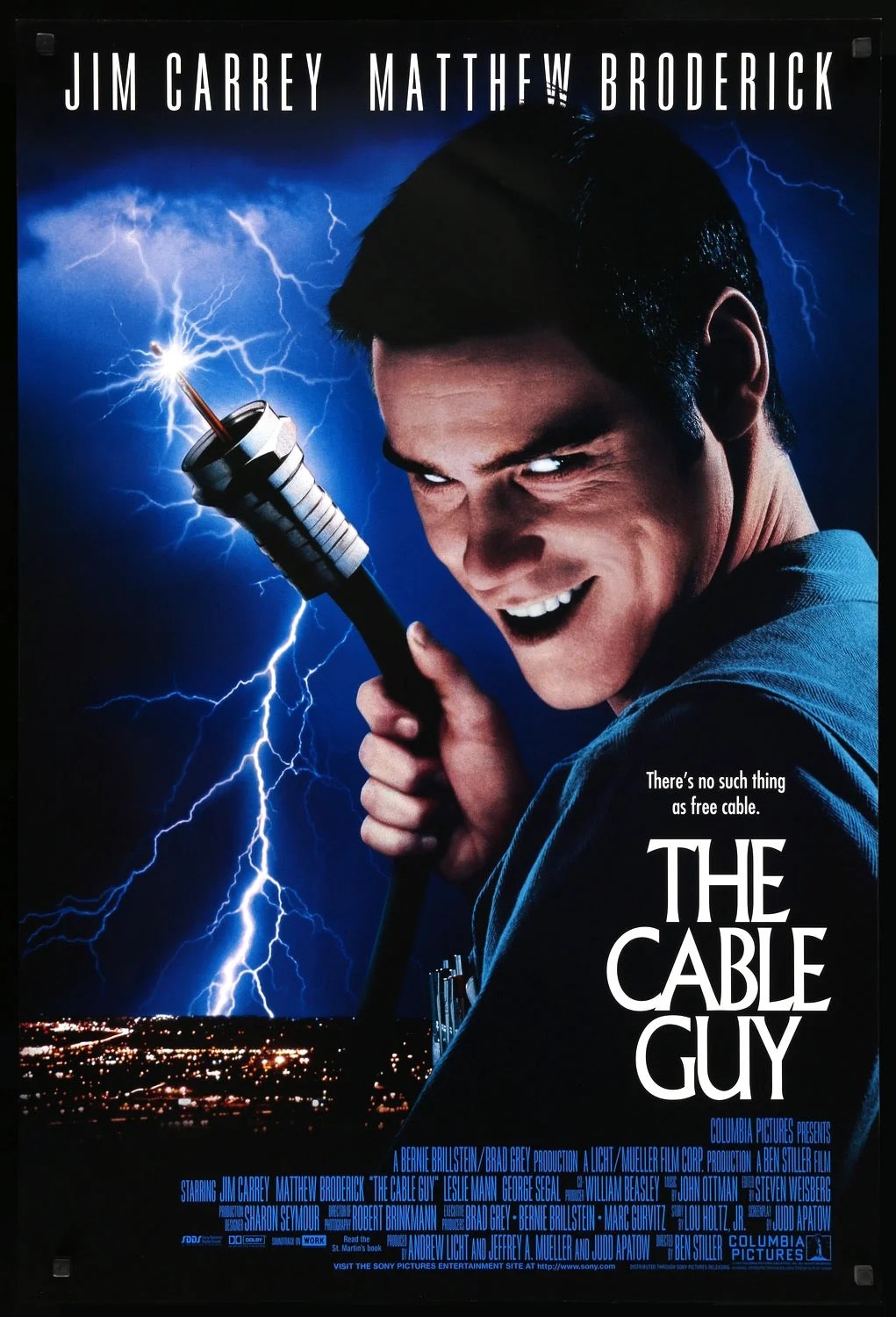
Few 1990s studio comedies are as awkwardly fascinating—or as misunderstood on arrival—as The Cable Guy. Directed by Ben Stiller and built around one of Jim Carrey’s most deliberately uncomfortable performances, it arrived at a strange point in Carrey’s career: he had become a massive box-office draw through films such as Ace Ventura: Pet Detective, The Mask, Dumb and Dumber, Batman Forever, and Ace Ventura: When Nature Calls. Audiences associated him with rubber-faced chaos, exuberant catchphrases, and a kind of manic but fundamentally likable comic energy. The Cable Guy offers something much colder. Carrey is still loud, physical, and wildly committed, but the movie twists those familiar traits into a portrait of loneliness, obsession, and emotional menace. It is a dark comedy about a man who has absorbed television culture so completely that he cannot form a normal human relationship without treating it like an episode of a sitcom.

That basic idea remains clever and surprisingly ahead of its time. Carrey plays Chip Douglas, a cable installer who enters the life of Steven Kovacs, played by Matthew Broderick, after Steven moves into a new apartment following a breakup with his girlfriend Robin, played by Leslie Mann. Steven wants cable television installed; Chip wants a best friend. What begins as awkward friendliness becomes invasive dependence, as Chip worms his way into Steven’s social circle, his professional life, and eventually his relationship with Robin. Chip is not simply a pest or an eccentric service worker. He is a lonely, emotionally stunted man whose references to television, movies, commercials, and game shows have become his entire vocabulary for intimacy.

The most interesting thing about The Cable Guy is that it understands television as both comfort and damage. Chip’s childhood was clearly shaped by neglect, with television functioning as his guardian, teacher, and surrogate parent. The movie makes this point broadly, sometimes too broadly, but it also gives the character a sad logic. Chip does not understand friendship as mutual connection; he understands it as a package deal. You meet someone, quote the same shows, hang out constantly, become inseparable, and live out the happy ending promised by popular entertainment. When Steven resists that fantasy, Chip does not know how to process rejection. His behavior turns increasingly controlling and vindictive because, in his mind, Steven has violated the rules of the relationship genre they are supposed to be playing.

In that respect, the film was well ahead of its time. In 1996, the idea of television becoming an all-encompassing babysitter for a generation of children was recognizable, but it still played largely as exaggerated satire. Chip represents the extreme result of a childhood where adults failed to provide stability, affection, supervision, and basic emotional guidance, leaving television to fill every role instead. He learned how to talk, how to joke, how to flirt, how to fight, and how to imagine friendship from whatever appeared on the screen. The tragedy is that media gave him endless information and endless imitation, but no real understanding of boundaries, empathy, or reciprocity.

That concern feels much less hypothetical today. Television did not disappear; it expanded into streaming libraries, on-demand movies, YouTube, social media feeds, online games, short-form video, and the constantly available internet. More children now grow up surrounded by screens that are not confined to a living-room television set or a few scheduled hours of programming. The old guardrails of limited channels, parental supervision around a shared TV, and the simple fact that a show ended at a certain time have weakened or, in many homes, disappeared altogether. The Cable Guy obviously does not predict every aspect of the internet age, but it does anticipate the emotional danger of allowing media to become a substitute for parenting, companionship, and healthy social development.

The film is careful enough to suggest that media alone did not create Chip. He is the product of abandonment first and television second. That distinction matters, because the movie is not arguing that children who watch too much television will inevitably become unstable stalkers. Rather, it suggests that screens can become especially powerful when they are used to fill an emotional void that should be addressed by family, community, and genuine relationships. Chip’s many references are funny at first because they are recognizable, but they become sadder as the movie reveals that he is not simply quoting pop culture for fun. He is quoting it because he has little else to draw from.

That makes the film more ambitious than its reputation as “the weird Jim Carrey movie” might suggest. The screenplay, by Lou Holtz Jr., has fun with media saturation, consumer culture, male insecurity, and the way people use technology to avoid direct emotional communication. The title itself now feels almost quaint, because cable installation hardly seems threatening in an age of smartphones, streaming services, social media surveillance, and algorithmic recommendation systems. Yet Chip’s obsession has only become more recognizable. He is essentially a proto-internet stalker, a man who treats access as entitlement. Because he can enter Steven’s home to connect his television service, he assumes he deserves access to Steven’s private life. The film exaggerates that premise for comic effect, but the underlying discomfort has aged well.

At the same time, The Cable Guy has a major problem, and it is inseparable from the reason the film exists: Jim Carrey. Casting Carrey was a commercial gamble meant to make a very dark premise accessible to a mainstream audience. In theory, it is an inspired decision. His brand of elastic, outsized comedy gives Chip a strange unpredictability; you never know whether he is going to make a ridiculous movie reference, belt out a sentimental song, physically humiliate himself, or suddenly become frightening. Carrey’s comic instincts make Chip memorable in a way that a more restrained actor likely would not have been. His version of the character is like an abandoned cartoon character who has somehow wandered into a real person’s life.

But the same performance often works against the movie. Carrey’s penchant for excessive facial expressions, exaggerated voices, and physical escalation overwhelms the subtler and more unsettling possibilities in the script. The film wants to be a satirical dark comedy, but it repeatedly gives itself over to big Jim Carrey bits. Some are undeniably funny, especially because Carrey commits to them with fearless energy, but they can make Chip feel less like a damaged human being and more like a delivery system for gags. The movie keeps shifting between “this man is dangerously unstable” and “look at Jim Carrey doing something weird,” and that unevenness prevents it from fully landing as either a truly disturbing character piece or a consistently hilarious farce.

The medieval-themed restaurant sequence is probably the clearest example of both the movie’s strengths and weaknesses. When Chip and Steven engage in an extended jousting and sword-fighting routine at Medieval Times, it is funny because it transforms a casual social outing into a ridiculous, testosterone-heavy spectacle. It also exposes the warped nature of their friendship: Chip is trying to force Steven into a grand, cinematic bonding ritual. Yet the scene is so broad and so committed to the escalating stunt comedy that it can feel detached from the film’s more interesting emotional undercurrents. It is memorable, certainly, but it is also the kind of scene that makes it easy to see why contemporary audiences may have expected another straightforward Carrey comedy rather than a satire with genuine bitterness beneath the jokes.

Broderick is important here because he provides the film’s necessary straight-man perspective. Steven is not a particularly dynamic protagonist, and that is partly the point. He is an ordinary, mildly selfish guy trying to rebuild his life after a breakup, which makes Chip’s intrusion feel even more invasive. Still, Broderick’s deliberately subdued performance can make Steven seem passive compared with the hurricane of Carrey’s performance. The movie needs Steven to be bland enough for Chip to project his fantasies onto him, but that choice also leaves the film with an imbalance: Chip is by far the most vivid person on screen, even when the story is asking us to see him as a nightmare.

Leslie Mann brings warmth and patience to Robin, while Jack Black, in an early supporting role as Steven’s friend Rick, adds a welcome jolt of weird energy without taking over the movie. The supporting cast understands the heightened tone, but Stiller’s direction occasionally pushes the material toward sketch-comedy exaggeration. That is not always a flaw; The Cable Guy is frequently inventive in its visual jokes, its television parodies, and its depictions of Chip turning every situation into a warped pop-culture performance. Still, the film is at its best when Stiller lets the strangeness breathe rather than constantly underlining it.

The movie’s lackluster initial reception makes sense in context. Audiences had been trained to see Carrey as a wildly energetic hero of broad studio comedies, not as a creepy, needy antagonist whose jokes often curdle into discomfort. The promotional challenge was enormous: sell The Cable Guy as a Jim Carrey movie, and viewers might expect another crowd-pleasing laugh machine; sell it honestly as a dark satire about loneliness and media dependency, and it becomes a much harder commercial proposition. Many viewers at the time seemed to reject it not because it lacked ideas, but because it did not give them the version of Jim Carrey they thought they were buying a ticket to see.

In the years since, however, the film has developed a deservedly large cult following. Distance has helped. Modern audiences are more accustomed to comedians making darker career turns, and the themes of mediated identity, parasocial attachment, isolation, and invasive access now feel much more relevant than they did in the mid-1990s. Carrey’s performance, once seen by many as abrasive or miscalculated, can now be appreciated as a risky attempt to weaponize his own comic persona. Chip is funny precisely because he is desperate to be liked, but he is also disturbing because his idea of being liked involves total possession.

The Cable Guy is not a perfect dark comedy. Its tone wobbles, its protagonist can feel underwritten, and Carrey’s larger-than-life antics sometimes obscure the sharper satire hiding underneath. Yet those flaws are also part of what makes it fascinating. It is a studio movie willing to be unpleasant, odd, and commercially confusing at the height of a superstar’s popularity. Rather than simply giving Jim Carrey another vehicle for his most familiar tricks, it turns those tricks into symptoms of a damaged man’s inability to connect. The result is uneven, but it is far more interesting than a safer 1996 Jim Carrey comedy would have been—and its cult status feels earned.

Previous Icarus Files:

  1. Cloud Atlas
  2. Maximum Overdrive
  3. Glass
  4. Captive State
  5. Mother!
  6. The Man Who Killed Don Quixote
  7. Last Days
  8. Plan 9 From Outer Space
  9. The Last Movie
  10. 88
  11. The Bonfire of the Vanities
  12. Birdemic
  13. Birdemic 2: The Resurrection 
  14. Last Exit To Brooklyn
  15. Glen or Glenda
  16. The Assassination of Trotsky
  17. Che!
  18. Brewster McCloud
  19. American Traitor: The Trial of Axis Sally
  20. Tough Guys Don’t Dance
  21. Reach Me
  22. Revolution
  23. The Last Tycoon
  24. Express to Terror 
  25. 1941
  26. The Teheran Incident
  27. Con Man
  28. Looker
  29. 1776
  30. Here
  31. The Adventures of Brisco County, Jr.

Guilty Pleasure #120: The Internship (dir by Shawn Levy)


In 2o13’s The Internship, Owen Wilson and Vince Vaughn play Nick and Billy, two longtime salesman who, having lost their jobs, apply for an internship at Google.  Despite there not being any logical reason for either one of them to be given a spot, Nick and Billy are accepted.  Suddenly, these two middle-aged guys who know next to nothing about programming or the Internet find themselves at the Google campus.  Teaming up with a group of much younger outcasts (albeit very smart outcasts), Nick and Billy compete for a job at Google.

(Personally, the only job I would want at Google would be designing the Google Doodle.)

At first, no one is happy about having to work with Nick and Billy.  Nick and Billy are adults, the type who still use landline phones and wonder why the kids are so obsessed with looking at a little screen.  They’re loud.  They make crude jokes and they don’t understand stuff like safe spaces.  They fall for obvious pranks, like being sent to a college campus to track down “Professor Charles Xavier.”  This leads to them both getting knocked out by a bald man in a wheelchair.  “Professor Xavier’s a total dick!” Billy gasps.

Eventually, though, Nick and Billy start to win everyone over.  Their old school competitiveness comes in handy during a game of Quidditch.  They know how to talk to women at bars.  They know how to appeal to someone running an old-fashioned business.  But will that be enough to win them a job at Google?

Back when the Onion was funny, one of their best headlines was ‘The Internship’ Poised To Be Biggest Comedy Of 2005!  The joke, of course, was that the film was coming out in 2013.  The headline worked because it was true.  The film felt very much out-of-place in the world of 2013.  The majority of the film’s humor came from Nick and Billy not really knowing what Google was but, by 2013, even the most cranky of boomer grandparents were using Google to search for their Facebook password.  Nick and Billy were not boomers.  They may have been older than the other interns but still, it’s hard to believe that two guys in their mid-40s would be that clueless about everything from the Internet to the identity of Charles Xavier.  I mean, the X-Men movies were kind of a big deal.

The other thig that dated the film was its portrayal of Google as essentially just being a fun playground full of nerdy prodigies who just needed someone to teach them how to party.  By 2013, everyone knew that Google was a powerful and somewhat intimidating company.  Indeed, at its weakest, the film basically feels like a 2-hour commercial for Google.  Never mind that, by 2013, Google was so big and omnipresent that it really didn’t need to advertise.

So, with all that in mind, why do I find myself watching this movie whenever I happen to come across it?  First off, as uneven as the movie is, it is funny.  The Quidditch scene did make me laugh.  John Goodman’s and Will Ferrell’s unhinged cameos made me laugh, almost despite myself.  The scene where Nick and Billy annoy the group by misinterpreting what is meant by “coding” made me laugh, if just because of how bizarrely enthusiastic Nick and Billy were when they convinced themselves that their internship director was a Jeff Goldblum fan.  (It makes no sense but just go with it.)  Most importantly, Owen Wilson and Vince Vaughn made me laugh.  There was absolutely no way to make it plausible that Nick and Billy would be that clueless about technology but Wilson and Vaughn really threw themselves into their roles and, as a result, I’m always willing to forgive some of the film’s missteps.  The mix of Vaughn’s overage frat boy goofiness and Wilson’s mellow spaciness always makes me laugh more than it probably should.  They’re a good comedic team and they’re both just so damn earnest in this movie that it works a lot better than it really should.  In the end, you do find yourself rooting for them.  They’re two hard-workers who like to play hard and who have the courage to reinvent themselves.  What’s more American than that?

(Even more importantly, when you come across the film on cable, you’re free to pretend that it actually came out in 2005, back when the plot would have actually made more sense.)

If any film lives up to the term guilty pleasure, it’s The Internship.

Previous Guilty Pleasures

  1. Half-Baked
  2. Save The Last Dance
  3. Every Rose Has Its Thorns
  4. The Jeremy Kyle Show
  5. Invasion USA
  6. The Golden Child
  7. Final Destination 2
  8. Paparazzi
  9. The Principal
  10. The Substitute
  11. Terror In The Family
  12. Pandorum
  13. Lambada
  14. Fear
  15. Cocktail
  16. Keep Off The Grass
  17. Girls, Girls, Girls
  18. Class
  19. Tart
  20. King Kong vs. Godzilla
  21. Hawk the Slayer
  22. Battle Beyond the Stars
  23. Meridian
  24. Walk of Shame
  25. From Justin To Kelly
  26. Project Greenlight
  27. Sex Decoy: Love Stings
  28. Swimfan
  29. On the Line
  30. Wolfen
  31. Hail Caesar!
  32. It’s So Cold In The D
  33. In the Mix
  34. Healed By Grace
  35. Valley of the Dolls
  36. The Legend of Billie Jean
  37. Death Wish
  38. Shipping Wars
  39. Ghost Whisperer
  40. Parking Wars
  41. The Dead Are After Me
  42. Harper’s Island
  43. The Resurrection of Gavin Stone
  44. Paranormal State
  45. Utopia
  46. Bar Rescue
  47. The Powers of Matthew Star
  48. Spiker
  49. Heavenly Bodies
  50. Maid in Manhattan
  51. Rage and Honor
  52. Saved By The Bell 3. 21 “No Hope With Dope”
  53. Happy Gilmore
  54. Solarbabies
  55. The Dawn of Correction
  56. Once You Understand
  57. The Voyeurs 
  58. Robot Jox
  59. Teen Wolf
  60. The Running Man
  61. Double Dragon
  62. Backtrack
  63. Julie and Jack
  64. Karate Warrior
  65. Invaders From Mars
  66. Cloverfield
  67. Aerobicide 
  68. Blood Harvest
  69. Shocking Dark
  70. Face The Truth
  71. Submerged
  72. The Canyons
  73. Days of Thunder
  74. Van Helsing
  75. The Night Comes for Us
  76. Code of Silence
  77. Captain Ron
  78. Armageddon
  79. Kate’s Secret
  80. Point Break
  81. The Replacements
  82. The Shadow
  83. Meteor
  84. Last Action Hero
  85. Attack of the Killer Tomatoes
  86. The Horror at 37,000 Feet
  87. The ‘Burbs
  88. Lifeforce
  89. Highschool of the Dead
  90. Ice Station Zebra
  91. No One Lives
  92. Brewster’s Millions
  93. Porky’s
  94. Revenge of the Nerds
  95. The Delta Force
  96. The Hidden
  97. Roller Boogie
  98. Raw Deal
  99. Death Merchant Series
  100. Ski Patrol
  101. The Executioner Series
  102. The Destroyer Series
  103. Private Teacher
  104. The Parker Series
  105. Ramba
  106. The Troubles of Janice
  107. Ironwood
  108. Interspecies Reviewers
  109. SST — Death Flight
  110. Undercover Brother
  111. Out for Justice
  112. Food Wars!
  113. Cherry
  114. Death Race
  115. The Beast Within
  116. Girl Series
  117. Gone in 60 Seconds
  118. Swordfish
  119. Marked For Death

Guilty Pleasure No. 78: Armageddon (dir by Michael Bay)


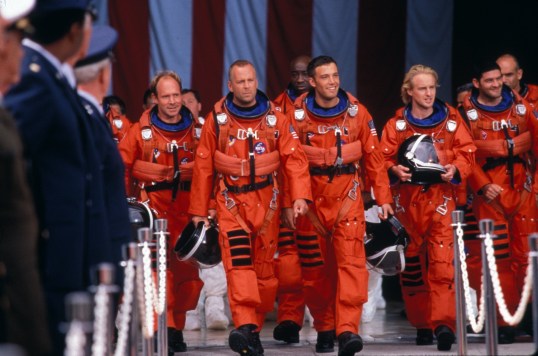
Remember that time that Bruce Willis and a team of oil drillers saved all of humanity from a giant asteroid that was apparently the size of Texas?

Sure, you do!  Everyone remembers Armageddon!

1998’s Armageddon is a film that doesn’t get a lot of respect but which everyone remembers.  There’s been a lot of movies made about giant asteroids on a collision path with the Earth.  Ever since scientists announced that a collision with a comet or an asteroid probably killed the dinosaurs, there’s been a somewhat irrational fear that the same thing could happen to us.  Back in 1978, Sean Connery and Karl Malden tried to stop a Meteor (and failed).  In 1998, the same year that Armageddon came out, Morgan Freeman, Robert Duvall, and Elijah Wood tried to stop an asteroid from causing a Deep Impact (and failed).  Adam McKay made an entire film about everyone saying, “Don’t Look Up,” in an attempt to promote increased panic about climate change (and failed).  (“I’m so scared!” Leonardo DiCaprio shouted and audiences responded, “Oh, calm down.”)  And yet, it’s Armageddon — ridiculed by critics, endlessly parodied by other movies — that people use as their go-to source for commenting on the prospect of a mass extinction event.  Mostly because, in Armageddon, humanity didn’t fail.  Bruce Willis showed that asteroid who was boss!

Why do we love Armageddon?  A lot of it has to do with the cast.  Not only do you have Bruce Willis battling an asteroid but you’ve also got Steve Buscemi, Owen Wilson, Ben Affleck, Will Patton, Michael Clarke Duncan, Peter Stormare, William Fichtner, and a host of others working with him.  You’ve got Billy Bob Thornton working ground control.  You’ve got Liv Tyler, somehow managing to give a decent performance even while Ben Affleck attacks her with animal crackers.  It’s not just the cast is full of familiar and likable actors.  It’s that the members of the cast know exactly what type of film that they’re appearing in and they all give exactly the right type of performance for that film.  They deliver their lines with conviction while not making the mistake of taking themselves too seriously.  Bruce Willis announces that his crew will destroy that asteroid in return for never having to pay taxes again and he announces with just the slightest hint of a smirk, knowing that the audience is going to cheer that moment.

But really, the real reason why Armageddon has survived that test of time is because it’s just so utterly shameless.  Director Michael Bay will never be accused of being a subtle director but Bay instinctively understood that Armageddon was not a film that demanded subtlety.  Armageddon is a film that demands that constantly moving camera and all of those carefully composed scenes that were clearly made so they could be included in the trailer.  It’s a film about big moments and big emotions.  Unlike something like Deep Impact, it doesn’t get bogged down in trying to be better than it actually is.  Unlike Don’t Look Now, it doesn’t degenerate into a bunch of histrionic speeches.  Armageddon exists to make the audience cheer and it succeeds.  It takes guts to include a slow motion scene of a bunch of kids celebrating in front of a faded Kennedy For President poster but Bay is exactly the type of director who can pull that off.  Michael Bay’s style is not right for a lot of films.  But it was perfect for Armageddon.

As I sit here typing this, there are some people panicking because there’s speculation that a meteor is going approach the Earth in the 2030s.  It’ll probably miss us but who knows?  But you know what?  I’m not worried at all.  I’ve seen Armageddon.  So, on this International Earth Day, let’s remember the courageous men who saved this planet back in 1998.

Previous Guilty Pleasures

  1. Half-Baked
  2. Save The Last Dance
  3. Every Rose Has Its Thorns
  4. The Jeremy Kyle Show
  5. Invasion USA
  6. The Golden Child
  7. Final Destination 2
  8. Paparazzi
  9. The Principal
  10. The Substitute
  11. Terror In The Family
  12. Pandorum
  13. Lambada
  14. Fear
  15. Cocktail
  16. Keep Off The Grass
  17. Girls, Girls, Girls
  18. Class
  19. Tart
  20. King Kong vs. Godzilla
  21. Hawk the Slayer
  22. Battle Beyond the Stars
  23. Meridian
  24. Walk of Shame
  25. From Justin To Kelly
  26. Project Greenlight
  27. Sex Decoy: Love Stings
  28. Swimfan
  29. On the Line
  30. Wolfen
  31. Hail Caesar!
  32. It’s So Cold In The D
  33. In the Mix
  34. Healed By Grace
  35. Valley of the Dolls
  36. The Legend of Billie Jean
  37. Death Wish
  38. Shipping Wars
  39. Ghost Whisperer
  40. Parking Wars
  41. The Dead Are After Me
  42. Harper’s Island
  43. The Resurrection of Gavin Stone
  44. Paranormal State
  45. Utopia
  46. Bar Rescue
  47. The Powers of Matthew Star
  48. Spiker
  49. Heavenly Bodies
  50. Maid in Manhattan
  51. Rage and Honor
  52. Saved By The Bell 3. 21 “No Hope With Dope”
  53. Happy Gilmore
  54. Solarbabies
  55. The Dawn of Correction
  56. Once You Understand
  57. The Voyeurs 
  58. Robot Jox
  59. Teen Wolf
  60. The Running Man
  61. Double Dragon
  62. Backtrack
  63. Julie and Jack
  64. Karate Warrior
  65. Invaders From Mars
  66. Cloverfield
  67. Aerobicide 
  68. Blood Harvest
  69. Shocking Dark
  70. Face The Truth
  71. Submerged
  72. The Canyons
  73. Days of Thunder
  74. Van Helsing
  75. The Night Comes for Us
  76. Code of Silence
  77. Captain Ron

Live Tweet Alert: Join #FridayNightFlix for Zoolander!


As some of our regular readers undoubtedly know, I am involved in a few weekly live tweets on twitter.  I host #FridayNightFlix every Friday, I co-host #ScarySocial on Saturday, and I am one of the five hosts of #MondayActionMovie!  Every week, we get together.  We watch a movie.  We tweet our way through it.

Tonight, at 10 pm et and weather-permitting, I will be hosting #FridayNightFlix!  The movie? 2001’s Zoolander!

It may be freezing outside but #FridayNightFlix will be keeping things hot with Ben Stiller, Owen Wilson, and Will Ferrell!

If you want to join us this Friday, just hop onto twitter, start the movie at 10 pm et, and use the #FridayNightFlix hashtag!  I’ll be there tweeting and I imagine some other members of the TSL Crew will be there as well.  It’s a friendly group and welcoming of newcomers so don’t be shy.

Zoolander is available on Prime and Paramount!  See you there!

Film Review: Marry Me (dir by Kat Coiro)


In Marry Me, Jennifer Lopez plays Kat Valdez, a superstar who has the number one single in the history of the world with Marry Me, a duet that she performs with her fiancé, Bastian (Maluma).  The plan is for Kat and Bastian to marry onstage, as the climax of one of Kat’s concerts.  For Kat, it will be her third marriage but she’s determined to make it work because, underneath all the glamour and show-biz glitz, Kat is a romantic at heart.  However, right before Kat is due to step out on stage to get married, TMZ reports that Bastian has been cheating on Kat.

Heart-broken, Kat steps out onstage.  She talks about the pain of being betrayed.  In the audience, one man nods along with her.  Kat sees the sympathetic look in the eyes of math teacher Charlie Gilbert (Owen Wilson) and she calls him up on stage.  “Kat,” the minister asks, “Do you take this guy?”  She says “I do.”  Charlie says that he does.  And …. they’re married!

Wait, what?

Now, of course, Charlie really isn’t sure who Kat Valdez is.  He came to the concert with his daughter and his best friend (played by Sarah Silverman) and the only reason that he was holding a sign that read “Marry Me,” was because it was handed to him at the last minute.  Charlie is far more interested in walking his dog, trying to connect with daughter, and coaching his students to victory in the upcoming mathalon.  As they leave the concert, Charlie explains that he just said “yes” because Kat appeared to need someone at that moment and that he certainly doesn’t expect to remain married to Kat.

However, Kat’s management suggests that maybe the two of them should stay married for three months, just for the sake of good publicity….

Wait, what?

Look, I could tell you that Marry Me is a deeply silly film but you probably already guessed that.  You probably guessed that from watching the trailer.  It’s a determinedly old-fashioned film, with the only thing indicating that the film was made after 2014 is the fact that it’s Jimmy Fallon who is shown making jokes about Kat’s marriage instead of Jay Leno.  The plot is not only silly but it’s also extremely predictable.  Do I really need to tell you that Kat is going to be charmed by Charlie’s simple life and that she’s going to end up helping his students prepare for the mathalon?  For that matter, do I have to tell you that Charlie is going to struggle with the feeling that he doesn’t fit in with Kat’s glamorous life style?  You know where this is going.

That said, it’s an amiable film, largely due to the two leads.  Jennifer Lopez is one of the few performers who can come across as being likable and down-to-Earth, even when she’s jumping into a limo and demanding that the driver take her to the airport.  The film also makes good use of Owen Wilson’s goofy charm.  The film’s story may be implausible but, if something that weird ever did happen, it would probably happen to Owen Wilson.  While I would have preferred a film with a bit more of a satirical edge and I think it’s one of those films for which you definitely have to be in the right mood, Marry Me is a likable romantic comedy.

Behind Enemy Lines (2001, directed by John Moore)


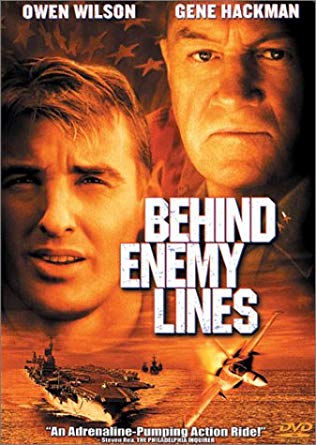
When hotshot Navy flight officer Chis Burnett (Owen Wilson) is shot down while doing a reconnaissance mission over Bosnia, he finds himself stranded behind enemy lines.  While Burnett tries to avoid being captured by a Serbian general and find evidence of illegal military operations in yje demilitarized zone, Admiral Leslie Reigart (Gene Hackman) tries to mount a rescue operation.  Standing in his way are the NATO bureaucrats who would rather just leave Burnett to his fate than run the risk of disrupting the peace process.

Behind Enemy Lines was released early in Owen Wilson’s acting career and, after years of watching him in buddy comedies and eccentric character roles, it can be strange to see him playing a traditional leading man, much less an action hero.  Burnett has his goofball moment but, for the most part, this is probably as dramatic a role as you’re ever going to see Owen Wilson perform.  Once you get over the fact that he’s Owen Wilson and still speaking in the same stoner cadences that he’s used in everything from Bottle Rocket to Inherent Vice, Wilson actually gives a decent performance as Burnett.  The fact that he’s not a traditional leading man actually makes the film’s action scenes more exciting.  If Burnett had been played by someone like Brad Pitt or Tom Cruise, you would never have any doubt about his survival.  With Owen Wilson in the role, you’re no longer quite as sure that he’s going to be able to make his way to safety.

Gene Hackman also gave a good performance, even if he didn’t really do anything with the role that he hadn’t already done with all of the other authority figures that he played from Unforgiven on.  Hackman’s intimidating as Reigart.  When Burnett says that he wants to retire from the Air Force, Reigart looks like he’s about to reach over and rip off his face.  But Hackman has so much natural authority that you understand why his men automatically respect Reigart and follow his every order.  Burnett is lucky to have him on his side because there’s no way Reigart’s going to let someone from NATO push him around.

When Behind Enemy Lines first came out, it was not loved by the critics.  They complained that the movie was heavy-handed and predictable.  They were right but it really didn’t matter.  Behind Enemy Lines made a lot of money because it was a legitimate crowd pleaser.  I remember seeing it when it first came out.  This was less than month after 9-11 and the theater was packed with people who, like me, were still dealing with the greatest national trauma of our lifetime.  When Owen Wilson killed the men who were trying to kill him, the audience cheered.  When Reigart said that there was no way he going to abandon an American behind enemy lines, the audience applauded.  By the time the film ended, everyone was on their feet and chanting “USA!  USA!”  (At least, that’s the way I remembered it.)  Critics be damned, at that time, Behind Enemy Lines was the movie that we needed.

Behind Enemy Lines was a huge box office success so, of course, it got a sequel that wasn’t as good.  I’ll review Behind Enemy Lines: Axis of Evil tomorrow.

Music Video Of The Day: God’s Gonna Cut You Down (2006, dir by Tony Kaye)


This is a case where I like the song more than the music video.  This video was actually filmed three years after Johnny Cash’s death.  As far as “official” music videos are concerned, I always feel like a musician should have some sort of say into how their music is visually interpreted.  Obviously, Johnny Cash wasn’t around to have anything to say about the video for God’s Gonna Cut You Down.

Since Cash wasn’t available, director Tony Kaye filled the video with cameos from other actors and musicians, a few of whom (though not many) were previous Cash collaborators.  Among the celebs who make an appearance in this video: David Allan Coe, Patricia Arquette, Travis Barker, Peter Blake, Bono, Sheryl Crow, Johnny Depp, the Dixie Chicks, Flea, Billy Gibbons, Whoopi Goldberg, Woody Harrelson, Dennis Hopper, Terrence Howard, Jay-Z, Mick Jones, Kid Rock, Anthony Kiedis, Kris Kristofferson, Amy Lee, Adam Levine, Shelby Lynne, Chris Martin, Kate Moss, Graham Nash, Busy Philipps, Iggy Pop, Lisa Marie Presley, Q-Tip, Corinne Bailey Rae, Keith Richards, Chris Rock, Rick Rubin, Patti Smith, Sharon Stone, Justin Timberlake, Kanye West, Brian Wilson, and Owen Wilson.  Some of the celebs — like Dennis Hopper and Kris Kristofferson — seem like they naturally belong there.  Others seem so out-of-place that you’ll want to throw something.  You know how that works,

God’s Gonna Cut You Down is a traditional folk song.  I’ve heard countless versions of it.  I prefer Cash’s version to the more traditional gospel arrangement but, then again, I tend to find gospel music to be dull in general.  Cash’s arrangement brought new life to an old song.

Enjoy!

Horror Film Review: Anaconda (dir by Luis Llosa)


In many ways, the 1997 monster film Anaconda is an incredibly dumb movie but let’s give credit where credit is for.  Whoever was in charge of casting this movie managed to assemble the most unlikely group of co-stars that you would ever expect to see in a movie about a documentary crew who run into a giant snake while sailing down the Amazon River.

I mean, let’s just consider the most familiar names in the cast.  Jennifer Lopez.  Ice Cube.  Jon Voight.  Owen freakin Wilson.  I mean, it’s not just that you wouldn’t expect to come across these four people all in the same movie.  It’s that they all seem to come from a totally different cinematic universe.  They’ve all got their own unique style of acting and seeing them all on the same small boat together is just bizarre.  You’ve got Jennifer Lopez, delivering her lines with a lot of conviction but not much sincerity.  And then you’ve got Ice Cube coolly looking over the Amazon and basically daring the giant snake to even think about trying to swallow him.  Owen Wilson is his usual quirky self, delivering his lines in his trademark Texas stoner drawl.  And then you’ve got Jon Voight.

Oh my God, Jon Voight.

Voight plays Paul Serone, a Paraguayan who says that he can help the documentary crew find an isolated Amazon tribe but who, once he gets on the boat, basically takes over and announces that he’s actually a snake hunter and he’s planning on capturing the biggest anaconda in existence.  It takes a while for the snake to show up.  When it finally does, it’s actually a pretty impressive throw-back to the type of cheesy by entertaining monsters that used to show up in drive-in movies back in the 50s and the 60s.  But really, the biggest special effect in the movie is Jon Voight.  Wisely, Voight doesn’t waste any time trying to be subtle or in anyway believable in the role of Serone.  Instead, Voight gives a performance that seems to be channeling the spirit of the infamous Klaus Kinski.  Voight growls, snarls, and glares as if the fate of the world depended upon it and he rips into his Paraguayan accent with all the ferocity of a character actor who understands the importance of being memorable in an otherwise forgettable movie.  It’s as if Voight showed up on set and looked at what was going and then said to himself, “Well, Jon, it’s all up to you.”  Serone is really a pretty vicious character.  I mean, he literally strangles a character to death with his legs!  But, thanks to Voight’s crazed energy he’s still the most compelling character in the movie.  It’s really scary to think about what the film would have been like without Voight shaking things up.  Along amongst the cast, Voight seems to understand just how silly Anaconda truly is.  Voight takes a rather middling monster movie and, through sheer force of will, manages to make it at least somewhat entertaining.

Personally, I’d like to see a remake of Anaconda, one that would feature the same cast but would be directed by Werner Herzog.  Just imagine if Herzog had told the story of that trip down the Amazon.  Gone would be the bland dialogue and rudimentary character motivations.  Instead, we’d have Jennifer Lopez slowly going insane while hundreds of monkey lay siege to the boat and Ice Cube musing on the never ending conflict between man and nature.  Herzog’s Anaconda would probably be just crazy enough to keep up with Jon Voight’s performance.

Insomnia File #34: The Minus Man (dir by Hampton Fancher)


What’s an Insomnia File? You know how some times you just can’t get any sleep and, at about three in the morning, you’ll find yourself watching whatever you can find on cable? This feature is all about those insomnia-inspired discoveries!

Last night, if you were unable to sleep at one in the morning, you could have turned over to Starz and watched the 1999 film, The Minus Man!

The Minus Man is a strange little film about a rather odd man.  Vann (Owen Wilson) is a drifter.  He avoids questions about his past with the skill of someone who specializes in being whatever he needs to be at the moment.  When he rents a room from Doug and Jane Durwin (Brian Cox and Mercedes Ruehl), he tells them that he’s only drunk one beer over the course of his entire life, he always works, he always pays his rent on time, and that he’s never smoked “the dope.”  He says it so earnestly that it’s difficult to know whether you should take him seriously or not.  And yet, Vann is so likable and so charmingly spacey that you can’t help but understand why people automatically trust him.  Vann succeeds not because people believe him but because they want to believe him.

Vann’s new in town.  As he explains to a cop who pulls him over, he’s just interested in seeing the countryside.  From the minute that Vann shows up, he’s accepted by the community.  He goes to a high school football game and befriends the local star athlete (Eric Mabius).  He tries to help repair Doug and Jane’s marriage, which has been strained ever since the disappearance of their daughter.  With Doug’s aid, Vann gets a job at the post office and proves that he wasn’t lying when he said he was a hard worker.  Vann even pursues a tentative romance with the poignantly shy and insecure Ferrin (Janeane Garofalo).

In fact, it’s easy to imagine this film as being a sweet-natured dramedy where a drifter comes into town for the holidays and helps all of the townspeople deal with their problems.  However, from the first time we see him, we know that Vann has some issues.  As Detective Graves (Dennis Haysbert) puts it, Vann is a “cipher, a zero.”  There’s nothing underneath the pleasant surface.  Of course, Graves doesn’t really exist.  Neither does his partner, Detective Blair (Dwight Yoakam).  They’re two figments of Vann’s imagination.  They appear whenever Vann is doing something that he doesn’t want the world to find out about.

Whenever the urge hits him, Vann kills people.  When we first meet him, he’s picking up and subsequently murdering a heroin addict named Casper (Sheryl Crow).  Vann makes it a point to use poison because he says that it’s a painless death.  Vann also says that he’s doing his victims a favor, as he feels that the majority of them no longer want to live.  Vann is the type of killer who, after having committed his latest murder, sees nothing strange about volunteering to help search for the missing victim.

Like a lot of serial killer films, The Minus Man cheats by giving all of the best lines to the killer.  In real life, most serial killers are impotent, uneducated losers who usually end up getting caught as a result of their own stupidity.  In the movies, they’re always surprisingly loquacious and clever.  While Vann may not be a well-spoken as Hannibal Lecter, he’s still a lot more articulate than the majority of real-life serial killers.  As I watched the film, it bothered me that we didn’t really learn more about Vann’s victims.  (It would have been a far different film if someone had mentioned that Vann’s third, unnamed victim was “Randy, who was just having a bite to eat while shopping for a present for his little girl’s birthday.”)  Too often, The Minus Man seemed to be letting Vann off the hook in a way that a film like Henry: Portrait of a Serial Killer or even American Psycho never would.

That said, The Minus Man may be occasionally uneven but it’s still an intriguing and sometimes genuinely creepy film.  The Minus Man makes good use of Owen Wilson’s eccentric screen persona and Wilson gives a very good performance as a man who has become very skilled at hiding just how empty he actually is.  Much like everyone else in the film, you want to believe that there’s more to Vann than meets the eye because, as played by Wilson, he’s just so damn likable.  Over the course of the film, Vann and Doug develop this weird little bromance and, as good as Wilson is, Brian Cox’s performance is even more unsettling because we’re never quite sure what Doug may or may not be capable of doing.  Even Janeane Garofalo gives a touching and believable performance as a character who you find yourself sincerely hoping will not end up getting poisoned.

With all that in mind, I wouldn’t suggest watching this film if you’re trying to get over insomnia.  This is the type of unsettling film that will keep you awake and watching the shadows long after the final credits roll.

Previous Insomnia Files:

  1. Story of Mankind
  2. Stag
  3. Love Is A Gun
  4. Nina Takes A Lover
  5. Black Ice
  6. Frogs For Snakes
  7. Fair Game
  8. From The Hip
  9. Born Killers
  10. Eye For An Eye
  11. Summer Catch
  12. Beyond the Law
  13. Spring Broke
  14. Promise
  15. George Wallace
  16. Kill The Messenger
  17. The Suburbans
  18. Only The Strong
  19. Great Expectations
  20. Casual Sex?
  21. Truth
  22. Insomina
  23. Death Do Us Part
  24. A Star is Born
  25. The Winning Season
  26. Rabbit Run
  27. Remember My Name
  28. The Arrangement
  29. Day of the Animals
  30. Still of The Night
  31. Arsenal
  32. Smooth Talk
  33. The Comedian

Music Video of the Day: Christmas In L.A. by The Killers ft. Dawes (2013, dir. Kelly Loosli)


We’re down to the last music video with Harry Dean Stanton that I can find.

Did you ever want to see a music video with Harry Dean Stanton just wanting to be left alone to drink and smoke rather than listen to Owen Wilson’s problems? I didn’t even know such a thing existed.

Okay, he does provide some “words of wisdom” at the start of the video. Granted, Wilson has to pressure him to answer a question by ignoring his simple “no”, but he does talk to him. After that, it’s leave-me-alone time.

In reality, they did three feature films together. Also, they share in common that people will likely remember both of them for a film that had “Paris” in the title–Midnight In Paris and Paris, Texas. Both of which I’m sure would give this video more meaning if I watched them again back-to-back with this video.

The rest of the video is a sad Christmas song about being alone in the reality behind the glamour of Hollywood that you can’t leave because your career depends on you being where the jobs are.

I like the animation. It feels like a cross between Do The Evolution by Pearl Jam and Don’t Answer Me by The Alan Parsons Project.

It has an animated Warren Zevon in it. He shows up when they mention Carmelita since that is one of Zevon’s songs. There’s also a character named Carmelita in Paris, Texas. Unfortunately, it’s been forever since I’ve watched it, so I couldn’t tell you about her character.

Unlike the other videos Stanton was in, this one actually has his name in the song. I think it’s a good one to go out on.

Rest in peace, Harry Dean Stanton.

Harry Dean Stanton Retrospective:

  1. Those Memories Of You by Dolly Parton & Linda Ronstadt & Emmylou Harris (1987, dir. White Copeman)
  2. Get Rhythm by Ry Cooder (1988, dir. David Fincher)
  3. Heart Of Stone by Dwight Yoakam (1996, dir. Dwight Yoakam)
  4. Sorry You Asked? by Dwight Yoakam (1996, dir. Dwight Yoakam)
  5. Nothing To Believe In by Cracker (1996, dir. Samuel Bayer)
  6. Stop by Black Rebel Motorcycle Club (2003, dir. Charles Mehling)
  7. Dreamin’ Of You by Bob Dylan (2008, dir. ???)