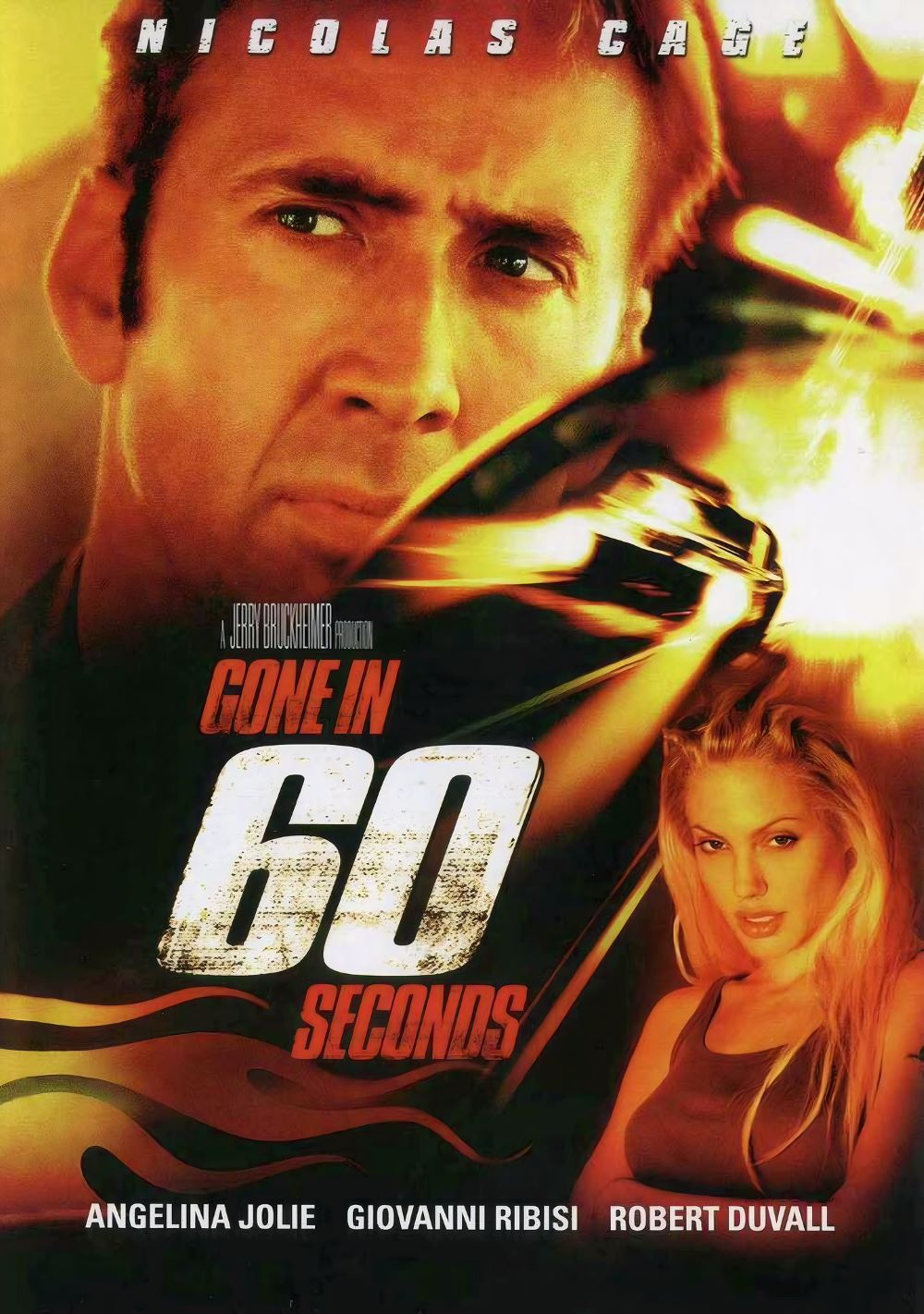
Guilty Pleasure No. 116: Gone in 60 Seconds (dir. by Dominic Sena)


There is a specific, almost alchemical quality to the late 1990s and early 2000s era of Nicolas Cage as an action star. Before the internet turned every one of his performances into a meme and before his financial troubles led him down the rabbit hole of direct-to-video oddities, Cage was genuinely one of the most exciting and weirdly compelling action heroes on the planet. From The Rock in 1996 to Con Air in 1997 and Face/Off in 1997, he delivered a holy trinity of high-octane insanity that no other actor could have pulled off. By the time the calendar flipped to 2000, Cage was at the peak of his powers, and director Dominic Sena’s Gone in 60 Seconds arrived as both a victory lap and a slight exhale. It is not as unhinged as Face/Off nor as tightly wound as The Rock, but it is a perfect snapshot of its moment: a glossy, MTV-infused car heist flick that smells like gasoline, leather, and late-90s hubris. And while it has plenty of shortcomings, Gone in 60 Seconds has earned its place not in the pantheon of great action cinema, but in that more beloved hall of fame: the Guilty Pleasure.

The plot is as simple as a carburetor. Cage plays Randall “Memphis” Raines, a legendary car thief who has supposedly gone straight, now living a quiet life designing hybrid engines. But when his reckless younger brother Kip, played with sweaty desperation by Giovanni Ribisi, botches a job for a ruthless British gangster named Raymond Calitri (Christopher Eccleston at his sleaziest), Memphis is forced back into the life he left behind. The task is absurdly impossible: steal 50 specific luxury cars in a single weekend, or Calitri will kill Kip. That’s right, fifty cars. In three days. The film never really bothers to explain the logistics of storing or delivering that many vehicles, but that’s not the point. The point is the ride, the revving engines, and the way Cage stares at a 1967 Shelby GT500 named Eleanor like she’s the ghost of a lost lover. That car is the real star, and the film knows it.

Dominic Sena, who previously directed Cage in the underrated road thriller Kalifornia, brings a music video sensibility to the proceedings. Gone in 60 Seconds is drenched in late-90s visual tics: slow-motion shots of hubcaps spinning, golden sunsets glaring off polished chrome, and a soundtrack that alternates between nu-metal grooves and bluesy rock. The editing is fast but not confusing, and the heist sequences have a rhythmic, almost choreographed feel. You never believe for a second that Memphis and his crew—a motley collection of oddballs played by Robert Duvall, Vinnie Jones, and a very underutilized Angelina Jolie—can actually pull off fifty thefts without the entire LAPD catching on. But the film operates on movie logic. Cars are hotwired in seconds, police radio chatter is effortlessly avoided, and every chase defies the laws of physics. It is pure fantasy, and that is exactly why it works as a guilty pleasure.

Now, let’s talk about Cage. In 2000, he was still riding the high of that legendary late-90s run, and Gone in 60 Seconds fits neatly into his brand of action star as tortured romantic. Memphis Raines is not the coked-up lunatic Castor Troy or the shouty Stanley Goodspeed. He is weary, melancholic, and trying to be honorable in a dishonorable profession. Cage plays him with a hangdog sincerity that is surprisingly effective. When he talks to Eleanor, stroking her steering wheel and whispering about how she tests her drivers, he is utterly committed. There is no irony, no winking at the camera. That is the secret to Cage’s enduring appeal in this era: he treats absurd material with the same intensity he would bring to a Shakespeare soliloquy. The action sequences—especially the climactic chase where Eleanor leaps over a drawbridge—showcase Cage’s physicality and willingness to do real stunt work. He sells the danger and the desperation. You believe that this man would risk everything for a car, and that belief makes the film’s silliness palatable.

But let’s be honest about the shortcomings, because Gone in 60 Seconds has plenty. The middle act drags considerably. For a movie about stealing fifty cars, there is a surprising amount of standing around in warehouses and having conversations about “respecting the machine.” Angelina Jolie’s character, Sara, is Memphis’s ex-girlfriend and a fellow thief, but she is given almost nothing to do except look cool in leather and exchange tepid romantic banter with Cage. The chemistry between them is nonexistent. Christopher Eccleston’s Calitri is a one-note villain who likes opera and cruelty, and his final defeat is laughably abrupt. Delroy Lindo plays a dogged detective, but he is so incompetent that he never generates real tension. The film’s central gimmick—the ticking clock of fifty cars in three days—is inconsistently tracked, and by the final act, you have no idea how many cars are left or why it still matters. The dialogue is also gloriously corny. Lines like “Ride or die” and “Respect the car, man” are delivered with such straight faces that they circle back around to being endearing.

And yet, Gone in 60 Seconds earns its status as a guilty pleasure because it understands exactly what it is. This is not a sophisticated heist thriller like Heat or a gritty crime drama. It is a shiny, high-budget B-movie about a man and his car, and it leans into that identity without apology. The final twenty-minute chase sequence is genuinely thrilling, with real cars being destroyed and practical stunts that modern CGI could never replicate. Eleanor getting airborne, landing hard, and somehow still running is a moment of pure cinematic joy. The sound design—the roar of that V8 engine, the screech of tires on asphalt—is visceral and satisfying. And Cage’s performance, even when the script lets him down, holds the whole thing together. He is the anchor that keeps the film from floating away into utter nonsense.

Looking back from today’s perspective, Gone in 60 Seconds is a time capsule of a very specific moment. It captures the tail end of the late-90s obsession with extreme sports, tuner culture, and the idea that cars had souls. It also captures Nicolas Cage at a fascinating crossroads: still an A-list action star, still capable of opening a blockbuster, but already showing the signs of the wonderful weirdness that would later define his career. This film is not his best, not by a long shot, but it is one of his most rewatchable. You put it on when you want to turn your brain off, hear some great engine noises, and watch a sweaty, sincere Nic Cage talk to a Shelby like she is his long-lost sweetheart. That is the definition of a guilty pleasure. It is not good in the traditional sense, but it is fun. And sometimes, fun is enough.

Previous Guilty Pleasures

  1. Half-Baked
  2. Save The Last Dance
  3. Every Rose Has Its Thorns
  4. The Jeremy Kyle Show
  5. Invasion USA
  6. The Golden Child
  7. Final Destination 2
  8. Paparazzi
  9. The Principal
  10. The Substitute
  11. Terror In The Family
  12. Pandorum
  13. Lambada
  14. Fear
  15. Cocktail
  16. Keep Off The Grass
  17. Girls, Girls, Girls
  18. Class
  19. Tart
  20. King Kong vs. Godzilla
  21. Hawk the Slayer
  22. Battle Beyond the Stars
  23. Meridian
  24. Walk of Shame
  25. From Justin To Kelly
  26. Project Greenlight
  27. Sex Decoy: Love Stings
  28. Swimfan
  29. On the Line
  30. Wolfen
  31. Hail Caesar!
  32. It’s So Cold In The D
  33. In the Mix
  34. Healed By Grace
  35. Valley of the Dolls
  36. The Legend of Billie Jean
  37. Death Wish
  38. Shipping Wars
  39. Ghost Whisperer
  40. Parking Wars
  41. The Dead Are After Me
  42. Harper’s Island
  43. The Resurrection of Gavin Stone
  44. Paranormal State
  45. Utopia
  46. Bar Rescue
  47. The Powers of Matthew Star
  48. Spiker
  49. Heavenly Bodies
  50. Maid in Manhattan
  51. Rage and Honor
  52. Saved By The Bell 3. 21 “No Hope With Dope”
  53. Happy Gilmore
  54. Solarbabies
  55. The Dawn of Correction
  56. Once You Understand
  57. The Voyeurs 
  58. Robot Jox
  59. Teen Wolf
  60. The Running Man
  61. Double Dragon
  62. Backtrack
  63. Julie and Jack
  64. Karate Warrior
  65. Invaders From Mars
  66. Cloverfield
  67. Aerobicide 
  68. Blood Harvest
  69. Shocking Dark
  70. Face The Truth
  71. Submerged
  72. The Canyons
  73. Days of Thunder
  74. Van Helsing
  75. The Night Comes for Us
  76. Code of Silence
  77. Captain Ron
  78. Armageddon
  79. Kate’s Secret
  80. Point Break
  81. The Replacements
  82. The Shadow
  83. Meteor
  84. Last Action Hero
  85. Attack of the Killer Tomatoes
  86. The Horror at 37,000 Feet
  87. The ‘Burbs
  88. Lifeforce
  89. Highschool of the Dead
  90. Ice Station Zebra
  91. No One Lives
  92. Brewster’s Millions
  93. Porky’s
  94. Revenge of the Nerds
  95. The Delta Force
  96. The Hidden
  97. Roller Boogie
  98. Raw Deal
  99. Death Merchant Series
  100. Ski Patrol
  101. The Executioner Series
  102. The Destroyer Series
  103. Private Teacher
  104. The Parker Series
  105. Ramba
  106. The Troubles of Janice
  107. Ironwood
  108. Interspecies Reviewers
  109. SST — Death Flight
  110. Undercover Brother
  111. Out for Justice
  112. Food Wars!
  113. Cherry
  114. Death Race
  115. The Beast Within
  116. Girl Series

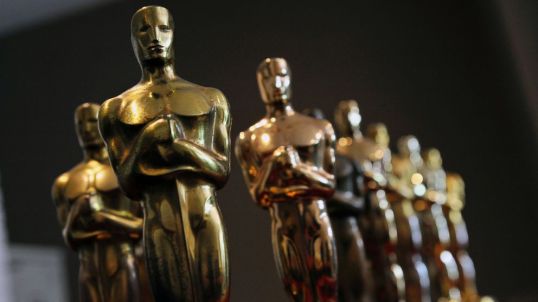
Lisa Marie’s Way Too Early Oscar Predictions For April


These are all pretty much random guesses so take them with several grains of salt.

Check out my predictions for March here!

Best Picture

The Adventures of Cliff Booth

Digger

Dune Part Three

Fatherland

I Play Rocky

Mr. Irrelevant

The Odyssey

Project Hail Mary

The Social Reckoning

Wild Horse Nine

Best Director

David Fincher for The Adventures of Cliff Booth

Phil Lord and Christopher Miller for Project Hail Mary

Christopher Nolan for The Odyssey

Pawel Pawlikowski for Fatherland

Aaron Sorkin for The Social Reckoning

Best Actor

David Corenswet in Mr. Irrelevant

Tom Cruise in Digger

John Malkovich in Wild Hose Nine

Brad Pitt in The Adventures of Cliff Booth

Hans Zischler in Fatherland

Best Actress

Daisy Edgar-Jones in Sense and Sensibility

Sandra Huller in Fatherland

Mikey Madison in The Social Reckoning

Renate Reinsve in Fjord

Michelle Williams in A Place in Hell

Best Supporting Actor

Scott Caan in The Adventures of Cliff Booth

Willem DaFoe in Werewulf

Colman Domingo in Michael

Matt Dillon in I Play Rocky

Jeremy Strong in The Social Reckoning

Best Supporting Actress

Elizabeth Debicki in The Adventures of Cliff Booth

Scarlett Johansson in Paper Tiger

Tao Okamoto in All Of A Sudden

Parker Posey in Wild Horse Nine

AnnaSophia Robb in I Play Rocky

Film Review: Boiler Room (dir by Ben Younger)


Released in 2000, Boiler Room tells the story of Seth Davis (Giovanni Ribisi).

Seth is only 19 years old.  He’s the son of a federal judge and he’s also a college dropout.  Seth is making a pretty good living for himself, running a casino out of a house near the campus.  One night, a handsome 20something named Greg Weinstein (Nicky Katt) stops by and tells Seth that he could be making an even better living for himself as a broker at J.T. Marlin.

Located somewhere in Long Island, J.T. Marlin is a brokerage firm that is dominated by loud and young men.  Overseen by the ruthless Jim Young (Ben Affleck, doing the glorified cameo thing), J.T. Marlin is a place where everyone owns an expensive car, an expensive watch, and where everyone brags about how much money they’ve made.  The insults and slurs fly from desk to desk, as they tend to do whenever a bunch of wealthy, highly competitive guys get together.  J.T. is seduced by the atmosphere, even as he watches some broker breaks down due to the pressure.  He becomes friends with Chris Varick (Vin Diesel) and falls for receptionist Abbie Halpert (Nia Long), who just happens to be Greg’s ex-girlfriend.  Eventually, Seth gets good at his job.  Unfortunately, it turns out that his job is centered around tricking people into investing in a pyramid scheme and eventually, one of Seth’s clients, Harry (Taylor Nichols), ends up broke and without his family.  The guilt-stricken Seth realizes that he has a conscience.

Like a lot of these type of movies, Boiler Room is at its best when it starts, when it’s all about tough talk, rude jokes, and obsessive competition amongst a bunch of well-dressed good-looking guys.  Nicky Katt and Vin Diesel are so much fun to listen to that it’s hard not to regret that the entire film wasn’t just about them.  Things become significantly less interesting once the FBI shows up and Seth decides to become a snitch.  For the most part, no one like a snitch, even if they’re motivated by the purest of intentions.  To make a snitch likable, he has to be a truly compelling character, like Henry Hill in Goodfellas.  For the most part, audiences prefer anti-heroes who go down with the ship as opposed to the rats who jump into the first lifeboat they see.  In The Wolf of Wall Street, Jordan Belfort agrees to wear a wire but then slips his business partner a note, warning him.  That’s one of the reasons why The Wolf of Wall Street is still a classic while Boiler Room has been largely forgotten.  As a character, Seth just isn’t compelling enough to pull off the snitch act.  Nor does he really seem clever enough to pull off what he does at the end of the film.

That said, I do enjoy Boiler Room.  It’s largely due to the cast.  Nicky Katt, Vin Diesel, Scott Caan, Giovanni Ribisi, they were all young, energetic, and eager to show off what they could do.  While their characters competed to see who could make the most money, the actors competed to see who could steal the most scenes.  The film is ultimately only so-so but that cast is unforgettable.

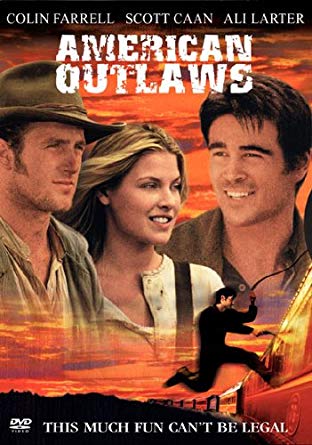
American Outlaws (2001, directed by Les Mayfield)


Returning to their hometown in Missouri in the days following the end of the Civil War, former Confederate guerrillas Jesse James (Colin Farrell) and Cole Younger (Scott Caan) are disgusted to discover that the railroad companies are trying to take over everyone’s land.  After Cole’s cousin and Jesse’s mother are killed by railway thugs, Jesse and Cole take revenge by forming the James/Younger Gang and robbing banks.  Soon, the members of the James/Younger Gang become folk heroes and the railroad company resorts to bringing in Alan Pinkerton (Timothy Dalton) to track the outlaws down.  However, even as they try to remain out of the clutches of Pinkerton’s men, there is growing dissension in the ranks of the James/Younger Gang.  Cole feels like Jesse doesn’t respect his opinions while Jesse is falling in love with Zee (Ali Larter) and it’s hard to court a girl when you’re constantly having to hide out from Alan Pinkertson.  Meanwhile, the other members of the gang wonder why their wanted posters never look as good as Jesse’s and Cole’s.

There have been many movies made about the James/Younger Gang and this is certainly one of them.  What sets this telling apart from other versions of this familiar tale is that American Outlaws is the feel-good version of the story.  Bob and Charley Ford are nowhere to be seen in American Outlaws and Jesse James doesn’t get shot in the back while straightening a picture.  This approach misses the point of what makes the legend of Jesse James so memorable in the first place.  Jesse James was the greatest outlaw in the west but he was ultimately taken down by a coward who shot him in the back.  Take out that part of the story and the story loses all of its power.  Jesse James just becomes another outlaw.

In real life, the James/Younger Gang were reportedly a rough group of outlaws who didn’t hesitate when it came to killing.  In American Outlaws, they come across more like a boy band with a side hustle robbing banks.  Jesse is the soulful leader, Cole is the rebel, and the other members of the gang are the interchangeable backup vocalists.  There’s been many good and even great films made about the James/Younger Game.  American Outlaws is not one of them.  For a good movie about the life and times of Jesse James and his associates, I would suggest checking out Walter Hill’s The Long Riders or Andrew Dominik’s The Assassination of Jesse James by the Coward Robert Ford.

Cleaning Out The DVR Yet Again #31: Black and White (dir by James Toback)


(Lisa recently discovered that she only has about 8 hours of space left on her DVR!  It turns out that she’s been recording movies from July and she just hasn’t gotten around to watching and reviewing them yet.  So, once again, Lisa is cleaning out her DVR!  She is going to try to watch and review 52 movies by the end of Wednesday, December 7th!  Will she make it?  Keep checking the site to find out!)

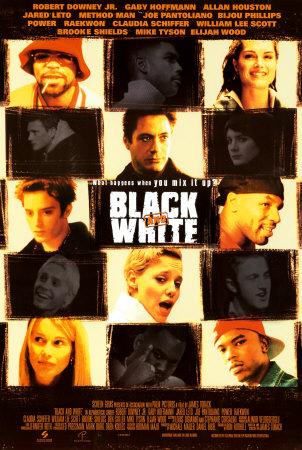
black_and_white_black_white-681253575-large

On November 15th, I recorded the 1999 melodrama, Black and White, off of Encore.

Black and White is a film that I’ve seen several times and I’ve always meant to review it.  It’s an attempt to explore the state of race, rap, crime, and sex in the late 20th century.  It’s also a James Toback film, which means that it contains all of the stuff that appears in every James Toback film: a threesome in the park, improvised dialogue, cameos from famous people playing themselves, an obsession with college basketball games, casual sexism, and a lot of talk about why you should never send “a little boy to do a man’s job.”  By his own admission, the white Toback is obsessed with the black experience but, when you watch a James Toback film, you get the feeling that his entire knowledge of African-American culture comes from watching other movies.

In short, Black and White is probably one of the silliest and most misjudged films that I’ve ever seen.  In fact, it’s so misjudged that it’s compulsively watchable.  Though I’m always hesitant to casually toss around the term “guilty pleasure,” that’s exactly what Black and White is.

Black and White tells several different stories, some of which are connected and some of which are not.  Sam Donager (Brooke Shields) is an independent filmmaker who is attempting to make a documentary about white people who try to act black.  Her husband, Terry (Robert Downey, Jr.), is gay and hits on every man (and boy) that he sees.  Sam and Terry start following around a group of privileged white kids who are obsessed with rap music.  Sam asks them if they want to be black.  They say that they’re going through a phase.

One of the kids is named Wren and he’s played by Elijah Wood.  He doesn’t really do much but every time he shows up in the film, you go, “It’s Elijah Wood!”  And then there’s Marty King (Eddie Kaye Thomas) who is the son of the Manhattan District Attorney (Joe Pantoliano).  Marty’s older brother is Will (William Lee Scott) ,who is some sort of low-level criminal.  And finally, the unofficial leader of the kids is Charlie (Bijou Phillips) and she gets to give a long monologue explaining the various uses of the n-word.

(Their teacher, incidentally, is played by Jared Leto.  If you’ve ever wanted to listen to Jared Leto lecture about the relationship between Othello and Iago, this is the film to see.  That said, the whole Othello and Iago lecture is just kinda randomly tossed in and doesn’t really pay off.)

Charlie is one of the many girlfriends of Rich Bower (Power), who is not only an up-and-coming rap producer but he’s also the head of a criminal organization.  (There’s a lengthy and kinda pointless scene where he and his associates demand money from a club manager played by Scott Caan.)  Rich is also friends with Mike Tyson.  Tyson plays himself and he gets to deliver an entire monologue about how Rich should never send a boy to do a man’s job.

But we’re not done!  Rich’s cousin is Dean Carter (Allan Houston), a college basketball player.  Dean is dating an anthropology graduate student (Claudia Schiffer, giving a hilariously terrible performance) who is obsessed with fertility symbols.  Dean is also being blackmailed by a corrupt cop named Mark Clear.  Guess who plays Mark Clear?

BEN FREAKING STILLER!

Needless to say, Ben Stiller is massively miscast.  He delivers he lines in his trademark comedic fashion, which makes it next to impossible to take him seriously as any sort of threat.  He also has a backstory that is needlessly complex but at least it allows him to say, “I’m Saul of Fucking Tarsus!”

Anyway, almost the entire film was improvised, which is one of those things that probably seemed like a good idea at the time.  A few of the actors do well with the improvisation.  Stiller may be miscast but at least he can come up with stuff to say.  Robert Downey, Jr.’s character may seem out-of-place but again, Downey knows how to keep things interesting.  But the rest of the cast seems to be a bit stranded so we end up with a lot of lengthy scenes of characters struggling to make some sort of sense of Toback’s storyline.

It’s obvious that James Toback felt that this film had something important to say but, instead of any insight, it can only offer up the occasionally strange-as-Hell scene.

Like this scene, for instance, in which Mike Tyson literally attempts to kill Robert Downey, Jr:

Or this weird little scene between Ben Stiller and Joe Pantoliano, which is dominated by Stiller’s odd delivery of his lines:

Or the closing montage, which is actually rather well-put together and makes great use of Michael Fredo’s Free:

Sadly, the video above ends before it gets to the part where we see Claudia Schiffer on a date with Mike Tyson, telling him about fertility symbols.

Anyway, Black and White is one of those films that wants to say something despite not being sure what.  Again, it may ultimately be rather silly but it’s still compulsively watchable.

(For the record, Marla Maples — who also appeared in Maximum Overdrive and was married to future President Donald Trump when this movie was made — has a cameo as a character named Muffy.  We live in a strange fucking world, don’t we?)

Back to School #55: Varsity Blues (dir by Brian Robbins)


james-van-der-beek-varsity-blues-e1358953220340

“I don’t want your finger.”

Bleh!

The 1999 high school football film Varsity Blues has been showing up on cable fairly regularly lately and, seeing as how I’m currently in the process of reviewing 80 of the best, worst,  most memorable, and most forgettable high school films of all time, I decided that I might as well watch the whole thing.

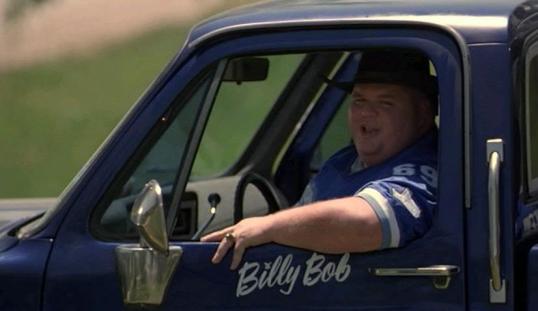
Don’t get me wrong. I had seen bits and pieces of it over the years.  I knew that it was set in Texas.  I knew Jon Voight played a fanatical football coach.  I knew that James Van Der Beek played an idealistic quarterback who clashed with the coach.  I knew that there was a fat guy named Billy Bob, mostly because every time an out-of-state director makes a film about Texas, there’s a fat guy named Billy Bob.  I knew about as much as one could learn from that episode of The Office where Michael Scott shows the film during “Movie Monday.”

"I don't want your truck."

“I don’t want your truck.”

But I had never seen the whole film so I decided, why not?  After all, I had already decided to review several other Texas-set high school films — The Last Picture Show, Dazed and Confused, Dancer, Texas, and Rushmore.  And hey those films were all good so maybe Varsity Blues would be good too!

Bleh.

One of the big clichés about Texas is that the entire state is obsessed with football.  (The other big cliché, of course, is saying that “everything is bigger in Texas.”  As if being a tiny state like Vermont is somehow preferable…)  I’ve always found the whole “Texas worships football” thing to be amusing because I’m a Texas girl and I don’t know a thing about football.  People tend to talk about Texas and football as if there aren’t any fanatical football fans in New York or California.  Ultimately, of course, it has little do with football and everything to do with the fact that the rest of the country loves to hate my home state.  If Vermont was known for being obsessed with football, there’d probably be thousands of articles about the “proud history of Vermont football.”  But since it’s Texas, we end up with movies like Varsity Blues.

"I don't want your painfully obvious at social commentary."

“I don’t want your painfully obvious attempt at social commentary.”

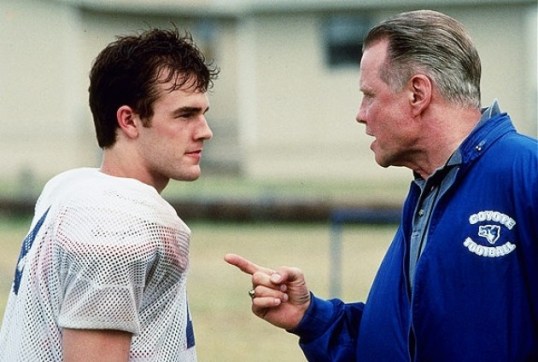
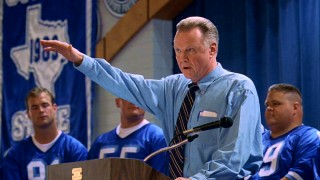
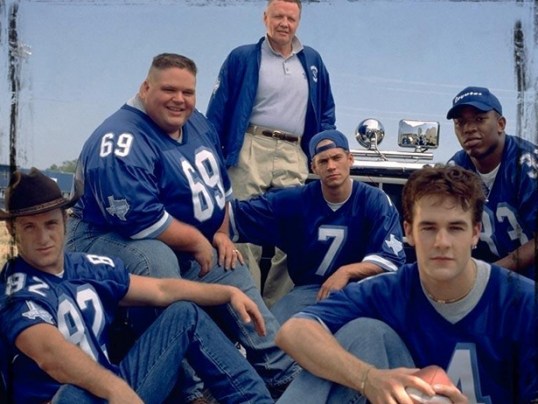
Anyway, Varsity Blues tells the story of Mox (James Van Der Beek), who is a backup quarterback for the championship-winning West Caanan High School football team.  However, Mox isn’t just your average jock.  For one thing, he’s seen reading Kurt Vonnegut’s Slaughterhouse Five.  (It’s indicative of this film’s approach to characterization that we never learn whether Mox actually understands or even likes Slaughterhouse Five.  We’re just supposed to be impressed by the fact that he owns a copy of the book.)  Mox wants to leave Texas to go to an Ivy League school.  He doesn’t want to play under the legendarily abusive Coach Kilmer (Jon Voight).  (How evil is Kilmer?  So evil that he poses for pictures like the one above.)   And Mox resents the pressure put on him by his football-crazed father.  (“You throw that fucking pigskin!” his dad shouts at one point.)  As Mox puts it, “I don’t want your life!” and the line is just hilarious because Van Der Beek’s attempt to sound like a Texan is hilarious.

(Tip for actors: If you can’t do the accent, don’t try.  Because I guarantee, if I ever meet James Van Der Beek, I’m going to tell him that his accent sucked and then I’m going to laugh and laugh.  It probably won’t do much for his self-image.  Sorry, James.)

"I don't want James Van Der Beek's career."

“Get me on Hawaii 5-0 because I don’t want James Van Der Beek’s career.”

Anyway, when star quarterback Lance (Paul Walker) is injured, Mox is suddenly the team’s starting quarterback.  And you know what?  Mox is going to play the game his way!  Soon, he is standing up the cartoonishly evil Coach Kilmer and challenging small town Texas’s obsession with high school football.

And here’s the thing: this is a film that wants to have it both ways.  It wants to challenge the philosophy of winning at all costs and it also pretends to be about the unfair pressure that high school athletes are put under.  But you better believe that the film ends with Mox leading his team to victory.  And it’s not so much that Mox wins as much as it’s the fact that you know the film would never have the courage to actually have Mox lose.  The film wants to be celebration of rebellion but, ultimately, it’s just a standard sports film.

And, even beyond that, it’s just not a very good film.  I was shocked, when I checked with the imdb, to discover that Varsity Blues was actually filmed in Texas because the film feels like it was made in California.  It has no authentic Texas flavor to it.  What it does have is some of the worst fake accents that I’ve ever heard in my life.

Mox may not want his father’s life but I don’t want this stupid film.

varsitybluesheader

“Well, we don’t want your review!”

10 Things To Be Thankful For In 2010


It’s the Thanksgiving season, that time when bloggers everywhere come up with lists of things that they are thankful for.  Here’s just 10 of the many things that I’ve been thankful for in 2010.

1) The fifth season of Dexter

I have to be honest.  I’ve been a fan of Dexter since the show’s 1st season but I wasn’t sure if the show would be able to survive after the fourth season ended with Rita (Julie Benz) dead in a bloody bathtub.  However, season 5 has been a triumph.  Yes, a little too much time has been devoted to the domestic troubles of LaGuerta and Batista (Lauren Velez and the always intriguing David Zayas) but Michael C. Hall (as Dexter) and Jennifer Carpenter (as Deb) have done some of their best work this season.  Even better, this season has featured two brilliant performances from guest stars Peter Weller and, especially, Julia Stiles (who really deserves her own spin-off).  Still, you have to wonder if any murder has ever actually been solved in Miami…

2) Noomi Rapace as Lisbeth Salander. 

In three films — The Girl With The Dragon Tattoo, The Girl Who Played With Fire, and The Girl Who Kicked The Hornet’s Nest, Rapace created one of the first truly iconic film characters of the 21st century and that’s an accomplishment that will stand regardless of any attempts by the Hollywood mainstream to steal her accomplishment through any unnecessary remakes. 

3) Lost

As more time has passed, the more I’ve come to admit just how dissatisfied I was with how the creators of Lost decided to end their show.  Still, that doesn’t change the fact that, for several years, I scheduled my life around when the next episode of Lost was going to air.  I may not be thankful for a series finale that left way too many questions unanswered (why couldn’t children be born on the island?  What was the sickness?) but even the final season featured some of the show’s best moments.

4) The Walking Dead

I’m not a huge fan of Frank Darabont (sorry, but The Shawshank Redemption sucks) but I’m happy to say that he didn’t fuck up The Walking Dead.

5) Kathryn Bigelow broke the glass ceiling.

I’m still not a huge fan of The Hurt Locker but I am definitely a fan of Kathryn Bigelow.  As bad as this year’s Oscar ceremony was, it was worth watching just to see Bigelow become the first woman to ever win an Oscar for best director.  In many ways, it almost felt like a fantasy come to life — not only did Bigelow win a historic victory but she did it by beating her ex, James Cameron (who, to judge from his films, has never met a woman to whom he wouldn’t condescend).  The fact that she then gave one of the only genuine acceptance speeches of the entire ceremony was a wonderful bonus.

6) Blue Valentine was rated NC-17.

The upcoming film Blue Valentine (which I have yet to see) was reportedly given an NC-17 rating on account of scenes featuring Ryan Gosling and Michelle Williams having sex.  That the film would feature characters played Gosling and Williams having sex makes sense when you consider that the movie is specifically about their marriage.  However, despite this, Blue Valentine was rated NC-17 while films like The Expendables, A Nightmare on Elm Street, the Saw films — in which thousands of people are graphically killed and tortured on-screen — are given an R rating as a matter of routine.  If Blue Valentine had been about Ryan Gosling murdering Michelle Williams (as opposed to fucking her), the film probably would have an R rating and would be considered appropriate viewing in malls across America.  I’m thankful for this rating because it serves as a reminder that it’s okay to show a woman being humiliated, tortured, or killed just as long as you don’t show her actually enjoying an orgasm.

7) Exit Through The Gift Shop

The rest of you mainstreamers can talk about how much you love the Social Network for the rest of eternity, if you want.  Exit Through The Gift Shop is still the best movie of 2010.

8 ) Lisa Marie finally figured out how to work her DVR.

Yes, yes, I know.  DVR has been around like forever and it’s all old news and I’m sure there’s something even better than DVR that everyone but me is raving about and using right now but — look, shut up, okay?  Yes, I’ve had DVR forever but I just figured out how to actually make it work a few months ago.  And I love it!  Now, if I want to sit down in the living room at 3 in the morning and watch old episodes of Project Runway, there’s no way anyone can stop me.

9) Joseph Gordon-Levitt floating through a dream hallway in Inception

Inception was a film full of excellent set pieces and memorable images but whenever I think about the movie, I will always see Joseph Gordon-Levitt floating through that hallway in a suit and looking rather adorable as he does it.

10) Cthulhu on South Park

Well, of course.

That’s just ten things I’m thankful for and I didn’t even start to talk about Scott Caan on Hawaii 5-0, James Franco in 127 Hours, or movies like Fish Tank, Winter’s Bone, and Never Let Me Go.  What are you thankful for?  Leave a comment, let the world know.  The best comment wins a renewed sense of peace and a happy new year.  (Please note that this is not a legally binding document.)