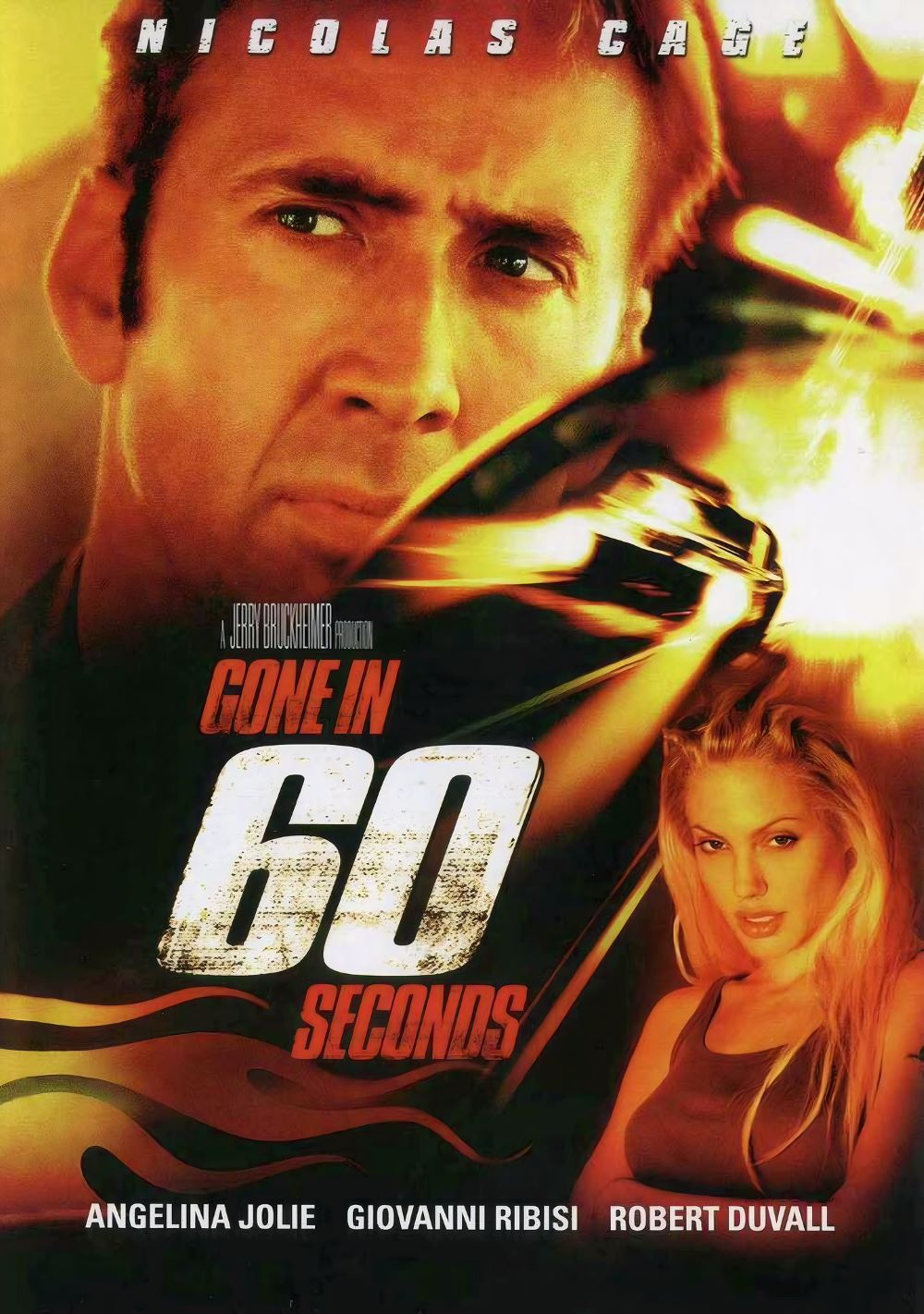
Guilty Pleasure No. 116: Gone in 60 Seconds (dir. by Dominic Sena)


There is a specific, almost alchemical quality to the late 1990s and early 2000s era of Nicolas Cage as an action star. Before the internet turned every one of his performances into a meme and before his financial troubles led him down the rabbit hole of direct-to-video oddities, Cage was genuinely one of the most exciting and weirdly compelling action heroes on the planet. From The Rock in 1996 to Con Air in 1997 and Face/Off in 1997, he delivered a holy trinity of high-octane insanity that no other actor could have pulled off. By the time the calendar flipped to 2000, Cage was at the peak of his powers, and director Dominic Sena’s Gone in 60 Seconds arrived as both a victory lap and a slight exhale. It is not as unhinged as Face/Off nor as tightly wound as The Rock, but it is a perfect snapshot of its moment: a glossy, MTV-infused car heist flick that smells like gasoline, leather, and late-90s hubris. And while it has plenty of shortcomings, Gone in 60 Seconds has earned its place not in the pantheon of great action cinema, but in that more beloved hall of fame: the Guilty Pleasure.

The plot is as simple as a carburetor. Cage plays Randall “Memphis” Raines, a legendary car thief who has supposedly gone straight, now living a quiet life designing hybrid engines. But when his reckless younger brother Kip, played with sweaty desperation by Giovanni Ribisi, botches a job for a ruthless British gangster named Raymond Calitri (Christopher Eccleston at his sleaziest), Memphis is forced back into the life he left behind. The task is absurdly impossible: steal 50 specific luxury cars in a single weekend, or Calitri will kill Kip. That’s right, fifty cars. In three days. The film never really bothers to explain the logistics of storing or delivering that many vehicles, but that’s not the point. The point is the ride, the revving engines, and the way Cage stares at a 1967 Shelby GT500 named Eleanor like she’s the ghost of a lost lover. That car is the real star, and the film knows it.

Dominic Sena, who previously directed Cage in the underrated road thriller Kalifornia, brings a music video sensibility to the proceedings. Gone in 60 Seconds is drenched in late-90s visual tics: slow-motion shots of hubcaps spinning, golden sunsets glaring off polished chrome, and a soundtrack that alternates between nu-metal grooves and bluesy rock. The editing is fast but not confusing, and the heist sequences have a rhythmic, almost choreographed feel. You never believe for a second that Memphis and his crew—a motley collection of oddballs played by Robert Duvall, Vinnie Jones, and a very underutilized Angelina Jolie—can actually pull off fifty thefts without the entire LAPD catching on. But the film operates on movie logic. Cars are hotwired in seconds, police radio chatter is effortlessly avoided, and every chase defies the laws of physics. It is pure fantasy, and that is exactly why it works as a guilty pleasure.

Now, let’s talk about Cage. In 2000, he was still riding the high of that legendary late-90s run, and Gone in 60 Seconds fits neatly into his brand of action star as tortured romantic. Memphis Raines is not the coked-up lunatic Castor Troy or the shouty Stanley Goodspeed. He is weary, melancholic, and trying to be honorable in a dishonorable profession. Cage plays him with a hangdog sincerity that is surprisingly effective. When he talks to Eleanor, stroking her steering wheel and whispering about how she tests her drivers, he is utterly committed. There is no irony, no winking at the camera. That is the secret to Cage’s enduring appeal in this era: he treats absurd material with the same intensity he would bring to a Shakespeare soliloquy. The action sequences—especially the climactic chase where Eleanor leaps over a drawbridge—showcase Cage’s physicality and willingness to do real stunt work. He sells the danger and the desperation. You believe that this man would risk everything for a car, and that belief makes the film’s silliness palatable.

But let’s be honest about the shortcomings, because Gone in 60 Seconds has plenty. The middle act drags considerably. For a movie about stealing fifty cars, there is a surprising amount of standing around in warehouses and having conversations about “respecting the machine.” Angelina Jolie’s character, Sara, is Memphis’s ex-girlfriend and a fellow thief, but she is given almost nothing to do except look cool in leather and exchange tepid romantic banter with Cage. The chemistry between them is nonexistent. Christopher Eccleston’s Calitri is a one-note villain who likes opera and cruelty, and his final defeat is laughably abrupt. Delroy Lindo plays a dogged detective, but he is so incompetent that he never generates real tension. The film’s central gimmick—the ticking clock of fifty cars in three days—is inconsistently tracked, and by the final act, you have no idea how many cars are left or why it still matters. The dialogue is also gloriously corny. Lines like “Ride or die” and “Respect the car, man” are delivered with such straight faces that they circle back around to being endearing.

And yet, Gone in 60 Seconds earns its status as a guilty pleasure because it understands exactly what it is. This is not a sophisticated heist thriller like Heat or a gritty crime drama. It is a shiny, high-budget B-movie about a man and his car, and it leans into that identity without apology. The final twenty-minute chase sequence is genuinely thrilling, with real cars being destroyed and practical stunts that modern CGI could never replicate. Eleanor getting airborne, landing hard, and somehow still running is a moment of pure cinematic joy. The sound design—the roar of that V8 engine, the screech of tires on asphalt—is visceral and satisfying. And Cage’s performance, even when the script lets him down, holds the whole thing together. He is the anchor that keeps the film from floating away into utter nonsense.

Looking back from today’s perspective, Gone in 60 Seconds is a time capsule of a very specific moment. It captures the tail end of the late-90s obsession with extreme sports, tuner culture, and the idea that cars had souls. It also captures Nicolas Cage at a fascinating crossroads: still an A-list action star, still capable of opening a blockbuster, but already showing the signs of the wonderful weirdness that would later define his career. This film is not his best, not by a long shot, but it is one of his most rewatchable. You put it on when you want to turn your brain off, hear some great engine noises, and watch a sweaty, sincere Nic Cage talk to a Shelby like she is his long-lost sweetheart. That is the definition of a guilty pleasure. It is not good in the traditional sense, but it is fun. And sometimes, fun is enough.

Previous Guilty Pleasures

  1. Half-Baked
  2. Save The Last Dance
  3. Every Rose Has Its Thorns
  4. The Jeremy Kyle Show
  5. Invasion USA
  6. The Golden Child
  7. Final Destination 2
  8. Paparazzi
  9. The Principal
  10. The Substitute
  11. Terror In The Family
  12. Pandorum
  13. Lambada
  14. Fear
  15. Cocktail
  16. Keep Off The Grass
  17. Girls, Girls, Girls
  18. Class
  19. Tart
  20. King Kong vs. Godzilla
  21. Hawk the Slayer
  22. Battle Beyond the Stars
  23. Meridian
  24. Walk of Shame
  25. From Justin To Kelly
  26. Project Greenlight
  27. Sex Decoy: Love Stings
  28. Swimfan
  29. On the Line
  30. Wolfen
  31. Hail Caesar!
  32. It’s So Cold In The D
  33. In the Mix
  34. Healed By Grace
  35. Valley of the Dolls
  36. The Legend of Billie Jean
  37. Death Wish
  38. Shipping Wars
  39. Ghost Whisperer
  40. Parking Wars
  41. The Dead Are After Me
  42. Harper’s Island
  43. The Resurrection of Gavin Stone
  44. Paranormal State
  45. Utopia
  46. Bar Rescue
  47. The Powers of Matthew Star
  48. Spiker
  49. Heavenly Bodies
  50. Maid in Manhattan
  51. Rage and Honor
  52. Saved By The Bell 3. 21 “No Hope With Dope”
  53. Happy Gilmore
  54. Solarbabies
  55. The Dawn of Correction
  56. Once You Understand
  57. The Voyeurs 
  58. Robot Jox
  59. Teen Wolf
  60. The Running Man
  61. Double Dragon
  62. Backtrack
  63. Julie and Jack
  64. Karate Warrior
  65. Invaders From Mars
  66. Cloverfield
  67. Aerobicide 
  68. Blood Harvest
  69. Shocking Dark
  70. Face The Truth
  71. Submerged
  72. The Canyons
  73. Days of Thunder
  74. Van Helsing
  75. The Night Comes for Us
  76. Code of Silence
  77. Captain Ron
  78. Armageddon
  79. Kate’s Secret
  80. Point Break
  81. The Replacements
  82. The Shadow
  83. Meteor
  84. Last Action Hero
  85. Attack of the Killer Tomatoes
  86. The Horror at 37,000 Feet
  87. The ‘Burbs
  88. Lifeforce
  89. Highschool of the Dead
  90. Ice Station Zebra
  91. No One Lives
  92. Brewster’s Millions
  93. Porky’s
  94. Revenge of the Nerds
  95. The Delta Force
  96. The Hidden
  97. Roller Boogie
  98. Raw Deal
  99. Death Merchant Series
  100. Ski Patrol
  101. The Executioner Series
  102. The Destroyer Series
  103. Private Teacher
  104. The Parker Series
  105. Ramba
  106. The Troubles of Janice
  107. Ironwood
  108. Interspecies Reviewers
  109. SST — Death Flight
  110. Undercover Brother
  111. Out for Justice
  112. Food Wars!
  113. Cherry
  114. Death Race
  115. The Beast Within
  116. Girl Series

Music Video of the Day: Magic by Mick Smiley (1984, directed by Greg Gold)


Magic is probably best known for being used in the original Ghostbusters.  It’s the song that plays while the ghosts are being released from Ghostbusters HQ and subsequently haunting New York.  It’s been said that composer Elmer Bernstein, who did the score for Ghostbusters, hated the way that Magic was used in the film.  Then again, Bernstein also hated the film’s Oscar-nominated theme song.

The video has nothing to do with ghosts but instead, it’s about the magic of attraction.  It was directed by Greg Gold, who also directed videos for Michael Bolton and the Hollies.  Far better known than the video’s director is the video’s cinematographer.  Dominic Sena would go on to direct several music videos before eventually branching into directing feature films like Kalifornia, Gone In 60 Seconds, Swordfish, and Season of the Witch.

Enjoy!

Music Video of the Day: Don’t Mean Nothin’ by Richard Marx (1988, directed by Dominic Sena)


Today’s music video of the day is Richard Marx’s Don’t Mean Nothin’.  This video was directed by Dominic Sena, who later directed films like Kalifornia, Gone in 60 Seconds, and Swordfish.  Let’s break it down and see if this video really don’t mean nothin’.

0:03 — I’m not sure but I think we may be in Hollywood.

0:04 — These scenes of Los Angeles street life will be familiar to anyone who has ever seen a movie about a small town girl moving to the big city to pursue her dreams.

0:18 — Welcome to Shangri-La!

0:26 — Cynthia Rhodes plays the small town girl.  You may recognize her from Flashdance, Staying Alive, and Dirty Dancing.  At the time this video was shot, she was dating Richard Marx.  She would marry him a year later.  They divorced in 2014.

0:38 — The sleazy apartment manager is played by the one and only G.W. Bailey.  Bailey has been in a ton of television shows and movies.  If you don’t know him from M*A*S*H, you probably know him from the Police Academy films.

0:48 — Cynthia knows what ol’ G.W. was doing back there.

0:55 — Richard Marx’s father was in advertising and Richard Marx started his singing career when he was five years old and he performed a jingle that his father had written.  When Marx was 17, he moved to Los Angeles.  This song was based on his experiences.

1:14 — Cynthia’s barely been in Hollywood for a week and she’s already got an audition!  That’s better that most small town girls do in the big city.

1:38 — Another great moment from G.W. Bailey.

1:53 — Cynthia is shocked! to discover what goes on in Hollywood.

2:09 — Richard says, “Drink up and enjoy the show!”  Cynthia is not amused.

2:24 — More Hollywood stock footage.

2:44 — That’s Joe Walsh of the Eagles on guitar.

2:59 — Proof that this video was made in 1988: Richard hands over a cassette of his music.

3:24 — Disgusted to see that Cynthia’s become either a maid or a waitress, Richard stops the music and throws away his future.

3:27 — There’s a lot of hockey hair in this video.

3:38 — Ol’ G.W.’s in trouble now.

3:42 — Are they taking pictures of G.W. getting beaten up?  Or does G.W. own a strobe light?

4:08 — Cynthia finally feels comfortable enough to wear an ugly sweater in L.A. and Richard has switched to decaf.

4:20 — A new small town girl arrives.  Cynthia tells her where she can find Ol’ G.W.

4:24 — Cynthia and Richard shares a smile and a private laugh as the new girl naively plunges into the moral abyss that is Hollywood.

4:32 — Don’t worry.  It don’t mean nothin’ at all.

Music Video of the Day: Somebody’s Watching Me by Rockwell (1984, dir. Francis Delia)


A few years ago when the Snowden stuff happened, it was priceless to come and look at this music video. You’d see comments along the lines that if Rockwell had only knew it was really the NSA that was watching him, or simply that Rockwell was right that somebody was watching him. Of course you also got the usual comments of people coming many decades later wondering if that is Michael Jackson singing the chorus. Yes, it is.

As is par for the course, this is the first time I have actually paid close attention to the music video I’m spotlighting. It is loaded with a lot of interesting stuff to tie-in with the theme of paranoia.

Why is Rockwell reading the Chinese characters at the beginning? Is that some sort of ghostly reference. Is that supposed to be a second Rockwell? We follow that one while it cuts back and forth to Rockwell in the shower. Is that supposed to mean he has a split personality? It’s probably just the music video’s requisite reference to Psycho (1960), but then we also get the scene with him watching himself on TV. I love it.

I think my favorite part is when someone dressed like a grieving widow is right outside his shower, but he doesn’t see them. They do the same thing while he is standing in the cemetery that apparently is in his backyard.

It comes as no surprise to me that this music video was directed by Francis Delia. He’s the director who brought us the music video for Blue Öyster Cult’s Shooting Shark, which is one of the best of the 1980s. That one was also surreal.

We know quite a few of the people who worked on this music video beyond the director.

The blonde coming out from under the bed is Francis Delia’s daughter Amy.

Nancy Leiviska wrote and produced the music video. You might know her as being the mother of RedFoo whom she had with Barry Gordy. She has apparently gone on to work as an executive assistant on numerous films for Ice Cube. She worked on several other music videos including appearing as one of the people in the music video for Rick James’ Super Freak.

Dominic Sena shot the music video. He directed around 40 music videos and shot around 10 of them. He also went on to direct movies like Gone in Sixty Seconds (2000) and Swordfish (2001).

Jason Braunstein was the production manager. The only other credit I can find for him is having worked as an associate in charge of production on Ms. 45 (1981).

Jon Leonoudakis was the production coordinator. He is in the music video as the guy who is looking in through the porthole of the front door. I can find a few credits on him like directing some sports documentaries in recent years. However, it’s clearly his work as an electrician on The Last American Virgin (1982), a production coordinator on Dead Women in Lingerie (1991), and a second unit location manager on Maniac Cop 2 (1990) that jump out at you on his IMDb profile page.

You could do a step-by-step review of this music video, but it’s only about three and a half minutes, so if you haven’t seen it yet, then watch it. It is one of the greatest music videos ever made, and still relevant today. In particular when you are trying to find a music video to help bookend the month of October.

Lisa Marie Does…Season of the Witch (dir. by Dominic Sena)


I have to write this review quickly because I have a feeling that, in another 30 minutes or so, my body’s immune system will succeed in destroying any trace of Season of the Witch.

In Season of the Witch, Nicolas Cage and Ron Perlman play two Crusaders who eventually get disillusioned with killing people so they desert the army, end up in a small village somewhere, and are informed that the town is being destroyed by the plague because a curse has been put on the town by a witch.  Cage and Perlman are then recruited by the local town’s cardinal (Christopher Lee, who is pretty much wasted under all of this really nasty plague makeup) to take the witch to a monastery that is located somewhere else.  You’re never really sure where any one location is in relation to another in this film, which is a bit of a problem since the majority of the film is taken up with the journey to the monastery. 

Anyway, the Monks at the monastery have this ancient book that apparently contains all these incantations that can be used against evil.  This book is the only one left in existence which leads to the question of why nobody ever bothered to make more than a handful of copies of all of these amazingly important books.  I mean, seriously, people.  So the idea is to take this witch to the monastery and read this book which will end the plague.

So, we go through the whole journey thing and a few unimportant characters are killed off along the way and Cage and Perlman discuss the meaning of life and faith and, at first, we’re led to doubt whether or not the accused witch is actually guilty but then she starts causing all of these supernatural, witch-like thing to happen so I guess the filmmakers got bored with that whole subplot early.

Then we reach the monastery and a whole other movie starts.  Seriously, I cannot begin to put into words just how massively the tone of the film changes once they reach the monastery.  The film actually becomes good in a kind of silly, over-the-top way as soon our knights are dealing with all of these flying demons and there’s disfigured monks all over the place, and the priest gets to say, “We’re going to need more holy water,” at one point.  (“Yay!” I nearly shouted out in the audience, “Catholic action movie one-liners!”)  The tone changes so massively that Season of the Witch actually becomes a really fun and entertaining little action movie but, unfortunately, just as soon as things start to get really fun — bang!  Movie is over.  Thank you for coming out tonight, folks.  Now get the Hell outta here.

Season of the Witch is, to put it politely, a mess.  This isn’t all that surprising as the movie is being released in January and January is, of course, reserved for either Oscar contenders going into wide release, films starring Jason Statham, or movies that are being released because the studio is contractually obligated.  Ron Perlman, being a veteran of both Guillermo Del Toro and Jean-Pierre Jeneut, knows exactly how play his role but Cage just rides around on his horse looking like he’s late for Halloween party.  Director Dominic Sena appears to have a mancrush on Zack Snyder and does the whole speed up the camera randomly then go into slow-mo even more randomly thing but it doesn’t really add up to anything more than just confusion.

Finally, I left this film feeling very betrayed because, seriously — how can you call your film Season of the Witch and not feature the classic Donovan song?