“The thing that’s always worried me about being one of the few is the way we keep on getting fewer.” — Flight Officer David Campbell
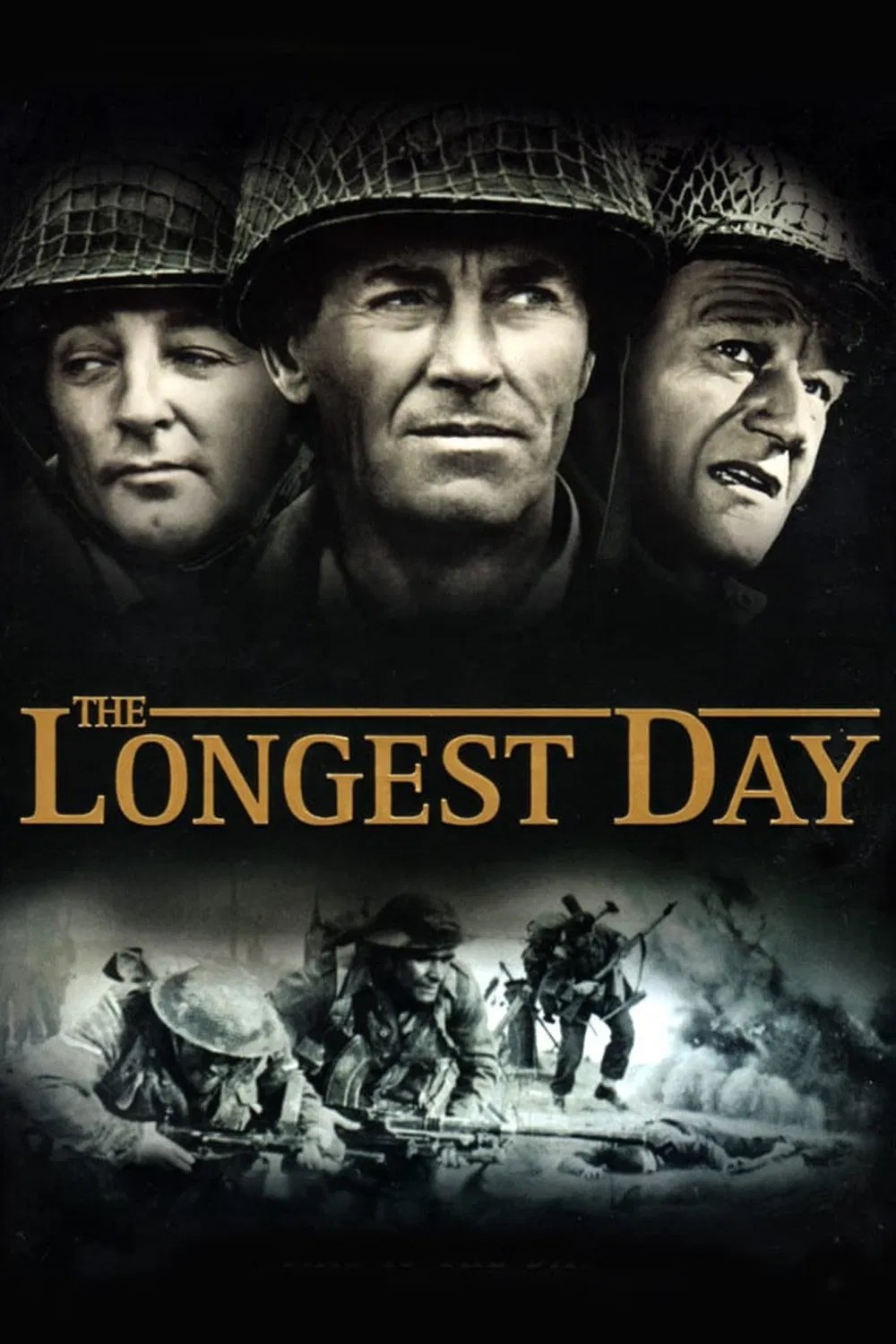
You could be forgiven for thinking that a three-hour black-and-white war epic from 1962 about the D-Day landings might feel like homework. The Longest Day sounds exactly like the kind of movie your history buff uncle would insist you watch, and you’d brace yourself for stiff acting, dated effects, and a flag-waving tone that hasn’t aged well. But here’s the surprise: this thing still cooks. It’s massive, messy in the best way, and surprisingly modern in its storytelling. Directed by a quartet of filmmakers—Ken Annakin for the British sequences, Andrew Marton for the Americans, Bernhard Wicki for the Germans, and with uncredited help from John Wayne’s own ego (more on that later)—The Longest Day isn’t one movie. It’s five or six movies crammed into a single sprawling canvas, and somehow that chaotic energy works perfectly for a story about the chaos of June 6, 1944.
First, let’s talk about the elephant in the room: the cast. It’s absurd. John Wayne, Robert Mitchum, Henry Fonda, Sean Connery, Richard Burton, Rod Steiger, Robert Wagner, Curt Jürgens, and a young Gert Fröbe (the future Goldfinger) are just the headliners. There are about forty other recognizable faces popping up for two minutes of screen time. You half expect a narrator to say “and that guy from that thing.” But here’s the trick: The Longest Day uses star power not as distraction but as shorthand. When you see John Wayne playing Lt. Col. Benjamin Vandervoort, you don’t need a backstory. You just know he’s the tough, unkillable leader. When you see Henry Fonda as Brig. Gen. Theodore Roosevelt Jr., you read quiet dignity and grit. The movie trusts that you’ll fill in the blanks, which allows it to jump between American, British, French, and German perspectives without pausing for emotional handholding. That’s a bold gamble, and it mostly pays off, though Wayne’s scenes are a prime example of the film’s one real weakness: occasionally, it lets the star overpower the story. His Vandervoort breaks his ankle jumping into Normandy and still leads his men—cool story, historically accurate—but Wayne plays it with that trademark swagger that feels more Rio Bravo than WWII. It doesn’t ruin the film, but it does remind you you’re watching a movie star, not a soldier.
Where The Longest Day truly earns its reputation is in its structure. The film opens with a ground-level view of the German defenders—foggy, tired, complacent. Rommel (Curt Jürgens) is home for his wife’s birthday. Junior officers are skeptical of the “invasion threat.” Then we cut to the Allied side, from Eisenhower’s agonized “go” decision to the paratroopers floating down into French nightmares. The film refuses to pick a hero. It bounces between a German machine-gunner mowing down Americans on Omaha Beach and a French Resistance fighter getting captured and executed. There’s no swelling music to tell you who to root for—the score by Maurice Jarre is often tense, percussive, or eerily quiet. That evenhandedness is shocking for an early-60s war film. The Germans aren’t cackling villains. They’re professionals, some cynical, some naive, all trapped in a bad situation. One scene shows a German officer calmly reporting the invasion to higher command while another weeps because his men have no air support. You don’t sympathize with them exactly, but you understand them. That’s rare for any war movie, let alone one starring John Wayne.
The set pieces remain jaw-dropping. Because this was made before CGI, every paratrooper you see actually jumped (with stuntmen and low altitudes). Every landing craft ramp dropping on Omaha Beach is filled with real extras who had to swim ashore in cold water. The famous shot of a lone French commando running across a bridge under fire? That’s a real explosion, real bullets (blanks, but still). The production employed thousands of military advisors and actual veterans as extras. You can feel that authenticity in the grain of the film. When American soldiers fumble with wet ammunition or a British glider crash-lands through a fence, it’s not slick Hollywood heroism. It’s clumsy, loud, and terrifying. The movie’s most quoted line—“The greatest thing about the greatest generation is they didn’t know they were the greatest”—isn’t in the film, but the spirit is everywhere. These guys aren’t quoting Shakespeare. They’re vomiting from seasickness, losing their gear, and crying for their mothers. Then they get up and climb a cliff. That contrast is what makes The Longest Day so effective: it’s a blockbuster that respects the small, undignified human moments.
If the film has a flaw beyond occasional star vanity, it’s pacing. The first hour is deliberately slow—building tension through radar stations, weather reports, and a French priest’s bicycle ride. That might bore viewers raised on Saving Private Ryan’s opening twenty minutes. But hang with it, because when the invasion starts, the deliberate pace pays off. You’ve been inside the German bunkers, heard their debates, seen their confidence. So when paratroopers land behind their lines with toy clickers (the actual “cricket” device from history), every crack of a twig feels tense. The other flaw is the film’s treatment of the French Resistance and civilians. They get a few noble moments—a girl running through gunfire to deliver a message—but overall, the French are sidelined. The movie is fundamentally Anglo-American, with German scenes as the “other” perspective. That’s honest to the command structure of D-Day, but it does mean the country being liberated mostly watches from the margins.
Still, The Longest Day achieves something that most war epics don’t: it’s a genuine ensemble piece without a single protagonist, and it never loses its moral clarity. There’s a scene where a German colonel (the wonderful Werner Hinz) looks at an American prisoner and says, “We fight for a monster. You fight for your homes.” That’s the whole movie in one line. It doesn’t demonize the Germans as evil—it shows them as humans who made terrible choices and are now paying for them. And it doesn’t sanctify the Allies—it shows them as scared kids with a just cause. The final image of the film is a lingering shot of the beach, littered with bodies and wreckage, as a narrator tells you the exact number of casualties on both sides. No music. No kiss. No flag. Just the silent aftermath. For 1962, that’s audacious. For today, it’s heartbreaking.
So should you watch The Longest Day? Yes, but not as a history lesson. Watch it as a time capsule of how we used to make movies: with real explosions, real extras, and a willingness to let a story breathe across three hours without a superhero or a snappy one-liner. It’s old-fashioned, sure. Some of the acting is stagey, and the black-and-white photography might feel like a relic. But once the landing craft doors drop and the bullets start kicking up water, you’ll forget the runtime. It’s not Saving Private Ryan’s visceral nightmare, and it’s not Band of Brothers’ intimate character study. It’s a reporter’s notebook of a film—raw, sprawling, and full of names you’ll never remember but faces you won’t forget. For a movie that’s over sixty years old, The Longest Day still has legs. And for a story about the longest day, it earns every single minute.


Pingback: Lisa’s Week In Review: 6/1/26 — 6/7/26 | Through the Shattered Lens