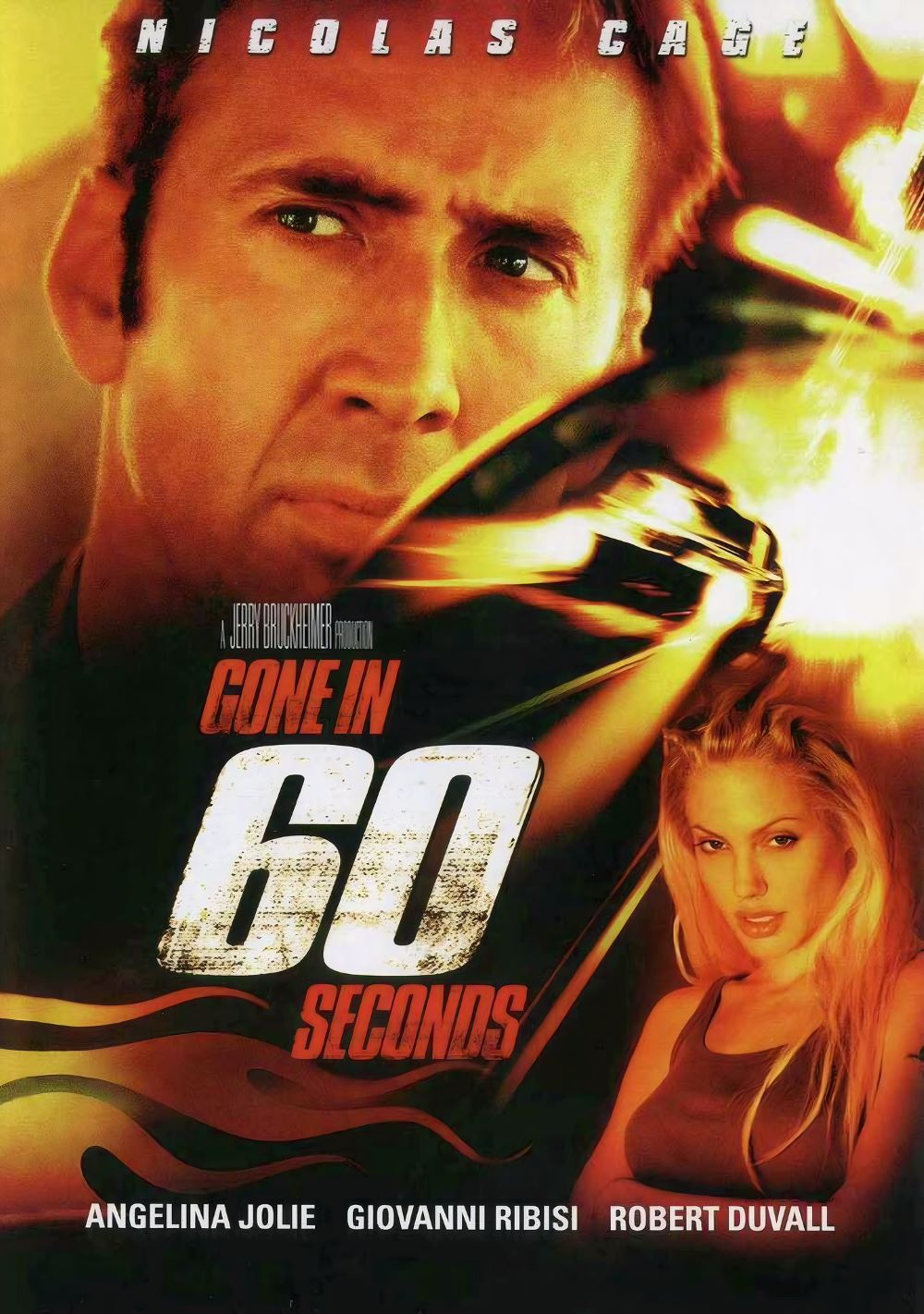
Guilty Pleasure No. 117: Gone in 60 Seconds (dir. by Dominic Sena)


There is a specific, almost alchemical quality to the late 1990s and early 2000s era of Nicolas Cage as an action star. Before the internet turned every one of his performances into a meme and before his financial troubles led him down the rabbit hole of direct-to-video oddities, Cage was genuinely one of the most exciting and weirdly compelling action heroes on the planet. From The Rock in 1996 to Con Air in 1997 and Face/Off in 1997, he delivered a holy trinity of high-octane insanity that no other actor could have pulled off. By the time the calendar flipped to 2000, Cage was at the peak of his powers, and director Dominic Sena’s Gone in 60 Seconds arrived as both a victory lap and a slight exhale. It is not as unhinged as Face/Off nor as tightly wound as The Rock, but it is a perfect snapshot of its moment: a glossy, MTV-infused car heist flick that smells like gasoline, leather, and late-90s hubris. And while it has plenty of shortcomings, Gone in 60 Seconds has earned its place not in the pantheon of great action cinema, but in that more beloved hall of fame: the Guilty Pleasure.

The plot is as simple as a carburetor. Cage plays Randall “Memphis” Raines, a legendary car thief who has supposedly gone straight, now living a quiet life designing hybrid engines. But when his reckless younger brother Kip, played with sweaty desperation by Giovanni Ribisi, botches a job for a ruthless British gangster named Raymond Calitri (Christopher Eccleston at his sleaziest), Memphis is forced back into the life he left behind. The task is absurdly impossible: steal 50 specific luxury cars in a single weekend, or Calitri will kill Kip. That’s right, fifty cars. In three days. The film never really bothers to explain the logistics of storing or delivering that many vehicles, but that’s not the point. The point is the ride, the revving engines, and the way Cage stares at a 1967 Shelby GT500 named Eleanor like she’s the ghost of a lost lover. That car is the real star, and the film knows it.

Dominic Sena, who previously directed Cage in the underrated road thriller Kalifornia, brings a music video sensibility to the proceedings. Gone in 60 Seconds is drenched in late-90s visual tics: slow-motion shots of hubcaps spinning, golden sunsets glaring off polished chrome, and a soundtrack that alternates between nu-metal grooves and bluesy rock. The editing is fast but not confusing, and the heist sequences have a rhythmic, almost choreographed feel. You never believe for a second that Memphis and his crew—a motley collection of oddballs played by Robert Duvall, Vinnie Jones, and a very underutilized Angelina Jolie—can actually pull off fifty thefts without the entire LAPD catching on. But the film operates on movie logic. Cars are hotwired in seconds, police radio chatter is effortlessly avoided, and every chase defies the laws of physics. It is pure fantasy, and that is exactly why it works as a guilty pleasure.

Now, let’s talk about Cage. In 2000, he was still riding the high of that legendary late-90s run, and Gone in 60 Seconds fits neatly into his brand of action star as tortured romantic. Memphis Raines is not the coked-up lunatic Castor Troy or the shouty Stanley Goodspeed. He is weary, melancholic, and trying to be honorable in a dishonorable profession. Cage plays him with a hangdog sincerity that is surprisingly effective. When he talks to Eleanor, stroking her steering wheel and whispering about how she tests her drivers, he is utterly committed. There is no irony, no winking at the camera. That is the secret to Cage’s enduring appeal in this era: he treats absurd material with the same intensity he would bring to a Shakespeare soliloquy. The action sequences—especially the climactic chase where Eleanor leaps over a drawbridge—showcase Cage’s physicality and willingness to do real stunt work. He sells the danger and the desperation. You believe that this man would risk everything for a car, and that belief makes the film’s silliness palatable.

But let’s be honest about the shortcomings, because Gone in 60 Seconds has plenty. The middle act drags considerably. For a movie about stealing fifty cars, there is a surprising amount of standing around in warehouses and having conversations about “respecting the machine.” Angelina Jolie’s character, Sara, is Memphis’s ex-girlfriend and a fellow thief, but she is given almost nothing to do except look cool in leather and exchange tepid romantic banter with Cage. The chemistry between them is nonexistent. Christopher Eccleston’s Calitri is a one-note villain who likes opera and cruelty, and his final defeat is laughably abrupt. Delroy Lindo plays a dogged detective, but he is so incompetent that he never generates real tension. The film’s central gimmick—the ticking clock of fifty cars in three days—is inconsistently tracked, and by the final act, you have no idea how many cars are left or why it still matters. The dialogue is also gloriously corny. Lines like “Ride or die” and “Respect the car, man” are delivered with such straight faces that they circle back around to being endearing.

And yet, Gone in 60 Seconds earns its status as a guilty pleasure because it understands exactly what it is. This is not a sophisticated heist thriller like Heat or a gritty crime drama. It is a shiny, high-budget B-movie about a man and his car, and it leans into that identity without apology. The final twenty-minute chase sequence is genuinely thrilling, with real cars being destroyed and practical stunts that modern CGI could never replicate. Eleanor getting airborne, landing hard, and somehow still running is a moment of pure cinematic joy. The sound design—the roar of that V8 engine, the screech of tires on asphalt—is visceral and satisfying. And Cage’s performance, even when the script lets him down, holds the whole thing together. He is the anchor that keeps the film from floating away into utter nonsense.

Looking back from today’s perspective, Gone in 60 Seconds is a time capsule of a very specific moment. It captures the tail end of the late-90s obsession with extreme sports, tuner culture, and the idea that cars had souls. It also captures Nicolas Cage at a fascinating crossroads: still an A-list action star, still capable of opening a blockbuster, but already showing the signs of the wonderful weirdness that would later define his career. This film is not his best, not by a long shot, but it is one of his most rewatchable. You put it on when you want to turn your brain off, hear some great engine noises, and watch a sweaty, sincere Nic Cage talk to a Shelby like she is his long-lost sweetheart. That is the definition of a guilty pleasure. It is not good in the traditional sense, but it is fun. And sometimes, fun is enough.

Previous Guilty Pleasures

  1. Half-Baked
  2. Save The Last Dance
  3. Every Rose Has Its Thorns
  4. The Jeremy Kyle Show
  5. Invasion USA
  6. The Golden Child
  7. Final Destination 2
  8. Paparazzi
  9. The Principal
  10. The Substitute
  11. Terror In The Family
  12. Pandorum
  13. Lambada
  14. Fear
  15. Cocktail
  16. Keep Off The Grass
  17. Girls, Girls, Girls
  18. Class
  19. Tart
  20. King Kong vs. Godzilla
  21. Hawk the Slayer
  22. Battle Beyond the Stars
  23. Meridian
  24. Walk of Shame
  25. From Justin To Kelly
  26. Project Greenlight
  27. Sex Decoy: Love Stings
  28. Swimfan
  29. On the Line
  30. Wolfen
  31. Hail Caesar!
  32. It’s So Cold In The D
  33. In the Mix
  34. Healed By Grace
  35. Valley of the Dolls
  36. The Legend of Billie Jean
  37. Death Wish
  38. Shipping Wars
  39. Ghost Whisperer
  40. Parking Wars
  41. The Dead Are After Me
  42. Harper’s Island
  43. The Resurrection of Gavin Stone
  44. Paranormal State
  45. Utopia
  46. Bar Rescue
  47. The Powers of Matthew Star
  48. Spiker
  49. Heavenly Bodies
  50. Maid in Manhattan
  51. Rage and Honor
  52. Saved By The Bell 3. 21 “No Hope With Dope”
  53. Happy Gilmore
  54. Solarbabies
  55. The Dawn of Correction
  56. Once You Understand
  57. The Voyeurs 
  58. Robot Jox
  59. Teen Wolf
  60. The Running Man
  61. Double Dragon
  62. Backtrack
  63. Julie and Jack
  64. Karate Warrior
  65. Invaders From Mars
  66. Cloverfield
  67. Aerobicide 
  68. Blood Harvest
  69. Shocking Dark
  70. Face The Truth
  71. Submerged
  72. The Canyons
  73. Days of Thunder
  74. Van Helsing
  75. The Night Comes for Us
  76. Code of Silence
  77. Captain Ron
  78. Armageddon
  79. Kate’s Secret
  80. Point Break
  81. The Replacements
  82. The Shadow
  83. Meteor
  84. Last Action Hero
  85. Attack of the Killer Tomatoes
  86. The Horror at 37,000 Feet
  87. The ‘Burbs
  88. Lifeforce
  89. Highschool of the Dead
  90. Ice Station Zebra
  91. No One Lives
  92. Brewster’s Millions
  93. Porky’s
  94. Revenge of the Nerds
  95. The Delta Force
  96. The Hidden
  97. Roller Boogie
  98. Raw Deal
  99. Death Merchant Series
  100. Ski Patrol
  101. The Executioner Series
  102. The Destroyer Series
  103. Private Teacher
  104. The Parker Series
  105. Ramba
  106. The Troubles of Janice
  107. Ironwood
  108. Interspecies Reviewers
  109. SST — Death Flight
  110. Undercover Brother
  111. Out for Justice
  112. Food Wars!
  113. Cherry
  114. Death Race
  115. The Beast Within
  116. Girl Series

Review: Identity (dir. by James Mangold)


“As I was going up the stairs, I met a man who wasn’t there. He wasn’t there again today. I wish, I wish he’d go away.” — Malcolm Rivers

There’s a certain kind of movie that thrives on a rainy Sunday afternoon or a late-night cable scroll—something pulpy, clever, and self-contained, with a cast that makes you sit up a little straighter. James Mangold’s Identity from 2003 is exactly that breed of thriller. It’s not trying to reinvent the wheel, but it’s having a damn good time spinning it through mud, rain, and a whole lot of psychological fog. On the surface, Identity is a slasher-adjacent whodunit set in a deserted Nevada motel during a biblical storm, and it wears its debt to Agatha Christie’s And Then There Were None like a bloodstained badge of honor. That classic novel—where strangers are lured to an isolated island and picked off one by one according to a nursery rhyme—provides the blueprint. Mangold swaps the island for a rundown motel, the nursery rhyme for room keys, and adds a thick layer of rainy noir atmosphere. But underneath the jump scares and dripping dread, Identity is also a sly, shaggy-dog meditation on identity, trauma, and the stories we tell ourselves to survive. Mangold, who’d go on to direct Walk the Line and Logan, shows his genre dexterity here—he treats the material with just enough seriousness to keep you invested, but not so much that you can’t laugh at the absurdity when the twist finally snaps into place.

The setup is classic Christie with a tar pit of dread. A motley crew of strangers gets stranded at a rundown motel when a flash flood washes out the roads, just as the guests in And Then There Were None find themselves cut off from civilization. There’s a former cop turned limo driver (John Cusack), a has-been actress (Rebecca De Mornay), a newlywed couple, a cop escorting a prisoner, a nervous motel manager, a prostitute with a heart of gold (Amanda Peet), and a few others who might as well have target silhouettes painted on their backs. The storm rages, the power flickers, and one by one, they start turning up dead. The killer leaves behind clues—room keys, specifically—and the survivors realize the bodies are being dropped in the order of the motel’s room numbers. It’s a wonderfully cheap gimmick that works because the film leans into its own artificiality. The rain never stops. The Nevada landscape is featureless and black. The motel feels less like a real place and more like a diorama in a psychiatrist’s office. Which, as it turns out, is almost exactly what it is.

Now, here’s where the review has to carefully step around spoilers, because Identity lives and dies on its midpoint rug-pull. But seeing as the movie is over twenty years old, a gentle acknowledgment is fair: the motel carnage is intercut with scenes of a criminal psychologist (Alfred Molina) arguing with a judge during a late-night hearing about a convicted serial killer’s sanity. That killer, Malcolm Rivers, is awaiting execution, and the defense is presenting new diary evidence. You don’t have to be a detective to start connecting dots. Mangold and screenwriter Michael Cooney aren’t interested in subtlety; they want you to squirm as the two storylines begin to converge. The motel guests, we gradually realize, are not random travelers. They are fractured pieces of a single damaged psyche—personalities inside Rivers’ mind, duking it out for survival as his body faces a real-world lethal injection. The killer in the motel isn’t a man in a mask; it’s the most malevolent alter among them, systematically erasing the others. Where Christie’s novel uses a hidden murderer working through a fixed list, Identity twists that formula by making the setting itself a psychological construct.

On a technical level, Identity is a masterclass in low-budget atmosphere. Phedon Papamichael’s cinematography drenches every frame in gray-blue gloom, and the sound design makes every creak and drip sound like a gunshot. Mangold directs the ensemble with a steady hand, and the cast clearly knows what movie they’re in. Cusack brings his usual blue-collar soulfulness to Ed, the ex-cop with a guilty conscience. Ray Liotta, as the suspicious cop, chews scenery in the best way—he’s all twitchy aggression and bad intentions. But the real standout is Amanda Peet as Paris, a call girl who just wants to start over on a Florida orange farm. She’s smarter and tougher than the archetype usually allows, and her final scene in the motel’s office carries an unexpected tenderness. That’s the trick of Identity: it makes you care about figments. For a good hour, you’re genuinely invested in whether the newlyweds survive or if the motel manager will finally clean that damn room 6.

Where the movie loses some people is in the execution of its twist. When the narrative finally snaps from the motel to the real-world courtroom, there’s a jarring shift that feels almost like a different film. The last fifteen minutes become a race to explain the rules of this shared-mind universe, and here the logic gets wobbly. How exactly does a personality “die” inside a system? Why does the motel order matter? And without giving too much away, the film’s famous final reveal—which involves a third-act twist on the twist—pushes credibility to the breaking point. Some viewers will throw their hands up and groan. Others will grin and applaud the audacity. I land somewhere in the middle. On one hand, the final image is genuinely chilling, a perfect little joke about evil’s persistence. On the other hand, the film spends so much time setting up the motel’s internal rules that it forgets to make the real-world stakes feel as urgent.

Still, Identity works best if you don’t overthink it. Think of it as a B-movie with an A-movie haircut, or as And Then There Were None filtered through a late-night cable dream about multiple personality disorder. Mangold directs the violence with a knowing wink—there are no gratuitous gore shots, just quick, sharp cuts and clever misdirection. One death involving a baseball bat and a laundry machine is as goofy as it is brutal, and that tonal tightrope is hard to walk. The film also has a sneaky thematic resonance beneath the pulp. At its heart, Identity asks whether people can truly change. Every character is trapped not just by the storm, but by their own backstory: the cop who failed a case, the actress past her prime, the prostitute who dreams of orange groves. In the motel of the mind, these backstories are just narratives the personality uses to justify itself. When Paris pleads, “I get to start over,” she’s speaking for anyone who’s ever wished they could delete a bad version of themselves. The film’s bleak final twist suggests that some stories are stronger than we think—the ones we tell ourselves about who we are, and who we’ve always been.

For a thriller that runs just over ninety minutes, Identity has surprising legs. It’s not a masterpiece, but it’s a tight, well-oiled machine of suspense with a gimmick that still feels fresh if you haven’t been spoiled. The dialogue crackles with noir-lite attitude, and the pacing never sags—once the bodies start dropping around the twenty-minute mark, you’re locked in. The biggest flaw is that the movie is so proud of its puzzle-box structure that it forgets to breathe between twists. You never get a quiet moment to sit with the characters as real people because, well, they’re not real people. But that’s also the point. Identity is a movie about a metaphor, and like most metaphors, it works until you poke it too hard. If you’re looking for a rainy-night thrill ride with a cast that commits to the bit and a final shot that’ll stick in your brain like a bad dream, check in. Just maybe avoid room 6.

Late Night Retro Television Reviews: Gun 1.2 “Ricochet”


Welcome to Late Night Retro Television Reviews, a feature where we review some of our favorite and least favorite shows of the past!  On Tuesdays, I will be reviewing Gun, an anthology series that ran on ABC for six week in 1997.  The entire show is currently streaming on Tubi!

This week, on Gun, Martin Sheen plays a cop who might be investigating the final murder of his career!

Episode 1.2 “Ricochet”

(Dir by Peter Horton, originally aired on April 19th, 1997)

The second episode of Gun opens with the death of a Japanese businessman.  He’s found shot on a cliffside that overlooks the ocean.  The gun that shot him is discovered and taken by a homeless man named Lazy Eye Pete (Bud Cort).  Pete is a cheerfully eccentric type, one who sings for money and who is dedicated to taking care of his pet dog, Chester.  But, as soon as Pete gets that gun, his personality starts to change and he even ends up pulling the gun on a group of teenagers who were attempting to mug him.  In the end, Pete sells the gun to a friend of his.

Also searching for that gun is Detective Van Guinness (Martin Sheen).  Guinness, who suffers from ulcers and who takes his job very personally, has promised his girlfriend (Tess Harper) that he will retire from the force.  However, he doesn’t want to go out on a simple or an unsolved case.  Fortunately, for Guinness, he’s assigned the complicated case of the dead businessman.  Unfortunately, for him, his girlfriend is not at all amused by his refusal to retire.

Van’s partner (Kirk Baltz) thinks that the businessman was killed during a robbery but Guinness disagrees.  Guinness thinks that the businessman was murdered by either his wife (Nancy Travis) or his amoral attorney (Christopher McDonald).  The wife and the attorney are sleeping together and they’ve also come up with a plan to somehow fix the California state lottery.  (I couldn’t really follow what their plan was but then again, I’ve also never played the lottery.)  The attorney thinks that the wife is the murderer.  The wife thinks that the attorney is the murderer.  The truth is a bit more complicated but, in order to full understand what happened, Van Guinness is going to have to find that gun.

Though the plot was a bit too complicated for its own good (Seriously, what was going on with the whole lottery subplot?), the second episode was a definite improvement over the first episode, with director Peter Horton keeping the action moving at a steady pace and establishing the consistent tone that the previous episode lacked.  Ricochet played out like a true ensemble piece, splitting its attention between Martin Sheen, Bud Cort, Nancy Travis, and Christopher McDonald.  All four of the actors did a good job bringing their characters to life.  I especially liked Christopher McDonald’s amoral attorney.  Nobody plays a crooked attorney with quite the style and wit of Christopher McDonald!

Next week: Rosanna Arquette and James Gandolfini appear in an episode directed by the show’s co-creator, James Steven Sadwith.


The Brawler (2019, directed by Ken Kushner)


The Brawler is a biopic of boxer Chuck Wepner (adequately played by Zach McGowan).  A resident of Bayonne, New Jersey and nicknamed “The Bleeder” because of how much he usually bled in the ring, Wepner was the first boxer to face Muhammad Ali (played by Jerrod Page, who looks and sounds like Ali but who has none of his fabled charisma) after Ali’s famous defeat of George Foreman.  No one gave Wepner much of a chance.  Ali barely bothered to train for the match and falsely accused Wepner of using racial slurs while talking to him.  To everyone’s shock, Wepner not only went 15 rounds with the champ but he even knocked Ali off of his feet.  Wepner ultimately lost the fight but he won the hearts of many of the people watching.  He also inspired Sylvester Stallone to write and star in a movie called Rocky.

Though he was famous being “the Real Rocky,” Wepner initially didn’t make a dime off of Rocky or any of the sequels that followed.  While Stallone became a superstar, Wepner got addicted to cocaine, fought exhibition matches against Andre the Giant and a bear, and finally ended up in prison.  After getting out of prison, Wepner returned to his old job of selling liquor and made money signing memorabilia.  After he nearly got arrested as a part of a fraudulent autograph scam, Wepner finally took Stallone to court and sued for the money that he felt Stallone owed him.  Stallone settled, making Chuck Wepner the only man to go the distance with both Muhammad Ali and Sylvester Stallone.

If the plot of The Brawler sounds familiar, maybe you’ve seen one of the many documentaries that have been made about Chuck Wepner.  Or maybe you saw Chuck, a 2016 film about Chuck Wepner that starred Liev Schrieber.  The Brawler hits all of the same points as Chuck, so much so that it almost feels like an unofficial remake.  (Both films even features a voice-over narration from the actor playing Chuck.)  The main difference between the two films is that The Brawler spends a lot more time on Wepner’s time as a drug addict and it also portrays Stallone (played unconvincingly by Anthony Mangano) in a much more negative light.  Even though Wepner screws up every opportunity that he’s offered (including a chance to appear in Rocky II), it’s Stallone who is portrayed as being a villain because he didn’t always return Wepner’s calls and Stallone’s assistants were sometimes rude.  While Chuck spends all of time whining about how unfair his life is, Stallone comes across as being often clueless but hardly malicious in the way he treated Chuck.  It’s not easy to make a Hollywood superstar into a more sympathetic character than the poor underdog who is suing for the money that he’s owed for inspiring one of the most successful franchises of all time but The Brawler manages to pull it off.  In Chuck, Wepner is an inspiring underdog who never lets life keep him down.  In The Brawler, Wepner is a self-destructive child who lets down everyone who tries to help him.  When it comes to Chuck vs The Brawler, it’s Chuck by a clear knock-out.

The most interesting thing about The Brawler is that Burt Young has a cameo as a man watching the Wepner/Ali fight in a bar.  You have to wonder how Stallone felt about that.  Et tu, Paulie?

Film Review: The Butterfly Effect (dir by Eric Bress and J. Mackye Gruber)


How many different ways can Ashton Kutcher fuck up time and space?

That’s the question asked in the gloriously silly The Butterfly Effect, a film that was a minor hit back in 2004.  Ashton plays Evan Treborn, a disheveled college student who is studying how memory works.  All through his life, Evan has suffered from seizures that are triggered by stress.  Evan has a lot of stress because apparently, there’s not a single bad thing that didn’t happen to him when he was a child.

Crazy father who tried to strangle Evan before being gunned down in front of his son’s terrified eyes?  Yep.

Sexual molestation at the hands of a suburban drunk?  Yep.

A best friend who blew up not only a mailbox but also a mother and a baby?  Yep.

A dog that was set on fire by a neighborhood bully?  Yep.

Another friend who was driven into a catatonic state by all the madness around him?  Yep.

A girlfriend who, due to family tragedy, had to move away?  Yep.

However, things seem to be getting better for Evan.  Now, he’s a psychology major with a bright future.  His professors love him.  He’s even got a roommate named Thumper (played, somewhat inevitably, by Ethan Suplee).   And, as he’s soon to discover, he possesses a special power.  All he has to do is read his old journals and, for a limited time, he can go into the past and change his history.

Of course, it turns out that changing history is a lot more complicated than it looks.  Evan goes back into the past and confronts the pervy suburban drunk.  He then goes back to the present and discovers that he’s now a shallow frat boy who is hated by both his professors and Thumper!  Even worse, he eventually ends up in prison for killing a man.  Going back into the past and saving his dog leads to his friend Lenny (Elden Hansen) spending the rest of his life imprisoned.  Another trip to the past results in Evan waking up as a double amputee.  Depending on what Evan does, his friend Kayleigh (Amy Smart) either becomes a shallow sorority princess or a drug-addicted prostitute.  Meanwhile, Kayleigh’s brother (William Lee Scott) goes from being a psychotic murderer to a clean-cut religious guy.

Thumper never changers, though.  Thumper endures.

This, of course, is a lot of pressure to put on any character played by Ashton Kutcher and soon, Evan is having nosebleeds and migraines.  Every time he changes the past, his brain is flooded with 20 years worth of new memories.  His brain might explode before he can fix all the damage that he’s done….

Watching The Butterfly Effect is an odd experience because, on the one hand, the premise is genuinely intriguing but, on the other hand, the film stars the reliably goofy Ashton Kutcher.  Ashton grows a beard and doesn’t wash his hair for the first half of the movie, which is the film’s way of letting us know that we’re meant to take him seriously but it doesn’t change the fact that he’s still Ashton Kutcher.  Even when playing the most dramatic of scenes, Ashton tends to deliver every line as if it’s the set up for a punch line.  It’s not surprising that the best part of The Butterfly Effect is when Ashton wakes up and discovers that he’s now a frat boy.  Those scenes are intentionally funny and they take advantage of what Ashton Kutcher is actually good at.

At the same time, it’s hard not to get into The Butterfly Effect.  It’s a mess but it’s a likable mess and it’s undeniably enjoyable to see how everyone’s life changes as a result of Ashton’s constant meddling.  (William Lee Scott especially has fun, switching between being full-blown psycho and full-blown religious.)  The Butterfly Effect may be dumb but it’s fun.  It’s a film that’s best watched with your snarkiest friends.

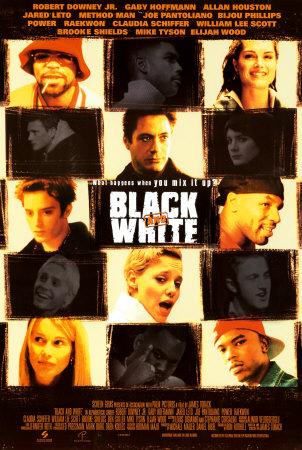
Cleaning Out The DVR Yet Again #31: Black and White (dir by James Toback)


(Lisa recently discovered that she only has about 8 hours of space left on her DVR!  It turns out that she’s been recording movies from July and she just hasn’t gotten around to watching and reviewing them yet.  So, once again, Lisa is cleaning out her DVR!  She is going to try to watch and review 52 movies by the end of Wednesday, December 7th!  Will she make it?  Keep checking the site to find out!)

black_and_white_black_white-681253575-large

On November 15th, I recorded the 1999 melodrama, Black and White, off of Encore.

Black and White is a film that I’ve seen several times and I’ve always meant to review it.  It’s an attempt to explore the state of race, rap, crime, and sex in the late 20th century.  It’s also a James Toback film, which means that it contains all of the stuff that appears in every James Toback film: a threesome in the park, improvised dialogue, cameos from famous people playing themselves, an obsession with college basketball games, casual sexism, and a lot of talk about why you should never send “a little boy to do a man’s job.”  By his own admission, the white Toback is obsessed with the black experience but, when you watch a James Toback film, you get the feeling that his entire knowledge of African-American culture comes from watching other movies.

In short, Black and White is probably one of the silliest and most misjudged films that I’ve ever seen.  In fact, it’s so misjudged that it’s compulsively watchable.  Though I’m always hesitant to casually toss around the term “guilty pleasure,” that’s exactly what Black and White is.

Black and White tells several different stories, some of which are connected and some of which are not.  Sam Donager (Brooke Shields) is an independent filmmaker who is attempting to make a documentary about white people who try to act black.  Her husband, Terry (Robert Downey, Jr.), is gay and hits on every man (and boy) that he sees.  Sam and Terry start following around a group of privileged white kids who are obsessed with rap music.  Sam asks them if they want to be black.  They say that they’re going through a phase.

One of the kids is named Wren and he’s played by Elijah Wood.  He doesn’t really do much but every time he shows up in the film, you go, “It’s Elijah Wood!”  And then there’s Marty King (Eddie Kaye Thomas) who is the son of the Manhattan District Attorney (Joe Pantoliano).  Marty’s older brother is Will (William Lee Scott) ,who is some sort of low-level criminal.  And finally, the unofficial leader of the kids is Charlie (Bijou Phillips) and she gets to give a long monologue explaining the various uses of the n-word.

(Their teacher, incidentally, is played by Jared Leto.  If you’ve ever wanted to listen to Jared Leto lecture about the relationship between Othello and Iago, this is the film to see.  That said, the whole Othello and Iago lecture is just kinda randomly tossed in and doesn’t really pay off.)

Charlie is one of the many girlfriends of Rich Bower (Power), who is not only an up-and-coming rap producer but he’s also the head of a criminal organization.  (There’s a lengthy and kinda pointless scene where he and his associates demand money from a club manager played by Scott Caan.)  Rich is also friends with Mike Tyson.  Tyson plays himself and he gets to deliver an entire monologue about how Rich should never send a boy to do a man’s job.

But we’re not done!  Rich’s cousin is Dean Carter (Allan Houston), a college basketball player.  Dean is dating an anthropology graduate student (Claudia Schiffer, giving a hilariously terrible performance) who is obsessed with fertility symbols.  Dean is also being blackmailed by a corrupt cop named Mark Clear.  Guess who plays Mark Clear?

BEN FREAKING STILLER!

Needless to say, Ben Stiller is massively miscast.  He delivers he lines in his trademark comedic fashion, which makes it next to impossible to take him seriously as any sort of threat.  He also has a backstory that is needlessly complex but at least it allows him to say, “I’m Saul of Fucking Tarsus!”

Anyway, almost the entire film was improvised, which is one of those things that probably seemed like a good idea at the time.  A few of the actors do well with the improvisation.  Stiller may be miscast but at least he can come up with stuff to say.  Robert Downey, Jr.’s character may seem out-of-place but again, Downey knows how to keep things interesting.  But the rest of the cast seems to be a bit stranded so we end up with a lot of lengthy scenes of characters struggling to make some sort of sense of Toback’s storyline.

It’s obvious that James Toback felt that this film had something important to say but, instead of any insight, it can only offer up the occasionally strange-as-Hell scene.

Like this scene, for instance, in which Mike Tyson literally attempts to kill Robert Downey, Jr:

Or this weird little scene between Ben Stiller and Joe Pantoliano, which is dominated by Stiller’s odd delivery of his lines:

Or the closing montage, which is actually rather well-put together and makes great use of Michael Fredo’s Free:

Sadly, the video above ends before it gets to the part where we see Claudia Schiffer on a date with Mike Tyson, telling him about fertility symbols.

Anyway, Black and White is one of those films that wants to say something despite not being sure what.  Again, it may ultimately be rather silly but it’s still compulsively watchable.

(For the record, Marla Maples — who also appeared in Maximum Overdrive and was married to future President Donald Trump when this movie was made — has a cameo as a character named Muffy.  We live in a strange fucking world, don’t we?)

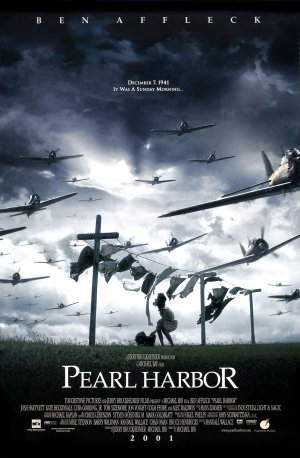
Embracing the Melodrama Part II #100: Pearl Harbor (dir by Michael Bay)


Pearl_harbor_movie_poster

“And then all this happened…”

Nurse Evelyn Johnson (Kate Beckinsale) in Pearl Harbor (2001)

The “this” that Evelyn Johnson is referring to is the Japanese attack on Pearl Harbor.  You know, the date will live in infamy.  The attack that caused the United States to enter World War II and, as a result, eventually led to collapse of the Axis Powers.  The attack that left over 2,000 men died and 1,178 wounded.  That attack.

In the 2001 film Pearl Harbor, that attack is just one of the many complications in the romance between Danny (Ben Affleck), his best friend Rafe (Josh Hartnett), and Evelyn (Kate Beckinsale).  The other complications include Danny briefly being listed as dead, Danny being dyslexic before anyone knew what dyslexia was (and yet, later, he’s still seen reading and writing letters with absolutely no trouble, almost as if the filmmakers forgot they had made such a big deal about him not being able to do so), and the fact that Rafe really, really likes Evelyn.  Of course, the main complication to their romance is that this is a Michael Bay film and he won’t stop moving the camera long enough for anyone to have a genuine emotion.

I imagine that Pearl Harbor was an attempt to duplicate the success of Titanic, by setting an extremely predictable love story against the backdrop of a real-life historical tragedy.  Say what you will about Titanic (and there are certain lines in that film that, when I rehear them today, make me cringe), Leonardo DiCaprio and Kate Winslet had genuine chemistry.  None of that chemistry is present in Pearl Harbor.  You don’t believe, for a second, that Ben Affleck and Josh Hartnett are lifelong friends.  You don’t believe that Kate Beckinsale is torn between the two of them.  Instead, you just feel like you’re watching three actors who are struggling to give a performance when they’re being directed by a director who is more interested in blowing people up than in getting to know them.

Continuing the Titanic comparison, Pearl Harbor‘s script absolutely sucks.  Along with that line about “all this” happening, there’s also a scene where Franklin D. Roosevelt (Jon Voight) reacts to his cabinet’s skepticism by rising to his feet and announcing that if he, a man famously crippled by polio and confined to a wheelchair, can stand up, then America can win a war.

I’ve actually been to Pearl Harbor in Hawaii.  I have gone to the USS Arizona Memorial.  I have stood and stared down at the remains of the ship resting below the surface of the ocean.  It’s an awe-inspiring and humbling site, one that leaves you very aware that over a thousand men lost their lives when the Arizona sank.

I have also seen the wall which lists the name of everyone who was killed during the attack on Pearl Harbor and until you’ve actually been there and you’ve seen it with your own eyes, you really can’t understand just how overwhelming it all is.  The picture below was taken by my sister, Erin.

Pearl Harbor 2003If you want to pay tribute to those who lost their lives at Pearl Harbor, going to the Arizona Memorial is a good start.  But avoid Michael Bay’s Pearl Harbor at all costs.