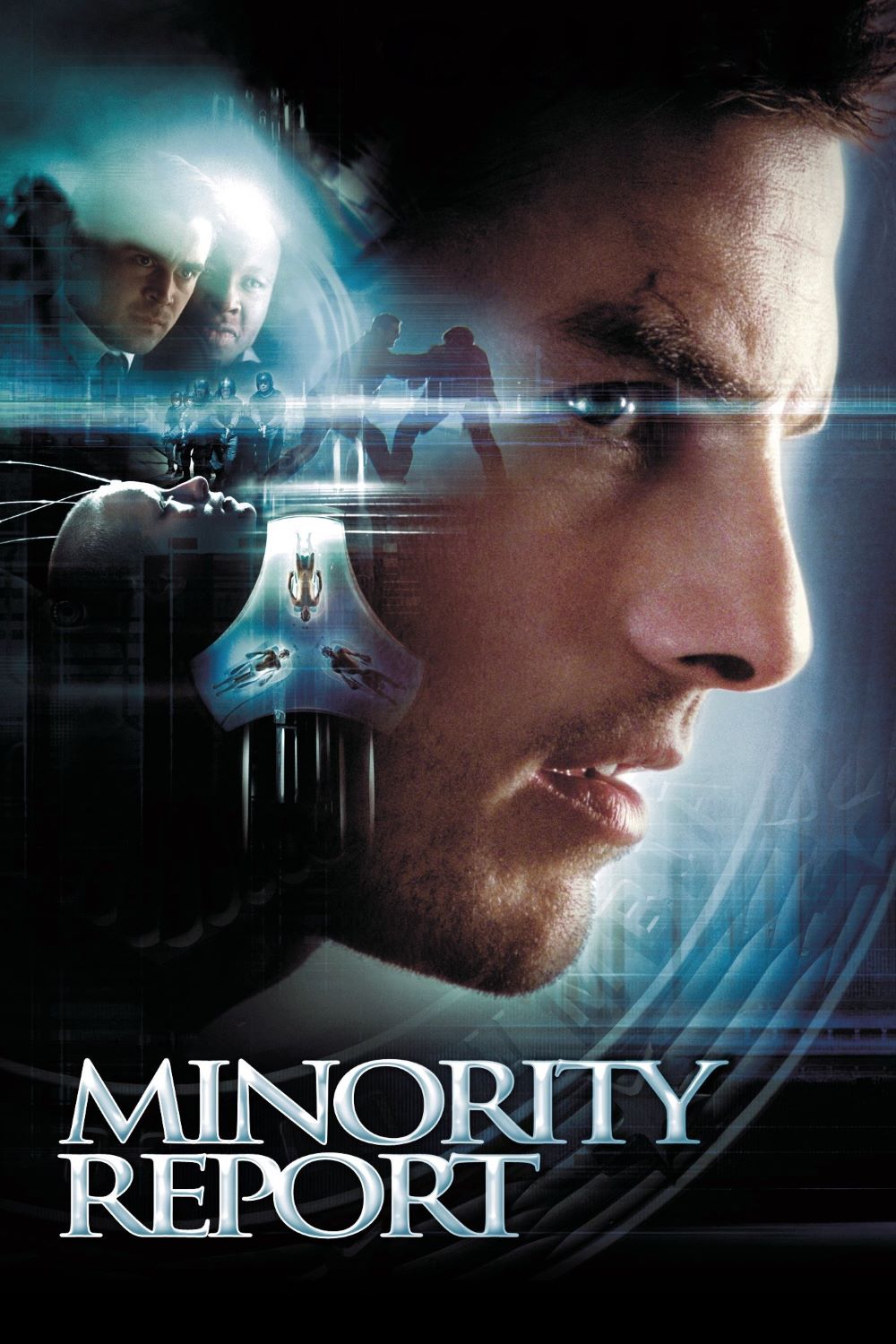
Review: Minority Report (dir. by Steven Spielberg)


“Sometimes, in order to see the light, you have to risk the dark.” — Dr. Iris Hineman

There’s a particular pleasure in revisiting Minority Report now, decades removed from its 2002 release, because it’s aged in the strangest possible way: it hasn’t dated so much as it’s caught up to us. Steven Spielberg’s adaptation of Philip K. Dick’s short story plays like a glossy, big-budget action thriller on the surface, all sleek gestural interfaces and Tom Cruise sprinting across rooftops, but underneath that polish is a film that’s quietly become one of the most unnervingly accurate predictions of how surveillance, data, and policing would actually evolve in the real world.

The premise is simple enough to fit on a poster. In a near-future Washington D.C., a special police unit called PreCrime uses three psychic “precogs” to see murders before they happen, allowing cops to arrest people for crimes they haven’t committed yet. John Anderton, played by Cruise with a kind of haunted, grief-soaked intensity, is the unit’s star detective, a true believer in the system who lost his son years earlier and has thrown himself into the work as a substitute for healing. Then the precogs name him as a future murderer, and the rest of the film is Anderton on the run, trying to prove his innocence inside a system explicitly designed to make innocence irrelevant. It’s a clever structural trick because it forces the audience to watch the hero discover, in real time, all the holes in a system he’s spent his career defending.

What makes the film work as more than just a stylish chase movie is how seriously Spielberg and his screenwriters, Scott Frank and Jon Cohen, take the philosophical rot at the center of the premise. PreCrime isn’t framed as a dystopian villain organization; it’s framed as something genuinely good and genuinely popular, a program that’s driven murder rates to near zero and that ordinary citizens are grateful for. That’s the unsettling part. The film isn’t asking you to be afraid of an obviously evil system. It’s asking you to be afraid of aSteve Harris system that works, that delivers real safety, and that nonetheless requires you to accept punishment without due process, fate without appeal, guilt assigned before the act. Cruise’s Anderton spends the film discovering that the machinery he trusted contains exactly the kind of ambiguity and abuse it was built to eliminate, and the film never lets you forget that the most dangerous systems are the ones that feel necessary.

Visually, this is one of Spielberg’s most distinct collaborations with cinematographer Janusz Kamiński, who bleached the color out of nearly every frame to give the film a cold, overexposed, almost silvery look. It’s a future that feels lived-in and grubby rather than chrome and gleaming, which was a deliberate choice; Spielberg and his production designers consulted with actual futurists and technologists to imagine a 2054 that felt plausible rather than fantastical. That’s part of why the gestural data interfaces Anderton uses, swiping and conducting evidence in midair like an orchestra conductor, became such a cultural touchstone; they didn’t feel like science fiction gadgetry so much as a believable next step from where computing was already heading.

And that brings us to the part of the film’s legacy that’s only grown more pointed with time. Minority Report arrived in June 2002, less than a year after September 11th, and it’s impossible to separate the film’s anxieties from that specific American moment. This was the period when the Patriot Act had just been signed, when warrantless surveillance and preventive detention were being normalized in the name of safety, when the entire architecture of American security policy pivoted toward stopping threats before they materialized rather than responding after the fact. Minority Report dramatizes that exact logic and then methodically exposes its flaws, showing a security state so committed to preventing harm that it’s willing to imprison the innocent, manipulate evidence, and treat dissent as a structural malfunction.

It’s worth situating the film alongside the other two movies Spielberg made in the years immediately following 9/11, because together they form a loose, unofficial triptych about post-9/11 American fear. War of the Worlds, his 2005 alien invasion film, restaged the trauma of a sudden, incomprehensible attack on home soil, with Tom Cruise again playing an ordinary man trying to shepherd his children through a landscape of falling ash, mass panic, and faceless threats descending from above, imagery that’s hard not to read as a direct echo of lower Manhattan that morning. Munich, released the same year, dug into the moral wreckage of a state’s decision to respond to terrorism with a covert campaign of targeted assassination, asking hard questions about whether vengeance dressed up as justice actually makes anyone safer or just perpetuates the cycle. Minority Report is the third leg of that stool, the one concerned not with the attack itself or the retaliation but with the surveillance and preemption apparatus built in the name of preventing the next one. Together, the three films trace a kind of emotional arc through American anxiety in that period: the shock of the unknown threat, the morally compromised vengeance that follows, and the paranoid, technologically enabled security state erected to make sure it never happens again. None of the three films name 9/11 directly, but all three are unmistakably shaped by it, by a culture suddenly suspicious of the outsider, willing to trade liberty for the promise of safety, and uncertain whether the institutions built to protect them could be trusted.

What’s remarkable is how much more relevant the surveillance angle feels today than it did in 2002. Predictive policing software is real now, with departments across the country having actually used algorithms to flag individuals or neighborhoods as high risk for future crime, often with the same built-in biases and feedback loops the film gestures at. Data brokers and advertising networks track movement and behavior with a granularity that makes the film’s retina-scanning ad billboards look almost quaint by comparison. The conversation about predictive algorithms making consequential decisions about people’s freedom, hiring, credit, and policing based on probabilistic models of future behavior is now a mainstream policy debate rather than science fiction. Watching the film now, the gap between its imagined 2054 and our actual 2026 feels uncomfortably narrow, less a futuristic warning than a documentary about tendencies we’re already deep inside of.

That’s what makes Minority Report so achingly prophetic, not just in its prediction of our tech, but in its prediction of our mindset. We live in a world now where predictive policing algorithms are actually being used, where social credit scores are a reality in some places, and where the debate over privacy versus security is a constant, exhausting hum in the background. We’re not at the level of precogs, but we don’t need to be. We have big data, machine learning, and a populace that’s been slowly conditioned to accept that if you have nothing to hide, you have nothing to fear. The film is a warning shot across the bow of that complacency. It asks us to consider the cost of a crime-free society, and it suggests that the price might be our very souls. Spielberg, ever the optimist even in his darkest films, ultimately comes down on the side of human fallibility. He prefers a world with crime and free will to a world of perfect, totalitarian peace. And watching it today, in an age of deepfakes, biometric tracking, and algorithm-driven justice, that preference feels less like a luxury and more like an urgent, desperate necessity. It’s a hell of a ride, with more twists than a pretzel factory and a car chase that still holds up, but the real thrill of Minority Report isn’t the action—it’s the haunting feeling that we’re not watching a dystopian future anymore. We’re watching the news.
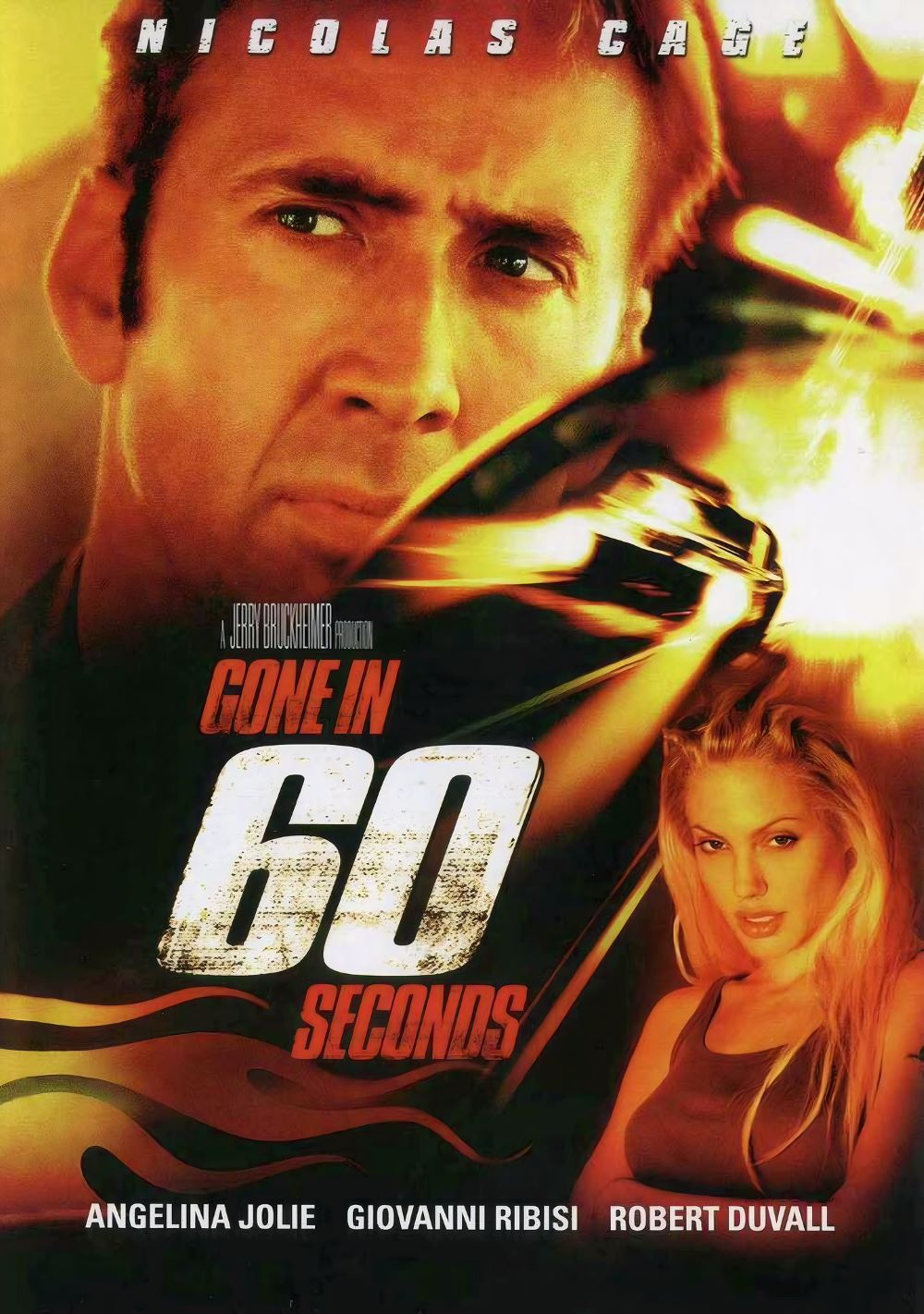
Guilty Pleasure No. 117: Gone in 60 Seconds (dir. by Dominic Sena)


There is a specific, almost alchemical quality to the late 1990s and early 2000s era of Nicolas Cage as an action star. Before the internet turned every one of his performances into a meme and before his financial troubles led him down the rabbit hole of direct-to-video oddities, Cage was genuinely one of the most exciting and weirdly compelling action heroes on the planet. From The Rock in 1996 to Con Air in 1997 and Face/Off in 1997, he delivered a holy trinity of high-octane insanity that no other actor could have pulled off. By the time the calendar flipped to 2000, Cage was at the peak of his powers, and director Dominic Sena’s Gone in 60 Seconds arrived as both a victory lap and a slight exhale. It is not as unhinged as Face/Off nor as tightly wound as The Rock, but it is a perfect snapshot of its moment: a glossy, MTV-infused car heist flick that smells like gasoline, leather, and late-90s hubris. And while it has plenty of shortcomings, Gone in 60 Seconds has earned its place not in the pantheon of great action cinema, but in that more beloved hall of fame: the Guilty Pleasure.

The plot is as simple as a carburetor. Cage plays Randall “Memphis” Raines, a legendary car thief who has supposedly gone straight, now living a quiet life designing hybrid engines. But when his reckless younger brother Kip, played with sweaty desperation by Giovanni Ribisi, botches a job for a ruthless British gangster named Raymond Calitri (Christopher Eccleston at his sleaziest), Memphis is forced back into the life he left behind. The task is absurdly impossible: steal 50 specific luxury cars in a single weekend, or Calitri will kill Kip. That’s right, fifty cars. In three days. The film never really bothers to explain the logistics of storing or delivering that many vehicles, but that’s not the point. The point is the ride, the revving engines, and the way Cage stares at a 1967 Shelby GT500 named Eleanor like she’s the ghost of a lost lover. That car is the real star, and the film knows it.

Dominic Sena, who previously directed Cage in the underrated road thriller Kalifornia, brings a music video sensibility to the proceedings. Gone in 60 Seconds is drenched in late-90s visual tics: slow-motion shots of hubcaps spinning, golden sunsets glaring off polished chrome, and a soundtrack that alternates between nu-metal grooves and bluesy rock. The editing is fast but not confusing, and the heist sequences have a rhythmic, almost choreographed feel. You never believe for a second that Memphis and his crew—a motley collection of oddballs played by Robert Duvall, Vinnie Jones, and a very underutilized Angelina Jolie—can actually pull off fifty thefts without the entire LAPD catching on. But the film operates on movie logic. Cars are hotwired in seconds, police radio chatter is effortlessly avoided, and every chase defies the laws of physics. It is pure fantasy, and that is exactly why it works as a guilty pleasure.

Now, let’s talk about Cage. In 2000, he was still riding the high of that legendary late-90s run, and Gone in 60 Seconds fits neatly into his brand of action star as tortured romantic. Memphis Raines is not the coked-up lunatic Castor Troy or the shouty Stanley Goodspeed. He is weary, melancholic, and trying to be honorable in a dishonorable profession. Cage plays him with a hangdog sincerity that is surprisingly effective. When he talks to Eleanor, stroking her steering wheel and whispering about how she tests her drivers, he is utterly committed. There is no irony, no winking at the camera. That is the secret to Cage’s enduring appeal in this era: he treats absurd material with the same intensity he would bring to a Shakespeare soliloquy. The action sequences—especially the climactic chase where Eleanor leaps over a drawbridge—showcase Cage’s physicality and willingness to do real stunt work. He sells the danger and the desperation. You believe that this man would risk everything for a car, and that belief makes the film’s silliness palatable.

But let’s be honest about the shortcomings, because Gone in 60 Seconds has plenty. The middle act drags considerably. For a movie about stealing fifty cars, there is a surprising amount of standing around in warehouses and having conversations about “respecting the machine.” Angelina Jolie’s character, Sara, is Memphis’s ex-girlfriend and a fellow thief, but she is given almost nothing to do except look cool in leather and exchange tepid romantic banter with Cage. The chemistry between them is nonexistent. Christopher Eccleston’s Calitri is a one-note villain who likes opera and cruelty, and his final defeat is laughably abrupt. Delroy Lindo plays a dogged detective, but he is so incompetent that he never generates real tension. The film’s central gimmick—the ticking clock of fifty cars in three days—is inconsistently tracked, and by the final act, you have no idea how many cars are left or why it still matters. The dialogue is also gloriously corny. Lines like “Ride or die” and “Respect the car, man” are delivered with such straight faces that they circle back around to being endearing.

And yet, Gone in 60 Seconds earns its status as a guilty pleasure because it understands exactly what it is. This is not a sophisticated heist thriller like Heat or a gritty crime drama. It is a shiny, high-budget B-movie about a man and his car, and it leans into that identity without apology. The final twenty-minute chase sequence is genuinely thrilling, with real cars being destroyed and practical stunts that modern CGI could never replicate. Eleanor getting airborne, landing hard, and somehow still running is a moment of pure cinematic joy. The sound design—the roar of that V8 engine, the screech of tires on asphalt—is visceral and satisfying. And Cage’s performance, even when the script lets him down, holds the whole thing together. He is the anchor that keeps the film from floating away into utter nonsense.

Looking back from today’s perspective, Gone in 60 Seconds is a time capsule of a very specific moment. It captures the tail end of the late-90s obsession with extreme sports, tuner culture, and the idea that cars had souls. It also captures Nicolas Cage at a fascinating crossroads: still an A-list action star, still capable of opening a blockbuster, but already showing the signs of the wonderful weirdness that would later define his career. This film is not his best, not by a long shot, but it is one of his most rewatchable. You put it on when you want to turn your brain off, hear some great engine noises, and watch a sweaty, sincere Nic Cage talk to a Shelby like she is his long-lost sweetheart. That is the definition of a guilty pleasure. It is not good in the traditional sense, but it is fun. And sometimes, fun is enough.

Previous Guilty Pleasures

  1. Half-Baked
  2. Save The Last Dance
  3. Every Rose Has Its Thorns
  4. The Jeremy Kyle Show
  5. Invasion USA
  6. The Golden Child
  7. Final Destination 2
  8. Paparazzi
  9. The Principal
  10. The Substitute
  11. Terror In The Family
  12. Pandorum
  13. Lambada
  14. Fear
  15. Cocktail
  16. Keep Off The Grass
  17. Girls, Girls, Girls
  18. Class
  19. Tart
  20. King Kong vs. Godzilla
  21. Hawk the Slayer
  22. Battle Beyond the Stars
  23. Meridian
  24. Walk of Shame
  25. From Justin To Kelly
  26. Project Greenlight
  27. Sex Decoy: Love Stings
  28. Swimfan
  29. On the Line
  30. Wolfen
  31. Hail Caesar!
  32. It’s So Cold In The D
  33. In the Mix
  34. Healed By Grace
  35. Valley of the Dolls
  36. The Legend of Billie Jean
  37. Death Wish
  38. Shipping Wars
  39. Ghost Whisperer
  40. Parking Wars
  41. The Dead Are After Me
  42. Harper’s Island
  43. The Resurrection of Gavin Stone
  44. Paranormal State
  45. Utopia
  46. Bar Rescue
  47. The Powers of Matthew Star
  48. Spiker
  49. Heavenly Bodies
  50. Maid in Manhattan
  51. Rage and Honor
  52. Saved By The Bell 3. 21 “No Hope With Dope”
  53. Happy Gilmore
  54. Solarbabies
  55. The Dawn of Correction
  56. Once You Understand
  57. The Voyeurs 
  58. Robot Jox
  59. Teen Wolf
  60. The Running Man
  61. Double Dragon
  62. Backtrack
  63. Julie and Jack
  64. Karate Warrior
  65. Invaders From Mars
  66. Cloverfield
  67. Aerobicide 
  68. Blood Harvest
  69. Shocking Dark
  70. Face The Truth
  71. Submerged
  72. The Canyons
  73. Days of Thunder
  74. Van Helsing
  75. The Night Comes for Us
  76. Code of Silence
  77. Captain Ron
  78. Armageddon
  79. Kate’s Secret
  80. Point Break
  81. The Replacements
  82. The Shadow
  83. Meteor
  84. Last Action Hero
  85. Attack of the Killer Tomatoes
  86. The Horror at 37,000 Feet
  87. The ‘Burbs
  88. Lifeforce
  89. Highschool of the Dead
  90. Ice Station Zebra
  91. No One Lives
  92. Brewster’s Millions
  93. Porky’s
  94. Revenge of the Nerds
  95. The Delta Force
  96. The Hidden
  97. Roller Boogie
  98. Raw Deal
  99. Death Merchant Series
  100. Ski Patrol
  101. The Executioner Series
  102. The Destroyer Series
  103. Private Teacher
  104. The Parker Series
  105. Ramba
  106. The Troubles of Janice
  107. Ironwood
  108. Interspecies Reviewers
  109. SST — Death Flight
  110. Undercover Brother
  111. Out for Justice
  112. Food Wars!
  113. Cherry
  114. Death Race
  115. The Beast Within
  116. Girl Series