The year is 2036 and the world is at war. Col. Flemming (Troy Donahue) assigns his protégé, Major Agatha Doyle (Terry Farrell), to infiltrate a facility with a group of specially selected soldiers. All of the soldiers were previously on death row and will be given a full pardon if they complete their mission. Siegal (Corey Feldman) is the neurotic hacker who was convicted of desertion. Cutter (Trevor Goddard) is a straight-up psycho. Ryan (Rick Springfield) wishes he had Jessie’s Girl… no wait, he’s a demolitions expert. Sorry, my mistake. Dr. Jones (Audie England) is a doctor who is also a religious fanatic. Koosman (Richmond Arquette) is probably on death row for having an embarrassing name. Captain Aldrich (Parker Stevenson) is the most competent officer on death row and also the only one of the soldiers who isn’t a complete lunatic. Poe (Elston Ridgle) is the soldier who initially gets blamed when members of the team start dying inside the facility. It’s actually not Poe’s fault. There’s something in the facility and it’s not human.
Though the movie starts out as a rip-off of Aliens, with its collection of cocky soldiers coming up against an enemy that’s greater than all of them, it soon settles into being an Alien rip-off, with plenty of scenes of people being stalked while walking down dark, pipe-lined hallways. Not surprisingly, it fails to capture both the kinetic energy of Aliens and the heart-pounding suspense of Alien. The entire film feels very familiar, and the decision not to show the monster until the final few minutes feels cheap.
The cast is probably the most interesting thing about the movie, with Audie England, Rick Springfield, and Trevor Goddard actually committing to their roles. Parker Stevenson looks embarrassed, and Terry Farrell is one of the least convincing military officers that I’ve ever seen. (Her dialogue largely consists of shouting “MOVE!” whenever one of the convicts tries to get out of being sent to their death.) Corey Feldman overacts as Siegal, making him so nervous that you wonder why he was selected for the mission.
Legion steals the plots of Alien and Aliens but not the quality.
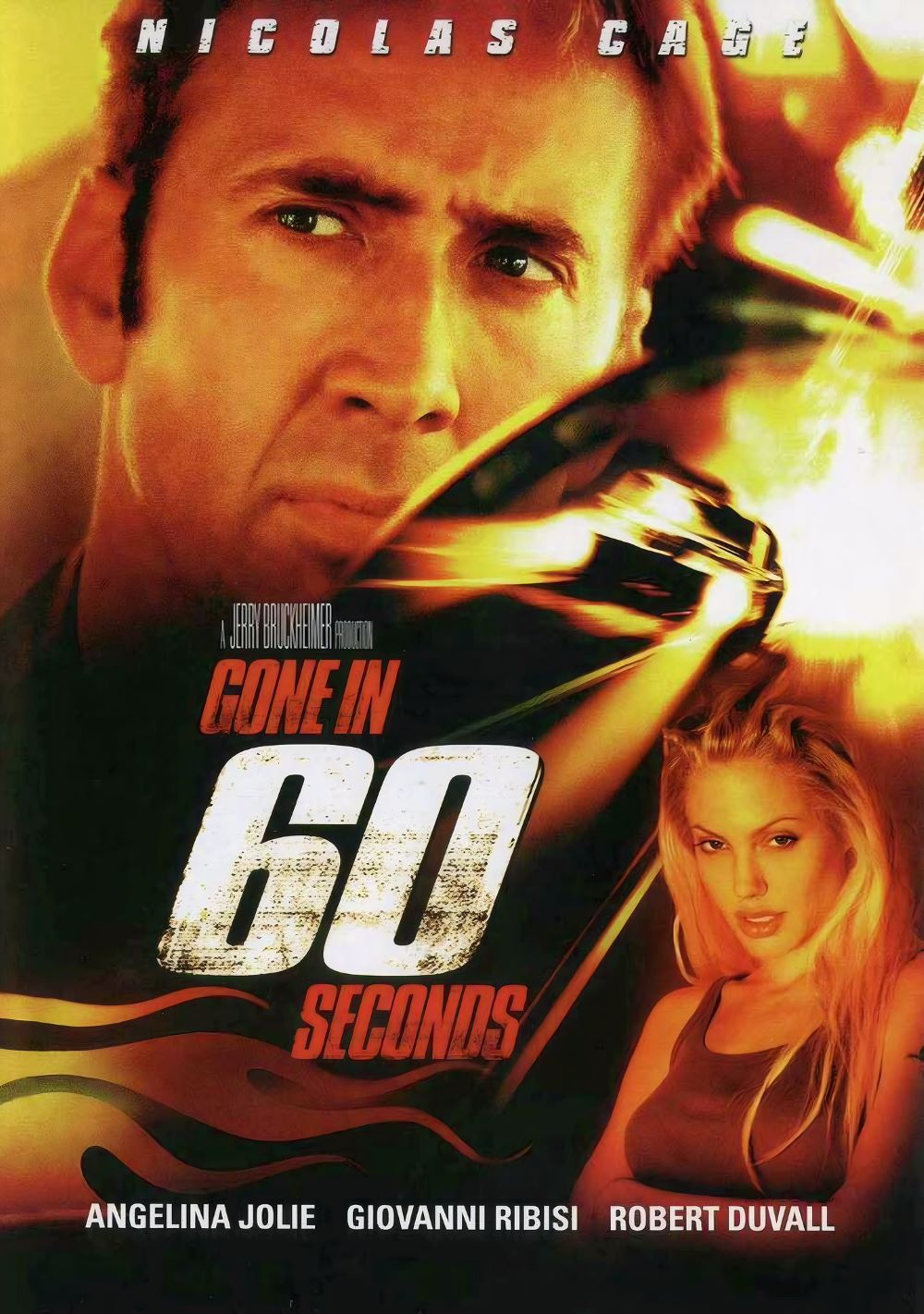
There is a specific, almost alchemical quality to the late 1990s and early 2000s era of Nicolas Cage as an action star. Before the internet turned every one of his performances into a meme and before his financial troubles led him down the rabbit hole of direct-to-video oddities, Cage was genuinely one of the most exciting and weirdly compelling action heroes on the planet. From The Rock in 1996 to Con Air in 1997 and Face/Off in 1997, he delivered a holy trinity of high-octane insanity that no other actor could have pulled off. By the time the calendar flipped to 2000, Cage was at the peak of his powers, and director Dominic Sena’s Gone in 60 Seconds arrived as both a victory lap and a slight exhale. It is not as unhinged as Face/Off nor as tightly wound as The Rock, but it is a perfect snapshot of its moment: a glossy, MTV-infused car heist flick that smells like gasoline, leather, and late-90s hubris. And while it has plenty of shortcomings, Gone in 60 Seconds has earned its place not in the pantheon of great action cinema, but in that more beloved hall of fame: the Guilty Pleasure.
The plot is as simple as a carburetor. Cage plays Randall “Memphis” Raines, a legendary car thief who has supposedly gone straight, now living a quiet life designing hybrid engines. But when his reckless younger brother Kip, played with sweaty desperation by Giovanni Ribisi, botches a job for a ruthless British gangster named Raymond Calitri (Christopher Eccleston at his sleaziest), Memphis is forced back into the life he left behind. The task is absurdly impossible: steal 50 specific luxury cars in a single weekend, or Calitri will kill Kip. That’s right, fifty cars. In three days. The film never really bothers to explain the logistics of storing or delivering that many vehicles, but that’s not the point. The point is the ride, the revving engines, and the way Cage stares at a 1967 Shelby GT500 named Eleanor like she’s the ghost of a lost lover. That car is the real star, and the film knows it.
Dominic Sena, who previously directed Cage in the underrated road thriller Kalifornia, brings a music video sensibility to the proceedings. Gone in 60 Seconds is drenched in late-90s visual tics: slow-motion shots of hubcaps spinning, golden sunsets glaring off polished chrome, and a soundtrack that alternates between nu-metal grooves and bluesy rock. The editing is fast but not confusing, and the heist sequences have a rhythmic, almost choreographed feel. You never believe for a second that Memphis and his crew—a motley collection of oddballs played by Robert Duvall, Vinnie Jones, and a very underutilized Angelina Jolie—can actually pull off fifty thefts without the entire LAPD catching on. But the film operates on movie logic. Cars are hotwired in seconds, police radio chatter is effortlessly avoided, and every chase defies the laws of physics. It is pure fantasy, and that is exactly why it works as a guilty pleasure.
Now, let’s talk about Cage. In 2000, he was still riding the high of that legendary late-90s run, and Gone in 60 Seconds fits neatly into his brand of action star as tortured romantic. Memphis Raines is not the coked-up lunatic Castor Troy or the shouty Stanley Goodspeed. He is weary, melancholic, and trying to be honorable in a dishonorable profession. Cage plays him with a hangdog sincerity that is surprisingly effective. When he talks to Eleanor, stroking her steering wheel and whispering about how she tests her drivers, he is utterly committed. There is no irony, no winking at the camera. That is the secret to Cage’s enduring appeal in this era: he treats absurd material with the same intensity he would bring to a Shakespeare soliloquy. The action sequences—especially the climactic chase where Eleanor leaps over a drawbridge—showcase Cage’s physicality and willingness to do real stunt work. He sells the danger and the desperation. You believe that this man would risk everything for a car, and that belief makes the film’s silliness palatable.
But let’s be honest about the shortcomings, because Gone in 60 Seconds has plenty. The middle act drags considerably. For a movie about stealing fifty cars, there is a surprising amount of standing around in warehouses and having conversations about “respecting the machine.” Angelina Jolie’s character, Sara, is Memphis’s ex-girlfriend and a fellow thief, but she is given almost nothing to do except look cool in leather and exchange tepid romantic banter with Cage. The chemistry between them is nonexistent. Christopher Eccleston’s Calitri is a one-note villain who likes opera and cruelty, and his final defeat is laughably abrupt. Delroy Lindo plays a dogged detective, but he is so incompetent that he never generates real tension. The film’s central gimmick—the ticking clock of fifty cars in three days—is inconsistently tracked, and by the final act, you have no idea how many cars are left or why it still matters. The dialogue is also gloriously corny. Lines like “Ride or die” and “Respect the car, man” are delivered with such straight faces that they circle back around to being endearing.
And yet, Gone in 60 Seconds earns its status as a guilty pleasure because it understands exactly what it is. This is not a sophisticated heist thriller like Heat or a gritty crime drama. It is a shiny, high-budget B-movie about a man and his car, and it leans into that identity without apology. The final twenty-minute chase sequence is genuinely thrilling, with real cars being destroyed and practical stunts that modern CGI could never replicate. Eleanor getting airborne, landing hard, and somehow still running is a moment of pure cinematic joy. The sound design—the roar of that V8 engine, the screech of tires on asphalt—is visceral and satisfying. And Cage’s performance, even when the script lets him down, holds the whole thing together. He is the anchor that keeps the film from floating away into utter nonsense.
Looking back from today’s perspective, Gone in 60 Seconds is a time capsule of a very specific moment. It captures the tail end of the late-90s obsession with extreme sports, tuner culture, and the idea that cars had souls. It also captures Nicolas Cage at a fascinating crossroads: still an A-list action star, still capable of opening a blockbuster, but already showing the signs of the wonderful weirdness that would later define his career. This film is not his best, not by a long shot, but it is one of his most rewatchable. You put it on when you want to turn your brain off, hear some great engine noises, and watch a sweaty, sincere Nic Cage talk to a Shelby like she is his long-lost sweetheart. That is the definition of a guilty pleasure. It is not good in the traditional sense, but it is fun. And sometimes, fun is enough.
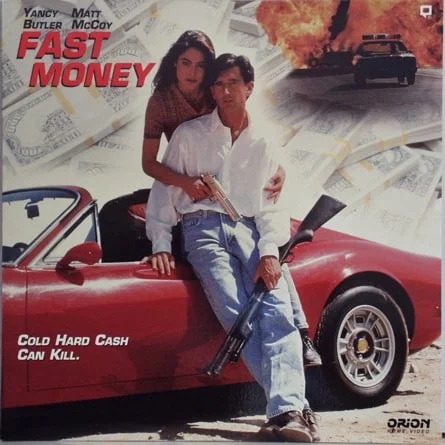
First released in 1996, Fast Money opens with Francesca March (Yancy Butler) stealing a car.
This is what Francesca does for a living. She steals cars and she’s good at it. She’s the type of who can look in any trashcan and find something that she can use to pick a lock. She’s master at hot-wiring a car. I personally have no idea how to hot-wire a car but, judging from the movies that I’ve seen, it appears to be the easiest thing in the world to do. Francesca doesn’t just steal cars for the money. She sincerely enjoys doing it, to the extent that it’s a compulsion for her. If she sees a car, she has to steal it.
This has not made her popular with the LAPD. In fact, an entire taskforce has been set up to stop her. Realizing that she has to get out of town, she rushes to the airport. It’s there that she runs into Jack Martin (Matt McCoy), a nerdy journalist who is working on a story that could take down a powerful U.S. Senator. Jack is looking to catch a flight to Reno. For reasons that aren’t particularly clear, Francesca rushes up to Jack and pretends to be his wife and the recently widowed Jack goes along with it.
Further complicating matters is that Francesca impulsively decides to seal one last car and the one that she picks just happens to have 3 million dollars in mob money and a bunch of counterfeit printing plates in the trunk. The evil Sir Stewart (Jacob Witkin) wants his money back and he sends Regy (Trevor Goddard) and corrupt detective Lt. Diego (John Ashton) to track down Francesca and Jack.
Soon, Francesca and Jack are desperately trying reach the Mexican border while dodging corrupt cops, FBI agents, and mobsters. It leads to a lot of car chases, explosions, helicopters, and shoot-outs. (The otherwise meek Jack turns out to be a surprising good shot. Neither he nor Francesca freaks out after he shoots multiple people, which is the sort of thing that I would probably freak out about.) Francesca and Jack also find themselves falling in love but wondering just how much they can trust each other. Stolen money does that to people.
Fast Money is a cheerfully dumb but entertainingly fast-paced movie, one in which the chase never stops long enough for the viewer to have too much time to try to figure out why the ultracool Francesa would be willing risk her freedom for a relationship with someone as whiny as Jack. Yancy Butler plays Francesca as being so confident and so fearless that it’s hard not to admire her but there’s also no way that she seems like she would ever have much use for someone as meek and repressed as Jack, regardless of how deadly his aim might be. One gets the feeling that the only thing keeping this couple together is the adrenaline rush of being hunted. If Jack and Francesca do make it to safety, their relationship will probably be over by the end of the week.
Though Fast Money is ultimately a fun but somewhat generic direct-to-video action film, I appreciated the film’s vision of a world where everyone from the mob to the police to the FBI were basically working together to track down one career criminal and one innocent man. When even the usually likable John Ashton is trying to murder you in a cheap motel, you know you have reached the other side of the looking glass. Jack learns what Francesca has always understood, which is that one should be suspicious of authority. Though it may not have been the film’s intent, Fast Money‘s ultimate message becomes, “Trust no one but yourself.”
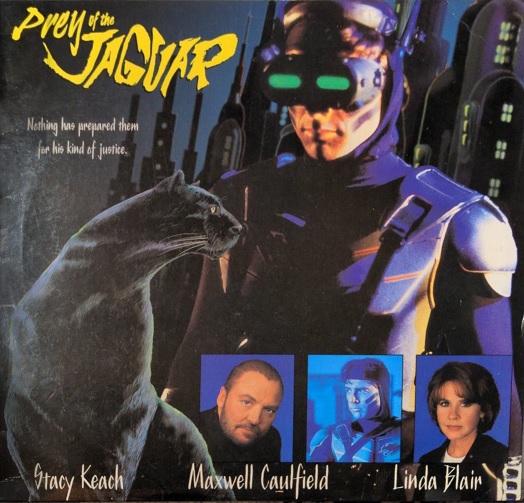
Derek Leigh (Maxwell Caulfield) is a former Special Ops agent whose son and wife are killed by a drug lord (Trevor Goddard) than Leigh helped to put behind bars. Inspired by his dead son’s love of super heroes, Leigh puts on a purple rubber suit and learns karate from Master Yee (John Fujioka) while The Toymaker (Paul Bartel) supplies him with an arsenal of weapons. Calling himself the Jaguar, Leigh goes after the men who killed his family.
Caulfield wears an obviously fake mustache for the first half of the film so that he can shave it off when he becomes The Jaguar. The camera never stops spinning around. Most of the fights look fake and the exterior of Derek’s house changes from shot-to-shot. Stacy Keach plays a high-ranking government official but doesn’t bother to get a haircut or hide his pony tail. Linda Blair plays a cop and sounds like she sucked helium before filming her lines. I’m not sure what she was doing in the movie. She may not have been sure either. Prey of the Jaguar is a reminder of just how cheap and cruddy most super hero films were before Marvel took over Hollywood. Of course, Derek doesn’t really have any super powers, beyond getting proficient at martial arts in record time. He is just wearing the outfit to honor the spirit of his dead son. That actually makes more sense than most of the Marvel origin stories. The movie itself was too cheap to work and the actors were so disinterested that they seemed to actively be trying to make sure that there would never be a Prey of the Jaguar 2.
The most interesting thing about the film are the opening credits, which reveal that this film was executive producer by the Wolf of Wall Street himself, Jordan Belfort.
 The year is 2036 and the world is at war. Col. Flemming (Troy Donahue) assigns his protégé, Major Agatha Doyle (Terry Farrell), to infiltrate a facility with a group of specially selected soldiers. All of the soldiers were previously on death row and will be given a full pardon if they complete their mission. Siegal (Corey Feldman) is the neurotic hacker who was convicted of desertion. Cutter (Trevor Goddard) is a straight-up psycho. Ryan (Rick Springfield) wishes he had Jessie’s Girl… no wait, he’s a demolitions expert. Sorry, my mistake. Dr. Jones (Audie England) is a doctor who is also a religious fanatic. Koosman (Richmond Arquette) is probably on death row for having an embarrassing name. Captain Aldrich (Parker Stevenson) is the most competent officer on death row and also the only one of the soldiers who isn’t a complete lunatic. Poe (Elston Ridgle) is the soldier who initially gets blamed when members of the team start dying inside the facility. It’s actually not Poe’s fault. There’s something in the facility and it’s not human.